5 min read

Jacob Dreamed at Heaven's Gate and Fell at Moab

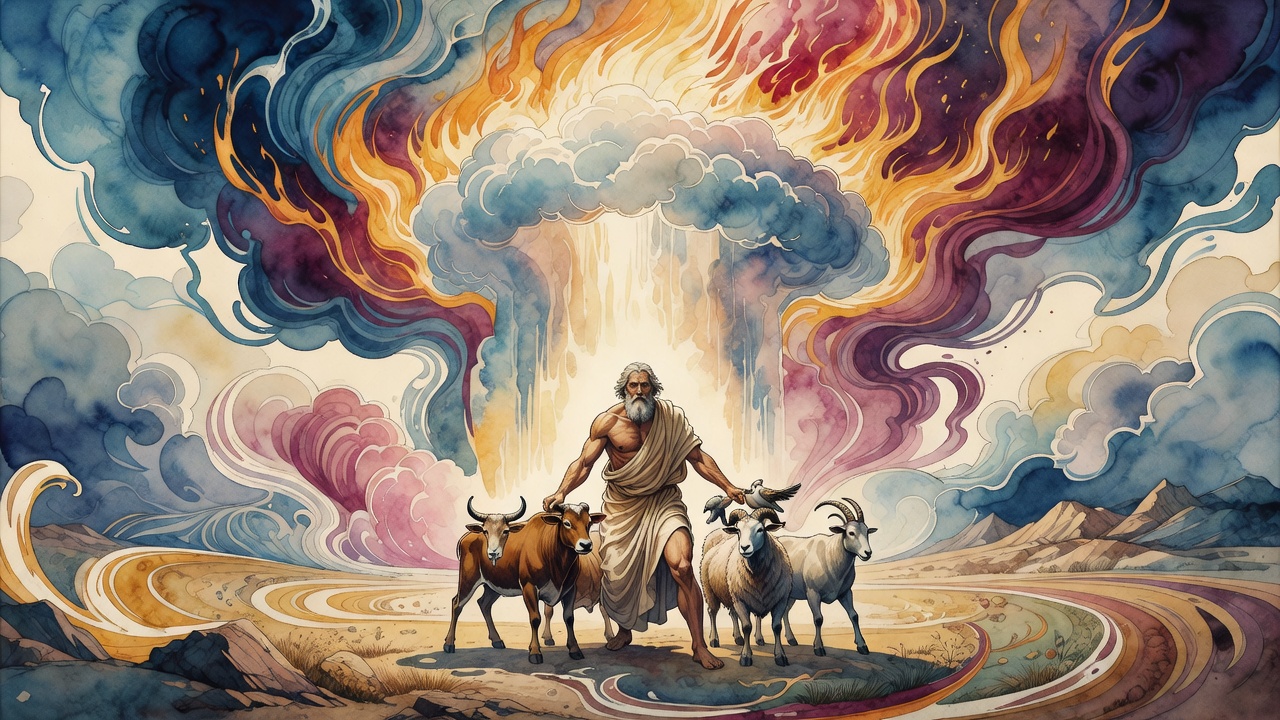
Jacob slept where heaven opened, but his children later crossed a tent doorway at Moab where wine turned desire into a plague.

Curated by Arthur · Told by Maggid ·
Table of Contents
  1. The Road Folded Under His Feet
  2. The Ladder Burned Like Sinai
  3. His Face Waited Above Him
  4. He Woke at the Gate
  5. Moab Opened a Softer Door
  6. Wine Lowered the Gate

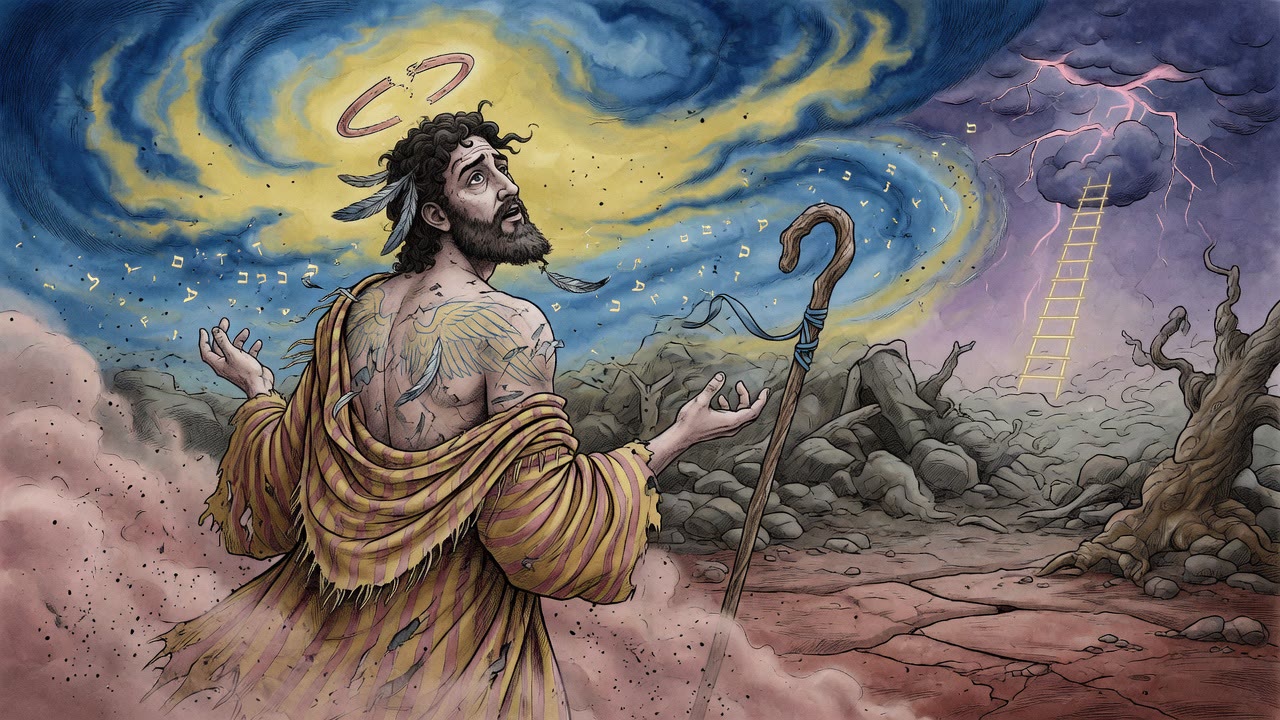
The road ended before Jacob ran out of strength. He was fleeing his brother, carrying no throne, no army, no house, only the blessing that had made home impossible.
The Road Folded Under His Feet

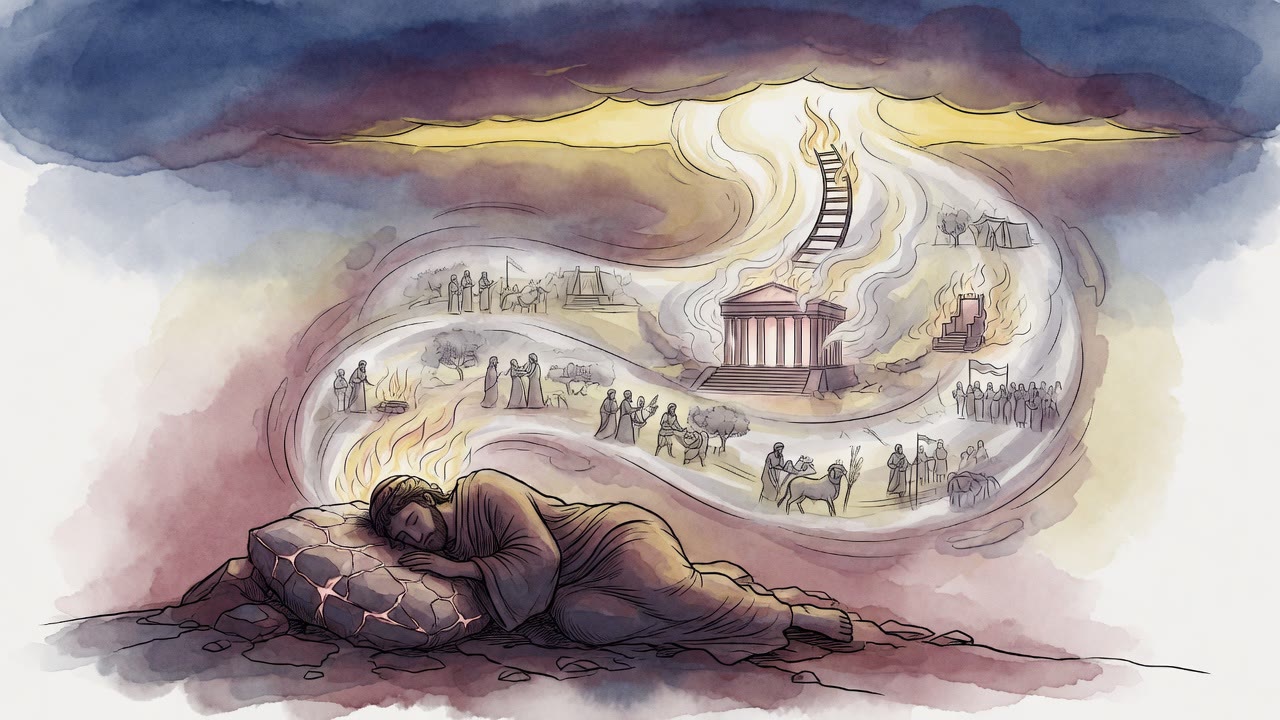
The land moved first. The path that should have stretched toward Haran folded beneath him, and the place came to meet the man. Then the sun went down before its hour, as if daylight itself had been ordered off the road. Jacob could keep walking no farther.

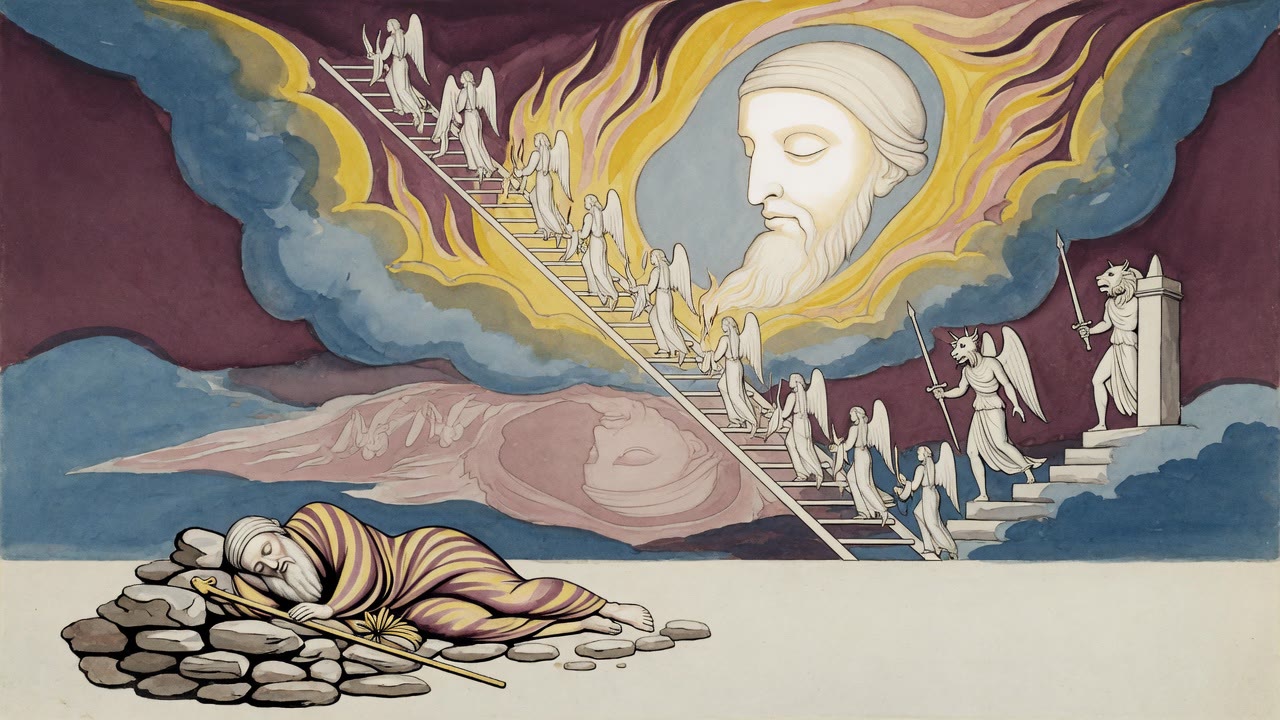
For fourteen years, he had served in the house of Eber and had not lain down at night. Torah had kept him upright. Flight had kept him moving. Now the world took both habits from him. He gathered stones around his head against the wild creatures and lowered himself to the ground.

The stones began to quarrel. Each wanted the righteous man's head. Each wanted the weight of that sleeping skull, the blessing, the fear, the future. God made them one stone, and Jacob slept on a pillow that had already become an argument settled by heaven.

The Ladder Burned Like Sinai

The dream rose from the earth and did not stop at the clouds. A ladder stood with its feet below and its head in heaven, and messengers of God moved along it, rising and descending through the night air.

The ladder was not only a ladder. It became the ramp of the altar, with priests climbing toward fire and coming down again with the smell of offerings on their garments. Its foot became the earthen altar. Its top became the place where fragrance traveled upward. The movement of angels became the movement of service, earth sending smoke toward heaven and heaven answering with presence.

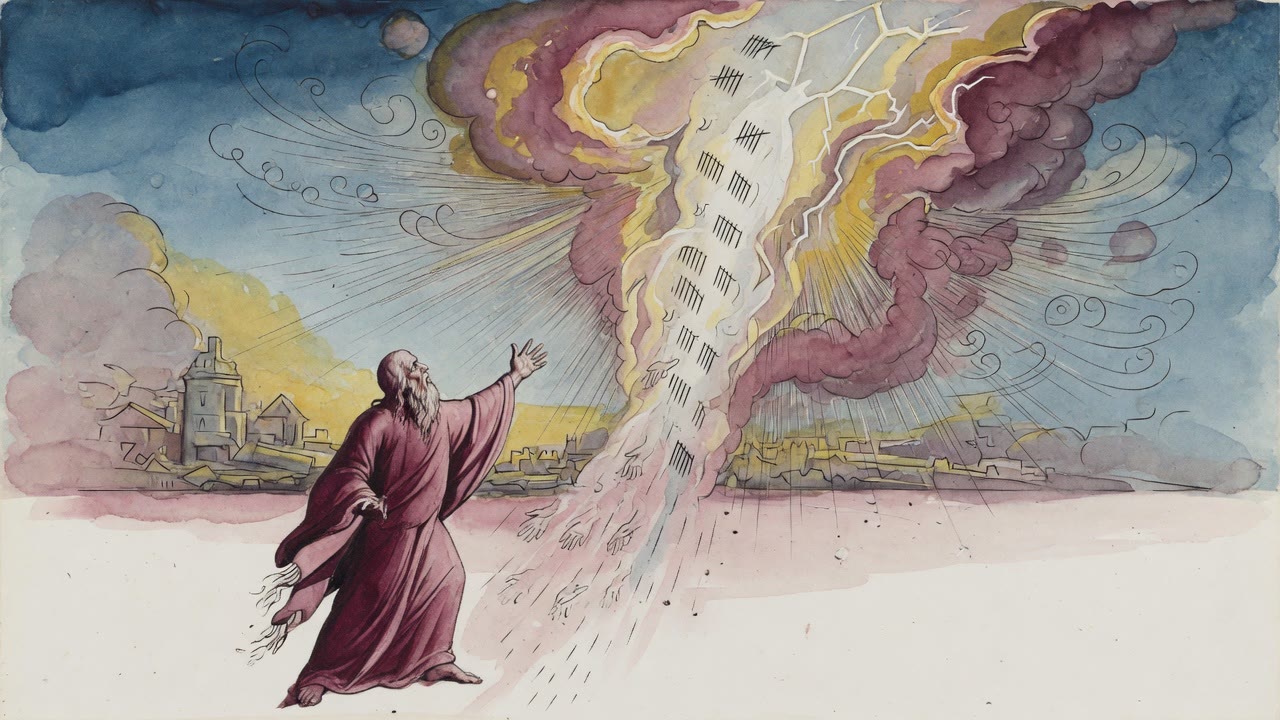
Then the ladder became Sinai. The same number lived inside the Hebrew words for ladder and Sinai, one hundred and thirty. The mountain burned to the heart of heaven. The people stood below. Moses and Aaron rose and descended like messengers, carrying command and fear between God and Israel.

His Face Waited Above Him

The angels were not only climbing past Jacob. Some rose upward and found his likeness engraved on high. Then they came down and found the same man asleep with dust near his mouth and a stone beneath his head.

They praised him and mocked him in the same breath. Above, his image belonged near the Throne. Below, his body needed rest. That was the scandal of Jacob: heaven carried his face, and earth carried his exhaustion.

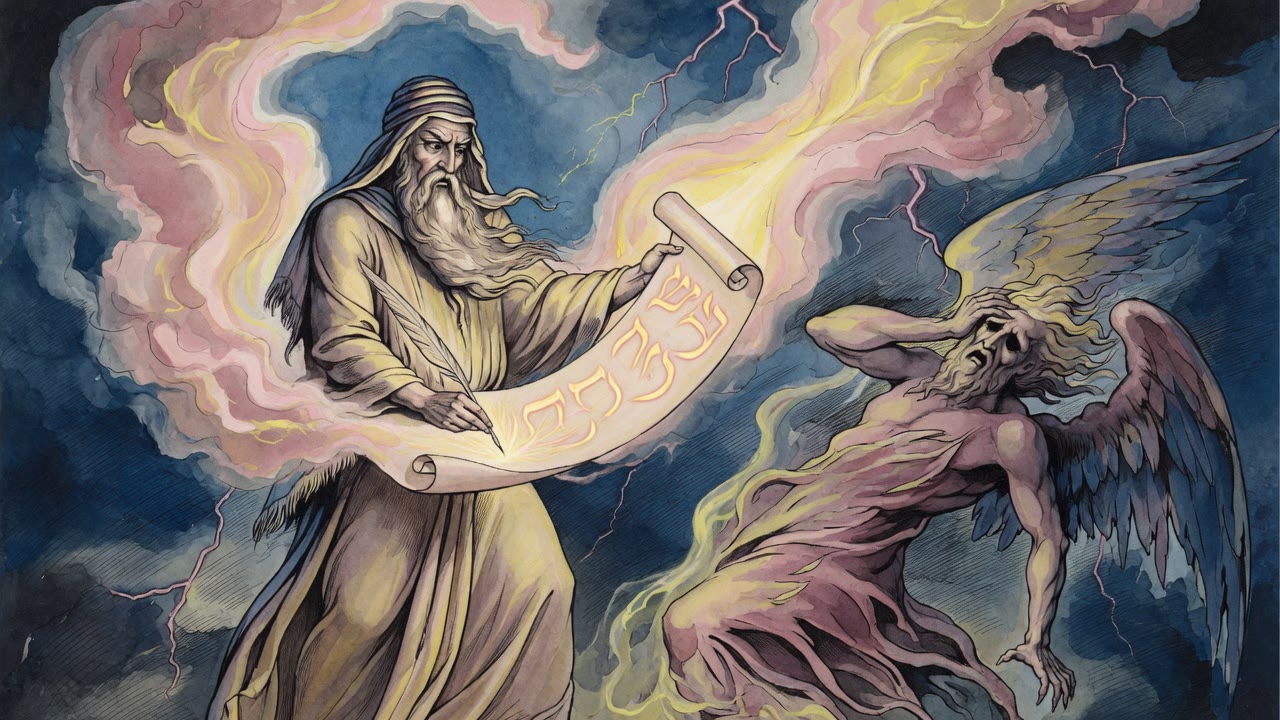
Other visions crowded the same night. A three-legged Throne stood before him, and Jacob was shown as the third leg with Abraham and Isaac. Angels whose bodies stretched across a third of the world moved in the space above him. Banished messengers returned after one hundred and thirty-eight years away from their station. The dream was too large for sleep, but sleep was the only door by which Jacob could enter it.

He Woke at the Gate

Morning found him changed. The stone beneath him became a pillar. Oil ran over it. The place had a name before, but Jacob gave it a wound of awe. House of God. Gate of heaven.

He had not searched for the gate. The gate had seized him. A holy threshold does not always ask permission. It stops the fugitive, darkens the sun, quiets the road, and leaves a man waking with fear in his throat.

From that stone would stretch the memory of a Temple built, a Temple broken, and a Temple restored. Earthly Jerusalem and heavenly Jerusalem leaned toward one another there. The Shechinah hovered where a tired man had slept.

Moab Opened a Softer Door

Generations later, Jacob's children stood at another threshold, on the plains of Moab with the promised land close enough to change the air. No wall stopped them. No early sunset saved them. No stone argued to guard their heads.

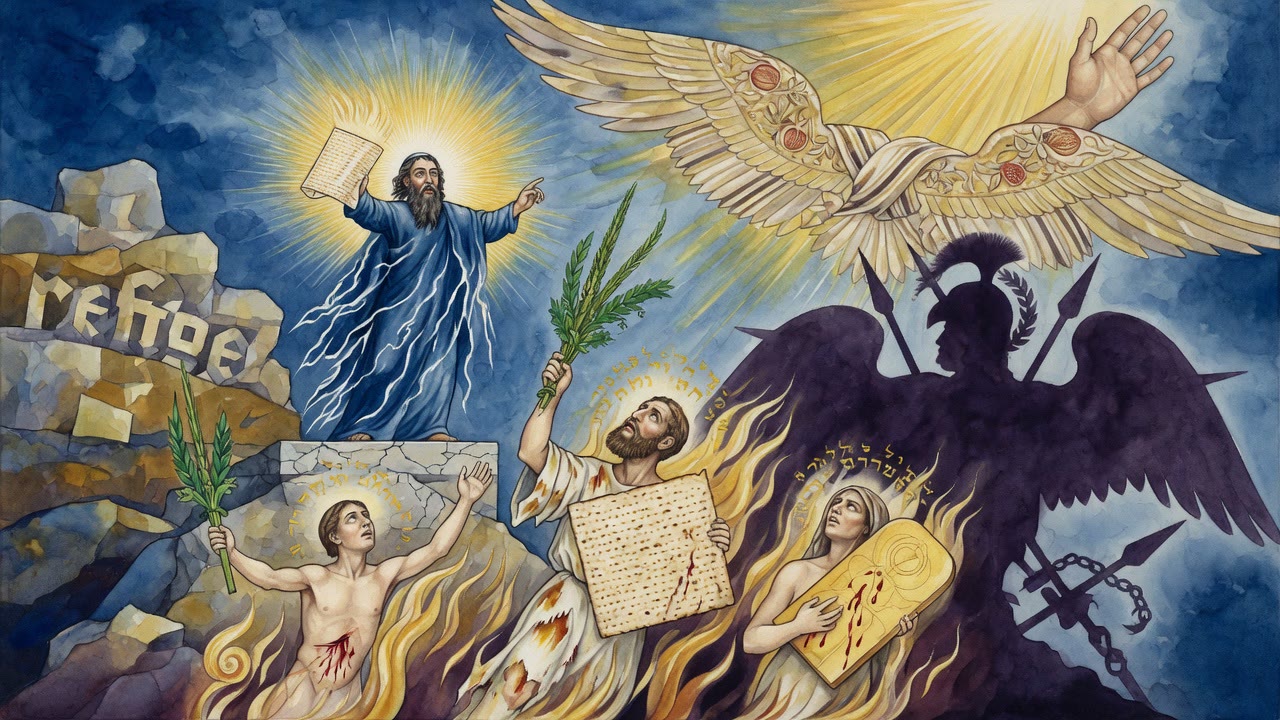
The doors were tent flaps. The voices were gentle. Elderly women sat outside the stalls and called Israelite men toward linen, vessels, and trade. Inside waited younger women with lower prices, easier smiles, and wine ready to pour.

The first cup loosened caution. The second made the stranger sound like kin. "We are all children of one father," she said. "Abraham came from Terah. So did we." Meat appeared, slaughtered in a way that made refusal harder. The man had crossed from market to table before he understood that the table had been a gate.

Wine Lowered the Gate

Then came the demand. Bow to Baal Peor.

The Israelite recoiled. Bowing to an idol still sounded impossible, even with wine hot in his blood. The woman made the act smaller. "No bowing," she said. "Only expose yourself before it. Nothing more."

The body did what the soul had refused to name. The plague came after. Twenty-four thousand fell, more than had died after the calf, and the bracelets given at Moab weighed heavier in memory than the earrings that once fed gold into fire.

Jacob had slept at a gate and woke to oil, stone, and fear of heaven. His children crossed a softer gate and woke to graves. One threshold raised a fugitive into covenant. The other turned desire into death while the promised land waited across the river.


← All myths
From the tradition

Sources

3 sources

The texts this telling draws on, in full. Open a card to read inline, or expand it for a wider, quieter read.

Rashi on Genesis 28:11Rashi

"And he came upon the place": Scripture did not mention in which place, but rather "the place," the one mentioned elsewhere, which is Mount Moriah, concerning which it is said, "And he saw the place from afar" (Genesis 22:4).

"And he came upon (vayifga)": like "And it reached Jericho" and "and it reached Dabbasheth" (Joshua 16 and 19). And our Rabbis explained it in the sense of prayer (Berakhot 26b), like "and do not entreat (tifga) Me" (Jeremiah 7:16), and we learn that he instituted the evening prayer. And Scripture varied its wording and did not write "and he prayed," to teach you that the earth leaped toward him, as is explained in the chapter "The Sciatic Nerve" (Chullin 91b).

"For the sun had set": it should have written "And the sun set, and he lodged there." "For the sun had set" implies that the sun set for him suddenly, before its proper time, so that he would lodge there.

"And he placed at his head": he arranged them like a kind of gutter around his head, for he was afraid of wild beasts. They began quarreling with one another. This one said: Upon me shall the righteous man rest his head, and that one said: Upon me shall he rest it. Immediately the Holy One, blessed be He, made them into a single stone, and this is what is said, "And he took the stone that he had placed at his head" (Genesis 28:18).

"And he lay down in that place": this is a term of limitation. In that place he lay down, but for the fourteen years that he served in the house of Eber he did not lie down at night, for he was occupied with the Torah.

Full source
Bereshit Rabbah 68:12Bereshit Rabbah

Dreams have always held a special fascination, and Jewish tradition is no exception. Take the famous dream of Jacob in (Genesis 28:12): "He dreamed, and behold, a ladder was set on the earth, its top was reaching the heavens, and behold, the angels of God were ascending and descending on it.” What does it all mean?

Well, as Rabbi Abbahu wisely said, "The content of dreams has no effect." Or, as the Yedei Moshe commentary puts it, dreams shouldn't be taken literally. But that doesn't mean they're meaningless!

There's a story in Bereshit Rabbah about a man who dreamed he was told to inherit his father’s business in Cappadocia. He went to Rabbi Yosei bar Ḥalafta for guidance. The Rabbi asked if his father had ever been to Cappadocia. When the man said no, Rabbi Yosei told him to count twenty beams in his roof and he would find it. Why twenty? Well, Bar Kappara cleverly points out that Cappadocia (Kappodekiya) sounds a bit like "kappa," the Greek letter kaf, which has a numerical value of twenty, plus "dokiya" meaning beams in Greek! The man followed the Rabbi's instructions and found a hidden treasure. So, even the strangest dream might point to something real, just not in the way we expect.

Bereshit Rabbah offers some fascinating interpretations of Jacob’s ladder. One interpretation equates the ladder with the ramp in the Temple, used by the priests to ascend to the altar. The phrase "set on the earth" alludes to the altar itself, referencing (Exodus 20:21), "You shall make for Me an altar of earth." And the top reaching the heavens? That's the offerings, whose fragrance rises up to God. The angels, then, are the High Priests ascending and descending the ramp. This imagery connects Jacob's dream directly to Temple service and the relationship between earth and the divine.

But the Rabbis don't stop there. Another interpretation connects the ladder to Sinai, the mountain where God gave the Torah. The word for "ladder" in Hebrew, sulam, has the same numerical value (gematria) as the word "Sinai"! "Was set [mutzav] on the earth" mirrors the Israelites standing at the foot of the mountain ((Exodus 19:17)) and "Its top was reaching the heavens" reflects the fiery spectacle described in (Deuteronomy 4:11). The angels? Well, prophets are sometimes called angels (malakhim), and in this case, they're Moses and Aaron, ascending and descending the mountain as intermediaries between God and the people.

Rabbi Salmoni, citing Reish Lakish, adds another layer, suggesting that God showed Jacob a vision of the three-legged Throne of Glory, implying that Jacob himself would be the "third leg," solidifying the foundation of God's presence in the world. Rabbi Yehoshua of Sikhnin, quoting Rabbi Levi, reinforces this idea by connecting Jacob to the portion of the Lord, just as a rope requires at least three strands to be woven.

And then there's the intriguing idea about the angels themselves. Rabbi Berekhya suggests that one-third of the world. What? Apparently, this comes from the description of an angel in (aniel 10:6), with a body like beryl (tarshish). The Sea of Tarshish is described as two thousand cubits, while the world is six thousand cubits, making the angel's body one-third of the world's size! Talk about cosmic scale!

Finally, Rabbi Ḥiyya and Rabbi Yanai debate whether the "ascending and descending" refers to the angels on the ladder, or to the perception of Jacob himself. If it's about Jacob, then the angels are both honoring and denigrating him. They see his greatness, his likeness etched on High, but they also see him asleep, a frail human. It's a reminder that even the most righteous figures are still human, with limitations. It's like a king seen in majestic judgment and then, moments later, asleep in the courtyard.

All these interpretations, woven together, show us that Jacob's dream isn't just a simple vision. It's a many-sided symbol, reflecting the Temple, the giving of the Torah, the importance of the Patriarchs, and the complex relationship between the divine and the human.

So, the next time you have a strange dream, remember Jacob's ladder. Maybe it's not about what it seems. Maybe it's inviting you to climb higher, to connect more deeply, and to see the world, and yourself, in a new light.

Full source
Yalkut Shimoni on Torah 119:4Yalkut Shimoni on Torah

"And he dreamed." Bar Kappara taught: there is no dream that has no interpretation. "And behold a ladder" - this is the ramp [of the altar], "set upon the earth" - this is the altar, as you say, "an altar of earth you shall make for Me, and you shall offer upon it your burnt-offerings" (Exodus 20:21). "And its top reached toward heaven" - these are the sacrifices whose fragrance rises to heaven. "And behold, angels of God" - these are the high priests. "Ascending and descending on it" - for they would ascend and descend on the ramp. "And behold, the LORD stood over it" - "I saw the LORD standing over the altar" (Amos 9:1).

The Rabbis interpret it of Sinai. "And behold a ladder" - this is Sinai; the letters of the one [sulam] equal in numerical value the letters of the other [Sinai]. "Set upon the earth" - "and they stood at the foot of the mountain" (Exodus 19:17). "And its top reached toward heaven" - "and the mountain burned with fire up to the heart of heaven" (Deuteronomy 4:11). "And behold, angels of God" - this is Moses and Aaron. "Ascending and descending on it" - "come up to Me on the mountain" (Exodus 24:12), "and Moses came down from the mountain" (Exodus 19:14). "And behold, the LORD stood over it" - "and the LORD came down upon Mount Sinai" (Exodus 19:20).

"And behold, the LORD stood over it." Resh Lakish said: He showed him a three-legged seat - you are the third leg, as it is written, "for the portion of the LORD is His people, Jacob the lot of His inheritance" (Deuteronomy 32:9); just as a cord of fewer than three strands cannot be untwisted [text uncertain], so the patriarchs are not fewer than three. Rabbi Berechiah said: He showed him the world and a third of the world - "ascending," not fewer than two, and "descending," not fewer than two, and the angel is a third of the world, as it is said, "and his body was like beryl" (Daniel 10:6). Rabbi Chiyya the Great and Rabbi Yannai: one said the angels were ascending and descending on the ladder, and one said they were ascending and descending on Jacob. The one who says on the ladder is straightforward. The one who says on Jacob means they were raising him up and bringing him down, leaping upon him, springing upon him, reviling him - "Israel, in whom I will be glorified" (Isaiah 49:3). You are the one whose features are engraved on high. They ascended on high and found his features, and descended below and found him sleeping. A parable: to a king who sat in judgment; they go up to the basilica and find him sitting in judgment, they go down to the colonnade and find him asleep.

Full source