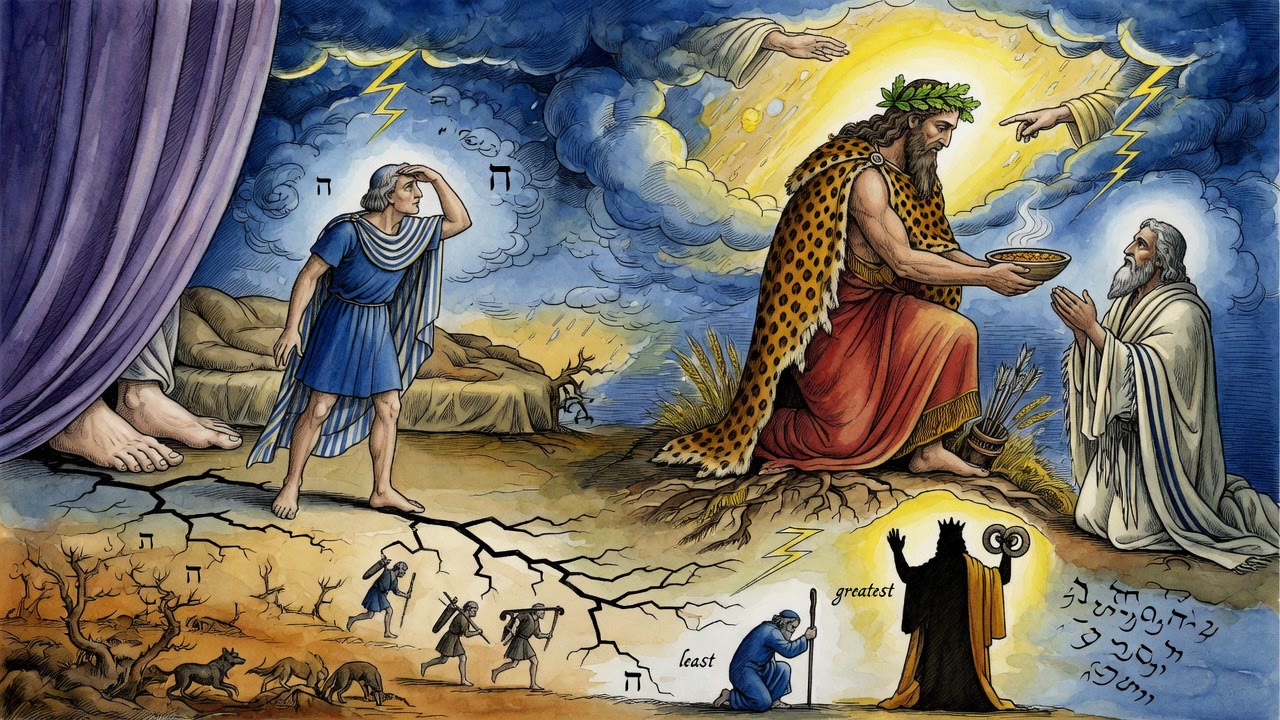
Michael Said the Blessing Jacob Took From Esau Was His by Right
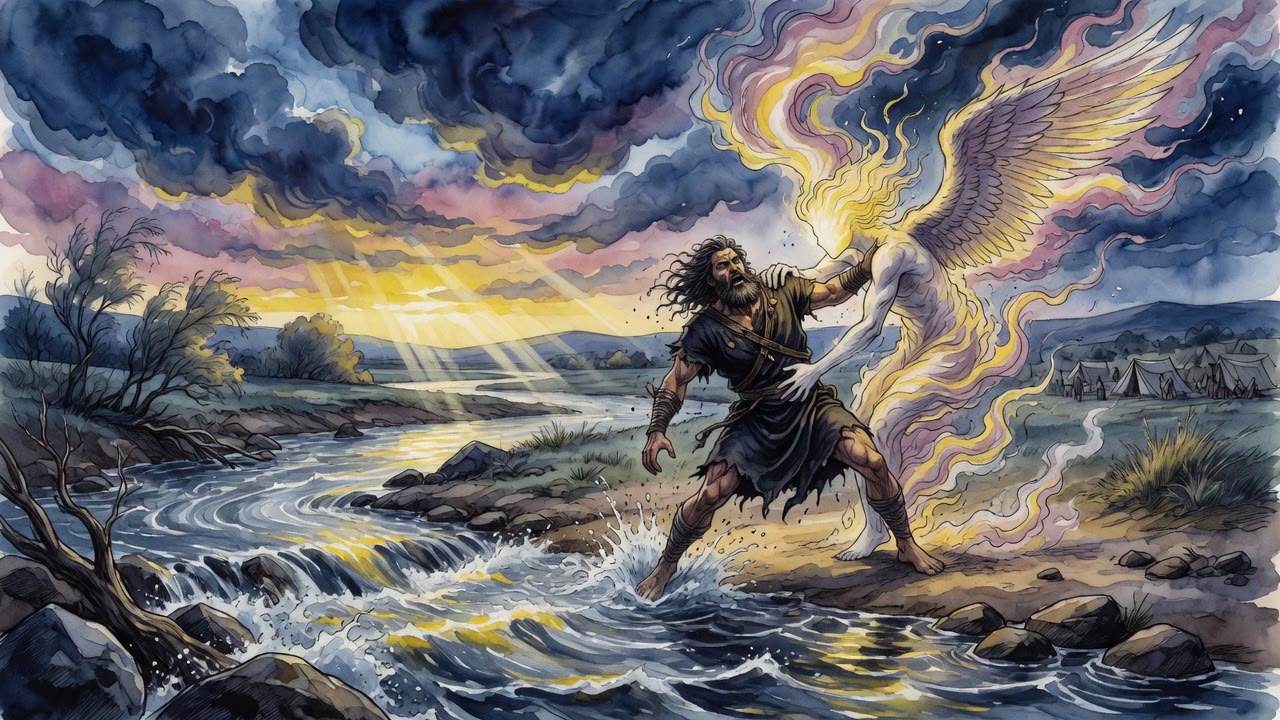
The angel had to be back in heaven before sunrise or the morning song could not start. Jacob had him by the throat and a question about Esau.
Table of Contents
 Click for full size
He Went Back Across for the Small Jars
Jacob put his wives, his children, his servants and every animal he owned over the ford of the Jabbok, and then he crossed back alone, in the dark, because he had left some small clay jars on the wrong bank.
He was going to meet Esau in the morning, and Esau had sworn twenty years earlier to kill him. He went back for the jars anyway.
A shepherd was standing on that bank with sheep and camels of his own, and he offered a trade. Each of us moves the other one's animals. Jacob agreed, on the condition that his own went first, and the shepherd put them across in the time it takes to blink. Then Jacob began carrying the shepherd's flock, and no matter how many he brought over the near bank stayed full. He worked at it most of the night before he understood, and then he had the man by the throat.
"You wizard. You wizard. No enchantment works at night."
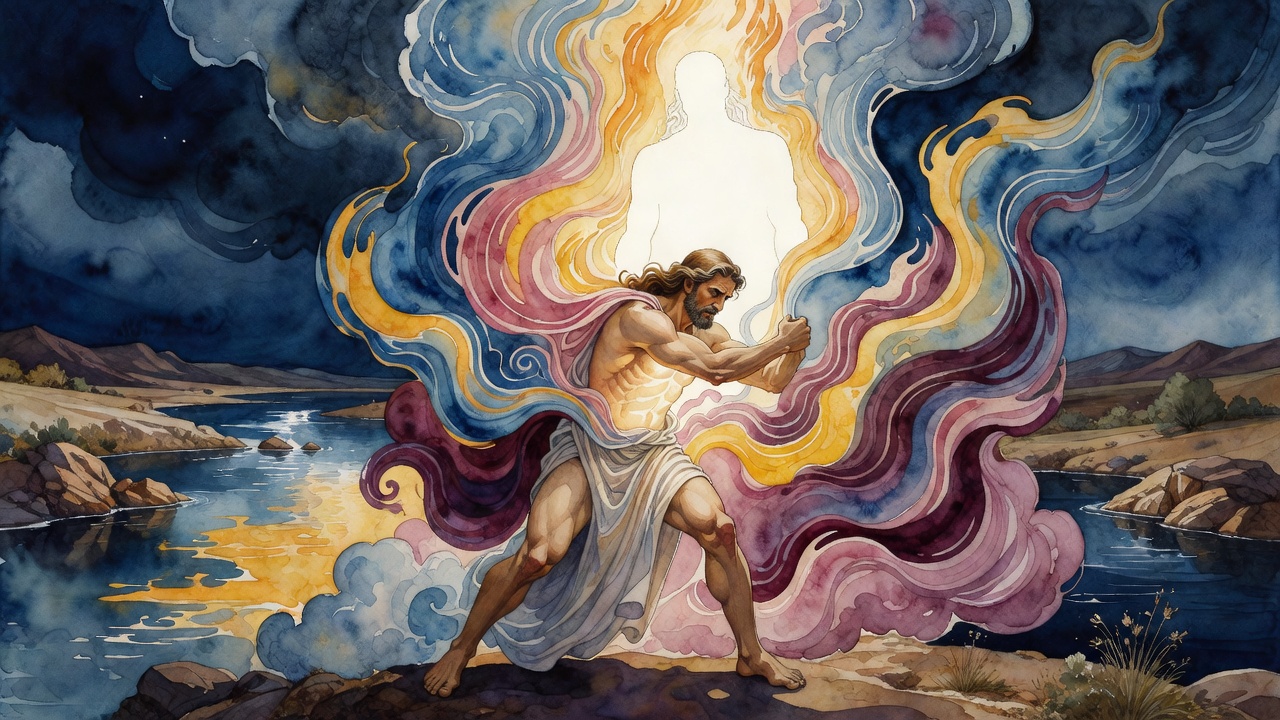
The stranger decided it was time to be recognized. He put one finger down and touched the ground, and fire came up out of the dirt between them.
Jacob did not step back. "You think you can frighten me with that. I am made entirely of fire."
My Priest in Heaven and My Priest on Earth
The shepherd was Michael, first of the angels, and the whole host under his command came down into the fight with him.
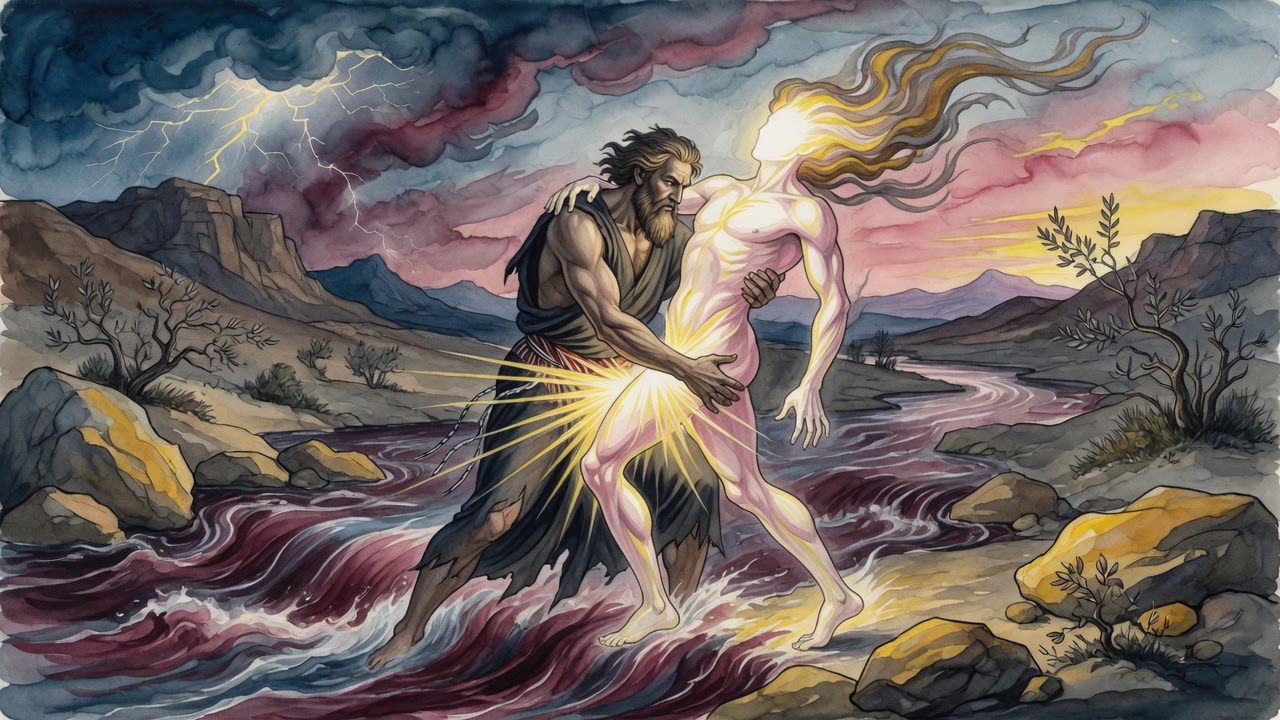
He had Jacob and was about to put a serious wound in him when God arrived at the ford, and every angel there felt the strength go out of his arms. What Michael managed instead was a touch to the hollow of the thigh, and Jacob's hip came out of its socket.
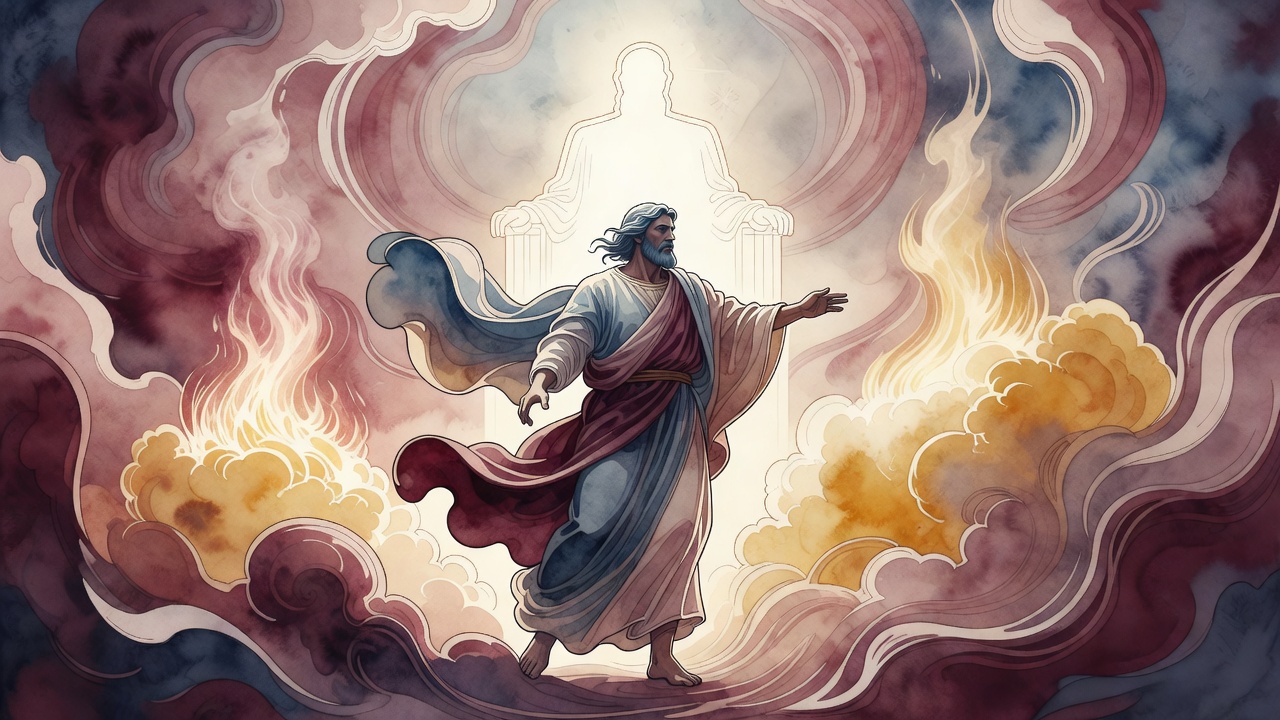
God spoke to him about it. "Is this a fitting thing to do, putting a blemish on My priest?"
Michael was genuinely astonished. "But I am Your priest."
"You are My priest in heaven. He is My priest on earth."
Michael called down the sky for Raphael, who has charge of every healing. "Comrade. Help me out of this." Raphael came and closed what Michael had opened.
God was not finished. "Why did you injure My firstborn son?"
"Only to glorify You."
So God handed Michael over to Jacob and to Jacob's descendants for as long as there were any, as the angel who would speak for them. You are fire and he is fire. You are head of the angels and he is head of the nations. The highest of the angels goes to the highest of the peoples, to go up and ask mercy on his behalf.
Michael turned to the man he had just been wrestling and asked him something that was almost tender. "How is it possible that you can beat me, and you are afraid of Esau?"
The Choir Could Not Begin Without Him
The sky went gray over the water.
"Let me go. The day is breaking."
Jacob held on. "What are you, a thief? A man throwing dice in an alley? Why should daylight worry you?"
Then the sky filled with voices, whole companies of angels calling down at the riverbank. "Come up, Michael. It is the hour of the song. If you are not there to start it, nobody sings." The angels of Aravot were waiting on a note only he could give, and if it did not come they would burn him for it.
"I will not let you go until you bless me."
"Which is greater, the servant or the son? I am the servant. You are the son. Why do you want a blessing out of me?"
"The angels who came to Abraham did not leave without blessing him."
"They were sent for that. I was not." The light was climbing. "Do you know what happens to an angel who lets out something from up there? A hundred and thirty-eight years outside the gates. Is that what you want to hear from me?"
Jacob did not move his hands.
Michael worked it out for himself, standing in the shallows with a man's grip on him. His children stand on their wishes with Him and He gives in to them. What was I supposed to do, refuse Jacob.
"A day is coming when God will show Himself to you and change your name, and I will be standing there when He does. You will not be called Jacob. You will be called Israel, because you were born of a woman, you walked into the palace of heaven, and you came out of it alive." Then he blessed him plainly, the way a man blesses another man. "May your children be as upright as you are."
The Tenth Son Went Up With the Angel
Michael was still not free, and he remembered a promise Jacob had made years earlier at a stone in Bethel, about a tenth of everything. Jacob counted his herds in the half light. Five thousand five hundred head. He cut out five hundred and fifty and set them aside.
"You have sons," the angel said. "You have not tithed them."
Jacob started naming them. Reuben was exempt, and Joseph, and Dan, and Gad, because each was the first son of his own mother. That left eight. He counted them off in order and ran out of boys at Benjamin, so he went back to the beginning of the list, and Simeon came ninth, and the tenth name in his mouth was Levi.
Michael took Levi up and set him in front of God. "This one is Your portion. The tenth belongs to You." God put out His hand and blessed the boy, that his children would serve on earth the way the angels serve above. Then Michael pressed like a man closing a contract. "Does a king not feed his own servants?" So everything holy was assigned to Levi's sons to live on.
The Dust Went Up to the Throne
One thing was left, and Jacob had been carrying it for twenty years.
"I took the blessing my father meant for my brother. Do you call it mine, or are you going to bring charges about it?"
"It is yours by right," the angel said. "You did not get it by cunning. I say so and every power in heaven says so, because you have proved yourself master over the strong ones of the sky, and over Esau and his legions with them."
Jacob made him give up his name before he opened his hands, and the name was Israel, which Jacob himself would carry. Then he blessed the angel, and the angel went up to sing.
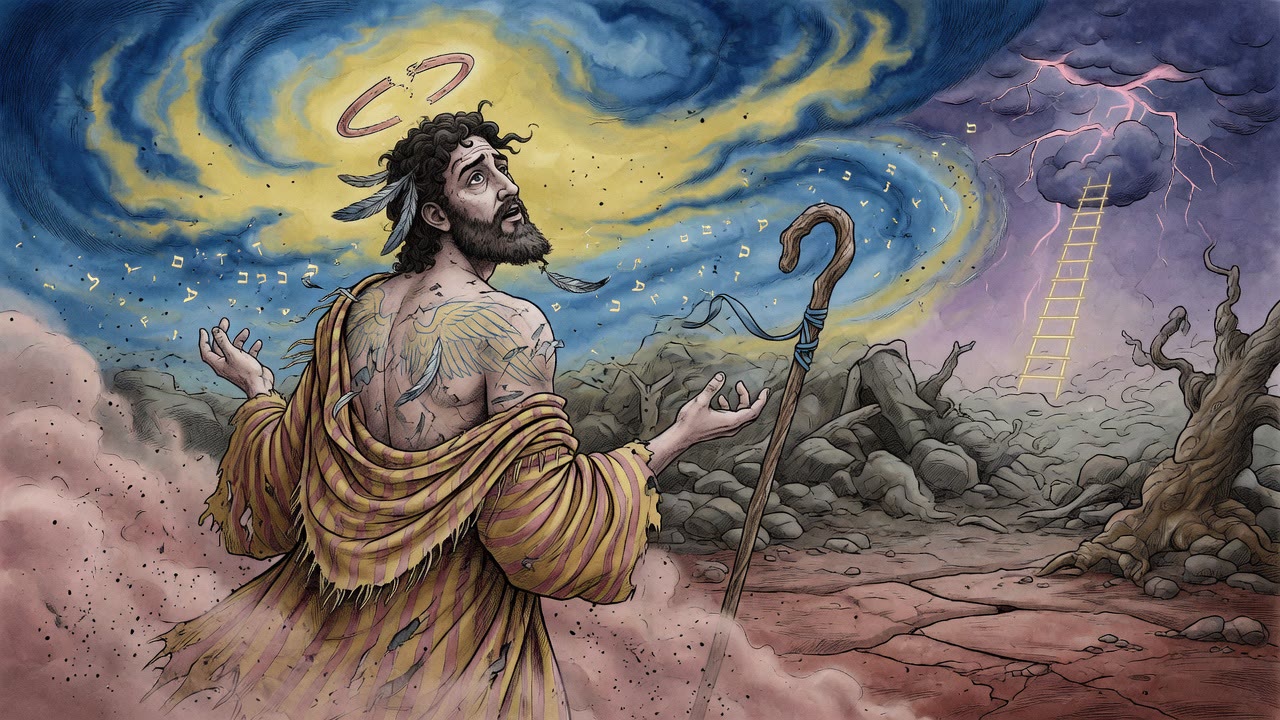
The dust their heels had thrown up all night was still going, all the way to the Throne of Glory, and the one who came out of the ford wearing it was not Jacob.
He crossed the water at sunrise dragging one leg. Generations later, in Egypt, Joseph looked at the brothers waiting outside his door and told his steward to open the slaughterhouse and cut the shrunken sinew out of the thigh before any meat went in front of them. They were the sons of a man who had been held at that joint and had not let go.
← All myths