5 min read

Jacob's Voice Silences the Angels When Israel Prays

When Israel recites the Shema, the angels fall silent. Bereshit Rabbah and the Tikkunei Zohar explain why Jacob's voice carries the weight of the cosmos.

Curated by Arthur · Told by Maggid ·
Table of Contents
  1. The Wings That Go Still
  2. What Kind of Silence This Is
  3. The Two Bloods That Saved Israel
  4. The Name Israel Carries

The Wings That Go Still

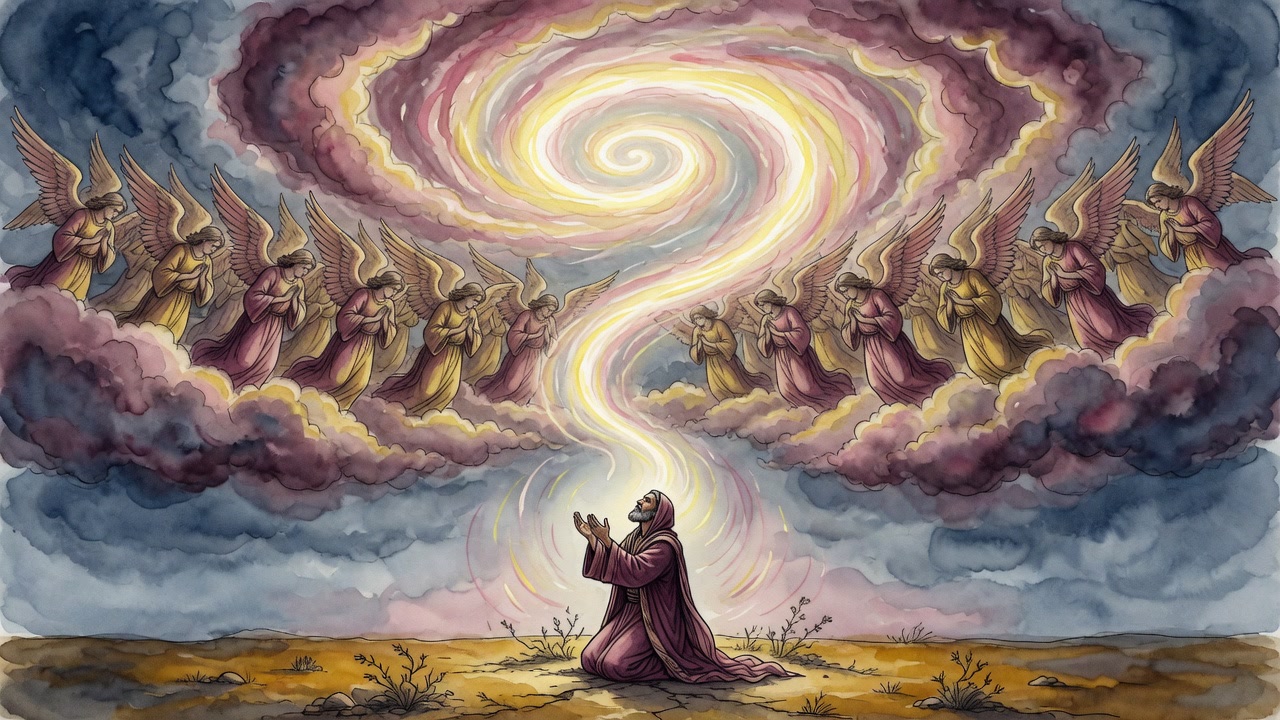
Every morning when Israel begins to pray, the celestial beings stop singing.

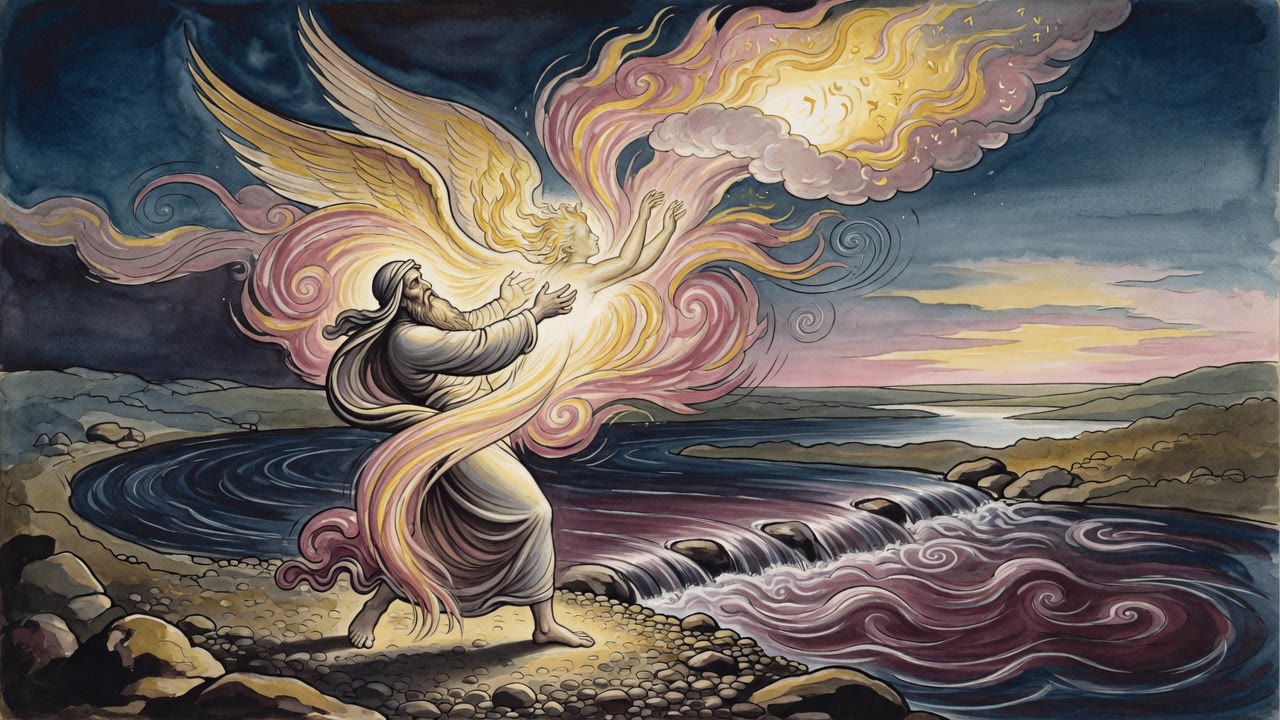
This is the claim Bereshit Rabbah makes through a reading of Ezekiel's vision. The prophet had seen the four living creatures, the hayyot, whose wings made the sound of rushing water and whose motion described the axis of the heavens. And then, at a specific moment: when they stood, their wings would slacken (Ezekiel 1:25). The noise stopped. The perpetual motion of the divine throne paused.

Rabbi Reuven asked what caused the pause. Rabbi Shmuel answered: the sound that made the wings stop was the voice of Jacob. The voice is the voice of Jacob, the foundational verse from the blessing of Isaac (Genesis 27:22), was being read not as a description of a particular patriarch's speech but as a statement about the cosmic role of the people who descended from him. When Israel prays, the angels go quiet.

What Kind of Silence This Is

Rabbi Shmuel's clarification matters. The angels do not sit down when they go still, because there is no sitting in the divine realm. Ezekiel 1:7 specifies their legs are a straight leg, unbending, in constant readiness. The silence is not rest. It is attention.

This distinction is what transforms the image from flattering to theological. The angels are not pausing because human prayer is a pleasant interruption to their routine. They are pausing because the covenant voice of Israel has a prior claim in the architecture of heaven. The creatures whose motion sustains the cosmic throne defer, in the moment of Israel's prayer, to the descendant of Jacob. The mechanics of heaven make room for the human voice below.

The Two Bloods That Saved Israel

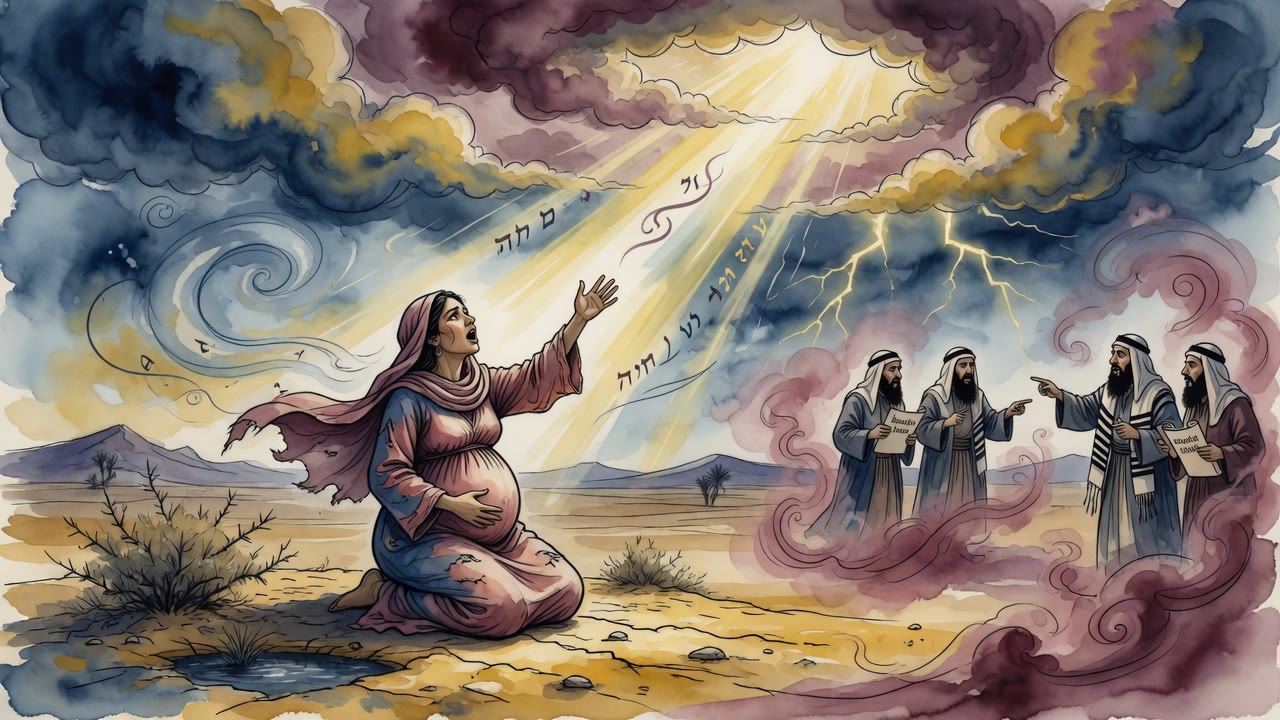
The Tikkunei Zohar, a kabbalistic expansion and commentary on the opening word of the Torah compiled in 13th-century Spain and attributed to the school of Rabbi Shimon bar Yochai, took the same claim and rooted it in the body rather than in the voice alone. It focused on a verse from Ezekiel addressed to Jerusalem in the allegory of the abandoned infant: And I said to you, in your blood, live (Ezekiel 16:6). The verse repeats the phrase. The repetition was what the tradition pressed on.

The Tikkunei Zohar read the two bloods as the blood of circumcision and the blood of the Passover offering. These were the two physical covenants, cut into the body and marked on the doorpost, that distinguished Israel from the nations in Egypt and allowed the death to pass them by. The life force that Jacob's descendants carry, the text argued, is anchored in these two acts of covenant marking. It is not merely a voice. It is a life shaped by commitment, made visible in blood, and it is this life force that holds Israel in the balance described as the Middle Pillar of Kabbalah's cosmic framework.

The Name Israel Carries

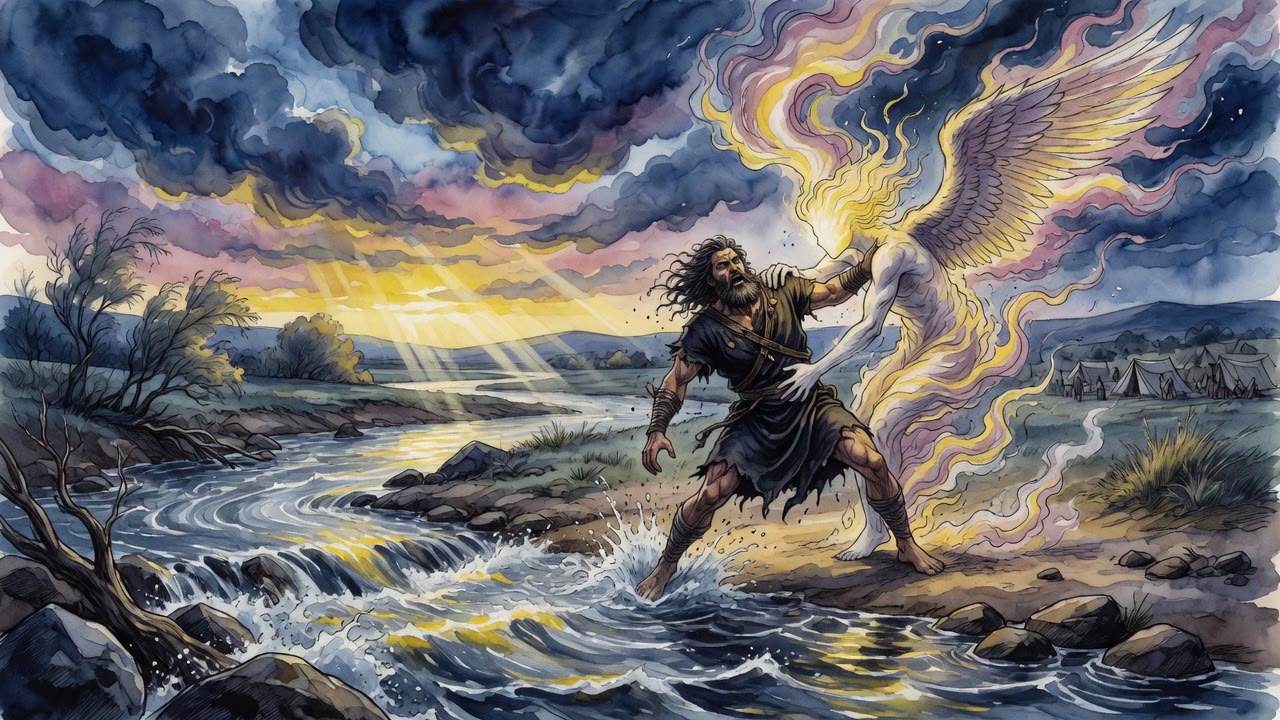
Jacob received the name Israel after wrestling at the Jabbok ford, and the name meant, by one reading, one who strives with God and with men and prevails (Genesis 32:29). The rabbinic interpretation of his name as the singular patriarch whose bed was complete, meaning all twelve of his children remained within the covenant, gave the name its weight. Abraham and Isaac had children who left the line. Jacob had none. The voice of Jacob was therefore the voice of a line that had not broken, a covenant that had passed intact through every generation down to the people praying the Shema in whatever century they lived in.

Bereshit Rabbah, the foundational Palestinian midrash on Genesis compiled roughly in the 5th century CE, read this completeness as the reason the angels defer. The creatures whose praise sustains the cosmos recognize in Israel's prayer the voice of the one line that held. The incomplete voices, the nations who received Noah's covenant but not Sinai, do not produce the silence. Only the descendants of Jacob do.


← All myths
From the tradition

Sources

2 sources

The texts this telling draws on, in full. Open a card to read inline, or expand it for a wider, quieter read.

Tikkunei Zohar 71:12Tikkunei Zohar

Jewish tradition sees that balancing act as fundamental, even cosmic. And it all comes down to… blood?

The Tikkunei (spiritual repair) Zohar, a mystical exploration of the Torah, dives deep into this idea. It focuses on a seemingly strange verse from Ezekiel (16:6): "…and I said to you: ‘In your blood, live!’ And I said to you: ‘In your blood, live!’" What's so important about blood here? The Tikkunei Zohar connects it to the "blood of the covenant of circumcision," a powerful symbol in Judaism.

It's about what that blood represents: the commitment, the covenant, the life force itself. And this life force, according to the Tikkunei Zohar, hangs in the balance. It exists "from the aspect of the Middle Pillar," a concept in Kabbalah representing equilibrium. This pillar, this life force, this you, is constantly shifting.

Here's the kicker: "if the deeds of the world deserve merit, then it turns towards ḥesed," towards benevolence, towards loving-kindness. But, "if not, then towards dyna," towards judgment, towards… well, you get the picture. It's a constant flux, a cosmic barometer responding to our actions. And it's not just limited to this one "pillar"; the Tikkunei Zohar tells us this dynamic applies to other aspects as well.

So, what happens when things aren't in perfect balance? When we fall short? That’s where another symbol comes into play: the bow, or qeshet in Hebrew. But not just any bow – the rainbow. The rainbow, the Tikkunei Zohar reminds us, is also a "sign of the covenant." for a second. After the flood, God set the rainbow in the sky as a promise, a reminder never to destroy the world again in that way. It's a symbol of hope, of renewal, of a second chance. And it's connected to this whole balancing act between ḥesed and dyna.

The text then quotes Ezekiel again (1:28), describing a vision: "Like the appearance of the rainbow that shall be in the cloud on the day of rain, so was the appearance of the nogah around." Nogah is a "glow," a radiance. The verse continues, "it is the appearance of the image of the glory of Y”Y, and I saw and I fell on my face, and I heard a voice speaking."

Falling on your face? That seems a bit extreme. Well, the Tikkunei Zohar explains why: "Because it is forbidden to gaze at the rainbow." Wait, what? Why is that? The Talmud (Ḥagigah 16a) elaborates on this idea, suggesting that staring directly at the rainbow is akin to staring at God's glory directly, which is too much for a mortal to bear. It's a reminder of the awesome power and responsibility that comes with being part of this covenant.

So, what does it all mean? We are constantly influencing the cosmic balance with our actions. We have the power to tip the scales towards kindness or, unfortunately, towards judgment. And the rainbow? It's a reminder of both the potential for destruction and the promise of renewal. It's a sign that even when we stumble, even when we fall short, there's always a chance to realign ourselves, to strive for that balance, to choose life, to choose ḥesed. It's a powerful thought, isn't it? What will you do with that knowledge?

Full source
Bereshit Rabbah 65:21Bereshit Rabbah

The ancient rabbis certainly did. to a fascinating passage from Bereshit Rabbah, a collection of rabbinic interpretations of the Book of Genesis, specifically section 65, to explore this very idea.

The passage begins with a powerful statement: "The voice is the voice of Jacob." But what does this mean? According to one interpretation, Jacob's voice, the voice of the Jewish people, has the power to silence even the celestial beings, both those in the heavens and those on Earth.

Rabbi Reuven delves deeper, referencing a verse from Ezekiel (1:25): "When they stood, their wings would slacken." The question arises: Is there "sitting on High"? Rabbi Shmuel clarifies, citing (Ezekiel 1:7) ("Their legs were a straight leg") to emphasize that there is no physical sitting in the divine realm. They have no joints. Instead, Rabbi Reuven connects "standing" to the Aramaic word kamaya, found in (Daniel 7:16) in reference to one of the angels. He equates kamaya with kayamaya, meaning "standing." And further references (Isaiah 6:2), "Seraphim were standing above Him" and II (Chronicles 18:18), "and all the host of the heavens were standing to His right and His left."

So, what does it mean when the angels "stand?" The text explains beomdam, "when they stood," as ba am dom, "when the nation comes, [there is] silence." In other words, when Israel recites the Shema Yisrael, the central Jewish prayer affirming God's oneness, the angels are silent. Why? To listen. To honor the devotion and connection of the Jewish people. It is taught that they then recite, "Blessed is the glory of the Lord from His place" ((Ezekiel 3:1)2), along with "Blessed is the name of the glory of His kingdom." This is a profound moment of shared praise and recognition.

Rabbi Levi offers another perspective, linking this celestial chorus to (Job 38:7): "When the morning stars sang together, and all the children of the great shouted." He suggests that the "offspring of Jacob," likened to stars in (Daniel 12:3) ("Those who lead the multitudes to righteousness, like the stars"), are the ones who initiate this praise. Then, "all the children of the great," meaning the ministering angels, join in, reciting "Blessed is the glory of the Lord from His place."

Rabbi Shmuel bar Naḥman adds another layer to this understanding, drawing from (Ezekiel 3:12): "A wind lifted me, and I heard behind me the sound of a great noise…" He interprets this "great noise" as the sound of praise, specifically the words "Blessed is the glory of the Lord from His place," recited by both himself and his counterparts.

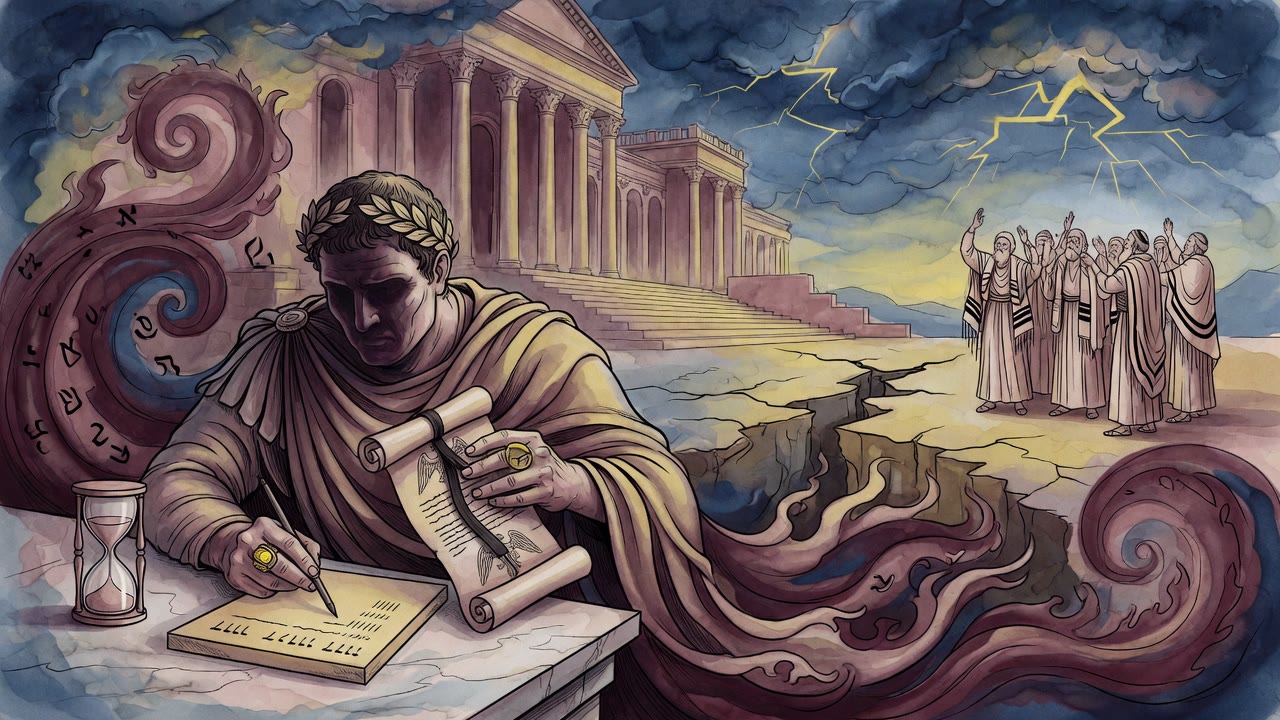
However, the passage takes a somber turn. Rabbi Yehuda bar Ilai interprets "The voice is the voice of Jacob" as a scream of pain, a cry of anguish caused by "the hands [that] are the hands of Esau." Rabbi Yoḥanan connects this to the horrific events under Emperor Hadrian, who, he says, killed eight hundred million people in Beitar. The point being that an incredibly large number of people were killed. This reminds us that the voice of Jacob, while powerful in its praise, also carries the weight of suffering and historical trauma.

What are we to make of all this? This passage from Bereshit Rabbah offers a glimpse into a world where our words have cosmic significance. It suggests that our prayers, our acts of devotion, resonate far beyond our immediate surroundings, reaching even the highest realms. But it also reminds us of the enduring pain and struggle that are woven into the fabric of Jewish history. It’s a reminder that even in the face of immense suffering, the voice of Jacob, the voice of the Jewish people, continues to be heard, a evidence of resilience, faith, and the enduring power of the human spirit.

Full source