5 min read

Jericho's Wall Sank Straight Into the Earth

A pilgrim standing where the wall of Jericho stood is supposed to say a blessing. There is nothing to look at. That is what the blessing is for.

Curated by Arthur · Told by Maggid ·
Table of Contents
  1. It Went Down and Not Over
  2. What the Horns Had Meant Until Then
  3. The One Man Who Reached Into It
  4. A Blessing for a Patch of Flat Ground

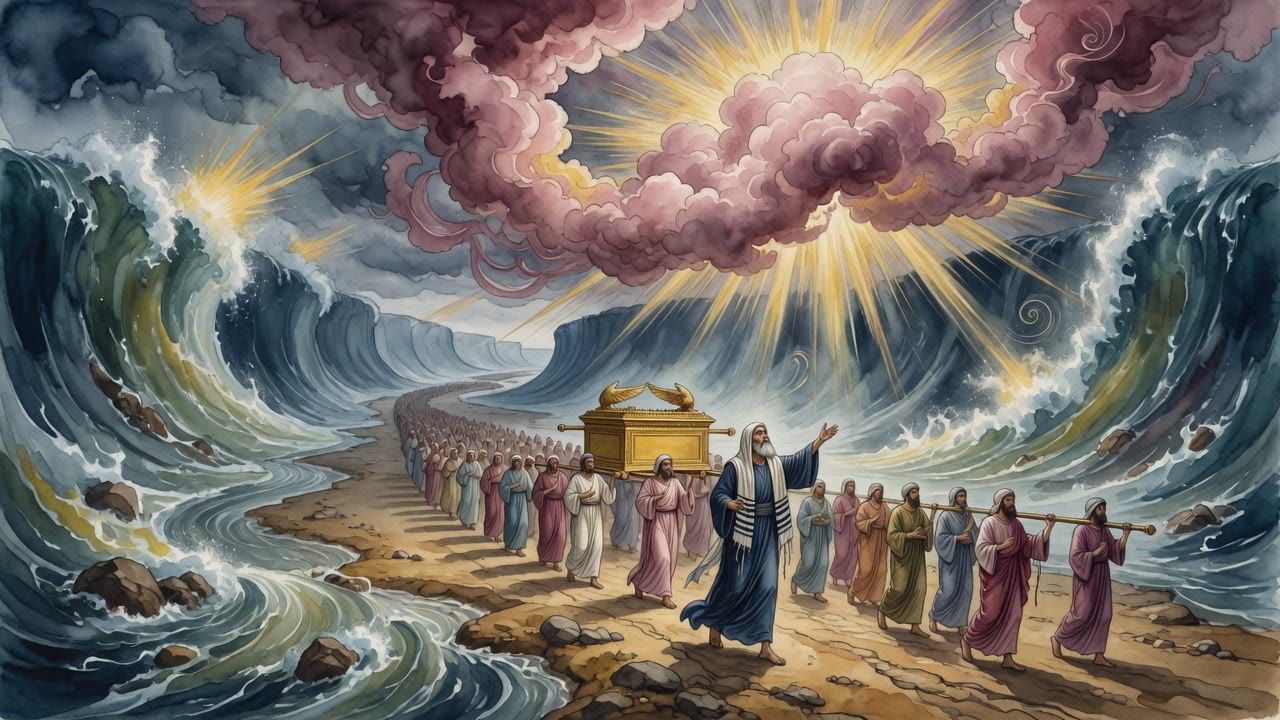
On the seventh morning the priests carried the ark around the city for the seventh time, and the long blast went out over the plain, and Israel shouted. Then the wall of Jericho came down.
Jericho's Wall Sank Straight Into the Earth Click for full size

It did not come down the way walls come down. Nothing leaned. Nothing scattered across the field. There was no sound of stone landing on stone.

It Went Down and Not Over

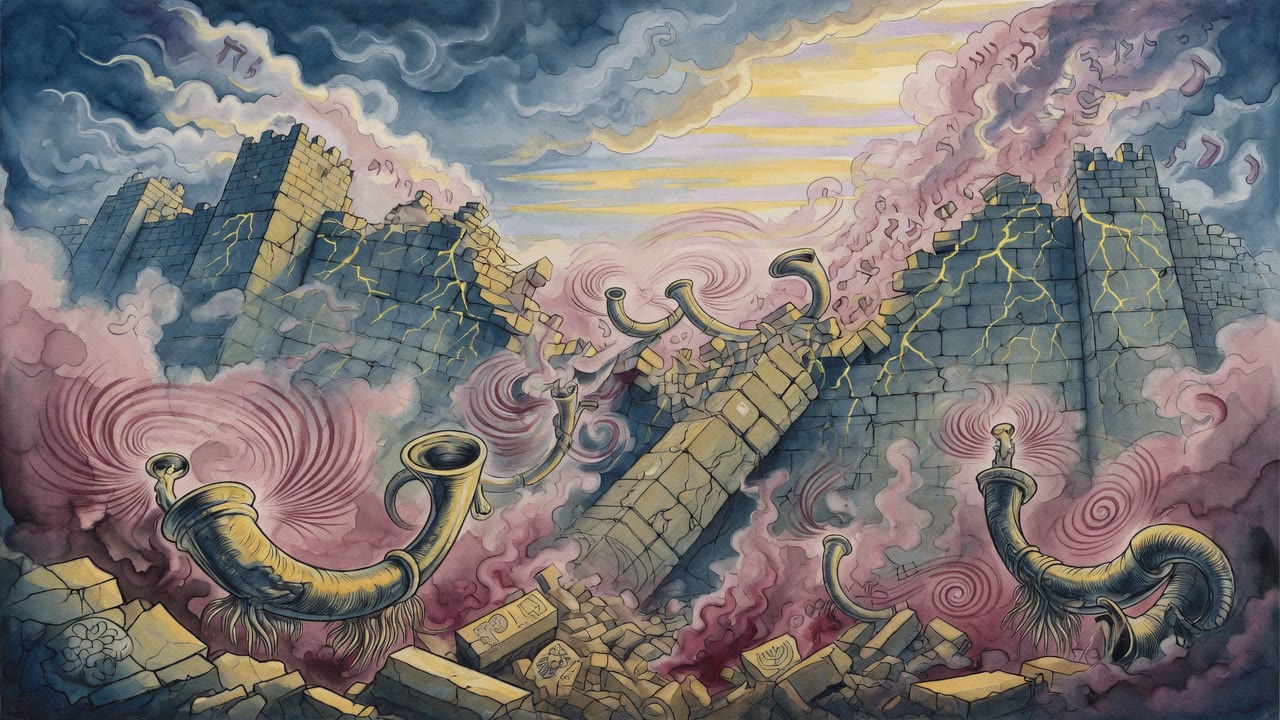
The whole structure sank straight down where it stood. Its height and its breadth came level with each other, the top sinking until it sat flush with the dirt at its own foot, and then the ground opened and took the rest of it in.

A fortress that had held the road into the country for as long as anyone could remember went under the ground it had been built to guard. No leaning tower. No slope of rubble for the soldiers to climb. Dust hung over the line where the wall had stood, and drifted, and settled, and when it cleared there was flat ground.

Men who had walked that circuit for a week stood there with their mouths open at a field.

What the Horns Had Meant Until Then

Israel already knew what horns were for. In the wilderness two beaten silver trumpets ran the whole camp, and a man had to know which sound he was hearing before he moved a foot.

One long note, tekiah, and the congregation gathered at the door of the tent. Long, then a broken flurry, then long again, and the camps struck the tents and traveled. The two calls could not be allowed to blur into each other. A broken note at a gathering would send hundreds of thousands of people packing, and a plain long note on a travel day would leave them standing in the sun waiting for orders that were never coming.

Joshua's priests did not carry the silver. They carried rams' horns, seven of them, walking in front of the ark for six days without a word from anyone behind them.

Mystics reading those same three sounds much later gave each one a face. Tekiah is the white face. Shevarim, the broken one, is the red face of a man under judgment. Teruah is green, the color of a woman close to her time, and by that sound Israel comes up out of exile. Happy is the nation that knows the teruah (Psalm 89:16). At Jericho the horns were doing older work than repentance. They were taking a wall apart.

The One Man Who Reached Into It

Everything in that city had been placed under the ban before the first circuit. The silver, the gold, the bronze and the iron went to the treasury of the Lord and nothing else came out at all.

Achan took three things anyway: a Babylonian coat that had caught his eye, two hundred shekels of silver, and a bar of gold. He buried them under the floor of his tent and told nobody.

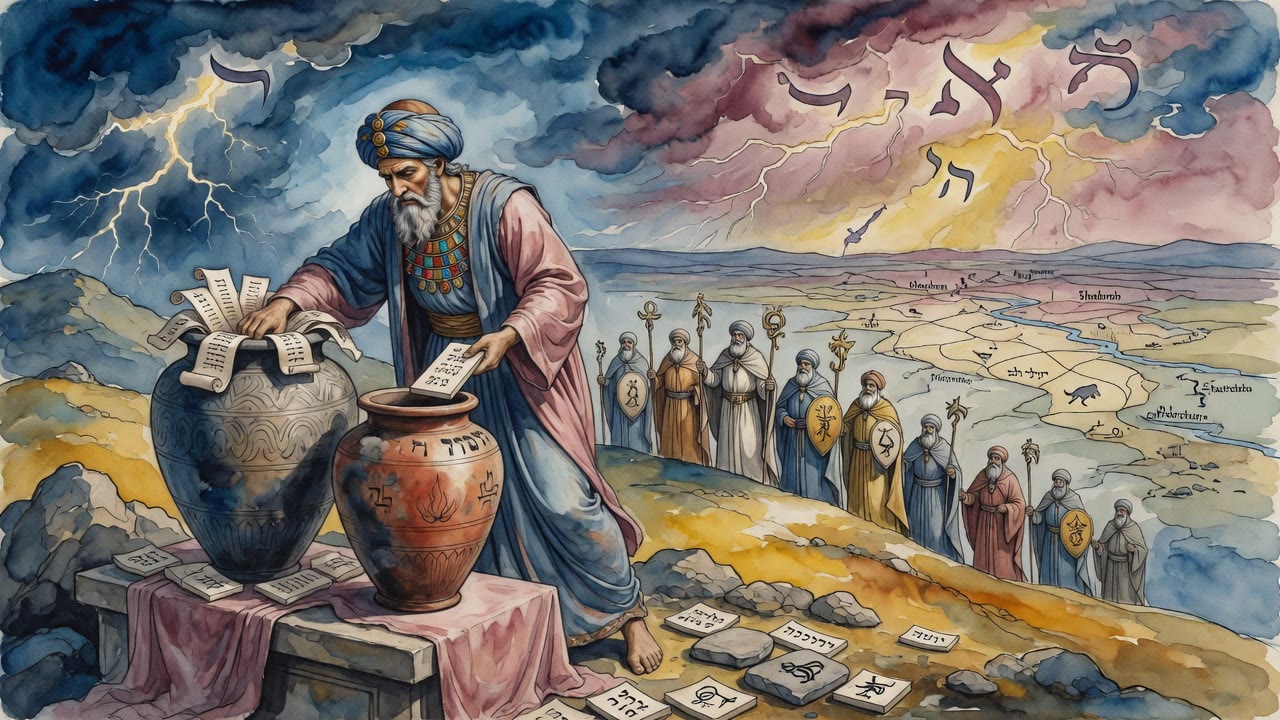
The next town was small and Israel sent a small force, and the men of Ai came out and chased them from the gate and killed thirty-six of them on the slope. Joshua tore his clothes and lay on his face in front of the ark until evening. Then the lots were cast, tribe and clan and household and man, and the circle closed around one soldier standing in the open with his hands empty and his tent full.

The earth at Jericho had already taken the first claim on that city. Achan had reached past a ground that had swallowed a fortress whole.

A Blessing for a Patch of Flat Ground

Long after the conquest, when the sages ruled on what a traveler says at the sites where wonders happened, they made room for Jericho, and the wording is careful. One who sees the wall of Jericho that was swallowed into the ground says a blessing.

Not the wall that fell. The wall that was swallowed.

So a man comes off the road to Jerusalem, stops at a stretch of open dirt outside a town, and stands there. Nothing is standing. Nothing has fallen. There is nothing to point a child at, no famous stone to lay a hand on, no broken arch for anybody to sketch. He says the blessing over an absence, over the shape of a thing the ground closed its mouth around, and then he picks up his bag and keeps walking.

Who is like You among the exalted, doing wonders for Your people, the house of Israel. Some wonders leave a monument. This one left a field a man could plow.


← All myths
From the tradition

Sources

4 sources

The texts behind this telling. Some cards carry a translation of the source; others are our own retelling of it, and each card says which. Every card links out to the original.

Yalkut Shimoni on Nach 15:21Yalkut Shimoni on Nach

Translation of the source text.Yalkut Shimoni on Nach (Sefaria) · CC-BY-NC

"And the wall fell down" (Joshua 6:20). Our rabbis taught: One who sees the wall of Jericho that was swallowed up must recite a blessing. But did it not fall, as it is written, "And the wall fell down"? Since its breadth and its height became equal to one another, for that reason it was swallowed, being swallowed up [into the ground].

Full source
Tikkunei Zohar 104:13Tikkunei Zohar

Retold in our words. Read the original at the link below.Sefaria-hosted English translation · CC-BY

The Tikkunei (spiritual repair) Zohar, a central text of Kabbalah, explores the deepest mysteries of the Torah. And in section 104, it gives us a interpretation of the shofar blasts we hear during the High Holy Days.

Te-qi’ah, a long, unbroken blast. She-varim, a series of broken, wailing sounds. And Te-ru’ah, a rapid, staccato burst. According to the Tikkunei Zohar, these aren't just random noises. They are, quite literally, instruments of cosmic repair. They are "the means of their smashing." Smashing what, you ask? Well, the forces of negativity, of exile, of everything that keeps us separated from the Divine.

It gets even more poetic. The text then quotes (Psalm 89:16): "Happy is the nation, those who know the te-ru’ah, Y”Y, they shall walk in the light of Your face." But what is "Your face?" The Tikkunei Zohar equates the faces of God to the sounds of the Shofar, and in doing so, transforms the blasts into colors: Te-qi’ah is the white of the face, she-varim is the red of the face, and te-ru’ah is the green of the face. The shofar blasts aren't just sounds; they are visual representations of the Divine, expressions of God's very essence. White, red, green – a spectrum of Divine presence made manifest through sound.

Why green? The Tikkunei Zohar makes a startling comparison: "And through it te-ru’ah Israel emerges from exile, when the faces of Israel are transformed to green, like a pregnant woman." Green, the color of life, of growth, of new beginnings. The green face of a pregnant woman – pale, perhaps, but filled with the promise of new life. The Talmud (Sanhedrin 98b) also speaks of this concept, linking the hope of redemption with the imagery of pregnancy.

So, the te-ru’ah, that rapid, fragmented blast, is the sound that heralds our emergence from exile. It's the sound that signifies transformation, the sound that brings us closer to redemption. It’s the sound of hope blooming, even in the midst of difficulty.

Next time you hear the shofar, remember this mystical interpretation. Remember the shattering, the colors, the promise of new life. Remember that the sound isn't just a tradition. It's a powerful force, capable of transforming not only ourselves, but the very fabric of reality. It's a call to walk in the light of God's face, a face revealed in the blasts of the shofar.

Full source
Sifrei Bamidbar 74:1Sifrei Bamidbar

Retold in our words. Read the original at the link below.Sifrei by Rabbi Shraga Silverstein · CC-BY

It's fascinating to think about how sound shaped their experience, how specific blasts of the shofar, the ram's horn, or trumpets dictated their actions.

Our focus today comes from Sifrei Bamidbar, a collection of legal interpretations on the Book of Numbers (Bamidbar in Hebrew).

What exactly does that mean? Why this particular instruction? To understand, we need to backtrack a bit. (Numbers 10:2) tells us these trumpets were for two primary purposes: "for convoking the congregation and for the traveling of the camps." So, gatherings and departures. Movement and stillness.

The question the Sifrei Bamidbar poses is this: if both convoking the congregation and signaling the traveling of the camps are done with trumpets, are they done in the same way? If one is done with a specific sequence of blasts, does that automatically mean the other is too? The text suggests that since both activities use two trumpets, as indicated in (Numbers 10:3) ("And when they blow with them, etc."), one might assume the pattern of blasts is identical for both.

But here’s the catch. We know that the traveling of the camps involved a specific sequence: tekiah-teruah-tekiah. Tekiah is a long, unbroken blast. Teruah is a series of short, staccato bursts. Picture the scene: a long, clear note, followed by a rapid, urgent flurry, and then another long, clear note. That's the signal to pack up and move!

So, the Sifrei Bamidbar anticipates a logical, but ultimately incorrect, assumption. Someone might think, "Aha! Traveling is tekiah-teruah-tekiah, so convoking the assembly must be too!"

That's where (Numbers 10:7) steps in to clarify. "And when the assembly is to be gathered, you shall blow a tekiah, but not a teruah." In other words, just a tekiah, a long blast, will suffice. No need for the short, broken sounds of the teruah.

Why this distinction? The text doesn't explicitly say, but we can infer a few things. Perhaps the single, unbroken tekiah was meant to signal a sense of unity and focused attention for the assembly. The teruah, with its broken and urgent sound, may have been more suitable for the active and somewhat chaotic process of breaking camp and moving.

It's a small detail, perhaps. But it speaks volumes about the precision and intentionality behind the rituals and signals of the ancient Israelites. Every sound, every blast, had a purpose, a meaning, a specific context. What sounds in your life call you to assemble? What sounds signal a time to move?

Full source
Targum Pseudo-Jonathan on Exodus 15:11Targum Pseudo-Jonathan on Exodus

Retold in our words. Read the original at the link below.The Targum of Jonathan ben Uzziel, trans. J. W. Etheridge, London, 1862 · Public Domain

The Song of the Sea reaches its highest note with a question: Who is like Thee among the exalted gods, O Lord, who is like Thee, glorious in holiness, fearful in praises, doing wonders and manifestations for Thy people, the house of Israel?

The Aramaic Targum Pseudo-Jonathan does not soften this question. It keeps the plural phrase "among the exalted" because the Sages understood it not as theology but as rhetoric. In the ancient world, every nation had its gods. The question is not "are there other beings in the council of heaven," which the Torah takes for granted. The question is: which of them is like this one? Which of them acts like this?

The Targum's answer is built into the verb it chooses. Doing wonders and manifestations. The Aramaic prishan means "set apart" or "manifest," the same root as parash, to separate. The Holy One is known not by being far above, but by drawing near and setting apart a people.

The Maggid catches the phrase glorious in holiness, fearful in praises. Glory and holiness belong together. So do fear and praise. A praise without reverence is flattery. A fear without praise is superstition. Israel at the sea learned to hold both in one breath.

The takeaway is small and portable: the way you praise tells the truth about what you worship. Loud promises and short memories worship themselves. Specific thanksgiving, named for the actual wonder received, worships the God who actually delivered.

Full source