5 min read

Eleazar Drew Twelve Tribes and Twelve Lands From Two Urns

Two urns stand before the High Priest. One holds twelve tribes, one holds twelve lands, and his hand must find what God already knows.

Curated by Arthur · Told by Maggid ·
Table of Contents
  1. The Land Was Taken, and Now It Had to Be Cut
  2. Two Urns and the Breastplate That Could Speak
  3. The Hand Found What the Mouth Had Already Called
  4. Twelve Names, Twelve Lands, and Nothing Left to Argue

Seven years the swords had been busy, and now the swords were quiet, and the quiet was worse. The cities of Canaan had fallen one after another, walls breached, gates burned, kings dragged down from their thrones. The land lay open. And a land lying open is a question, not an answer.

Eleazar the priest, son of Aaron, stood where everyone could see him, and he could feel the weight of what was about to happen settle onto his shoulders like a second garment.

The Land Was Taken, and Now It Had to Be Cut

Behind him the hills he would soon be assigning to one family or another caught the late light. He knew the arithmetic of grievance better than he knew the borders. Give a tribe too little, and the resentment would fester for generations. Give a tribe the green valley its neighbor had bled for, and you had not ended a war, you had only moved it inside the camp. A line drawn wrong here would outlast every man standing in this field.

Joshua stood near him, the conqueror who had no taste for this part. Joshua could take a city. Joshua could not look twelve brothers in the eye and tell them which one of them was lying when each swore the lot had cheated him. So the dividing was not left to Joshua, and it was not left to any man's judgment at all. It was lifted out of human hands on purpose, because human hands could not be trusted with it.

Two Urns and the Breastplate That Could Speak

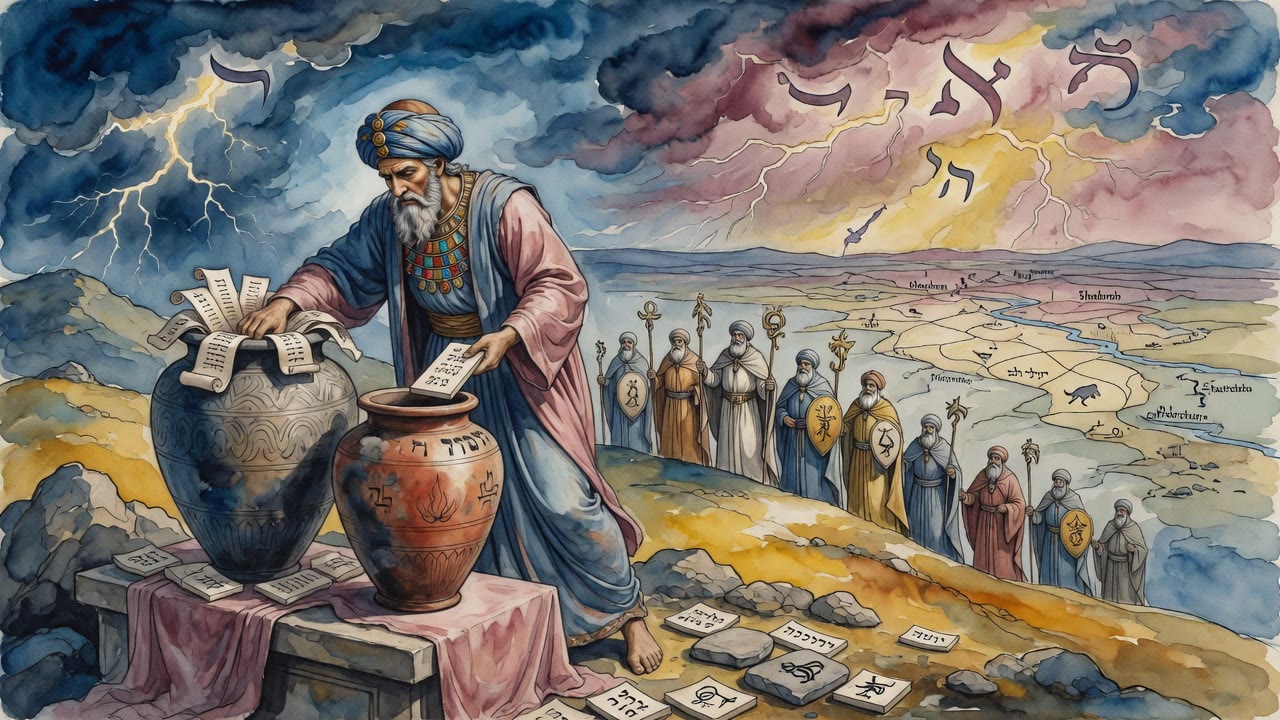
Before Eleazar stood two urns. The first was filled with the names of the tribes, every one of them, Reuben and Simeon and Judah and all the rest, slips of name waiting in the dark of the vessel. The second urn held the names of the districts, the regions carved out of the conquered country, each portion that some family would one day call home.

On Eleazar's chest the breastplate caught the light, and set into it were the Urim and Thummim (אוּרִים וְתֻמִּים, the lights and the perfections), the stones through which the will of Heaven made itself known. No one could say exactly what they were. Everyone knew what they did. When the priest stood before them in a moment of communal dread and asked, they answered. They turned uncertainty into a voice.

The whole congregation of Israel had gathered to watch. They had crossed a sea and wandered a wilderness and buried a generation in the sand for the sake of this ground, and now they pressed close to learn whose it would be.

The Hand Found What the Mouth Had Already Called

This was the wonder of it. Eleazar did not simply reach into a jar and pull a name and hope the people believed him. Before his fingers touched the slips, the Urim and Thummim spoke through him. His mouth, lit by the stones, named the tribe and named the land in the same breath. Judah, and the south. Only then did his hand go down into the first urn and rise with the slip that said Judah, and down into the second and rise with the slip that named exactly the portion he had already spoken.

The drawing did not decide the outcome. The drawing confirmed it. A man could rig an urn. No man could rig his own voice to call out, before he had drawn, the precise pairing his blind hand was about to lift from two separate vessels. The match between the spoken word and the drawn slip was the proof, repeated tribe after tribe, that Heaven and not Eleazar was doing the cutting.

Twelve Names, Twelve Lands, and Nothing Left to Argue

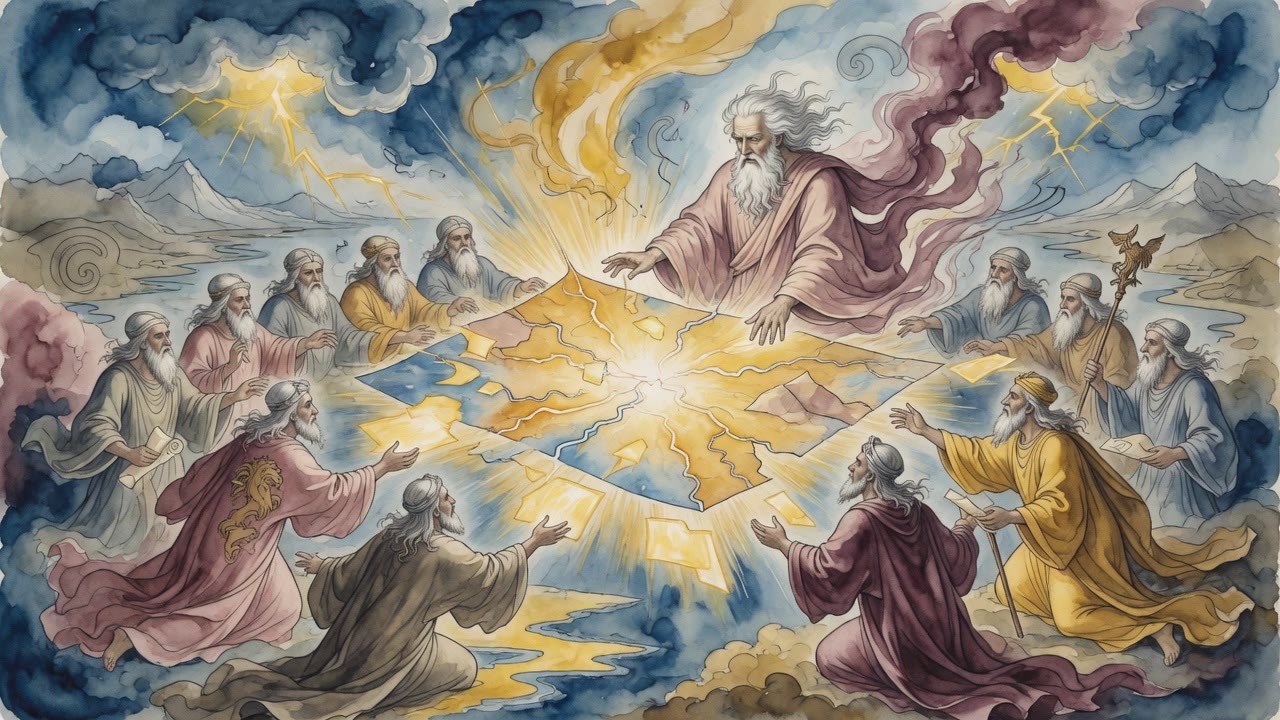
One by one the names came up. Each time the voice came first and the hand came second, and each time the two agreed, and a tribe learned the shape of its future. The grumbling that should have followed such a division never found its footing. How does a man stand in that field and shout that he was robbed, when the same lips that drew his portion had named it aloud before the hand moved, and the field of his brothers heard it?

So the land was parceled out by lot, as the record of those days describes (Joshua 14 to 21), the tribes receiving their inheritances by the casting of the lot before the priest. What reads on the page as a procedure, a quiet bureaucratic word, was in the telling a held breath repeated a dozen times, a voice ringing out over a silent crowd, a hand disappearing into darkness and rising with the very name the voice had spoken.

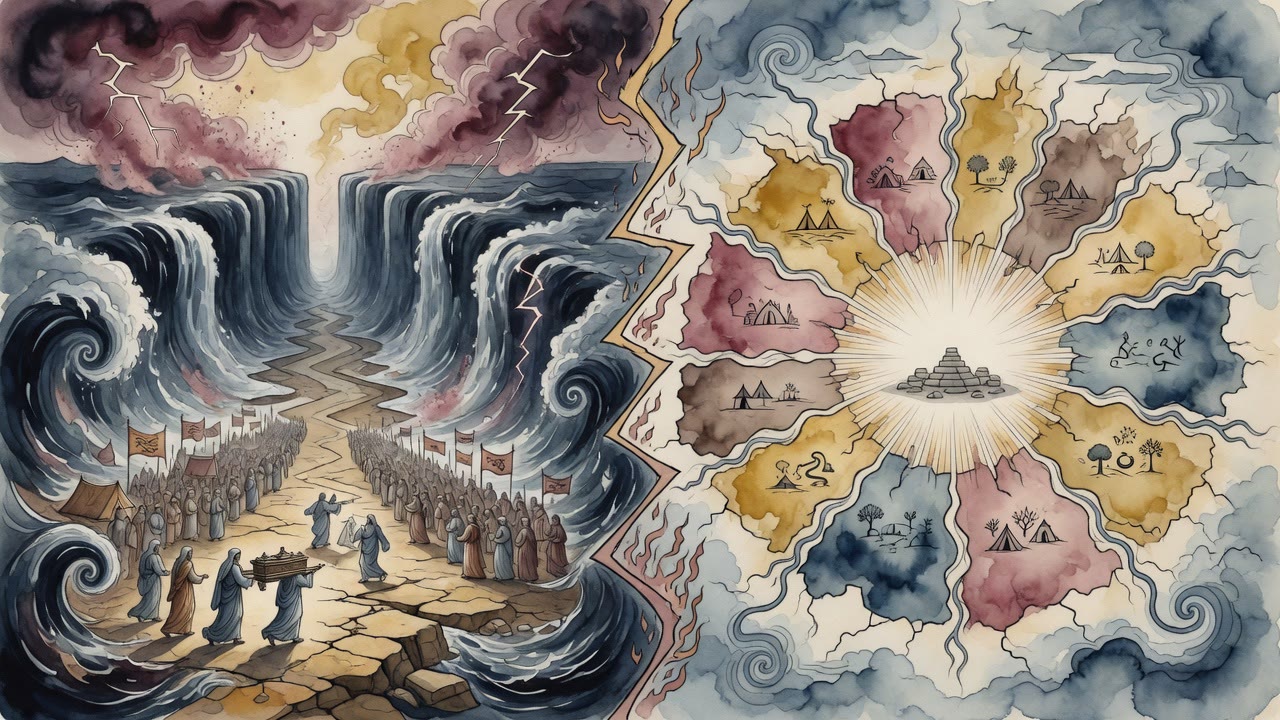
When it was finished, every tribe had its ground, and not one of them could blame Eleazar, or Joshua, or each other. The lines had been drawn by something no man could lean on or bribe. The war for the land was over. The war over the land, the one that should have come next, had been answered before it began.


← All myths

From the tradition

Sources

2 sources

The texts this telling draws on, in full. Open a card to read inline, or expand it for a wider, quieter read.

Legends of the Jews 1:49Legends of the Jews

It wasn't just a matter of drawing lines on a map. It was, according to tradition, a divinely orchestrated process, a fascinating blend of the practical and the miraculous.

After seven long years of warfare, Joshua finally had the chance to allocate the conquered land to the twelve tribes. But how do you fairly divide up a whole country? Well, the ancient rabbis imagined a pretty dramatic scene.

Eleazar, the High Priest, stands before the people. He's not alone. Joshua is there, and the entire Israelite community has gathered. Eleazar is wearing the Urim and Thummim, mystical objects embedded in the High Priest's breastplate. These weren't just pretty jewels; they were believed to be instruments of divine communication. Think of them as an ancient Israelite version of a Magic 8-Ball, but, you know, powered by God.

Before him are two urns. One is filled with the names of the tribes – Reuben, Simeon, Judah, and all the rest. The other contains the names of the different districts into which the land was divided.

According to Ginzberg's retelling in Legends of the Jews, the Holy Spirit then inspired Eleazar. He exclaims a tribal name, say, "Zebulon!" Then, he reaches into the first urn and pulls out... Zebulon! And from the second urn? The district of Accho. So, the tribe of Zebulon gets the district of Accho. As we find in Midrash Rabbah, this happened with each tribe in turn, a seemingly random selection guided by divine will. Each tribe received their portion.

But here's where it gets really interesting. How do you make sure those boundaries stayed fixed? Land disputes are nothing new, even back then! Joshua, according to this tradition, had a clever solution: He planted the Hazubah.

Now, the Hazubah is no ordinary plant. It's described as having a rootstock so tenacious that, once established, it's almost impossible to get rid of. You could plow deep furrows over it, but it would just keep sending up new shoots, growing again amid the grain. It acted as a living marker, stubbornly defining the old division lines, ensuring that everyone knew where one district ended and another began.

What a potent image. A simple plant, yet symbolizing the enduring nature of the divine decree. It makes you wonder: What are the "Hazubahs" in our lives? What are the things that, no matter how hard we try to erase them, keep resurfacing, reminding us of our past, our boundaries, and maybe even our destinies?

Full source
Legends of the Jews 1:47Legends of the Jews

The familiar story is this: – the Exodus, the wandering in the desert, and finally, the moment to claim their inheritance. But it wasn’t just a simple walk in the park. There were nations already there, powerful and not exactly thrilled to see the Israelites arriving. And Joshua, ever the strategist, knew that words could be just as important as swords.

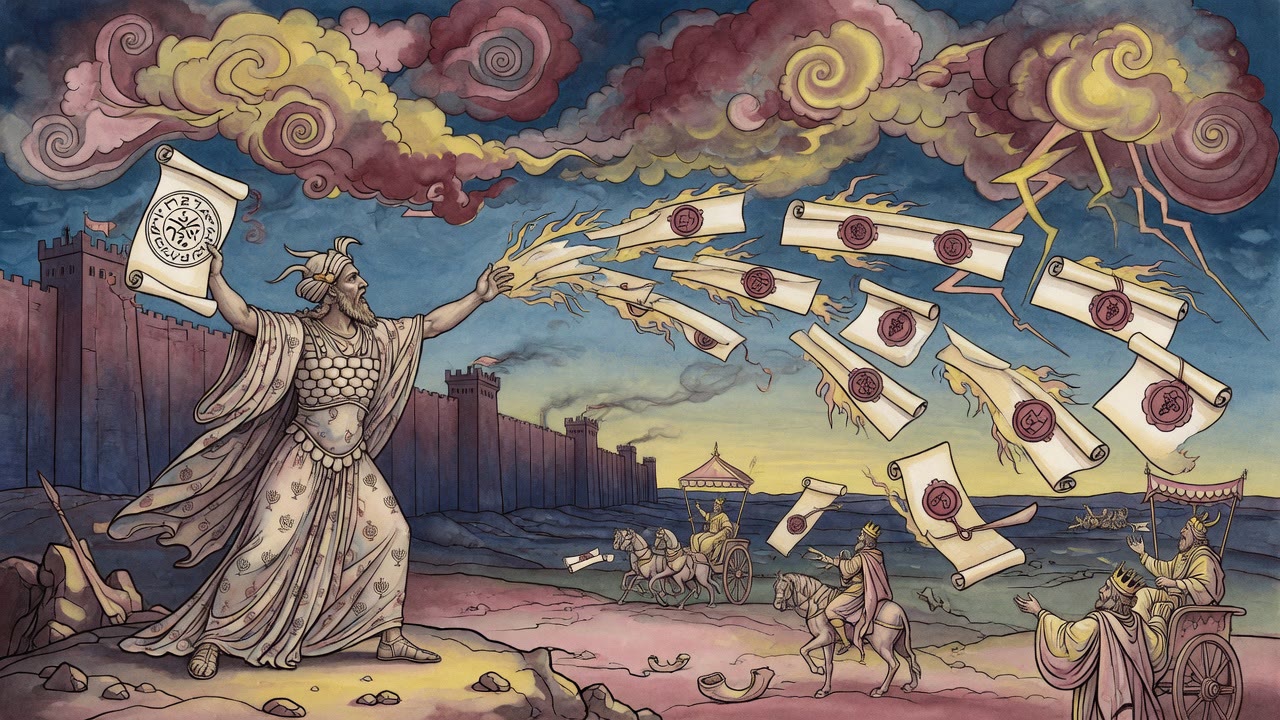
In Legends of the Jews, compiled by Rabbi Louis Ginzberg, Joshua sent a letter ahead to these nations, a kind of "heads up" before they arrived. It wasn't just a polite invitation; it was a powerful declaration. He reminded them of all the miracles God had performed for Israel, a history of divine intervention that should make anyone think twice before messing with them. And he ended with a bold statement: "If the hero Japheth is with you, we have in the midst of us the Hero of heroes, the Highest above all the high."

Can you imagine receiving that letter? The reaction of those "heathen" nations must have been a mix of fear and disbelief. And it only intensified when Joshua's messenger started talking about the Israelite army's discipline, the sheer size of Joshua himself – reportedly five amot (ells) tall!, his regal attire, and a crown inscribed with the very Name of God. It was a full-on intimidation tactic.

Words can only go so far. After seven days, Joshua appeared with twelve thousand troops. And that’s when things got really interesting.

Enter the mother of King Shobach, described as a powerful witch. Not one to back down from a challenge, she used her magic to trap the Israelite army within seven walls. Talk about a magical checkmate! What could Joshua do?

He sent a carrier pigeon – yes, a carrier pigeon!, to Nabiah, king of the tribes east of the Jordan, urging him to come quickly with the priest Phinehas and, crucially, the sacred trumpets, the shofarot (plural of shofar).

Nabiah didn't waste any time. But before he even arrived, Shobach’s mother, the witch, realized her magic was failing. She saw a star rising in the East, a sign that her power was useless against the divine force backing the Israelites. In a fit of rage, Shobach threw his own mother from the wall! He didn't last much longer himself, falling to Nabiah in battle.

Finally, Phinehas arrived with the shofarot. And here's where the story takes a truly wondrous turn. At the sound of those trumpets, a blast of sacred sound, the walls toppled! Just like that.

A pitched battle followed, and according to the legend, the heathen were completely annihilated.

What does this all mean? It's more than just a war story. It's a reminder that even when we feel trapped, walled in by seemingly insurmountable obstacles, there's always hope. Joshua's story reminds us of the power of faith, of strategic thinking, and of the unwavering belief in something greater than ourselves. And maybe, just maybe, the right sound at the right time can bring down even the strongest walls.

Full source