Judith Rose When Bethulia Ran Out of Water
Siege dried the cisterns of Bethulia. Judith, daughter of a long Israelite line, rose while the city talked of surrender.
Table of Contents
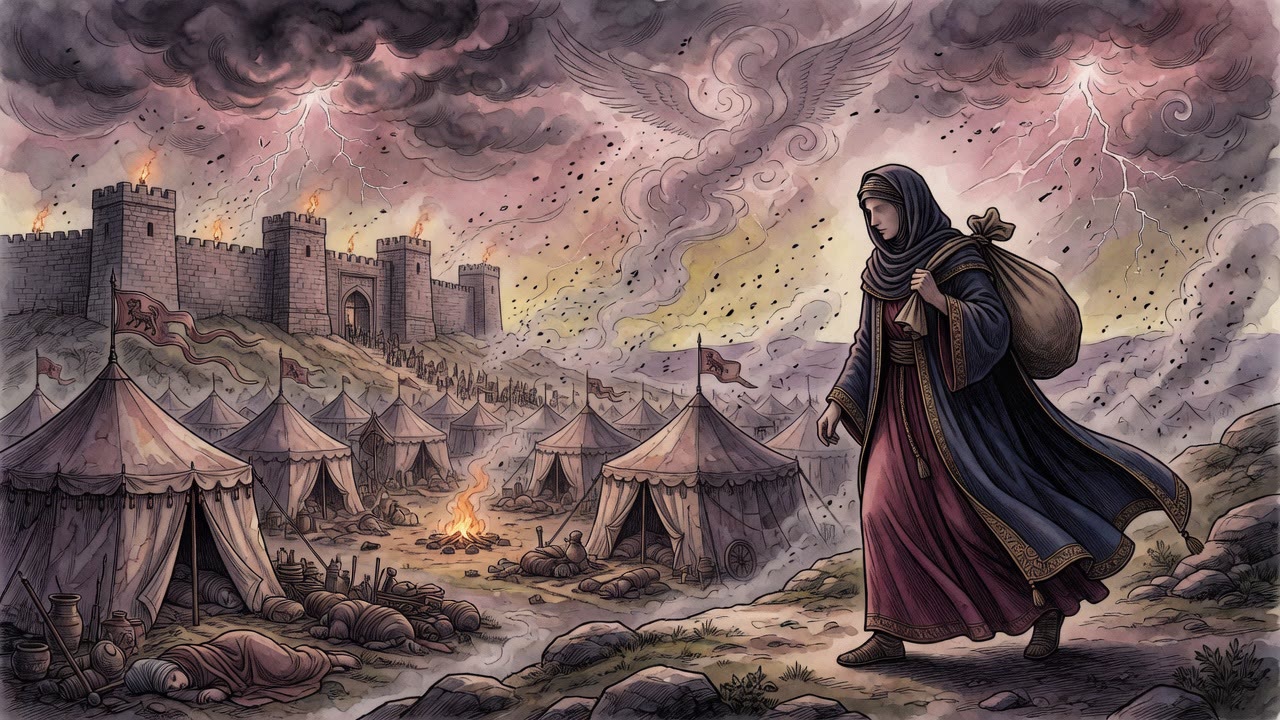
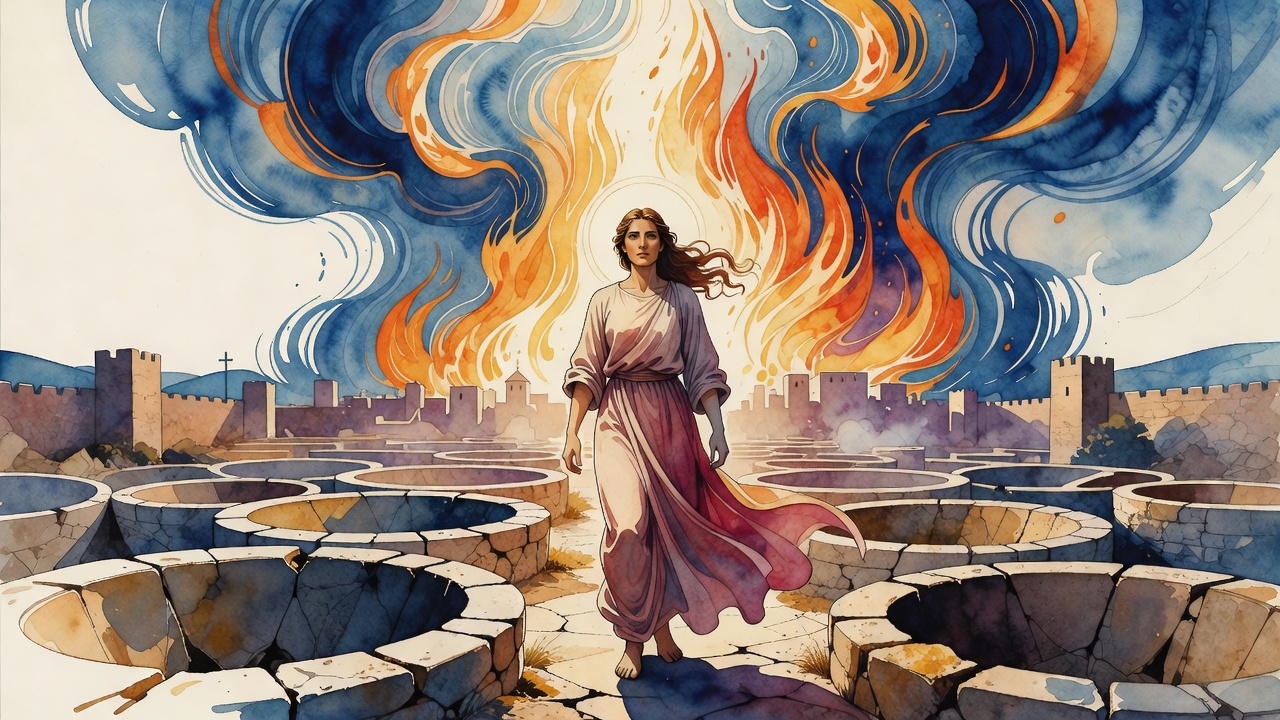
The rope came up light. The boy hauled the jar over the lip of the cistern and it held a hand's depth of water with grit turning in it, so he set it down slowly, because spilling had stopped being a small thing in Bethulia. The city had been shut inside its wall for weeks. The camp outside sat across the springs, and the springs were the whole argument.
 Click for full size
Word of the short jar moved faster than the water did. Men who had spent the siege counting days started counting jars instead, and the jars ran out sooner. By evening the talk in the lanes had moved from the wall to the gate, and from the gate to what a man might reasonably say to a general who was in a good mood.
Judith heard it.
She was a widow with a house built into the wall, and in three years of black clothes she had heard a great deal come up through that floor. This was not the usual noise. This was her own city doing its arithmetic out loud, and there was only one answer inside the arithmetic. She stood in the upper room until the voices moved off down the lane, and then she did not sit back down.
Fifteen Fathers Standing Behind One Widow
Her book stops at exactly that moment to say who she was, and the answer takes a while, because it is a chain. Judith, daughter of Merari. Merari, son of Ox. Ox, son of Joseph. After Joseph the names keep coming, Ozel and Elcia and Ananiah and eleven more, until the chain ends where every Israelite chain ends, at Israel himself.
Fifteen fathers stand between the woman in the upper room and the man who wrestled at the ford. A city getting ready to open its gates has decided, quietly, that its story finishes here. The list is the argument against that, since the story had not finished before, and it had not finished under worse men than the one camped at the spring.
But a chain of names is not water, and the men in the lane knew the difference.
The Nations Called to the Shining Woman
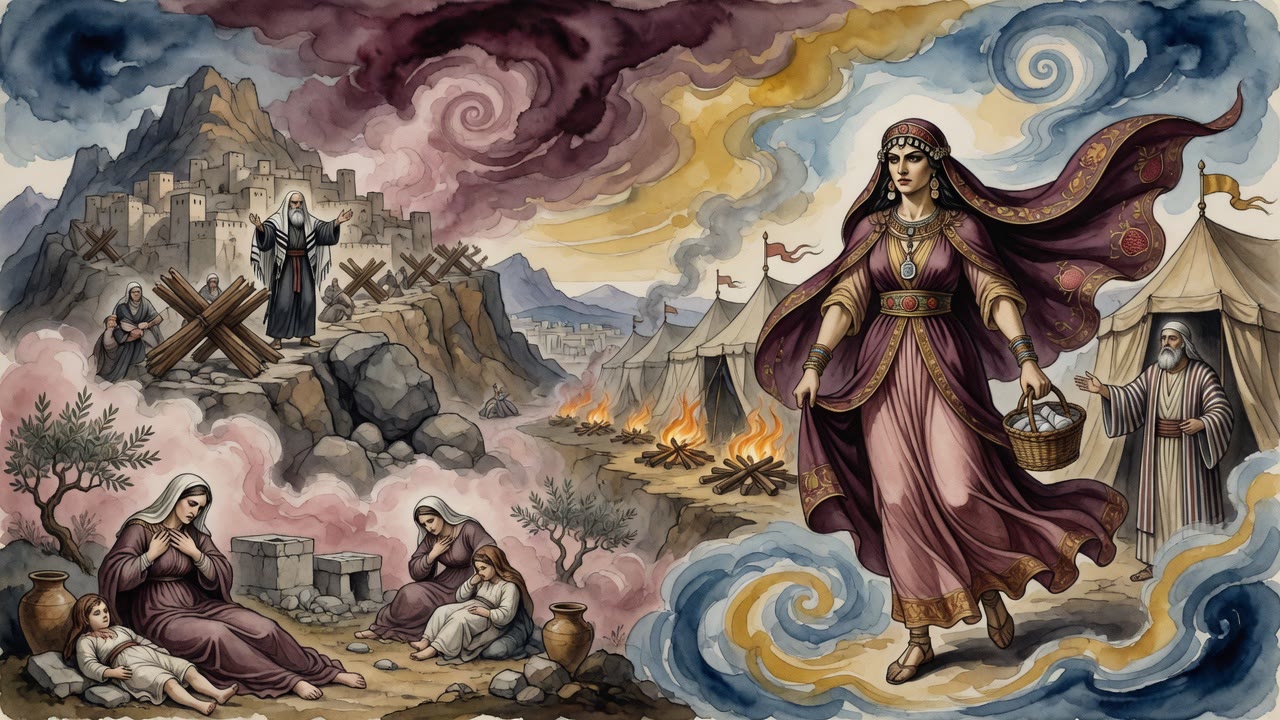
The offer being drafted in Bethulia had been made to Israel once before, out in open country, with the water problem already solved and the honor problem still wide open. The camp lay in four great blocks around the Tabernacle, every tribe under its own standard, and from the ridges the nations watched the arrangement and could not stop watching it. "Who is this woman that shines through like the dawn, as beautiful as the moon" (Song of Songs 6:10). They said it out loud, the way people talk about something they have already decided they want.
Then they came down off the ridges with terms. "Return, return, O Shulammite. Cling to us, come to us, and we will make you sultans and generals and commanders. Return, return, that we may look upon you" (Song of Songs 7:1). The looking was not admiration. When Jethro told Moses to look out able men for the courts (Exodus 18:21), the same word meant appointing them to office, so what the nations were holding out was rank.
The Dance of the Camps No Empire Could Buy
Israel answered with a question instead of a refusal. "What will you see in the Shulammite? What grandeur are you handing us? Something like a dance of the camps?"
Then came the only list that mattered: the standard of the camp of Judah, the standard of the camp of Reuben, the standard of the camp of Ephraim, the standard of the camp of Dan. Four blocks of tents wheeling into position at a signal, dust up past the knees, poles going into the sand in the same order every time. No empire could hand that over as a commission, because a commission is a thing a king gives and can take back. And the word for that dance, meholat, sits one letter away from the word for pardon, mohel, so the camps that wheeled were also the camps that got forgiven when they sinned, and were told afterward that the camp shall be holy (Deuteronomy 23:15).
Balaam on the Ridge With His Eyes Bulging
One man tried to put a price on it anyway. Balaam had been hired to curse them, so he went up and raised his eyes and saw Israel dwelling tribe by tribe (Numbers 24:2), and his eyes bulged in his head, because there was no way in. He said so where nobody could hear him. "Who can touch these people, when every last one of them dwells under his own standard."
He went home without his fee. The thing he could not curse was not a wall and not an army. It was an order of tents.
The Woman Who Came Down the Stairs
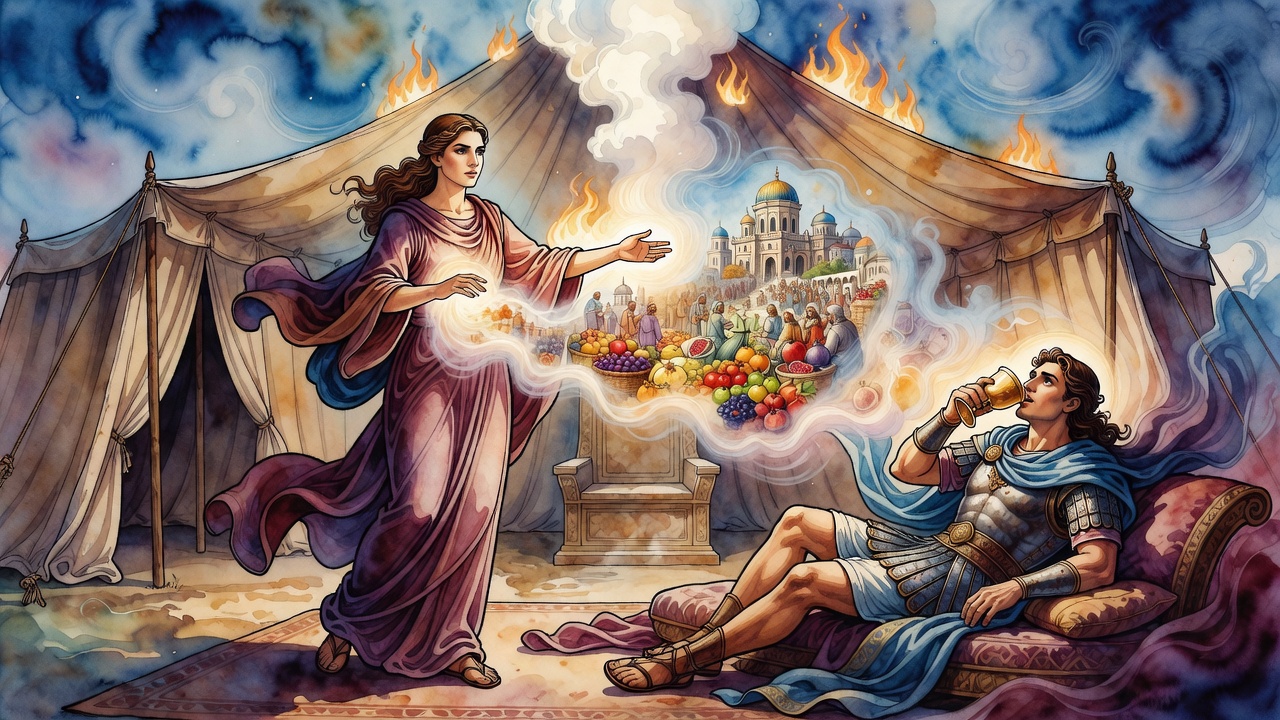
Bethulia had no four camps and no ridge full of astonished nations. It had a wall, a short count of jars, and a general at the spring who was willing to be generous to anyone who opened a gate for him. Terms always sound reasonable on the day the water comes up as grit. Keep your lives, yield the gate, let the general's gods stand in the square while you say your own indoors.
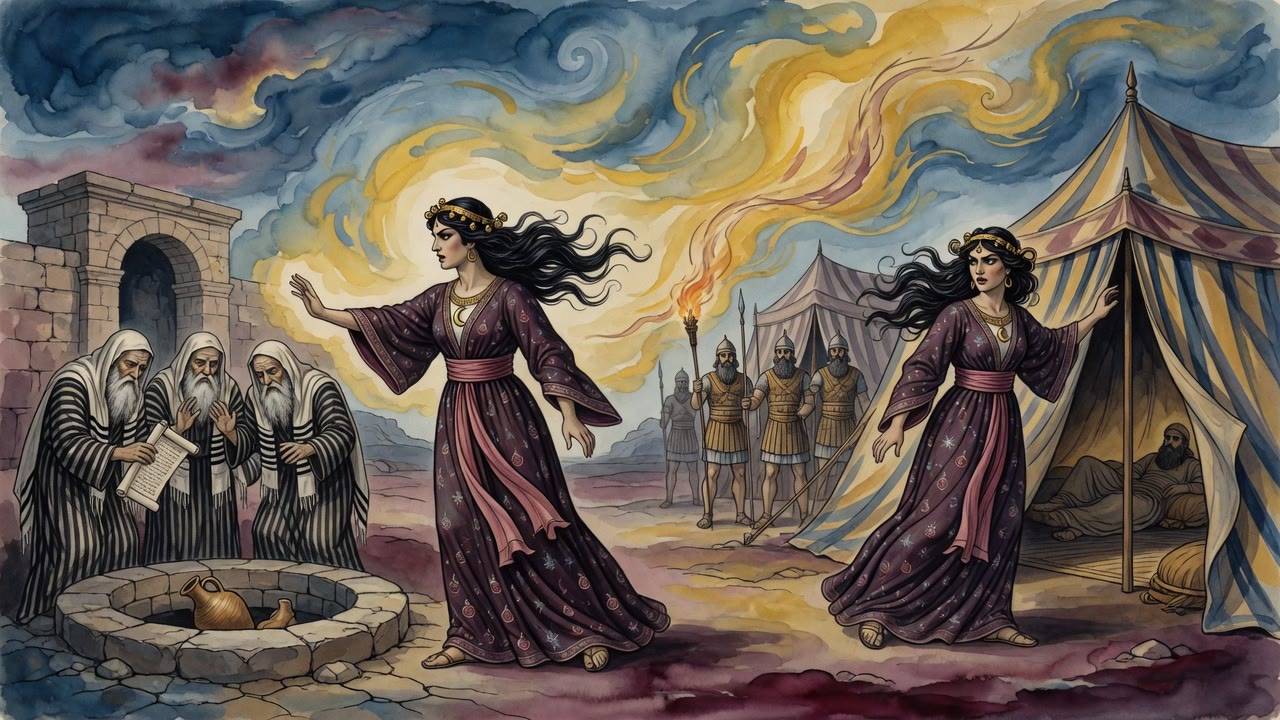
The men in the lane were most of the way through that arithmetic when the widow came down her stairs. They had been reckoning in days. She had been listening to the same numbers through her floor, but she had been hearing them against fifteen fathers and a line that ran back to Israel, so the numbers came out differently on her side of the ceiling.
They looked up from the short count and found her standing in the doorway with nothing in her hands.
← All myths