5 min read

Kikanos Fell and Moses Broke the Snake Wall

After nine years of siege and a dead king, Moses starved young storks three days, then loosed them on Balaam's snakes until the city opened.

Curated by Arthur · Told by Maggid ·
Table of Contents
  1. The Capital That Locked Its King Out
  2. Nine Years and a River of Dead Men
  3. A Refugee Placed on a Throne
  4. Storks Taught to Hunt Like Hawks
  5. A Throne That Could Not Hold Him Forever
Kikanos Fell and Moses Broke the Snake Wall Click for full size

The Capital That Locked Its King Out

Kikanos rode home under victory banners and found his own gates shut. From the road the new walls looked like pride. He told his officers the city must have raised them against Canaan while he was away fighting the East. He called up to the guards. The answer came cold. By order of Balaam, no one entered.
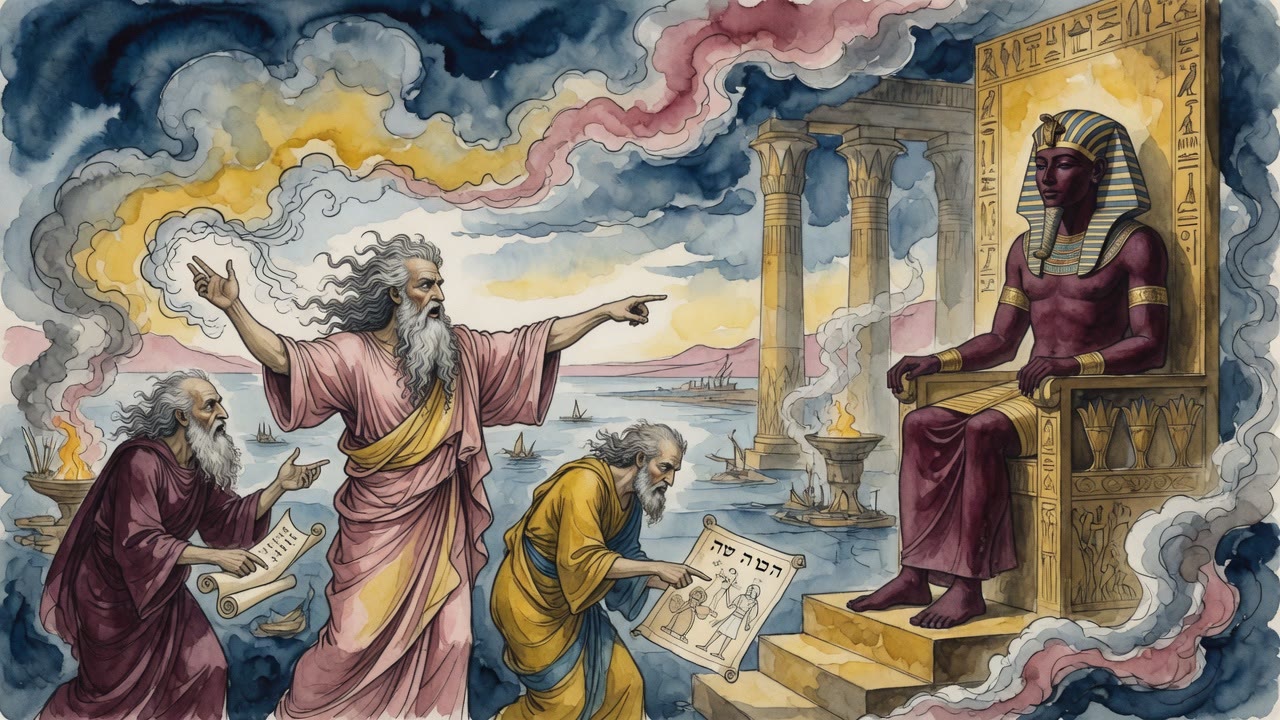
Balaam had not waited. When Kikanos marched out, he left the prophet and the prophet's sons, Jannes and Jambres, to hold the capital. In the king's absence Balaam won the people, took the throne, and set his sons over the army. Two sides of the city rose higher in stone. A third side became a maze of canals fed from Ethiopia's river. On the fourth side, magic arts gathered snakes and scorpions until the ground itself became a living wall. No one left. No one entered.

Nine Years and a River of Dead Men

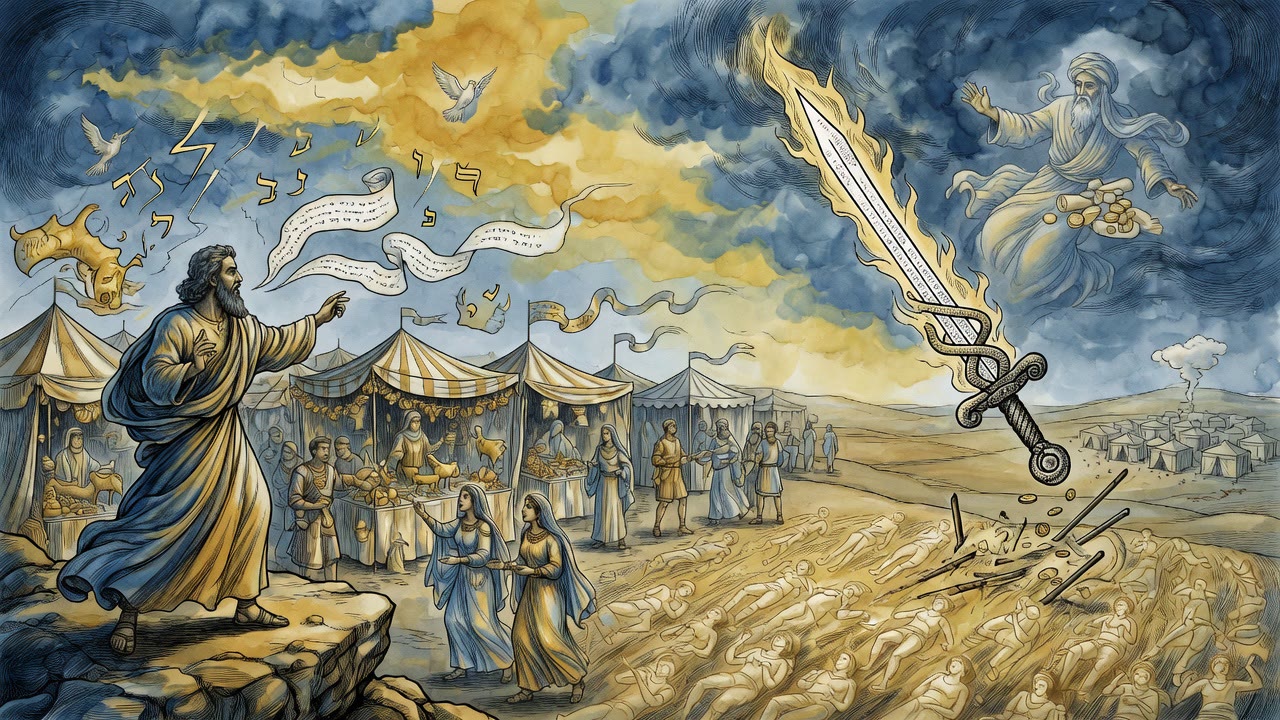
Kikanos tried the gates and lost one hundred thirty men in the first skirmish. The next day he stood his troops on the far bank and sent thirty riders into the water. The current took them. Rafts followed. In the canals the water spun like mill wheels and dragged two hundred more under, twenty from each raft. On the third day he forced the snake side. The reptiles killed one hundred seventy. The king stopped charging and began a siege that lasted nine years. Homes sat empty of husbands. Wives waited beyond the dust. The city would not open.

Then Kikanos died in that long war's grief. His men stood in the wilderness and counted their options out loud. Attack the city and many fall. Stay and starve while princes of Aram and the children of the East hear that the king is gone and rush them until no remnant remains. "Counsel us," they said to one another. "Let us set a king over us, and remain here besieging the city until it surrenders."

A Refugee Placed on a Throne

Moses had fled Egypt after the hangman's reach failed. He had not come looking for a crown. The camp of Cush needed a living command more than it needed another funeral, and the men set him over them. He was twenty-seven when the reign began. The children of Cush loved him. On the seventh day they bowed and asked for counsel about the city that had stolen nine years of their lives.

Moses refused another frontal bloodbath. "If we fight as before the death of Kikianus, many will fall as before," he said. He promised them the city if they would obey a strange order. They answered as soldiers answer a commander they already trust. All that their lord commanded, they would do.

Storks Taught to Hunt Like Hawks

The order went through the whole camp. Every man would go to the forest and bring a young stork in his hand. Anyone who refused would die, and the king would seize his goods. They climbed fir trees. They carried chicks home. They reared them until the birds grew strong and learned to dart as young hawks dart. Then Moses ordered three days of hunger. On the third day the men armed, mounted, and rode each with a starved stork toward the serpent wall.

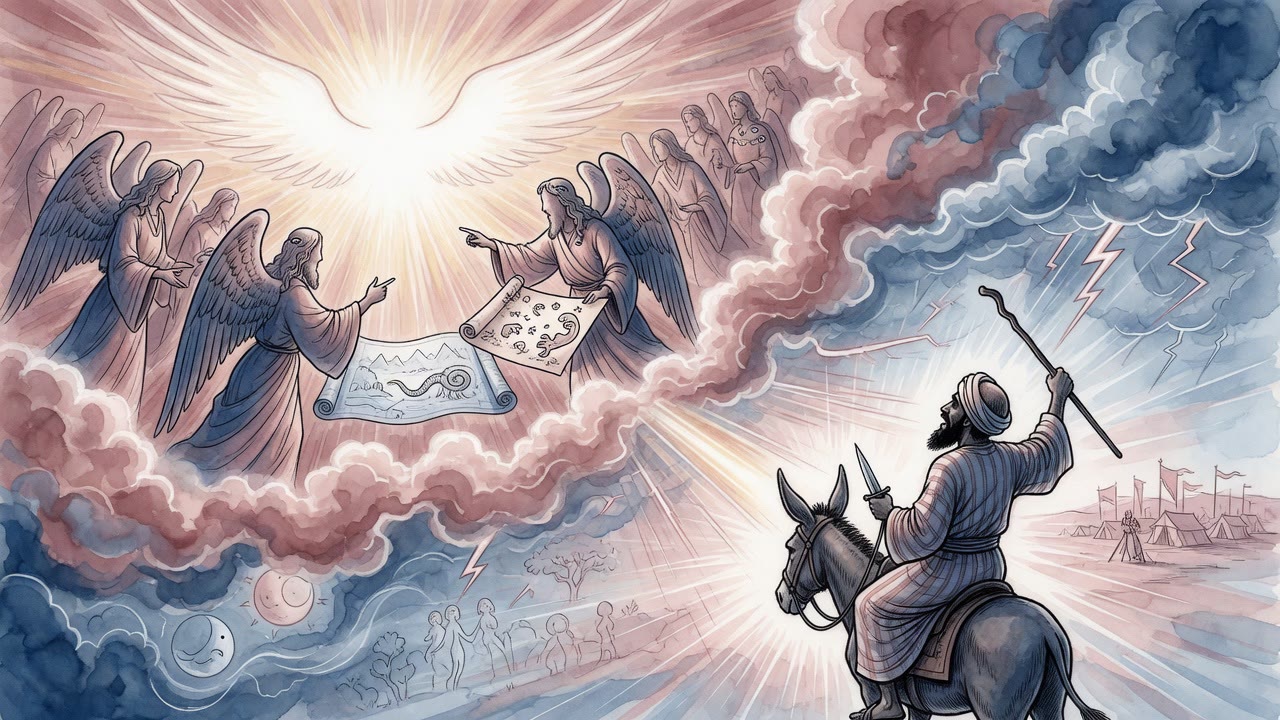
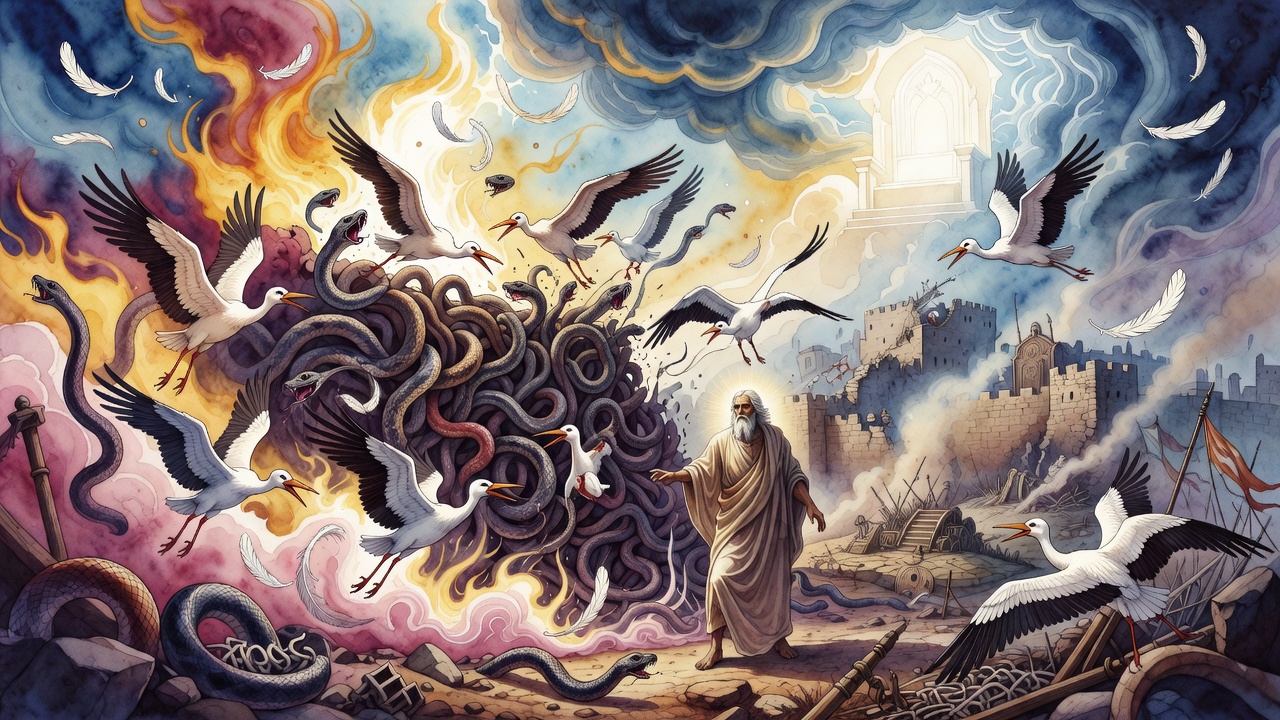
"Send forth each man his young stork upon the serpents," Moses said. The birds dropped. Hunger did what ladders and rafts could not. Snakes vanished into beaks. The living wall broke. The army poured through the gap and took the city without losing a man. Balaam fled toward Egypt with his sons, the same line of sorcerers who would later stand against Moses in another court. The siege of nine years ended on wings and empty stomachs.

A Throne That Could Not Hold Him Forever

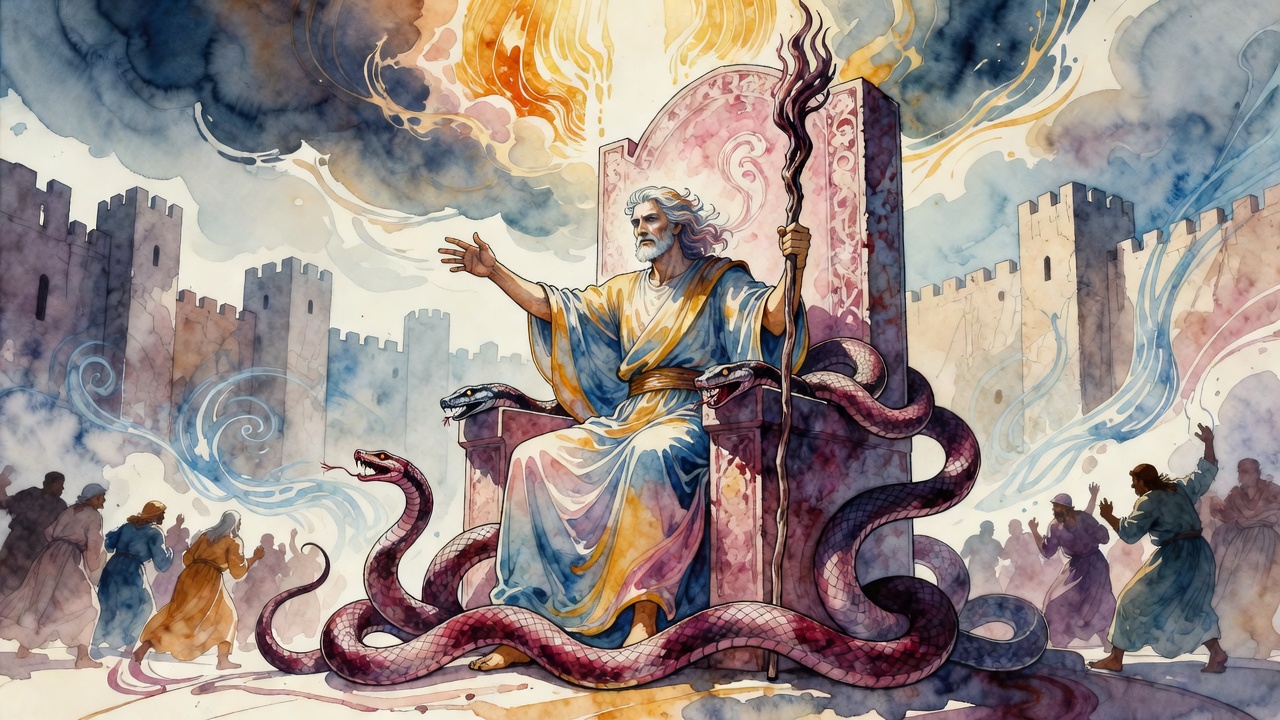
They crowned Moses in the place of Kikanos. They even set the dead king's widow, Adoniah, before him as queen. Moses remembered the oaths of Abraham and Isaac against wives from the lines of Ham's curse and against Canaanite alliances. He ruled with justice and would not approach her as a husband. For forty years Cush feared him and loved him at once. In the fortieth year Adoniah stood in the court and named the wound. He had not approached her. He had not served the gods of Cush. He was not of their flesh. Let Menacrus, son of Kikianus, reign.

By morning the nobles raised Menacrus. Moses left the throne that storks had won him and took the road that would later lead to Midian, a well, and a bush that burned. The snake wall was gone. The prophet who built it had already run. The king who starved birds to free a city walked away with empty hands and a name the world had not yet finished needing.


← All myths
From the tradition

Sources

4 sources

The texts behind this telling. Some cards carry a translation of the source; others are our own retelling of it, and each card says which. Every card links out to the original.

Legends of the Jews 4:102Legends of the Jews

Retold in our words. Read the original at the link below.The Legends of the Jews by Louis Ginzberg (1909) · Public Domain

Legends of the Jews turns to Death of Kikanos.

The Legends of the Jews recounts their despair, and it’s palpable. Imagine: nine long years spent away from home, wandering in the wilderness, locked in a seemingly endless siege. Kikanos's death hangs heavy. "Counsel us," they plead, one to another, "what shall we do at this time?"

Their options? Grim. To attack the city meant almost certain death for many. To remain meant slow starvation and the risk of being overwhelmed. "If we fight against the city, many of us will fall dead; and if we remain here besieging it, we shall also die," they lament.

It wasn't just the immediate situation. The potential for a wider conflict loomed. Word of Kikanos's death would spread like wildfire. "For now all the princes of Aram and of the children of the East will hear that our king is dead, and they will attack us suddenly." The consequences? Utter annihilation. "They will fight with us until not a remnant will be left." Can you feel their desperation?

So, what's their answer? Faced with such overwhelming odds, they turn to a familiar solution: leadership. "Now, therefore, let us go and set a king over us." A new leader, they hope, can rally them, give them direction, and perhaps, just perhaps, turn the tide of their misfortune. They would "remain here besieging the city until it surrenders unto us."

In times of crisis, we often look for someone to take charge, to offer a vision, to provide hope. Whether it's a general on the battlefield or a CEO in a struggling company, the search for a leader is often born from the depths of despair.

But does simply anointing a new king solve their problems? Does it erase the years of hardship, the looming threat of annihilation? We'll have to see. Can a single individual truly make the difference in the face of such profound adversity? Or is their hope in something beyond a single leader, something perhaps hidden within themselves?

Full source
Legends of the Jews 4:99Legends of the Jews

Retold in our words. Read the original at the link below.The Legends of the Jews by Louis Ginzberg (1909) · Public Domain

It involves Kikanos, a conquering hero returning home, only to find… the gates barred against him.

Kikanos, fresh from quelling rebellious nations, leads his victorious army toward his city. But as they approach, they see the city walls looming high. "They must think we were gone so long," Kikanos muses, perhaps aloud, "that they've fortified the city against the Canaanites!" That's what Ginzberg tells us, at least, in his Legends of the Jews.

There's more to it than meets the eye. When Kikanos and his men reach the gates, they find them firmly shut. They call out to the guards, demanding entry, but the guards, under the influence of none other than Balaam, refuse to open them. Remember Balaam? The prophet who could both bless and curse? He’s a key player here.

A skirmish breaks out. Can you picture it? The weary but triumphant army, clashing with their own city's guards. In this initial fight, Kikanos loses one hundred and thirty men. A heavy price to pay for a homecoming.

The next day, the battle continues. Kikanos positions his troops on the riverbank. Thirty of his riders, confident in their steeds, attempt to swim across the river. But the waters prove treacherous, and they are swept away. Thirty more lives lost.

Undeterred, Kikanos orders the construction of rafts to transport his men across the river. But as these makeshift vessels reach the canals, disaster strikes again. The waters swirl violently, like they're driven by powerful mill wheels, and two hundred more men are dragged under – twenty from each raft. It's almost as if the very waters are fighting against them.

On the third day, Kikanos tries a different approach. He orders an assault on the side of the city infested with snakes and scorpions. You can almost feel the heat, the dust, the fear. But even this daring maneuver fails. The reptiles, guardians of the city in their own right, kill one hundred and seventy more men.

Finally, Kikanos is forced to concede defeat – at least for now. He abandons the direct assault. But he doesn't give up entirely. Instead, he lays siege to the city. For nine long years, he surrounds it, preventing anyone from entering or leaving. Nine years of tension, of waiting, of simmering conflict.

What does this story tell us? Perhaps it's about the futility of war, even when victory seems within reach. Or maybe it's about the unexpected obstacles that can arise, even when you're coming home. It's a reminder that even the most powerful leaders can be thwarted, and that sometimes, the greatest battles are not fought on the field, but within the walls of our own homes – or in this case, outside them.

Full source
Legends of the Jews 4:98Legends of the Jews

Retold in our words. Read the original at the link below.The Legends of the Jews by Louis Ginzberg (1909) · Public Domain

He has no clue that destiny has something truly unexpected in store. At this precise moment, war erupts between Ethiopia and its former eastern territories. King Kikanos, leading his massive army, leaves behind a trio of figures to watch over his capital: Balaam – yes, that Balaam – and his two sons, Jannes and Jambres (names you might recognize from other parts of Jewish tradition!).

Big mistake, Kikanos.

The king's absence gives the notoriously opportunistic Balaam the perfect opening. He begins to sway the people, planting seeds of dissent and subtly undermining Kikanos' authority. And wouldn't you know it? He succeeds. He's crowned king, seizing power while Kikanos is off fighting! And his sons? They’re appointed generals, naturally.

Balaam isn’t content with just snatching the throne. He’s determined to keep it. To completely cut off Kikanos and his army, Balaam and his sons lay siege to the city. They want to ensure no one can enter or leave without their say-so. According to Legends of the Jews, they use a multi-pronged strategy worthy of a Bond villain.

On two sides of the city, they reinforce the walls, making them virtually impenetrable. On another side, they create a complex network of canals, diverting the river that surrounds Ethiopia and turning it into a watery maze. And finally, on the fourth side, they unleash… well, let's just say they use their "magic arts" to summon a horrifying swarm of snakes and scorpions. Imagine trying to get past that security detail! It's a full-on lockdown. No one in, no one out.

So, what does this all mean? It's a fascinating glimpse into the chaotic world of ancient legends, where political intrigue, warfare, and even a bit of sorcery intertwine. How often do seemingly small decisions – like leaving Balaam in charge – have enormous, unforeseen consequences? And what happens to Moses in all of this? Well, that, my friends, is a story for another time...

Full source
Jasher 73Book of Jasher

Retold in our words. Read the original at the link below.The Book of Jasher, J. H. Parry edition (1887) · Public Domain

It's considered by many to be part of the Apocrypha, a collection of writings of uncertain origin, that elaborates on stories from the Bible and fills in gaps. And Chapter 73 is where things get really interesting.

The chapter opens by telling us that in the 55th year of Pharaoh's reign, which was the 157th year of the Israelites' sojourn in Egypt, Moses was reigning in Cush. He was 27 years old, and he reigned for 40 years! The people of Cush loved him. He was favored by both God and man.

Here's the thing: Cush was in the middle of a long, drawn-out siege of a city. Nine years, no end in sight. The people were desperate. So they came to their new king, Moses, and asked for his counsel. "Give us counsel that we may see what is to be done to this city!" they pleaded.

Moses, ever the strategist, comes up with a plan. But it's not what you'd expect. He tells them to gather young storks from the forest. Every man must bring one back, or face death! Then, they had to raise these storks, teaching them to hunt like hawks. After they were grown, they had to be starved for three days.

Okay, stay with me.

On the third day, Moses orders the men to arm themselves, grab their hungry storks, and ride to the place where the serpents are. And there – this is the key – they released the storks on the snakes. The storks, ravenous after three days of hunger, devoured the serpents.

With the serpent problem solved, the army of Cush stormed the city and took it, losing not a single man. Balaam the magician (yes, that Balaam) fled back to Egypt with his sons and brothers. According to the Book of Jasher, these are the same sorcerers who later opposed Moses during the plagues.

So, Moses wins the city through wisdom and is placed on the throne, replacing the previous king, Kikianus. They even give him Kikianus's widow, Adoniah, as a wife!

But here's where Moses's true character shines through. He feared God and remembered the oaths of his ancestors – Abraham and Isaac, as we are told in the text. They had sworn not to take wives from the Canaanites or make alliances with the children of Ham. The Book of Jasher even states that God gave Ham and his descendants as slaves to the children of Shem and Japheth. So, Moses refuses to consummate the marriage with Adoniah, remaining true to his faith.

Moses strengthens his kingdom, guides the people with wisdom, and prospers. When Aram and the children of the East hear of Kikianus's death, they rebel. Moses gathers an army and defeats them, bringing them under Cushite rule. He governs with righteousness, following in the footsteps of Abraham, Isaac, and Jacob. "Moses feared the Lord his God all his life, and Moses walked before the Lord in truth, with all his heart and soul."

What's fascinating about this story is how it portrays Moses as a leader before his encounter with the burning bush. It highlights his strategic mind, his piety, and his unwavering commitment to God's law. It’s a glimpse into a Moses we don't typically see in the traditional narrative.

The Book of Jasher, while not canonical, offers a compelling and thought-provoking perspective on biblical figures and events.

Full source