Parshat Vayera5 min read

Lot Bought Zoar Then Climbed the Mountain Anyway

Angels pull Lot from fire. He bargains for a small city, loses his wife to salt, and ends in a cave because even Zoar feels too near judgment.

Curated by Arthur · Told by Maggid ·
Table of Contents
  1. Hands on His Wrists
  2. The Mountain Is Too Far
  3. Salt for Salt
  4. Zoar Turns Cold
  5. What Merit Does and Does Not Fix
Lot Bought Zoar Then Climbed the Mountain Anyway Click for full size

Hands on His Wrists

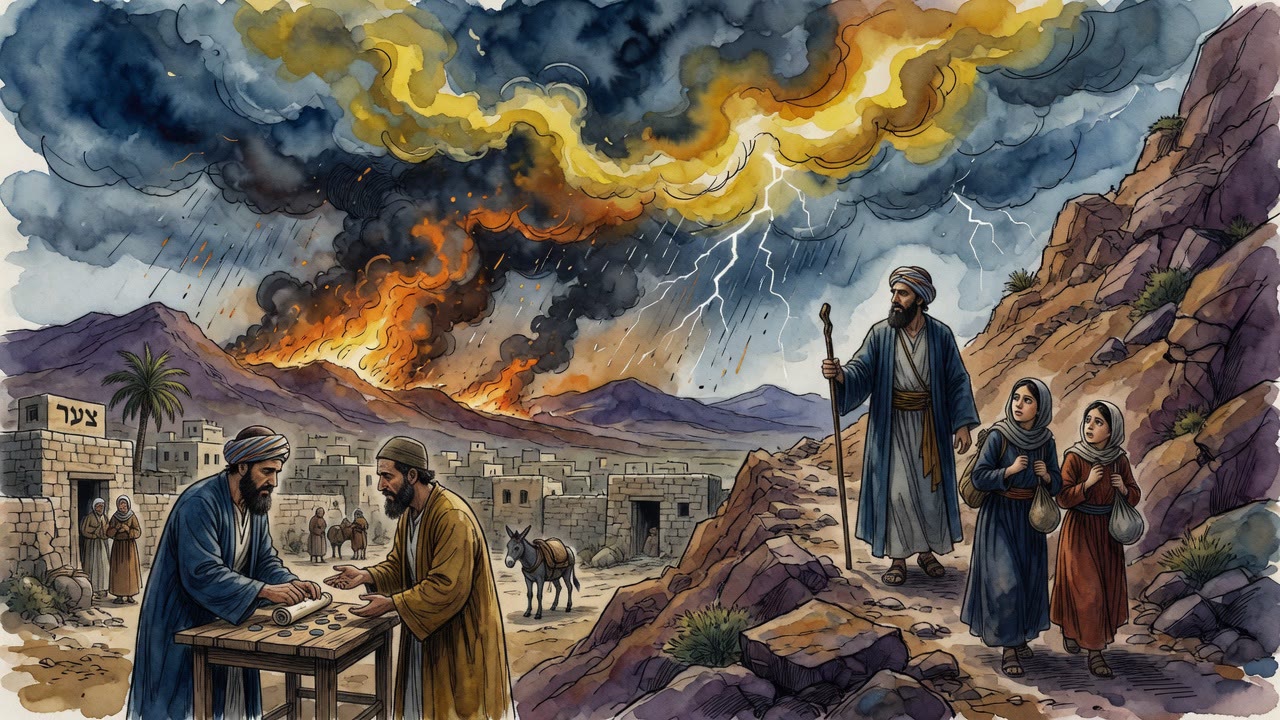
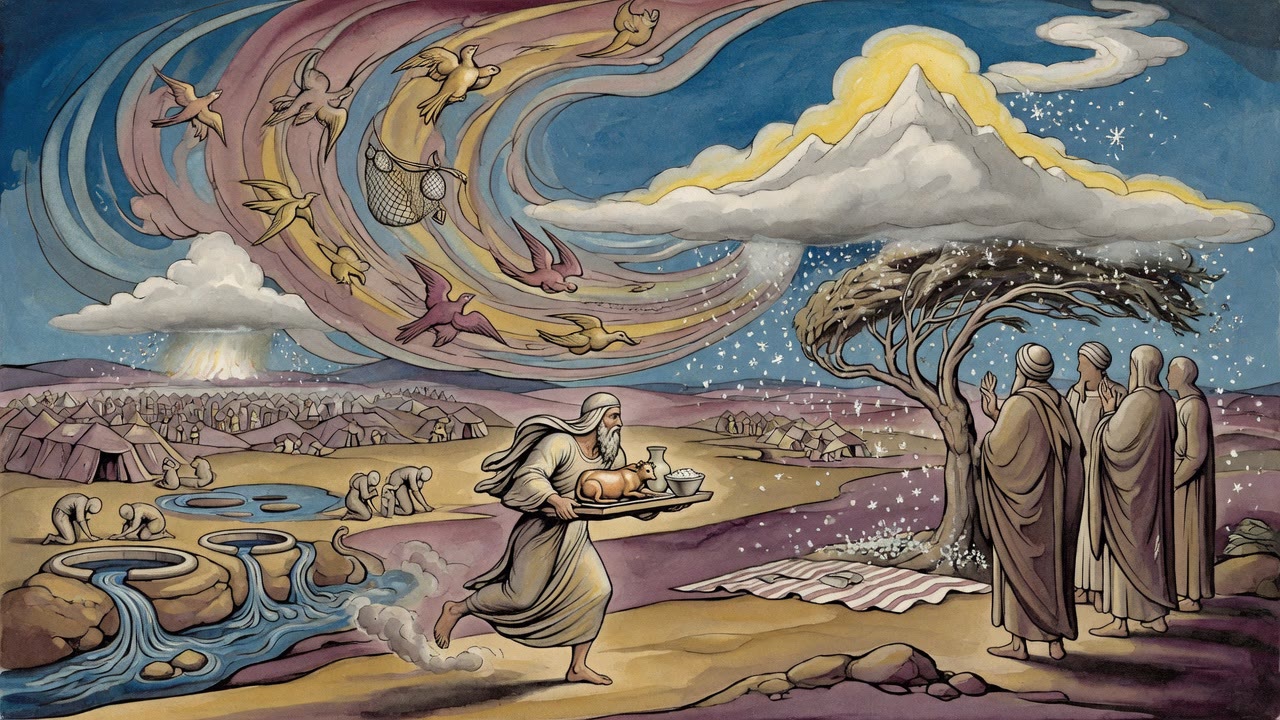
Dawn is already a blade on the plain when the angels seize Lot. He hesitates at the edge of his own rescue. The city that raised his children is about to become smoke, and his feet will not choose the mountain fast enough. So hands take him. Mercy becomes a grip hard enough to leave memory in the bone.

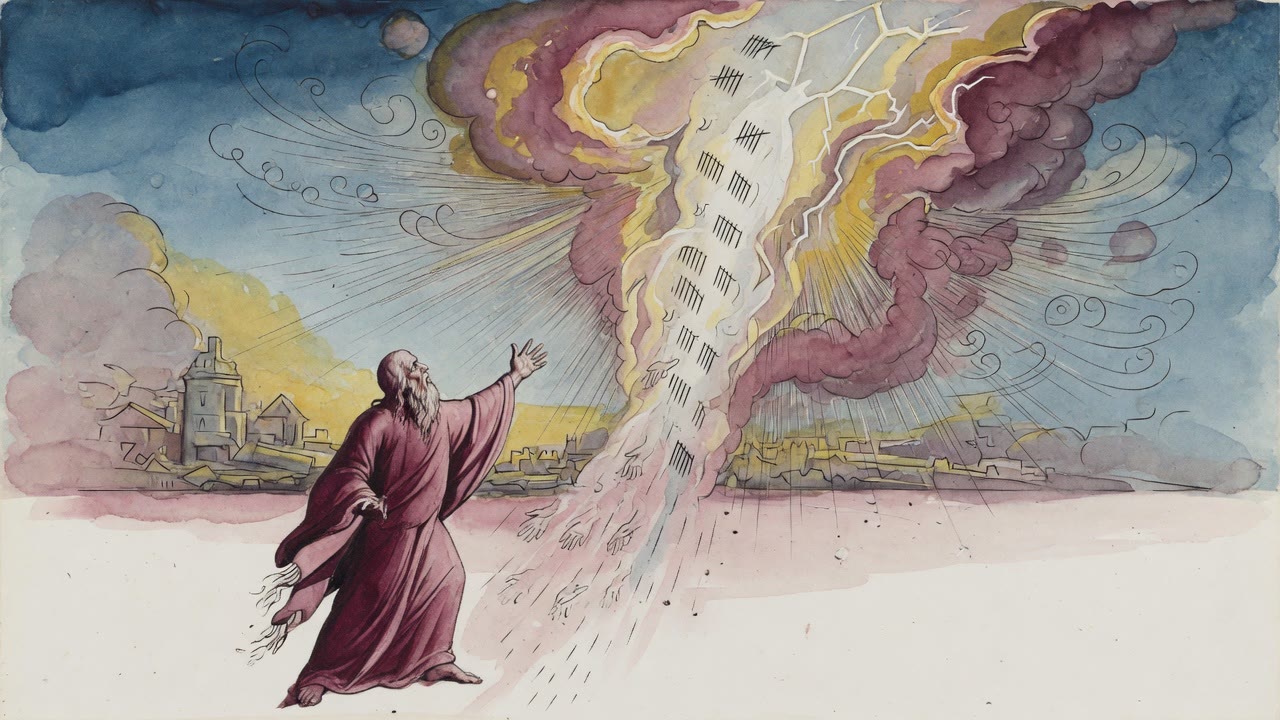
Behind that grip stands a name not spoken in the street of Sodom. When the Lord overthrows the cities of the plain, He remembers the righteousness of Abraham and sends Lot out from the midst of the overthrow. The verse does not credit Lot's virtue. It credits an uncle's merit. Lot lives because someone else argued for the world the night before while ash was still only a threat in a vision.

His sons-in-law had laughed. His house had been surrounded. Now the street is a tunnel of forced speed, and the green fields he once chose over Abraham's dry heights are finishing their last ordinary hour.

The Mountain Is Too Far

"I am not able to escape to the mountain, lest evil overtake me, and I die." Lot negotiates while the air still smells of sulfur not yet fallen. He has already received more kindness than he can measure, and he asks for one more inch of softness. Let me reach a nearer place. Let me keep a roof that is not rock and a market that is not silence.

Heaven allows Zoar. The smallest city of the plain is spared so a frightened man can finish his flight without climbing. Rescue without rigor. Elevation deferred. The angel hears the plea and grants the smaller city as if mercy itself is tired of dragging him by the wrist and would rather he run under his own power for the last mile.

Lot's lungs burn. He names the concession a kindness, which it is. He does not yet know that the mountain he refuses will still be waiting after every softer option fails him.

Salt for Salt

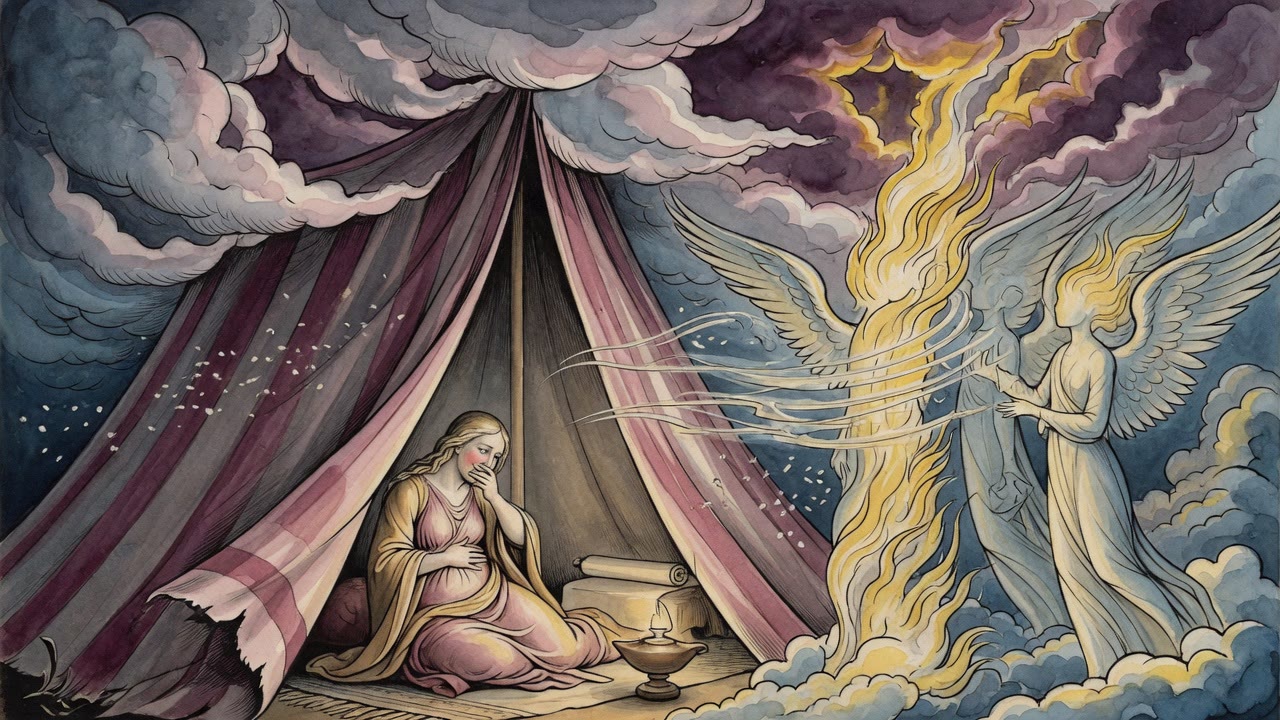
Lot's wife looks back. The Targum will not let the glance be idle curiosity. She is of the daughters of Sodom. Her father's house is still inside the fire. The turn of her neck is divided loyalty, a refusal to unhook from the people Heaven has finished judging.

And she sinned by salt. When the angels came and Lot asked for food, she went borrowing salt through the streets, advertising strangers in the house to a city that punished hospitality as a crime. Each door she knocked became a witness. Salt was her weapon of gossip. Salt becomes her sentence. Measure answers measure until a woman stands as a white statue on the road, a monument to the community she could not leave even when the sky opened its furnace.

Lot does not have time to dig a grave. The road keeps demanding forward. He runs with two daughters and a hole in the family where a wife had been, and the hole is the shape of a pillar he must not turn to study.

Zoar Turns Cold

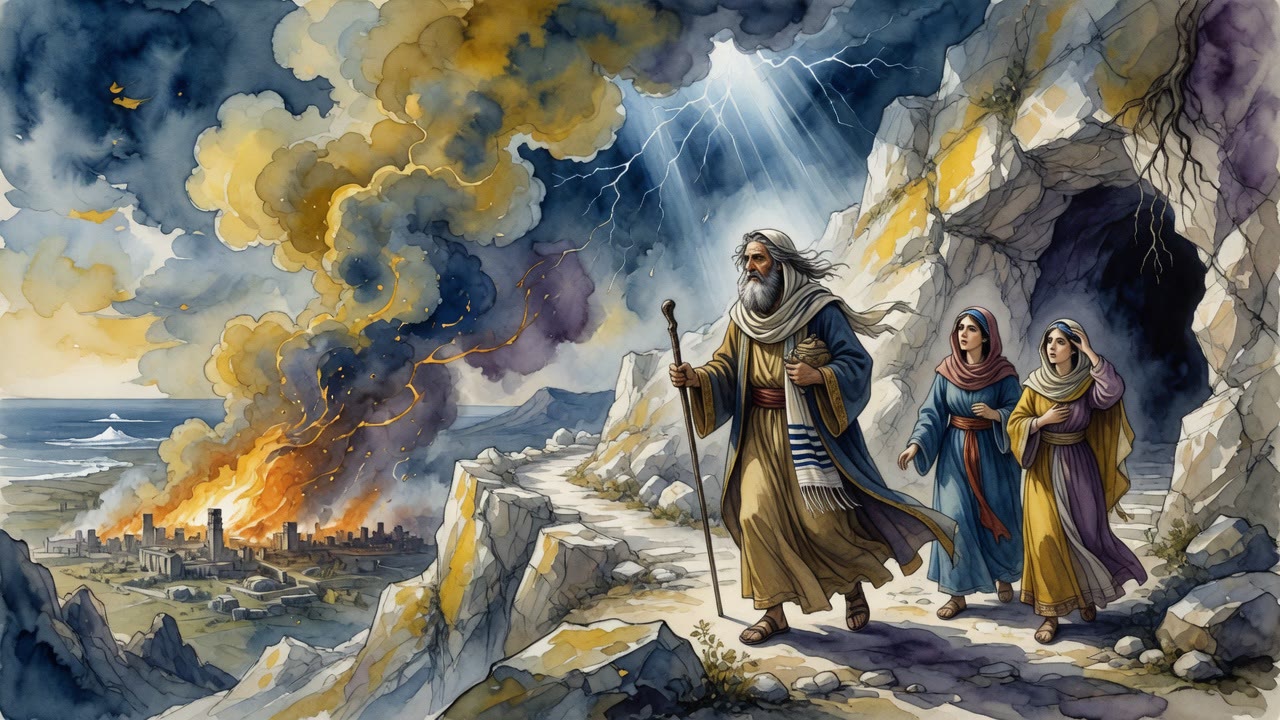
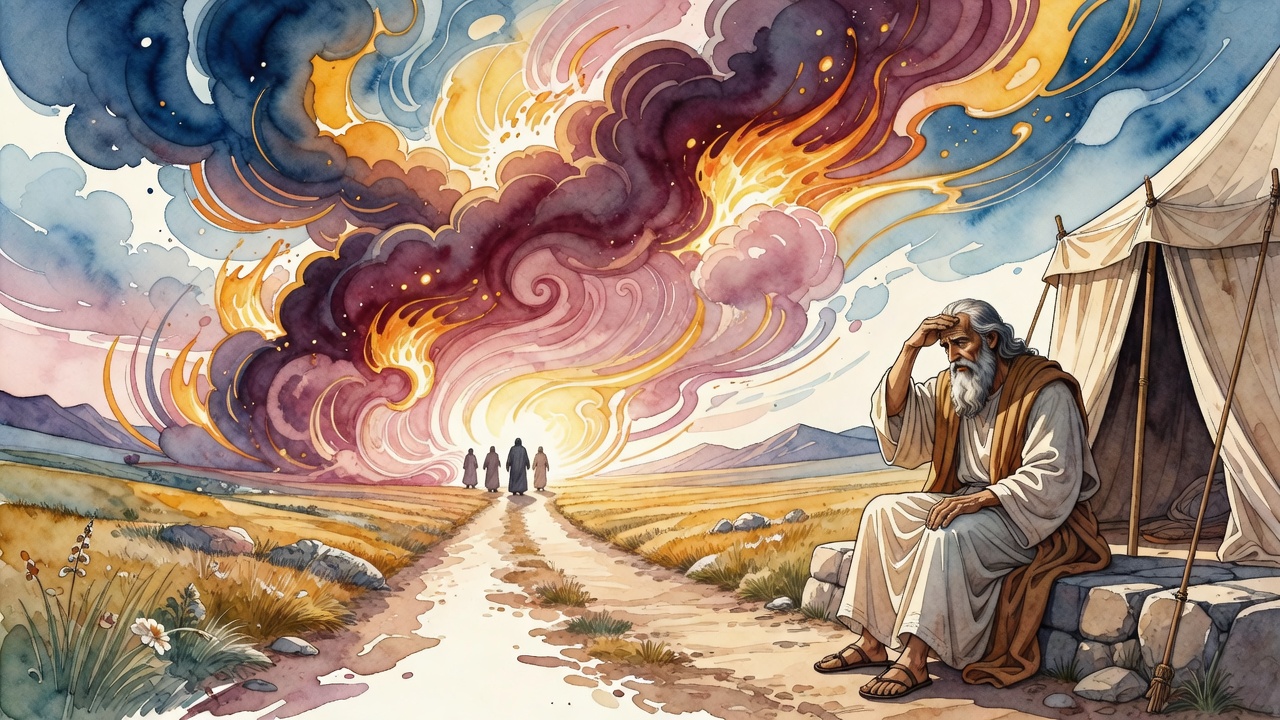
Lot reaches the small city he begged for and cannot stay. If four cities fell in a morning, what keeps the fifth off the list tomorrow? Fear of cities enters his bones like winter. He climbs at last to the mountain the angel named first, and takes a cavern, he and his two daughters, no wife, no sons-in-law, no market noise, no neighbors to borrow salt from or to fear.

The word for cave will later name the doubled burial place of Abraham and Sarah. Lot's cave is the bitter twin: not covenant completed, but a broken household hiding in stone. From this dark the lines of Moab and Ammon will begin, peoples who will press against Israel for centuries with kinship and quarrel mixed like water in wine.

Wind moves past the cave mouth. Lot sleeps badly. Every crack of rock sounds like a city remembering how to burn.

What Merit Does and Does Not Fix

Abraham's zechut pulled Lot from fire. It did not straighten Lot's spine for the mountain on the first try. It did not keep a wife from looking home. It did not make Zoar feel safe after the bargain was won. Merit opens a door. The rescued still have to walk, bargain, fail, climb, and sleep on rock while the plain smokes behind the eyelids.

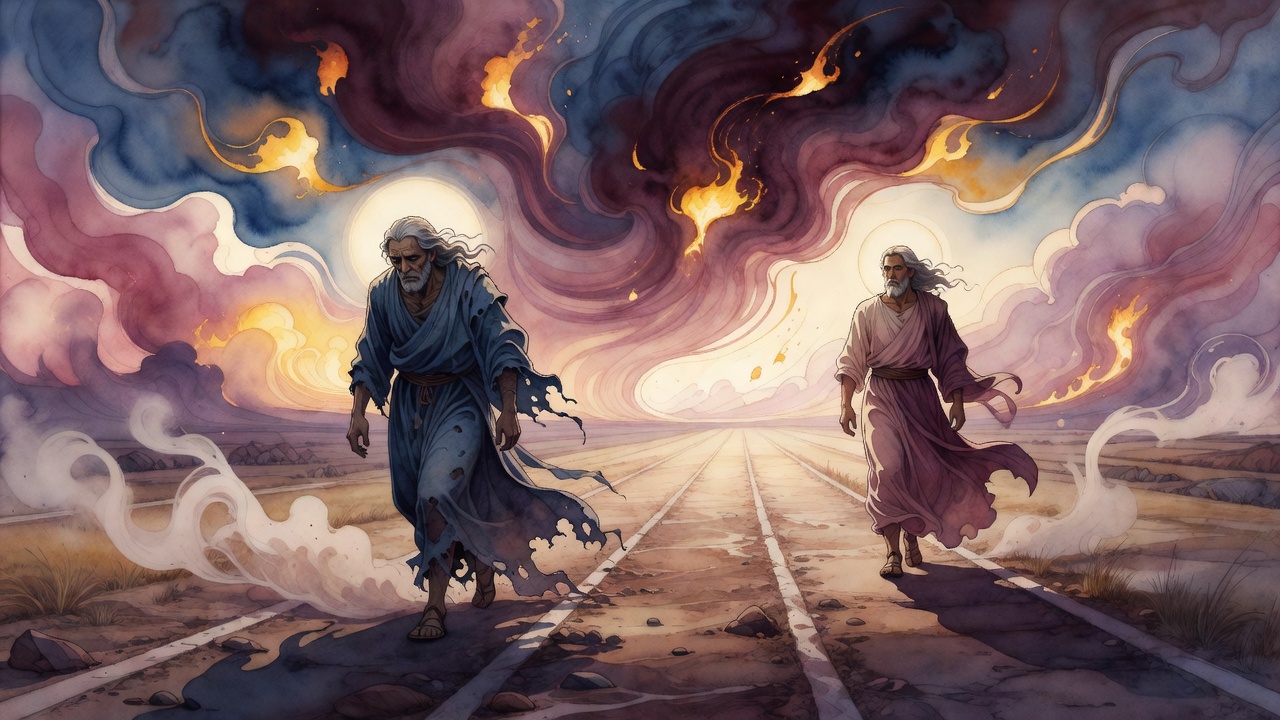
On the plain, statues of salt and pillars of smoke mark the old addresses. In the cave, a man who once pitched tents toward Sodom's green fields learns the sound of wind without neighbors. The mountain he refused at dawn becomes the only roof he trusts by night, and the trust is thin, like cloth washed too many times.

He lives. That was never free. The bill came due in salt, in height, in a darkness that is safety and prison in the same breath.


← All myths
From the tradition

Sources

4 sources

The texts behind this telling. Some cards carry a translation of the source; others are our own retelling of it, and each card says which. Every card links out to the original.

Targum Pseudo-Jonathan on Genesis 19:19Targum Pseudo-Jonathan on Genesis

Retold in our words. Read the original at the link below.The Targum of Jonathan ben Uzziel, trans. J. W. Etheridge, London, 1862 · Public Domain

The angel has commanded Lot to flee to the mountain. Lot looks at the rising sun and the distant ridges and says, in (Genesis 19:19), a deeply human thing.

"Behold, now, thy servant hath found mercy before Thee, and Thou hast multiplied the kindness Thou hast done me in saving my life, and I am not able to escape to the mountain, lest evil overtake me, and I die."

In the Targum's Aramaic, Lot is negotiating, politely, nervously, desperately. He is acknowledging that he has already been granted more mercy than he deserves, and then, in the same breath, he is asking for one more concession. The mountain, he says, is too far. I will not make it. Let me go somewhere closer.

The rabbis of Bereshit Rabbah read Lot's plea as a mix of genuine fear and spiritual cowardice. The mountain, the midrash suggests, represents a place of elevation, where one might have to live alone, without the comforts and crowds of city life, closer to God and farther from commerce. Lot is asking for a smaller city instead. He wants rescue without the rigor that comes with real ascent.

But the angel hears him out. In the next verse, God will grant the request and spare Zoar, the smallest of the five plain-cities, just so Lot has somewhere to flee that is not the mountain (Genesis 19:21).

The takeaway: sometimes Heaven accommodates even our weaknesses. But the story usually ends, eventually, with us ascending the mountain anyway, as Lot will, a few verses later, when Zoar becomes too frightening and he flees upward after all.

Full source
Targum Pseudo-Jonathan on Genesis 19:26Targum Pseudo-Jonathan on Genesis

Retold in our words. Read the original at the link below.The Targum of Jonathan ben Uzziel, trans. J. W. Etheridge, London, 1862 · Public Domain

(Genesis 19:26) is famously brief. Targum Pseudo-Jonathan is not.

"And his wife looked after the angel, to know what would be in the end of her father's house, for she was of the daughters of the Sedomaee; and because she sinned by salt (bemilcha) she was manifestly punished; behold, she was made a statue of salt."

The Targum adds two crucial details the Hebrew leaves out. First, Lot's wife is Sodomite by birth. Her family, her father's house, is still inside the burning plain. Her backward glance is not mere curiosity. It is divided loyalty. She cannot bear to let go of her people of origin, even when God has declared them finished.

Second, and more striking: the Targum tells us the specific sin she committed that earned the specific punishment. She sinned "by salt", bemilcha. The rabbinic tradition preserved here (also found in Bereshit Rabbah 50:4 and Pirkei DeRabbi Eliezer 25) explains: when the angels arrived and Lot asked his wife to prepare food for them, she went around the city borrowing salt from the neighbors, deliberately advertising the fact that her household was entertaining strangers. She was, in effect, reporting her husband to Sodom's anti-hospitality police.

Salt was her weapon. Salt became her sentence. Middah k'neged middah, measure for measure, in its purest form.

The takeaway: a person who cannot let go of the community that destroys kindness will, eventually, be preserved as a monument to the thing they could not leave.

Full source
Targum Pseudo-Jonathan on Genesis 19:29Targum Pseudo-Jonathan on Genesis

Retold in our words. Read the original at the link below.The Targum of Jonathan ben Uzziel, trans. J. W. Etheridge, London, 1862 · Public Domain

(Genesis 19:29) gives the whole Sodom episode its underlying machinery in a single sentence. Targum Pseudo-Jonathan translates it plainly.

"And it was when the Lord destroyed the cities of the plain, that He remembered the righteousness of Abraham, and sent forth Lot from the midst of the overthrow, when He overthrew the cities wherein Lot had dwelt."

Notice what the verse does not say. It does not say God remembered Lot's righteousness. Lot has been rescued, but the verse credits Abraham, not him. The rabbis of Bereshit Rabbah made this explicit: Lot owed his life entirely to his uncle's merit. The bargaining in Genesis 18, the ten-righteous ceiling, the hand-pulling angels, all of it traces back to Abraham's intercession, not to anything Lot himself did.

This is the Torah's first clear example of zekhut avot, the merit of the ancestors, as a functioning principle of divine judgment. A later descendant can be saved on the strength of an earlier ancestor's righteousness. The rabbis of the Talmud (Shabbat 55a, Berakhot 7b) would develop this into a foundation of daily Jewish prayer: "Remember the covenant of Abraham, Isaac, and Jacob."

The Aramaic phrase the Targum uses, udkar et zakhutha d'Avraham, "He remembered the merit of Abraham", will echo through synagogue liturgy for two millennia.

And yet, within the same verse, there is a quiet rebuke. God pulled Lot out of "the cities wherein Lot had dwelt." Wherein he dwelt. He chose those cities. He moved his family there. His rescue is real, but the verse will not let us forget that he authored his own crisis.

The takeaway: the prayers of people who loved you can still save you from a fire you lit yourself.

Full source
Targum Pseudo-Jonathan on Genesis 19:30Targum Pseudo-Jonathan on Genesis

Retold in our words. Read the original at the link below.The Targum of Jonathan ben Uzziel, trans. J. W. Etheridge, London, 1862 · Public Domain

Lot's arc is almost done. (Genesis 19:30) places him, finally, where the angel originally told him to go in (Genesis 19:17), the mountain.

"And Lot went up from Zoar, and dwelt in the mountain, and his two daughters with him; because he feared to reside in Zoar. And he dwelt in a cavern, he and his two daughters."

The Targum's Aramaic word for "cavern", m'artha, is the same word that will later describe the Cave of Machpelah where Abraham and Sarah will be buried. But the parallel is bitter. Abraham's cave is a monument to a completed covenant and a treasured wife. Lot's cave is a hideout for a broken man with no wife, no sons-in-law, no home, no community, only two surviving daughters.

Why is Lot afraid to stay in Zoar? The rabbis of Bereshit Rabbah read the fear as theological. Zoar had been spared only temporarily, and Lot suspected that its reprieve might not last. If Heaven had destroyed four cities in one morning, what was to stop it from striking the fifth tomorrow? Better to climb the mountain and sleep in a cave than to sleep in a city that might still be on God's list.

There is also a psychological reading. Lot has just watched his entire world dissolve into fire and salt. He cannot imagine ever trusting a city again. So he flees even the small refuge he fought for, and hides in stone.

It is from this cave, in the verses that follow, that Moab and Ammon will be conceived, two peoples who will haunt Israel for centuries, and from whom, eventually, Ruth the Moabitess and King David will descend.

The takeaway: even the smallest rescue sometimes ends in a cave, and even a cave can be the birthplace of a king.

Full source