6 min read

Lot Took the Bench Among Sodom's Chief Liars

The morning they seated Lot on Sodom's high court, his four colleagues were named Chief of Lies, Chief Scoundrel, and worse. By dark, a mob had his door.

Curated by Arthur · Told by Maggid ·
Table of Contents
  1. The Day They Seated Him
  2. Two Guests Under His Roof
  3. Hands at the Door
  4. Fire on the Plain
  5. Wine in the Cave
  6. What the Bench Could Not Save
Lot Took the Bench Among Sodom's Chief Liars Click for full size

The Day They Seated Him

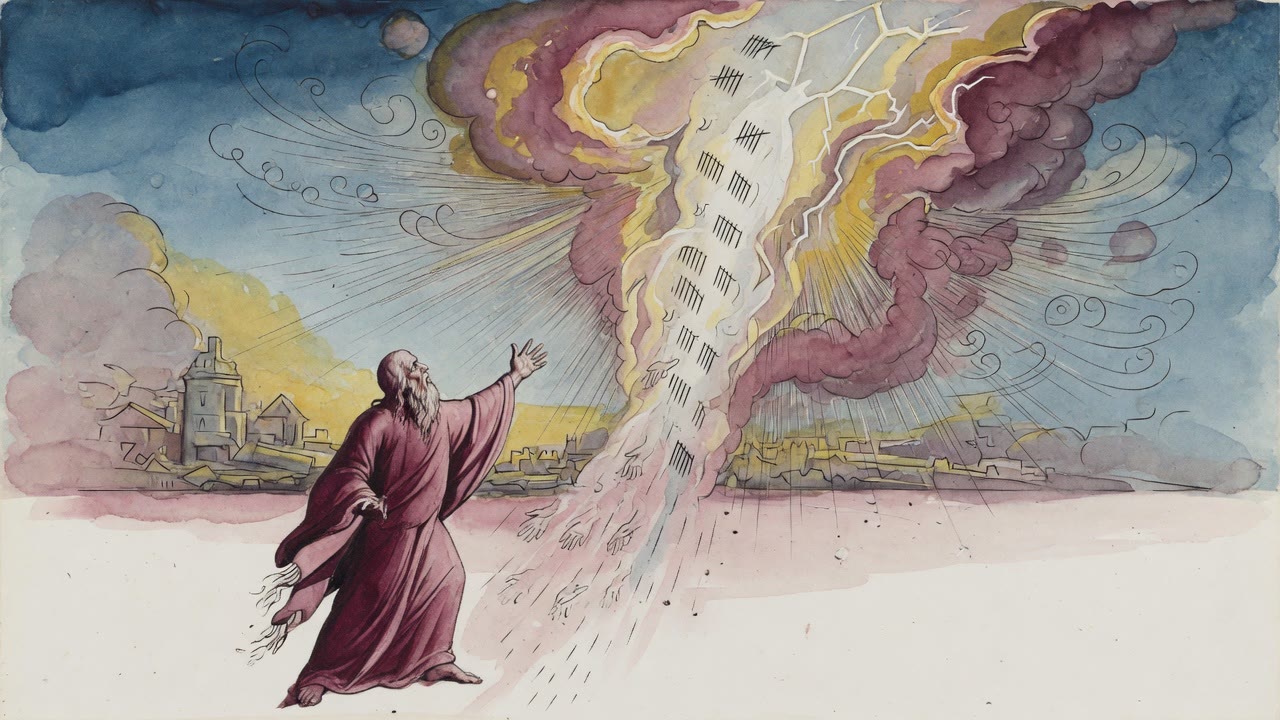
Lot took the high seat in Sodom on the morning of the last day the city had. Four judges sat with him and every one of them was named for what he did. Ketz Sheker, Ultimate in Lies. Rav Sheker, Chief of Lies. Rav Masteidin, Chief Perverter of Justice. Rav Naval, Chief Scoundrel. Klepander, the Abductor. Lot was made chief justice over the lot of them.

The work went well while he agreed with them. "Gesh hala," they would call out when a ruling pleased them. Rise to the top.

When he ruled against them the room turned. "This one came here to sojourn," they said, "and he sits in judgment?"

He had picked the plain years earlier because it looked green and well watered, like a garden, like Egypt. Now the green was a courthouse full of thieves and he was the newest thing in it.

The sun went down on Sodom early that evening, and the sentence on the city was already sealed.

Two Guests Under His Roof

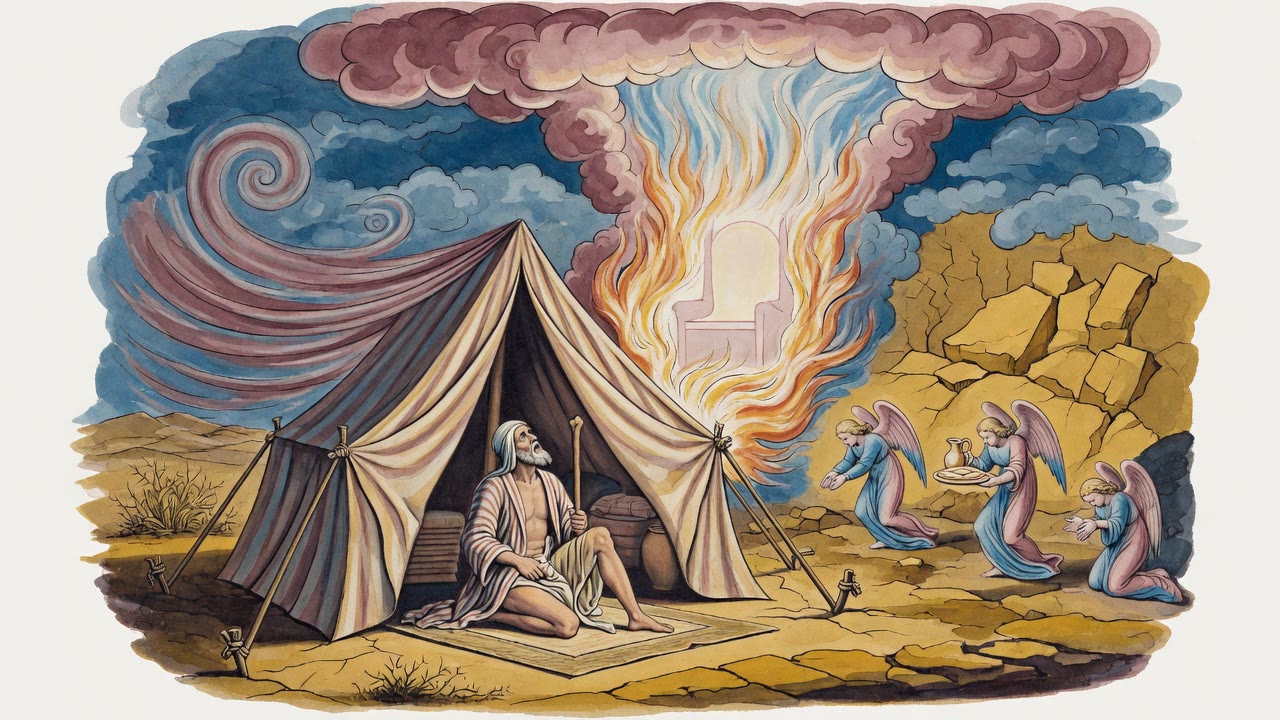
Two men came through the gate at dusk. Lot got up from his seat, bowed his face to the ground, and pressed them to turn aside into his house. They said they would sleep in the square. He pressed harder until they came.

He baked flat bread for them and they ate. His wife had opinions about it. "If you want to take them in," she told him, "take them in on your side of the house." So the strangers were moved to his half. My roof, he would say later. Mine, not hers.

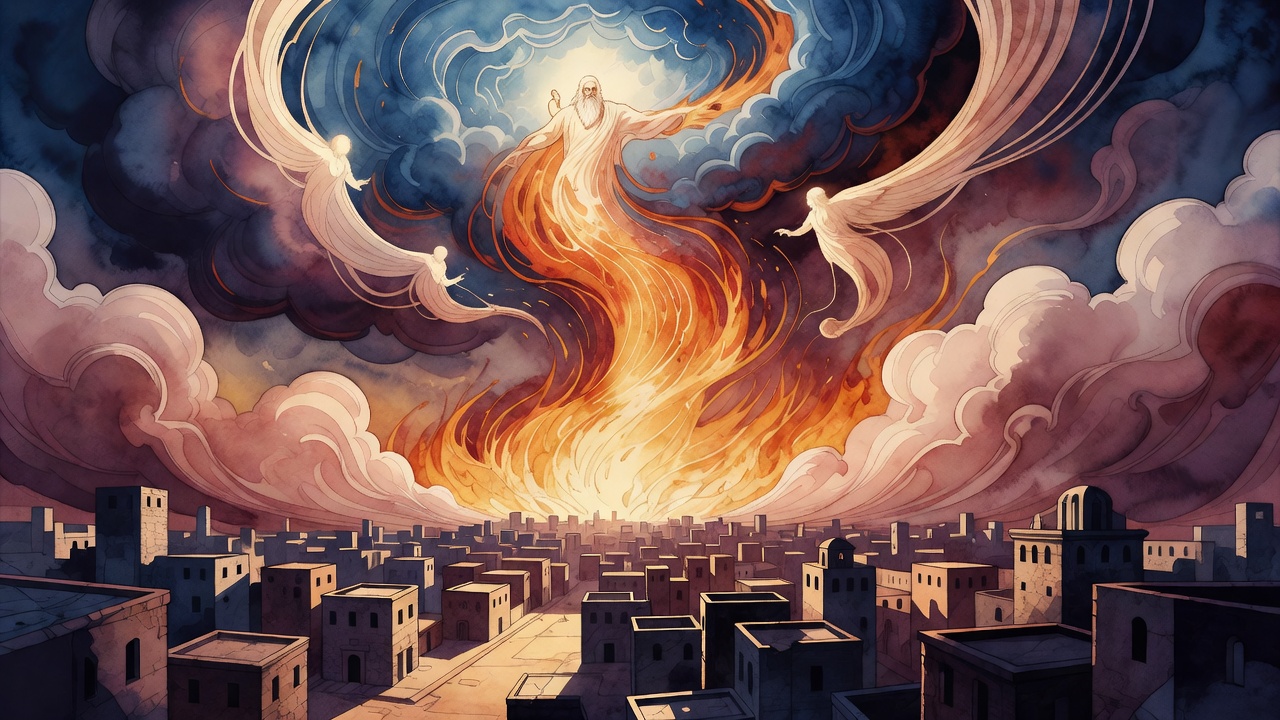
Before anyone lay down, the men of the city ringed the house, young and old, the whole population of it, and shouted for Lot to send the visitors out to them.

Lot went out the door and pulled it shut behind him.

"Please, my brothers," he said. "Do not do evil."

Then he offered the thing the tradition has never smoothed over. "I have two daughters who have never been with a man. Let me bring them out to you and do to them whatever is right in your eyes. Only do nothing to these men, because they came under the shadow of my roof."

Hands at the Door

The crowd would not take the trade. "Stand back," they told him. "This one came to sojourn and he keeps judging us." They pressed hard against Lot, the same man who had been calling out rulings that morning, and moved to break the door down.

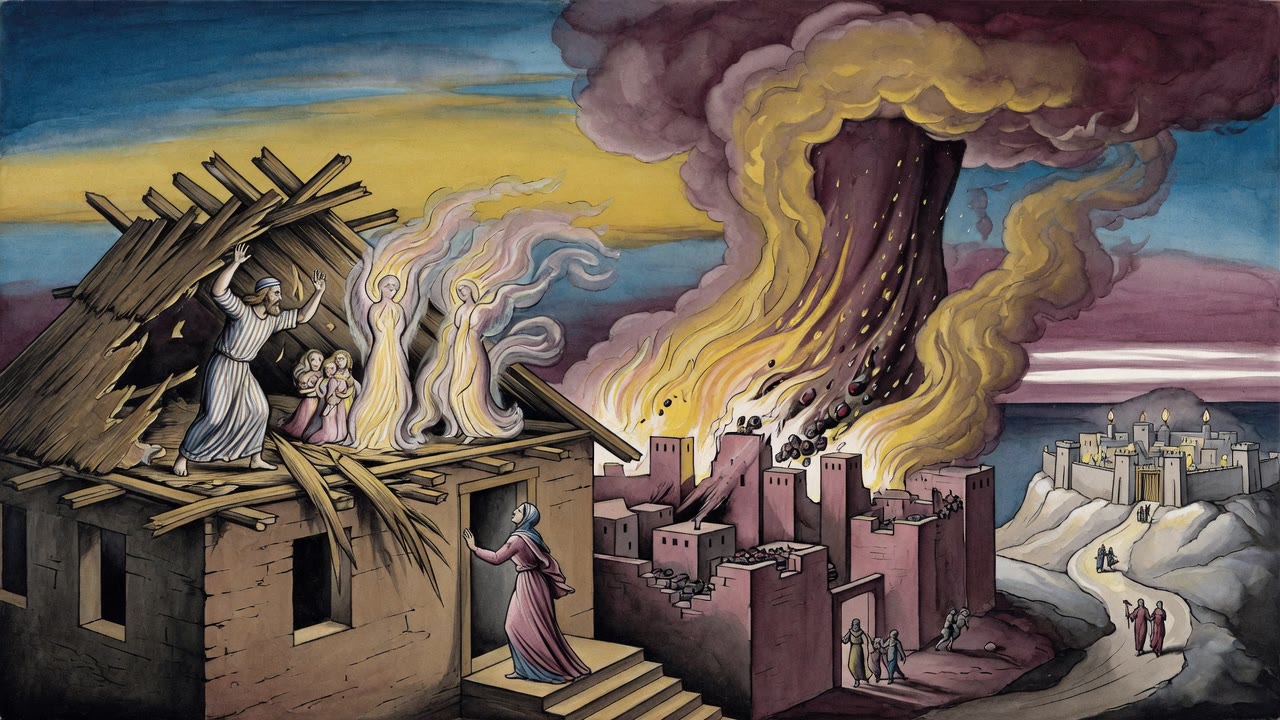
The two guests reached out, caught him by the arms, hauled him inside, and shut the door. Then they struck every man at the entrance blind, small and great, and the mob groped along the wall all night looking for a handle they could no longer find.

The new chief justice of Sodom could not clear his own threshold. The roof he had claimed as his own had never been the thing protecting anybody in that house. The merit holding the door was older than Lot and it belonged to Abraham, out on his hill, far from the plain.

Before dawn the men took Lot by the hand, and his wife, and his two daughters, and dragged them out of the city because the Lord had spared him.

Fire on the Plain

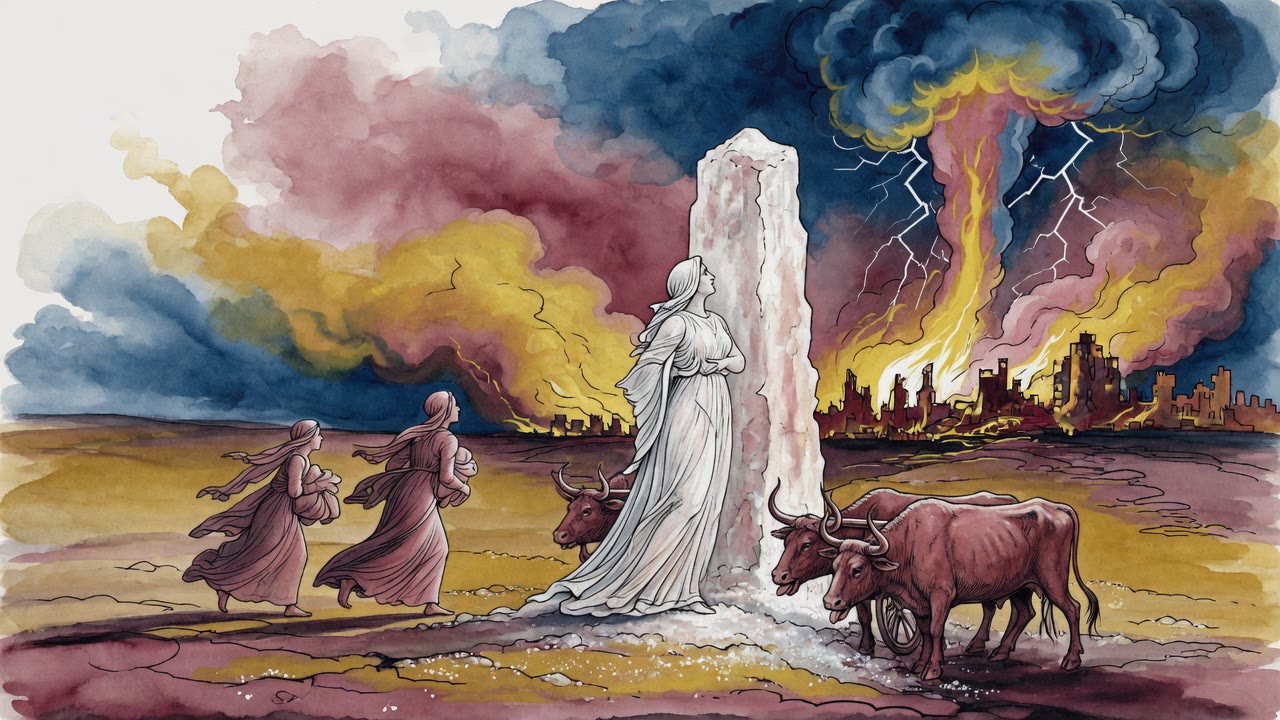
Sulphur and fire came down on Sodom and Gomorrah and the cities of the plain and everything growing in the ground. Lot's wife looked back and stood there as a pillar of salt.

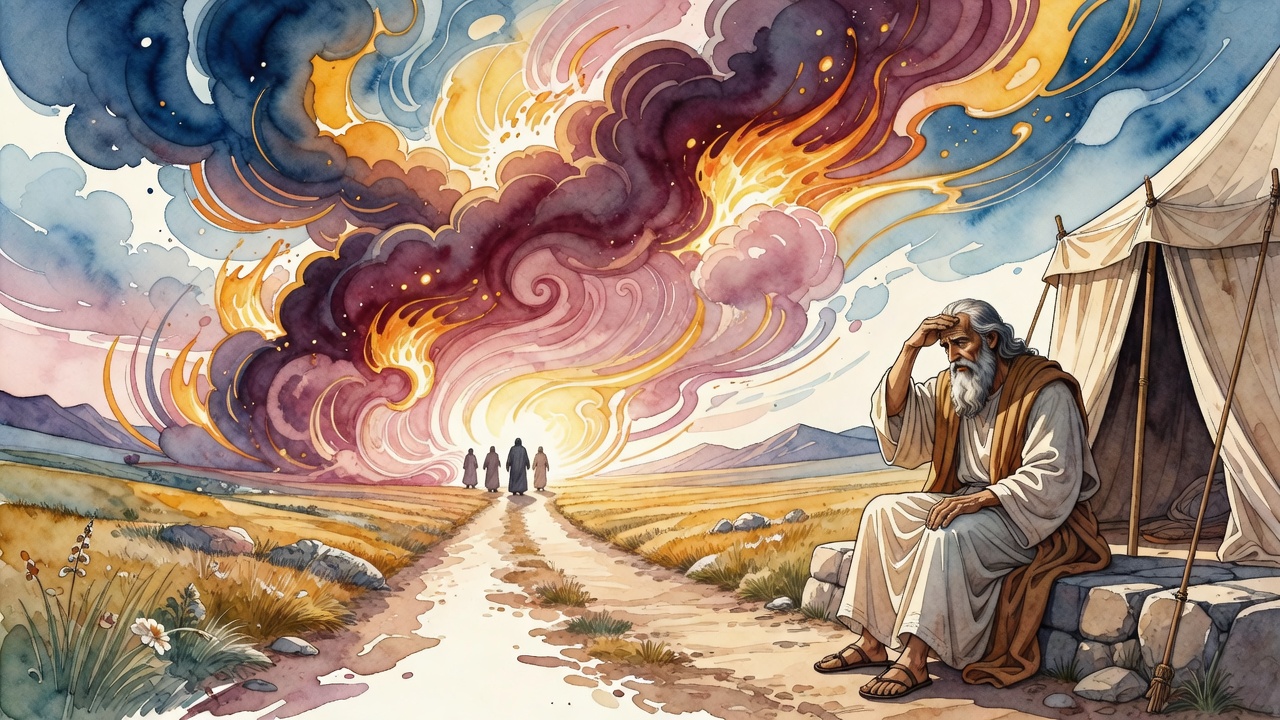
Lot was afraid to stay in the little town they had let him run to, so he went up into the hill country with his two daughters and they lived in a cave.

From the mouth of it the plain smoked for days.

Wine in the Cave

The elder daughter said to the younger, "Our father is old, and there is not a man left on the earth to come to us in the way of the whole world." She meant it. They had watched fire fall over everything they knew and they believed the world had ended the way it ended in the generation of the Flood, and that the three of them were what was left.

"Come, let us give our father wine to drink and lie with him, and we will keep offspring alive from our father."

There was wine because the people of Sodom had drunk so much of it that they hid the surplus away in caves, and it had been set there for the two of them like a sample of the world to come, so that a line would run out of that cave through Moab to Ruth and on to David. On the day that comes, the mountains will drip with juice.

They poured it that night. The elder lay with her father. He did not know when she lay down. He knew when she got up.

The next day she told her sister what she had done, and they poured again, and the younger went in.

Two nations came out of that cave, Moab and Ammon. The daughters thought they were saving the last seed on earth. Heaven was already counting further than their fear.

What the Bench Could Not Save

Lot had sat among liars and tried, for one afternoon, to judge. By dark he was bargaining daughters against a mob. By dawn he was being dragged out of a burning city by the wrist. He woke in a cave with his head full of stolen Sodomite wine and a future moving in two bodies he could not see yet.

The bench was ash. The house was ash. His wife stood white on the road behind him and did not come.


← All myths
From the tradition

Sources

4 sources

The texts behind this telling. Some cards carry a translation of the source; others are our own retelling of it, and each card says which. Every card links out to the original.

Bereshit Rabbah 50:3Bereshit Rabbah

Retold in our words. Read the original at the link below.The Sefaria Midrash Rabbah, 2022 · CC-BY

It's like a linguistic puzzle, where sometimes a single letter can shift the whole meaning of a word. And that brings us to a curious little detail in the Torah, one that our sages in Bereshit Rabbah (50) pick up on when discussing the story of Sodom.

The Torah says "To Sodom" [sedoma]. Now, Rabbi Nechemya teaches us something fascinating: often, words that would normally start with the prefix lamed – which usually indicates "to" – get a heh at the end instead. Think of it: Sedoma (to Sodom), Se’ira (to Se’ir), Mitzraima (to Egypt), Ḥarana (to Ḥaran). It's like a little code baked right into the language.

Then, of course, there's always an exception that proves the rule. What about the verse "The wicked will return to the netherworld [lishola]" (Psalms 9:18)? It's got both a lamed prefix AND a heh suffix! What gives? Rabbi Abba bar Zavda offers a chilling explanation: in this case, it means "to the lowest depths in the netherworld." It’s not just going to the netherworld, but sinking as far down as possible. Ouch.

The text shifts gears, focusing on the timing of Sodom's demise. "In the evening [ba’erev]"...the Bereshit Rabbah tells us that “the evening of Sodom arrived [ba arba]; its sun had set, and its sentence was sealed. Rabbi Levi then adds a layer of meaning, explaining that God judges the nations of the world at night, when they are sleeping and presumably not actively sinning. But Israel? Israel is judged during the day, when they are engaged in mitzvot (commandments), in good deeds. This is based on the verse, "He will judge the world in righteousness. [He will administer fair judgment to the nations]" (Psalms 9:9).

And then, there's Lot. Poor Lot. "And Lot was sitting [yoshev]"... but the text notes that it's written yashav, which implies he wasn't just sitting, but he "assumed his seat." The Midrash (rabbinic interpretive commentary) then reveals that on that very day, Lot had been appointed chief justice of Sodom! Talk about a thankless job.

The text even gives us the names of the other judges: Ketz Sheker (Ultimate in Lies), Rav Sheker (Chief of Lies), Rav Masteidin (Chief Perverter of Justice), Rav Naval (Chief Scoundrel), and Klepander (Abductor). With colleagues like that, who needs enemies?

Apparently, Lot's "honeymoon" period as a judge didn't last long. When he agreed with the Sodomites, they'd say, "Gesh hala" - rise to the top! But when he dared to disagree, they turned on him, sneering, "This one came to sojourn, and he sits in judgment?" (Genesis 19:9). It just goes to show you, sometimes doing the right thing puts you squarely in the crosshairs.

So, what are we left with? A fascinating linguistic tidbit, a glimpse into the timing of divine judgment, and a stark reminder of the challenges of standing up for what's right, even when surrounded by wickedness. The times when speaking truth to power isn't exactly a popularity contest. And perhaps, it reminds us to choose our "seats" carefully, and to always strive to be a force for good, even when it's unpopular.

Full source
Bereshit Rabbah 50:6Bereshit Rabbah

Retold in our words. Read the original at the link below.The Sefaria Midrash Rabbah, 2022 · CC-BY

It's a tough story, full of uncomfortable choices, and the rabbis in Bereshit Rabbah, that treasure trove of early commentary, don't shy away from wrestling with it.

Remember the scene? The angels arrive in Sodom disguised as men, and Lot, Abraham's nephew, insists they stay at his house for protection. But the men of the city surround the house, demanding Lot hand over his guests for their pleasure. That's when Lot makes a horrifying offer: his own daughters.

"Lot went out to them to the entrance, and he closed the door behind him," the verse tells us (Genesis 19:6). Then he pleads, "Please, my brethren, do not do evil" (Genesis 19:7). And then comes the truly awful part: "Here now, I have two daughters who have not been intimate with a man; I will now bring them out to you, and you may do to them as is fit in your eyes; only to these men do nothing, inasmuch as they came under the shelter of my roof" (Genesis 19:8).

The rabbis in Bereshit Rabbah (50) pick up on the unusual language Lot uses: "only to these [hael] men.” What's with that word, hael? It sounds almost like a curse. The rabbis see it as pointing to the "terrible acts" the men of Sodom intended. "Just to the men, do not do these terrible [hael] sins," one interpretation suggests.

But there’s another, more surprising, reading: "they are godly." The word El, as in hael, can mean godly or mighty. Could Lot have been hinting at the divine nature of his guests? Were they powerful beings not to be trifled with? It’s a fascinating thought.

And what about that phrase, "inasmuch as they came under the shelter of my roof"? Lot seems to be taking full credit for protecting the angels. But the rabbis offer a different perspective. Maybe it wasn't Lot's merit at all. Maybe, just maybe, it was the merit of Abraham, his righteous uncle, that was protecting everyone. As (Genesis 19:29) suggests, Abraham is described as Lot’s sheltering roof, as it was his merit that protected him from harm.

There's even a suggestion that Lot's wife played a role. The rabbis say that she moved the angels to Lot's side of the house, implying she only agreed to host them in his part of the dwelling. She said to him: ‘If you want to receive them, receive them in your portion [of the house].’ This is why Lot said: “my roof” – mine, but not my wife’s. (Bereshit Rabbah 50). Was she reluctant to welcome these strangers? Did she sense something dangerous about them?

This passage from Bereshit Rabbah reminds us that even the most familiar stories in the Bible are full of hidden depths. It forces us to confront difficult questions about morality, hospitality, and the nature of divine protection. It invites us to look beyond the surface and consider the complex motivations of the characters involved. Who was really protecting whom in Sodom that night? And at what cost?

Full source
Bereshit Rabbah 51:8Bereshit Rabbah

Retold in our words. Read the original at the link below.The Sefaria Midrash Rabbah, 2022 · CC-BY

The story, as told in (Genesis 19:31), has Lot’s daughters deeply concerned. "Our father is old," they say, "and there is no man on earth to consort with us in the way of the world."

Why such a dire conclusion? Well, according to Bereshit Rabbah 51, they believed the entire world had been destroyed, just like in the time of the Flood. They thought they were the only people left! A pretty understandable mistake, given the circumstances.

So, what do they do? They hatch a plan. "Let us give our father wine to drink, and we will lie with him, and we will give life to offspring from our father" (Genesis 19:32).

This is where it gets…complicated. Rabbi Tanhuma, quoting Rabbi Shmuel, points out a key detail: the verse doesn't say "we will give life to a child from our father," but "we will give life to offspring from our father." The distinction, according to this interpretation, is crucial. It hints at a future lineage, "that offspring that will come from another place." And what is that other place? The messianic king! The Messiah, a descendant of David, would be a distant relative of Lot, through Moab and Ruth.

The plan unfolds: they get their father drunk. (Genesis 19:33) tells us, "They gave their father wine to drink that night. The elder came and lay with her father and he was not aware when she lay and when she arose.” But there’s a tiny, yet telling, detail in the Hebrew text. There's a dot over the vav in the word uvkuma (and when she arose). The Sages of the Midrash (rabbinic interpretive commentary) see this as an intimation. According to this subtle hint, he was unaware when she lay down, but became aware when she arose.

The next day, the elder daughter proposes they repeat the act. Where did they even get the wine in that desolate cave, you might ask? Rabbi Yehuda bar Simon offers a fascinating explanation: the people of Sodom were overflowing with wine and hid it away in caves. But even more strikingly, he says that something resembling a sample of the World to Come was provided for them. It arrived miraculously, so that Lot’s daughters could intoxicate him and have children, from whom David would descend! He even quotes (Joel 4:18): "It will be on that day, that the mountains will drip with juice," connecting this event to Messianic times.

So, what are we to make of this story? It's uncomfortable, to say the least. But within its discomfort lies a profound message. Even from morally questionable actions, even from the most unlikely of circumstances, redemption can emerge. The line of David, the line of the Messiah, springs from this very human, very flawed, and frankly, very strange series of events. Perhaps that's the most important lesson this unusual story teaches us.

Full source
Bereshit Rabbah 51:9Bereshit Rabbah

Retold in our words. Read the original at the link below.The Sefaria Midrash Rabbah, 2022 · CC-BY

The verse that kicks it all off: "Lot's two daughters conceived from their father" (Genesis 19:36). Simple enough The first reading. But immediately, the rabbis of the Midrash (rabbinic interpretive commentary) dive into the complexities.

Rabbi Elazar raises a point: "A woman never conceives from her initial act of intercourse." So how do we reconcile that with the daughters of Lot? Rabbi Tanḥuma offers a rather… graphic explanation: they "manipulated themselves, broke their hymen, and conceived as though it were from a second act of intercourse." Yikes. It's a stark reminder that even in sacred texts, we find these raw, human, and sometimes unsettling details.

Then, Rav Naḥman bar Ḥanin chimes in with a chilling proverb: "Anyone who has a ravenous appetite for sexual relations will ultimately be fed his own flesh." It's a clear metaphorical condemnation of incest. This isn't just about physical acts; it's about unchecked desire leading to self-destruction.

The questions don't stop there. Who initiated the act? Who truly desired whom? Rabbi Yudan of Gaul and Rabbi Shmuel bar Naḥman, citing Rabbi Elyehoeini, wrestle with this: "We do not know whether Lot lusted after his daughters or his daughters lusted after him." They turn to (Proverbs 18:1), "The isolated one seeks lust," suggesting that Lot, isolated from Abraham and his community, was the one driven by desire. It implies a power imbalance, a vulnerability in Lot that his daughters may have exploited… or perhaps not. The ambiguity is unsettling.

And why does this story resurface so frequently? Rabbi Tanḥuma bar Rabbi Ḥiyya, quoting Rabbi Hoshaya the interpreter, notes: "There is no Shabbat (the Sabbath) on which one does not read the passage about Lot." Apparently, in those days, this passage was recited every Shabbat as a warning against excessive indulgence, particularly in wine. (Proverbs 18:1) is invoked again: "The isolated one seeks lust, with all tushiya he will be exposed." Tushiya, here, is understood as a reference to Torah (Sanhedrin 26a). Meaning, even with all the wisdom and guidance of the Torah, one can still fall prey to base desires.

Rabbi Aḥa offers a final, poignant observation about the consequences. He notes that the verse doesn't say "they will be exposed," but "he will be exposed." This, he argues, means that while the men of Ammon and Moab were forever distanced from the Israelite community (due to the Torah's prohibition in Deuteronomy 23:4), the women were not. The shame of Lot is preserved, but the lineage of his daughters continues. This speaks to the complex ways societies confront shame, lineage, and the burdens of the past.

So, what do we take away from all this? It's not a comfortable story, that's for sure. But maybe that's the point. It forces us to confront uncomfortable truths about human desire, the dangers of isolation, and the lasting impact of our choices. It's a reminder that even within the framework of sacred texts, we find stories that challenge us, provoke us, and ultimately, invite us to reflect on our own humanity. It's not just about Lot and his daughters; it's about us.

Full source