Translation of the source text.Torat Emet (Yalkut Shimoni) · CC-BY-NC
A story of Rabbi Yohanan ben Matya, who said to his son, Go out and hire laborers for us. He went and pledged them food. When he came back to his father, his father said to him: My son, even if you make them a feast like Solomon's in his prime, you will not have fulfilled your duty to them, for they are children of Abraham, Isaac, and Jacob. Rather, before they begin work, go out and tell them: You have no claim on me beyond bread and beans alone. Rabbi Shimon ben Gamliel says: He need not say it; everything follows the custom of the land.
Is it to be said that Abraham's meal was greater than Solomon's? But is it not written, "Solomon's daily provision was thirty kor of fine flour and sixty kor of meal" (1 Kings 5:2), and that was only for the dough of the cooks and for stews? And Solomon had a thousand wives, and each one made as much in her own house, each thinking perhaps he would dine with her that day. Yet of Abraham it is written, "And Abraham ran to the herd." Rav Yehuda said in the name of Rav: "calf" is one, "tender" is two, "and good" is three. He answered him: There it was three oxen for three men; here it was for all Israel, as it is said, "Judah and Israel were as many as the sand by the sea" (1 Kings 4:20).
"Tender and good" - say it means just one, as people say "tender and good"? He answered: Let Scripture write "tender, good." What is "tender and good"? It is for exposition; the "and" of "good" is for exposition and "tender" too is for exposition. Rava bar Ulla objected: "And he gave it to the lad, and he hurried to prepare it" (Genesis 18:7) - each one he gave to a single lad. "And he took curds and the calf which he had prepared" (Genesis 18:8): each first one that was ready he brought before them. Why all this? Rav Yehuda said in the name of Rav: in order to feed them three tongues with mustard.
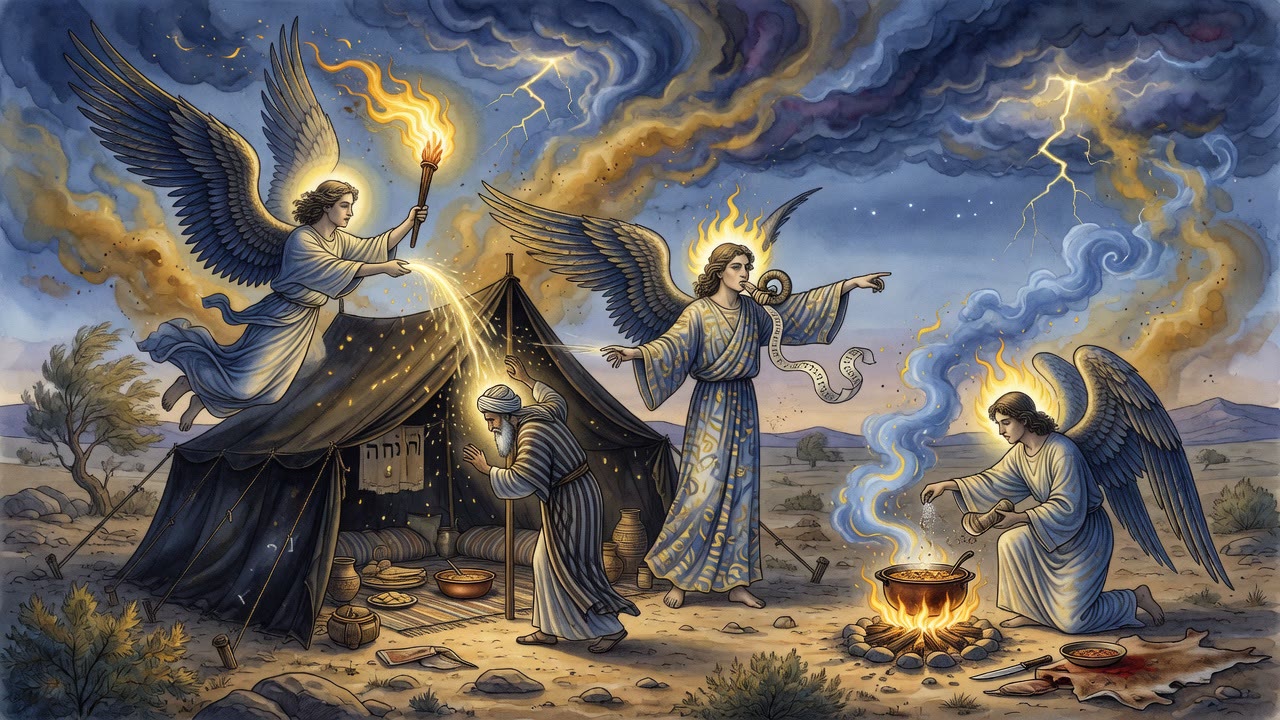
"And he stood over them under the tree, and they ate" (Genesis 18:8). Rabbi Tanhum bar Hanilai said: A person should never deviate from the custom of the land, for Moses went up on high and did not eat or drink, while the ministering angels came down below and ate and drank. Could it enter your mind that they ate and drank? Rather, they appeared as if they ate and drank.
"And he took curds and milk": the finest is one part in sixty, the medium one in forty, the coarse one in twenty. Rabbi Yonah said: the finest is one in a hundred, the medium one in fifty, the coarse one in twenty. And where was the bread? Ephraim Maksha'ah, disciple of Rabbi Meir, in the name of Rabbi Meir: our mother Sarah had become menstrually impure and the dough was rendered unfit. The rabbis say: he brought even bread before them. And if things he had not promised them he brought, how much more the things he had promised.
"And he stood over them": here you say "and he stood over them," but elsewhere you say "standing over him" (Genesis 18:2). Before they had performed their errand they were standing over him; once they had done it, he stood over them, his awe upon them: Michael trembled, Gabriel trembled. Rabbi Tanhum in the name of Rabbi Elazar, and Rabbi Aibo in the name of Rabbi Meir: the proverb says, When you enter a town, follow its customs. Above, where there is no eating and drinking, Moses went up and resembled them: "And I sat on the mountain forty days and forty nights; I ate no bread and drank no water" (Deuteronomy 9:9). But below, where there is eating and drinking, "he stood over them under the tree, and they ate" - and were they eating? Rather, they appeared to be eating, and each portion was withdrawn one by one.
A person should keep these things in mind, that he not eat with an unlearned man at the same table, because the unlearned are lax in tithes and in the sabbatical produce. Scripture says, "What has the straw to do with the grain?" (Jeremiah 23:28). Every bird dwells with its kind, and a person with one who is like him. So David says, "I have not sat with worthless men" (Psalms 26:4), "I hate the company of evildoers" (Psalms 26:5), "I wash my hands in innocence" (Psalms 26:6), "Gather not my soul with sinners" (Psalms 26:9). A person should always make his meals with disciples of the wise rather than with the unlearned, for after a while they will speak slander of him. A person should always take leave of his teacher and only then do the bidding of the disciples of the wise who come to him, as it is said, "If now I have found favor in your eyes" (Genesis 18:3).
One who says the angels did not eat with Abraham has said nothing, for by the righteousness of that righteous man, and as a reward for the trouble he took, the Holy One, blessed be He, opened their mouths and they ate, as it is said, "standing over them under the tree, and they ate." As a reward for the pitcher of water with which they washed their feet, the Holy One, blessed be He, gave Israel the well for forty years. When Israel does His will the well rises early and goes and flows where Israel encamps; and when Israel does not do His will it would delay an hour, two, three, four, five, until disciples of the wise and youths and little ones go out and say, "Spring up, O well" (Numbers 21:17), by the merit of Abraham, Isaac, and Jacob, by the merit of Moses, Aaron, and Miriam, and then it goes and flows between the tribe of Judah and the tribe of Issachar, as it is said, "the well that the princes dug" (Numbers 21:18).
And whoever makes his meals often with the unlearned, his words are not heeded, and in the end disputes multiply against him, and he disgraces his Torah, and profanes the Name of the Omnipresent, and widows his wife and orphans his children and does not fill out his days and ties an evil name to himself and to his children and his household until the end of all generations. For the sake of one man they said: Great is charity, for from the day the world was created until that hour, behold one is praised and rescues himself from the judgment of Gehinnom, as it is said, "Happy is he who considers the poor; in the day of evil the LORD will deliver him" (Psalms 41:2), and "the day of evil" is none other than the day of the judgment of Gehinnom, as it is said, "and the wicked for the day of evil" (Proverbs 16:4); and it says, "Happy are they who keep justice, who do righteousness at all times" (Psalms 106:3).
Our early fathers, why did they merit this world and the days of the Messiah and the world to come? Because they conducted themselves with charity. Of Abraham it is said, "For I have known him, that he may command" (Genesis 18:19). Isaac was praised only for charity, as it is said, "And Isaac sowed" (Genesis 26:12), and sowing is nothing but charity, as it is said, "Sow for yourselves in righteousness" (Hosea 10:12). Jacob was praised only for charity, as it is said, "I am too small for all the kindnesses" (Genesis 32:11); "small" means little, and little is nothing but charity, as it is said, "Better a little with righteousness" (Proverbs 16:8). Moses was praised only for charity, as it is said, "He did the righteousness of the LORD" (Deuteronomy 33:21). Aaron was praised only for charity, as it is said, "The Torah of truth was in his mouth" (Malachi 2:6), and truth is nothing but charity, as it is said, "Truth springs from the earth" (Psalms 85:12). David was praised only for charity, as it is said, "and Your righteousness to the king's son" (Psalms 72:1). Even the Holy One, blessed be He, is praised through charity, as it is said, "and the holy God is sanctified through righteousness" (Isaiah 5:16). Even the Throne of Glory is praised through charity, as it is said, "Righteousness and justice are the foundation of Your throne" (Psalms 89:15).
When a person gives charity to his fellow, he intends thereby that the other should live and not die; so too the Holy One, blessed be He, gives it that one should live and not die, as it is said, "and charity delivers from death" (Proverbs 11:4). How do you know that one who has the means to give charity and does not, to sustain lives and does not, brings death upon himself? As it is said, "And Nabal answered David's servants and said, Who is David and who is the son of Jesse? And shall I take my bread...?" (1 Samuel 25:10-11), and it is written, "And about ten days later the LORD struck Nabal" (1 Samuel 25:38).
How do you know that charity lengthens a person's days? It is said of sending away the mother bird, the lightest commandment in the Torah, "that it may be well with you and that you may prolong your days" (Deuteronomy 22:7); how much more so for charity, which is weightier in the Torah. How do you know it brings a person to the life of the world to come? As it is said, "Happy is the man who has not walked" (Psalms 1:1), and it is written, "Happy are they who keep justice, who do charity"; just as the "happy" said there refers to the world to come, so the "happy" said here refers to the world to come. How do you know it is equal to the Torah? As it is said, "If you walk in My statutes" (Leviticus 26:3), and it says, "And I will give peace in the land" (Leviticus 26:6), and of charity it says, "And the work of charity shall be peace" (Isaiah 32:17). How do you know the Torah is likened to charity? As it is said, "And it will be charity for us if we are careful to do" (Deuteronomy 6:25). How do you know it hastens the days of the Messiah and the days of redemption? As it is said, "Keep justice and do charity, for My salvation is near to come" (Isaiah 56:1). How do you know it raises and seats its giver next to the Throne of Glory? As it is said, "He who walks in righteousness and speaks uprightly... he shall dwell on high" (Isaiah 33:15-16).
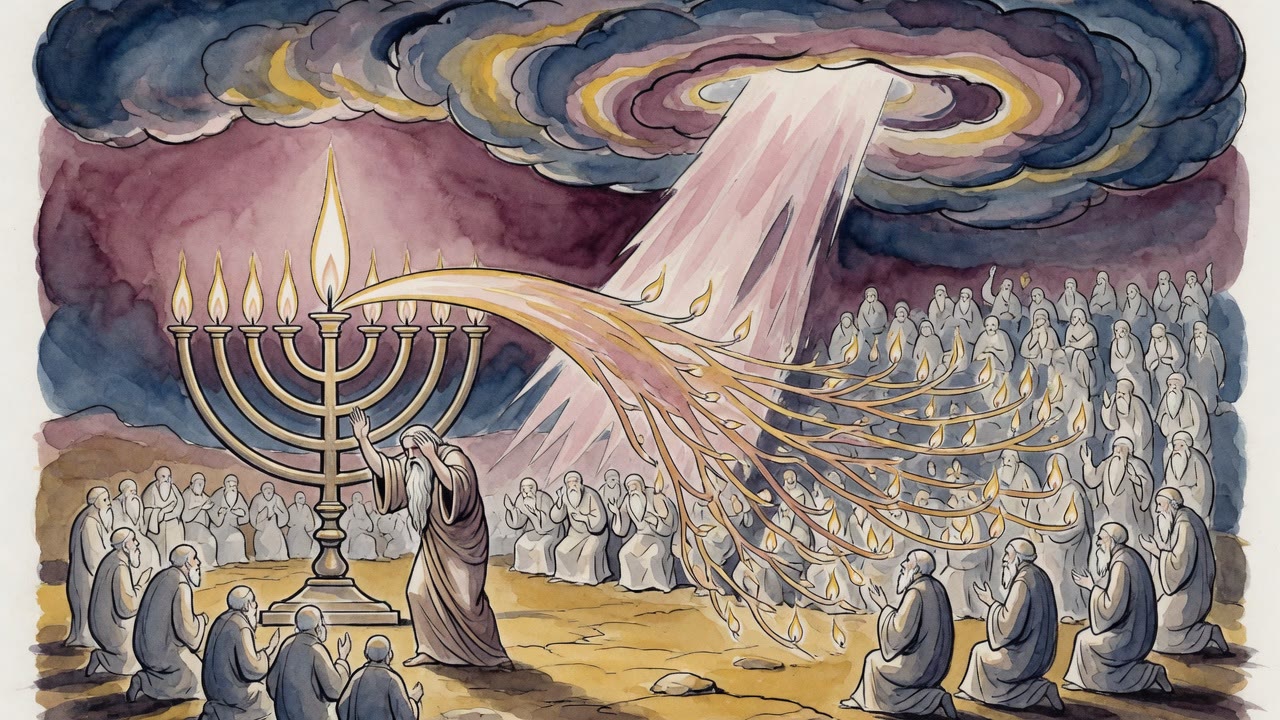
"And Abraham ran to the herd": the calf fled before him and entered the cave of Machpelah, and he entered after it there, and saw there Adam and his helpmate lying asleep, with lamps burning over them and a sweet fragrance upon them like the scent of incense. Therefore he desired the cave of Machpelah. He spoke to the sons of Jebus (and were they not Hittites? But they were called Jebusites after the city Jebus) to buy from them by a sale of gold and an eternal deed for a burial holding, and they would not accept. He began to bow and prostrate himself before them, as it is said, "And Abraham bowed before the people of the land" (Genesis 23:12). They said to him: Cut a covenant and an oath with us that your seed will not inherit the city of the Jebusite, and we will sell to you. He cut a covenant and an oath with them. What did the men of Jebus do? They made themselves images of bronze and set them up in the city square and wrote upon them the covenant of Abraham's oath. And when Israel came to the land it is written, "And the Jebusite who dwelt in Jerusalem" (Judges 1:21). King David wished to enter and they did not let him, as it is said, "And the men of Jebus said, You shall not come here" (1 Chronicles 11:4-5 / 2 Samuel 5:6). What was the strength of the men of Jebus to say to David "You shall not come," when Israel were as many as the sand of the sea? Only the strength of the oath: "unless you remove the blind and the lame" (2 Samuel 5:6) - these are the images that have eyes but see not and feet but walk not.
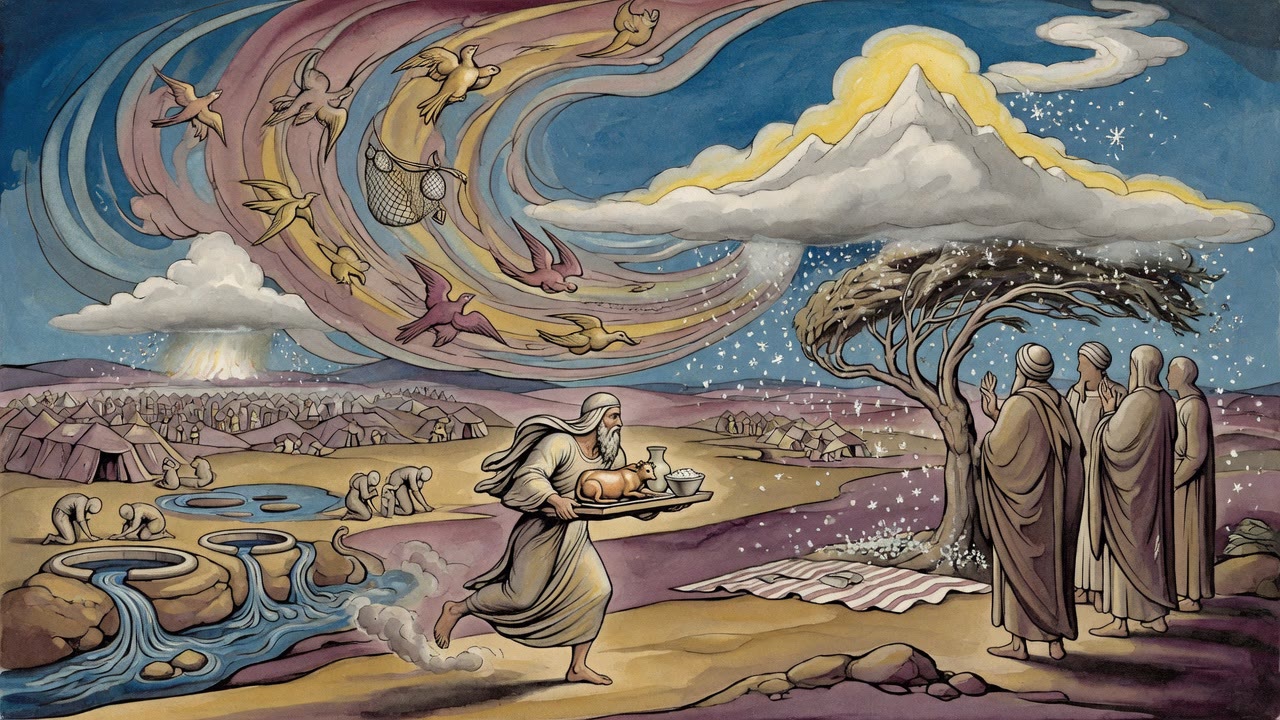
The Holy One, blessed be He, said to Abraham: For the merit of three runnings you ran, by your life, when I come to give the Torah to Israel I will run before them. The three runnings Abraham ran: "and he ran to meet them" (Genesis 18:2), "and Abraham ran to the herd" (Genesis 18:7), "and Abraham hurried" (Genesis 18:6). And the Holy One, blessed be He, repaid him: "And he said, The LORD came from Sinai" (Deuteronomy 33:2). Rabbi Simon in the name of Rabbi Elazar said: One who does kindness with one who has no need of kindness - Abraham did kindness with the ministering angels, as it is written, "and he stood over them." See what the Holy One, blessed be He, repaid his children: the manna, and the well, and the quail, and the clouds of glory surrounding them. And these things are a matter of inference from minor to major: if for one who did kindness with those who needed no kindness the Holy One, blessed be He, repaid thus, then for one who does kindness with those who need kindness, how much more so.
Another interpretation: if for those who did not do kindness with those who needed no kindness - Ammon and Moab with Israel, as it is written, "because they did not come to meet you" (Deuteronomy 23:5) - and were they needed? For all the forty years that Israel were in the wilderness the manna came down and the well rose and the quail was present and the clouds of glory surrounded them. What did the Holy One, blessed be He, repay them? "No Ammonite or Moabite shall enter the assembly of the LORD" (Deuteronomy 23:4). And these things are a matter of inference from minor to major: if those who did not do kindness with those who needed no kindness, the Holy One, blessed be He, repaid them thus, then one who does kindness with one to whom he is obligated - such as Jethro with Moses, as it is written, "and he also drew water for us" (Exodus 2:19) - the Holy One, blessed be He, repaid him in the days of Saul, as it is written, "And Saul said to the Kenites, Go, depart, go down from among the Amalekites, lest I destroy you with them, for you showed kindness" (1 Samuel 15:6). And did Jethro do kindness with all Israel? He did it only with Moses. Rather, it teaches you that whoever does kindness with one of the great ones of Israel, it is reckoned to him as if he did kindness with all Israel. And these things are a matter of inference from minor to major: if one who does kindness with one to whom he is obligated, see what reward the Holy One, blessed be He, repaid him, then one who does kindness with one to whom he is not obligated, how much more so.
"And they said to him, Where is Sarah your wife?" (Genesis 18:9). The word "to him" [elav] is pointed with dots over the letters aleph-yod-vav, but the lamed is not pointed. Rabbi Elazar said: wherever you find more letters than dots, you expound the letters; more dots than letters, you expound the dots; here, where the dots are more than the letters, you expound the dots: "Where [ayo] is Abraham?" Just as they said to Abraham, "Where is Sarah," so they said to Sarah, "Where is Abraham?" "And he said, Behold, in the tent" (Genesis 18:9). This is as it is written, "Blessed above women shall Jael be, the wife of Heber the Kenite; above women in the tent shall she be blessed" (Judges 5:24). Rabbi Elazar said: above the women of the men of the wilderness. Another interpretation: "Where is Sarah your wife" - did they not know where she was? It was only to make known that our mother Sarah was modest, in order to endear her to her husband. Rabbi Yose bar Hanina said: in order to send her a cup of blessing. It was taught in the name of Rabbi Yose: why are the dots over "ayo" of "elav"? The Torah taught you proper conduct, that a person should inquire about his host. But did not Shmuel say, One does not inquire after a woman's welfare? Through her husband it is different.
"After I am worn out shall I have pleasure" (Genesis 18:12): after the flesh had withered, the wrinkles smoothed out and the beauty returned to its place. Great is peace, for the Holy One, blessed be He, altered His words for it, as it is said, "And the LORD said to Abraham, Why did Sarah laugh, saying, Shall I indeed bear a child, seeing I am old?" (Genesis 18:13).

 Click for full size