5 min read

Sarah's Dry Tree Blossoms and Isaac Is Born at the Appointed Noon

Sarah had been inside two foreign palaces, so the camp was ready to count months. Then Abraham lifted the boy up and everyone saw whose face he had.

Curated by Arthur · Told by Maggid ·
Table of Contents
  1. Where Is Sarah
  2. Two Palaces and a Rumor
  3. The Dry Tree
  4. The Camp Counted on Its Fingers
  5. At the Hour the Lamb Is Killed
Sarah's Dry Tree Blossoms and Isaac Is Born at the Appointed Noon Click for full size

Where Is Sarah

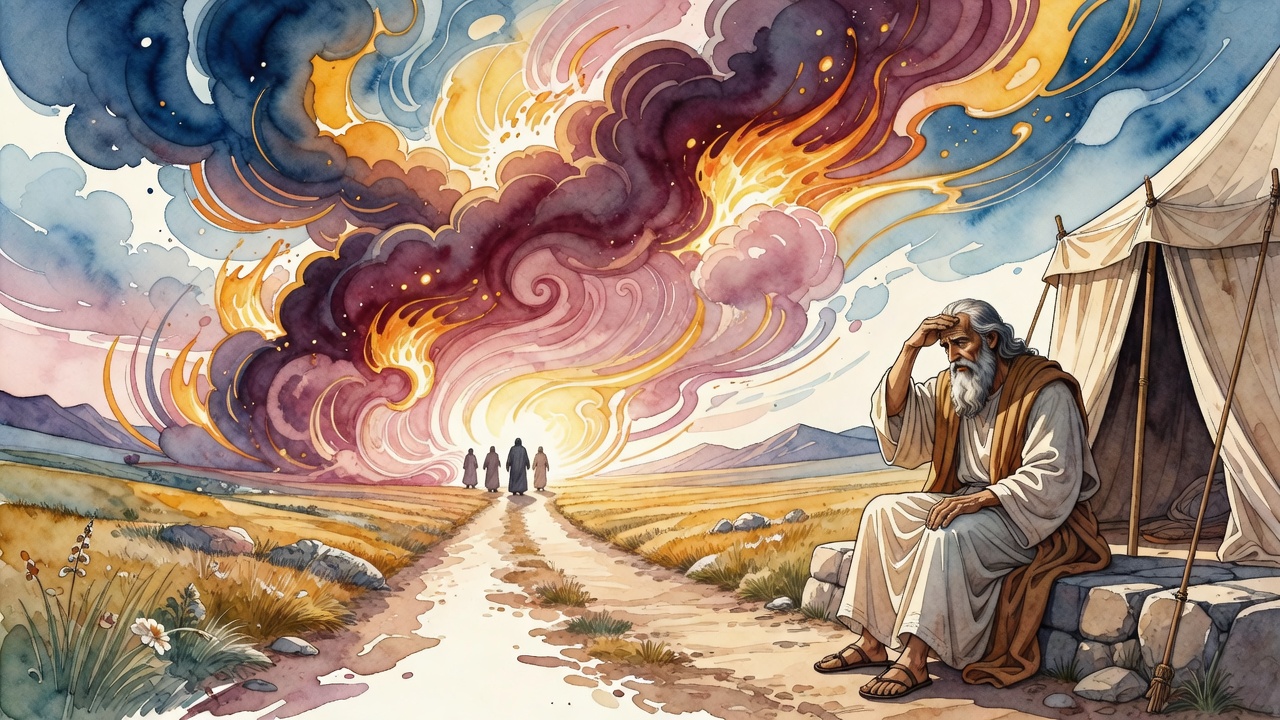
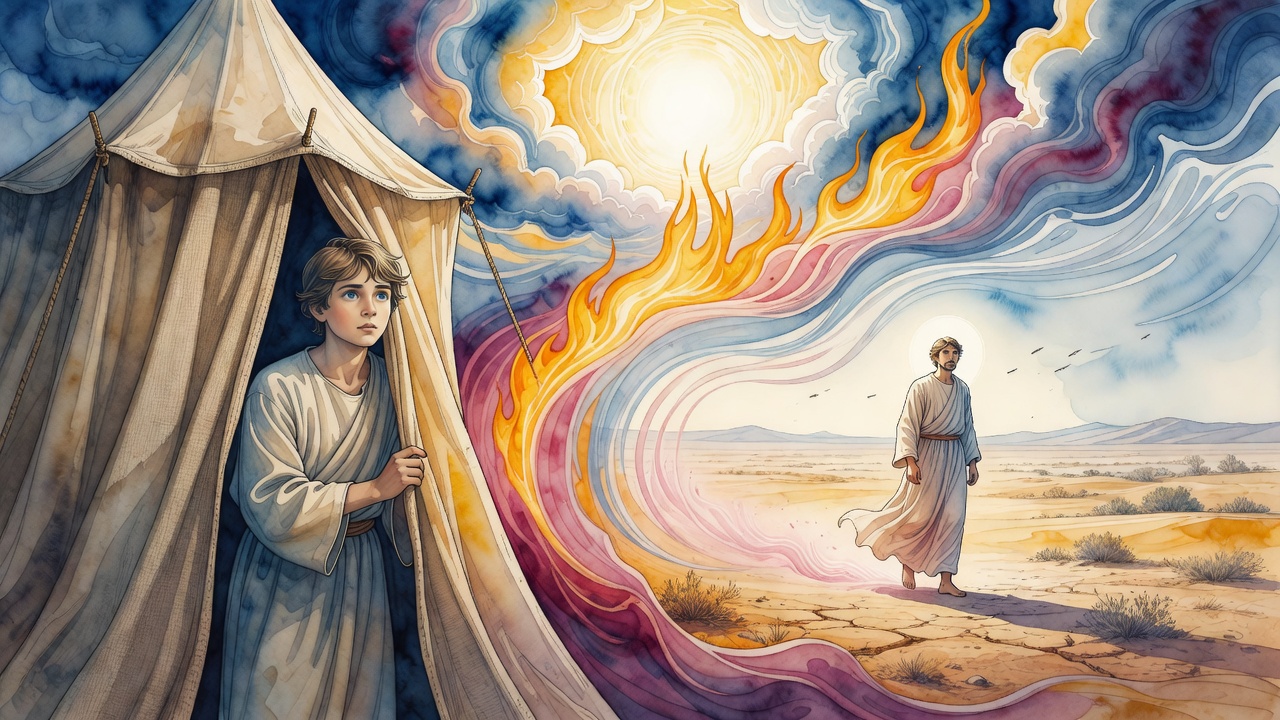
Three men stood in the heat outside Abraham's tent and asked him where his wife was. "In the tent," he said. Behind the cloth, ninety years old, Sarah heard them ask after her.

Scribes have put dots over three letters of the word they used, and the dotted letters spell a second question the visitors were also asking: where is he? They asked Abraham where Sarah was, and they turned around and asked Sarah where Abraham was. Neither one was allowed to be a bystander at what came next.

Then the promise. At the appointed time I will come back to you, and Sarah will have a son. She laughed at it from inside the tent, which is what a body does when it has already done the arithmetic. Long afterward Deborah would sing that Yael was blessed beyond the women of the tent, and the women of the tent were these, the ones who bore children and kept the world running.

Two Palaces and a Rumor

The problem was not only her age. Sarah had walked into Pharaoh's house once and into Abimelech's house once, and she had walked out of both of them untouched, and everybody in the region knew both stories.

Rabbi Yitzhak weighed it against the Torah's own hardest case. A husband drags his wife to the priest, she drinks the bitter water, the water clears her, and Scripture promises her a child for what she went through. If a woman merely suspected is owed that, said Rabbi Yitzhak, what is owed to a woman who went through two royal houses and came out clean?

There is an angel appointed over conception, people said. Rabbi Yehuda ben Rabbi Simon would not allow it here. No officer, no deputy, nothing standing between. The Lord Himself remembered Sarah.

The Dry Tree

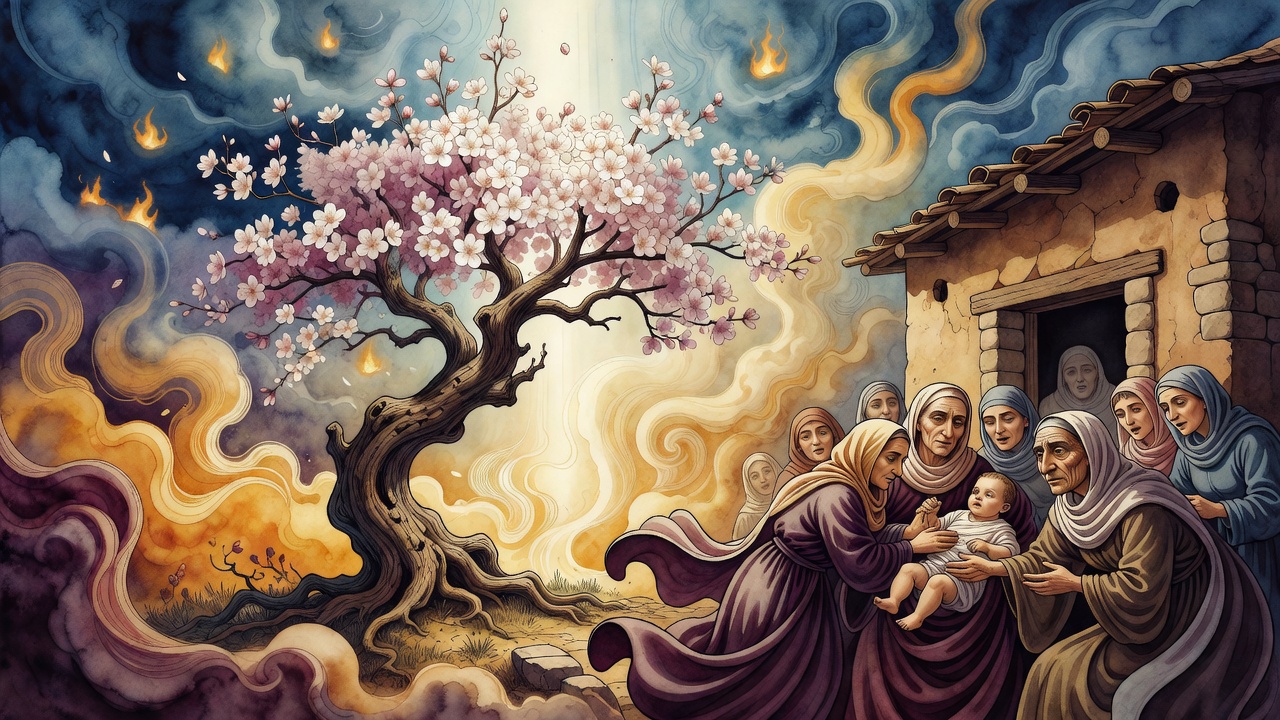
Ezekiel had watched God do this before and put it in the language of an orchard. I have brought down the high tree and lifted up the low tree. I have dried the green tree and made the dry tree blossom.

The high tree was Abimelech, a king who reached for another man's wife and woke from a dream that told him he was a dead man. The low tree was Abraham, who owned no field and pitched his tent wherever the water was. The green tree drying was Abimelech's household, every womb in it shut fast for as long as Sarah stayed under his roof. And the dry tree that put out blossom was Sarah.

Not like a man who talks and never moves, God said through the prophet. I have spoken, and I have done it. He had spoken at the tent door. Now He did it.

The Camp Counted on Its Fingers

She conceived and she carried and she bore a son, and the counting started before the birth cries stopped.

Rabbi Yudan said the pregnancy ran the full nine months, not a day short, precisely so that nobody could stand in the market and say the child had been scooped out of Abimelech's palace. Rabbi Hama said seven months, which are nine incomplete ones, and said the calendar never mattered anyway.

It never mattered because of the boy's face. Scripture calls him a son of Abraham's old age, and the word for old age is nearly the word for the shine of a likeness. The child came out wearing his father's features. On the eighth day Abraham lifted him for the circumcision, and every guest who had been doing sums in his head looked at the small face and stopped doing sums.

She had not gone anywhere for that child. Not to a palace, not to a physician, not to anyone.

At the Hour the Lamb Is Killed

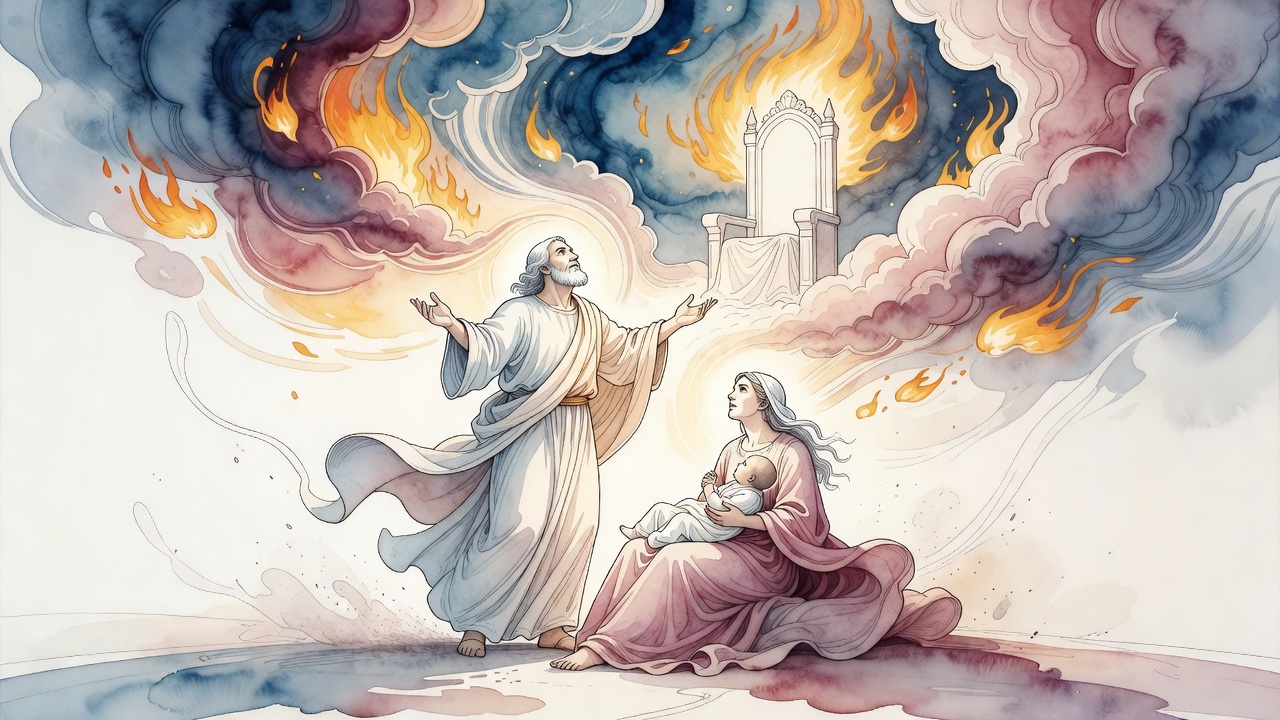
Rabbi Huna, in the name of Rabbi Hizkiyah, fixed the hour. Isaac was born at noon.

The verse says he was born at the appointed time, and the same word for appointed time turns up in the law of the Passover offering, the hour when the lamb is slaughtered as the sun tips over from the top of the sky and starts down. That is when the child arrived. Not in the dark, not at the edge of a night when a story could be adjusted afterward, but with the light standing straight overhead and no shadow anywhere to hide a rumor in.

The dry tree was in fruit. The king who had taken her was low, his house barren, his dream still on him. And a woman who had spent her whole life being other men's business held a boy with her husband's face on him, in the middle of the day, where anyone could look.


← All myths
From the tradition

Sources

3 sources

The texts behind this telling. Some cards carry a translation of the source; others are our own retelling of it, and each card says which. Every card links out to the original.

Bereshit Rabbah 53:1Bereshit Rabbah

Retold in our words. Read the original at the link below.The Sefaria Midrash Rabbah, 2022 · CC-BY

It all comes down to remembering, and more importantly, acting. to a story about just that, found in Bereshit Rabbah 53, a section of the ancient midrashic (rabbinic interpretive commentary) (interpretive) collection on the Book of Genesis. It centers on the verse, "The Lord remembered Sarah as He had said, and the Lord did to Sarah as He had spoken" (Genesis 21:1).

This isn't just a nice sentiment; it's a profound statement about the nature of God and the fulfillment of prophecy. "The Lord remembered Sarah as He had said." The text draws our attention to another verse, from the prophet Ezekiel (17:24): “All the trees of the field will know that I, the Lord, have lowered a high tree, elevated a lowly tree.”

Rabbi Yudan, a sage whose teachings are preserved in the Midrash, offers a powerful interpretation. It's not enough to just talk, he says. God isn't like "those who speak but do not act." Rather, "I, the Lord, have spoken and acted." Where did He speak? Back in (Genesis 18:14), God promises, "At the prescribed time, I will return to you… and Sarah will have a son." And He acted. Sarah did have a son, Isaac, in her old age.

What about those trees of the field? What do they have to do with it?

The Midrash explains, "All the trees of the field will know" refers to people. After all, as (Deuteronomy 20:19) tells us, "For man is the tree of the field." So, who are these specific trees?

"That I, the Lord, have lowered a high tree" – this refers to Avimelekh, the king who, in a previous episode, took Sarah into his harem, thinking she was Abraham's sister. God intervened, causing him great trouble. "Elevated a lowly tree" – this, then, refers to Abraham, who was a wanderer, seemingly powerless, yet chosen by God.

There's more: "Dried a moist tree" refers to Avimelekh’s wives, who, due to God's intervention, could not conceive until Sarah was returned to Abraham. And finally, "Caused a dry tree to blossom" refers, beautifully, to Sarah herself – barren for so long, now miraculously bearing fruit.

The passage concludes by circling back to the original verse: "I, the Lord, have spoken – where [in Scripture] did He speak? 'At the time, I will return to you.' And acted – that is what is written: 'And the Lord did to Sarah as He had spoken.'"

So, what's the takeaway here? Promises, even the most improbable ones, are kept. It's also a powerful metaphor for the ups and downs of life, the humbling of the mighty, and the elevation of the seemingly insignificant. And perhaps most profoundly, it speaks to the incredible potential for renewal, for even a "dry tree" to blossom with hope and new life. It’s a story about faith, action, and the transformative power of divine remembrance.

Full source
Bereshit Rabbah 53:6Bereshit Rabbah

Retold in our words. Read the original at the link below.The Sefaria Midrash Rabbah, 2022 · CC-BY

The verse It But Rabbi Yitzchak sees something much deeper here. He draws a parallel to the ordeal of a suspected adulteress described in (Numbers 5:28). There, it says, "If the woman was not defiled, and is untainted, she will be absolved, and will conceive offspring." Rabbi Yitzchak's logic is powerful: if an innocent woman falsely accused is granted the blessing of children, how much more so Sarah, who remained pure even after being in the palaces of Pharaoh and Avimelech! It's an argument of kal v’chomer, "how much more so" – a classic rabbinic way of thinking.

Then Rabbi Yehuda ben Rabbi Simon adds another layer. Rabbi Huna had taught that an angel is in charge of desire and procreation. But, Rabbi Yehuda argues, Sarah's case was different. It wasn’t just an angel at work. No, "it was He Himself in His glory – 'the Lord remembered Sarah.'" This emphasizes the utterly miraculous nature of Isaac's birth.

The text continues, "Sarah conceived, and bore Abraham a son in his old age, at the appointed time that God had spoken to him" (Genesis 21:2). The words "in his old age [zekunav]" are particularly interesting. The Rabbis interpret this to mean that Isaac's features [ziv ikonin] strongly resembled his father Abraham's. It's a subtle but important detail, reaffirming Isaac's lineage and dispelling any doubt about his parentage.

The passage unfolds "at the appointed time [moed]." This phrase sparks a debate between Rabbi Yudan and Rabbi Ḥama. Rabbi Yudan says Isaac was born after nine months, the normal gestation period. Why is this important? To silence those who might suggest Isaac was conceived during the time Sarah spent in Avimelech's palace.

Rabbi Ḥama offers a slightly different take: seven months. But not just seven months. He explains that it was seven full months plus two partial months which equates to nine incomplete months. According to Ginzberg's Legends of the Jews, both rabbis are trying to address potential questions about Isaac's parentage.

Finally, Rabbi Huna, quoting Rabbi Hizkiya, adds that Isaac was born at noon. He connects the word moed, “appointed time,” here with its use in (Deuteronomy 16:6), which refers to the time of the Passover offering, which is offered "as the sun begins to set. the appointed time of your exodus from Egypt.” This connection elevates Isaac's birth to a level of national significance, linking it to the foundational story of the Jewish people. The Midrash (rabbinic interpretive commentary) is telling us that even the time of day was divinely appointed.

So, what does it all mean? This passage isn't just about the mechanics of Isaac's birth. It's a powerful affirmation of faith, evidence of God's promise, and a reminder that even in the face of seeming impossibility, miracles can – and do – happen. And sometimes, those miracles arrive exactly when they're meant to. It makes you wonder, what miracles are waiting to unfold in your own life, at their appointed time?

Full source
Bereshit Rabbah 48:15Bereshit Rabbah

Retold in our words. Read the original at the link below.The Sefaria Midrash Rabbah, 2022 · CC-BY

The three angels, disguised as men, are visiting Abraham, and they ask him, "Where is Sarah your wife?" He replies, "Behold, in the tent.” Simple enough. But here’s the thing: in some Torah scrolls, three letters in the word "elav" (to him), when the angels speak to him, are dotted: alef, yod, and vav. These are the three letters in elav. The lamed isn't. What does it mean? Why are these dots there?

Rabbi Shimon ben Elazar offers a fascinating rule of interpretation: If there are more undotted letters than dotted ones, we focus on the undotted letters. But if the dotted letters outnumber the undotted, we pay special attention to the dotted letters. In this case, with three dotted letters and only one undotted, the dots are shouting something at us.

So, what are they saying? According to Rabbi Shimon ben Elazar's interpretation, those three dotted letters – alef, yod, and vav – can be rearranged to spell "ayo" – "where is he?" Suddenly, the question isn't just about Sarah. It's also, subtly, about Abraham. "Where is he?"

Rabbi Azarya takes this idea even further. Just as the angels inquired about Sarah's whereabouts, he suggests they also asked Sarah, "Where is Abraham? A subtle reminder that both Abraham and Sarah are vital.

The verse says that Sarah is “Behold, in the tent.” This leads to a discussion about the significance of the tent, and who resides within it.

Then, the text shifts to the story of Yael from the Book of Judges (5:24): "Blessed beyond women is Yael, wife of Ḥever the Kenite; beyond the women in the tent, she shall be blessed." Why is Yael singled out for such praise?

Rabbi Elazar and Rabbi Shmuel bar Naḥman offer two different perspectives. Rabbi Elazar says that Yael is more blessed than the women of the generation who wandered in the wilderness, who also dwelled in tents, as (Numbers 11:10) says, "Each man at the entrance of his tent." These women bore children and kept the world going, but according to Rabbi Elazar, without Yael, Israel would have been eradicated.

Rabbi Shmuel bar Naḥman, however, suggests that Yael is even more blessed than the matriarchs themselves – Sarah, Rebecca (Genesis 24:67), and Leah and Rachel (Genesis 31:33), all of whom are associated with tents. Again, they bore children and kept the world going, but were it not for her, they would have been eradicated.

Both Rabbis highlight the crucial role Yael played in saving the Israelites, emphasizing the power and importance of women, especially those associated with the tent. The tent, then, becomes a symbol of protection, of domesticity, but also of hidden strength and influence.

So, what's the takeaway? It's easy to skim over seemingly minor details in the Torah. But, as this passage from Bereshit Rabbah illustrates, these "small" things – like a few dots above some letters – can unlock layers of meaning and reveal profound insights into our tradition.

Next time you're reading the Torah, pay attention to those little whispers. You never know what secrets they might be trying to tell you.

Full source