5 min read

Isaac Was Remembered Into the World on Rosh Hashanah

Abraham prayed for another household, and heaven answered Sarah on the Day of Remembrance with Isaac's miraculous birth.

Curated by Arthur · Told by Maggid ·
Table of Contents
  1. The Day Itself Became an Argument
  2. The Child Was Given, Not Merely Born
  3. His Face Answered the Whisperers
  4. God Edited Sarah's Laughter
  5. The Angels Watched the Promise Ripen

Sarah was remembered on the day built for remembering.
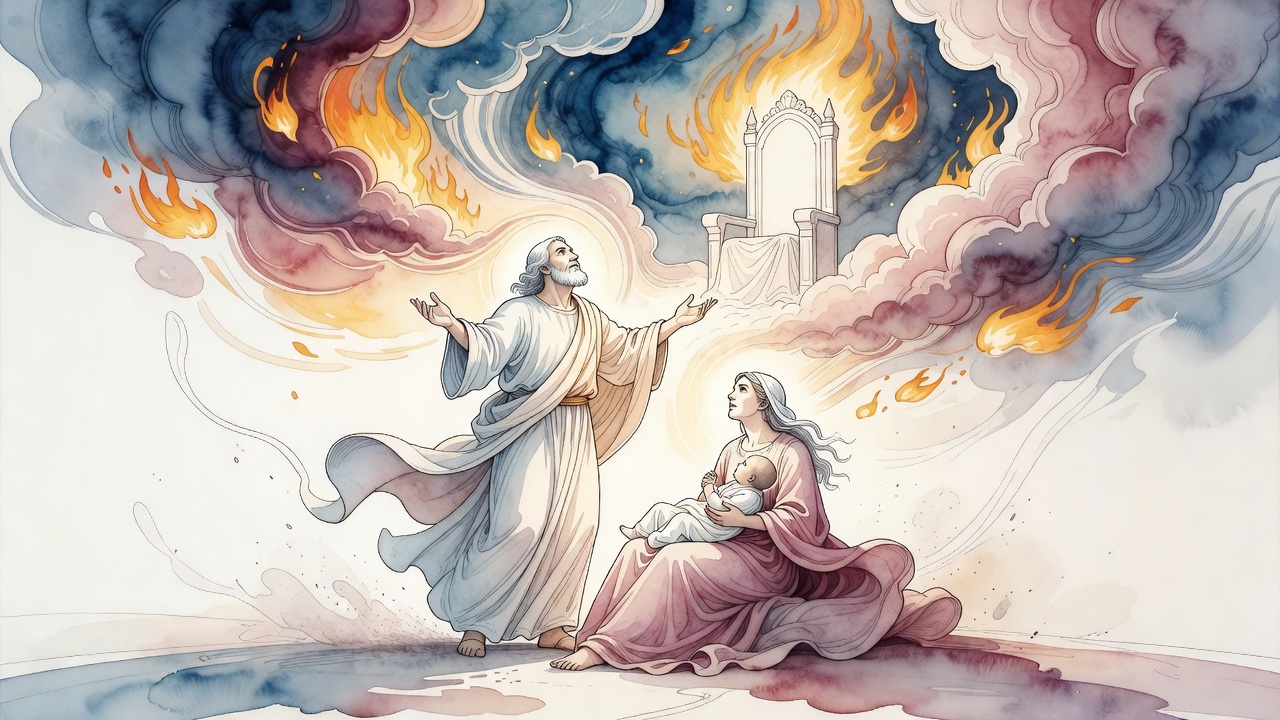
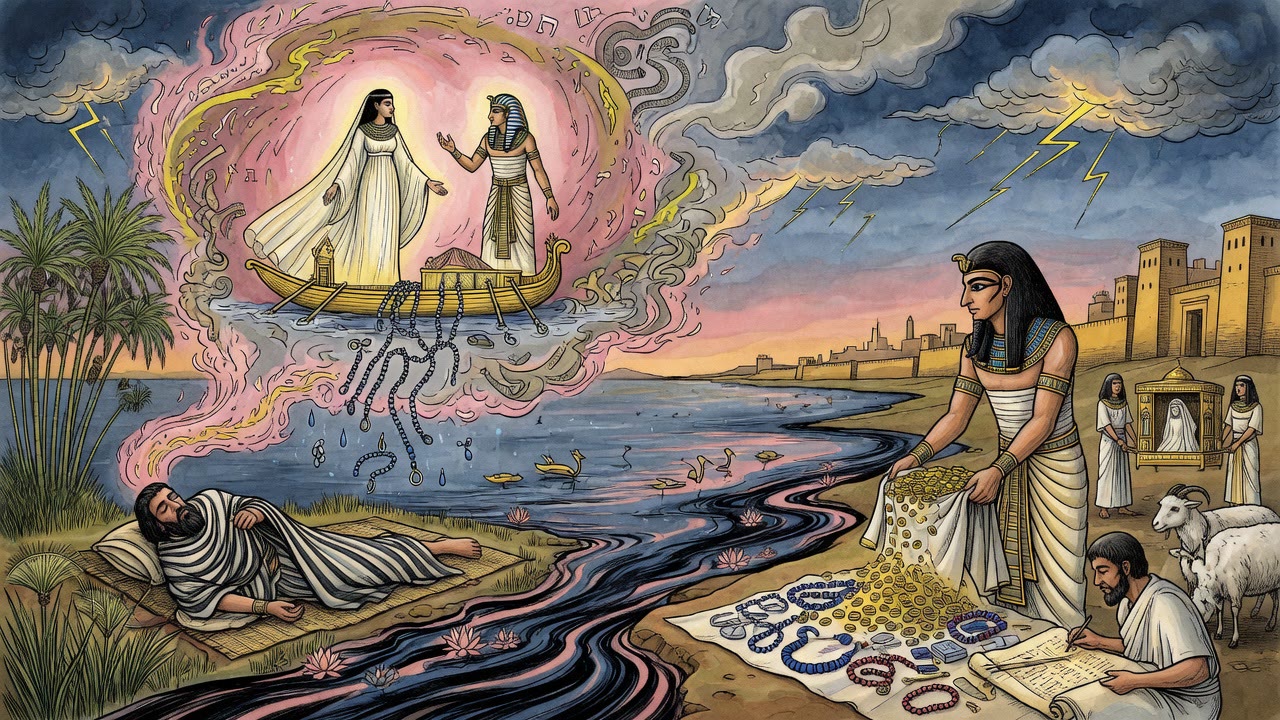
Abraham had prayed for Abimelech's house first. The king had taken Sarah, and barrenness had fallen across his household like a locked door. Abraham prayed, and the doors opened. Wombs that had been closed were restored. The angels watched the healing move through a stranger's house while Abraham's own tent still held the ache of decades.

Then heaven turned toward Sarah.

The Day Itself Became an Argument

Rosh Hashanah is the Day of Remembrance.

On that day, the tradition says, God remembered Sarah. The timing mattered. She was not remembered by accident and not because the calendar happened to pass beneath her grief. The day whose work is memory became the day her name rose before heaven. Abraham had asked mercy for another family, and the mercy came home.

The house that had prayed for strangers now heard its own locked future begin to open.

The Child Was Given, Not Merely Born

Bereshit Rabbah hears a precise verb in Joshua's memory of Abraham.

God says He gave Abraham Isaac. The midrash does not let that become ordinary speech. Isaac's birth was not only the result of a late pregnancy or a household finally receiving what it had wanted. The child was a gift placed into the world by divine decision, a life that arrived after nature had stopped offering explanations.

Sarah's body bore him. Heaven gave him.

His Face Answered the Whisperers

People whispered.

A woman of Sarah's age did not bear a son without mouths opening around the camp. The timing was too strange. Abimelech's palace was too recent. Suspicion crawled where joy should have stood. So God shaped the proof into Isaac's face. The child resembled Abraham so completely that anyone who saw the father could read the son.

Every feature became testimony. The laugh in the child's name did not belong to mockers anymore.

God Edited Sarah's Laughter

The household had already been protected once by a changed sentence.

When Sarah laughed behind the tent, she thought of age, weariness, and the impossible distance between promise and body. God reported the laughter to Abraham, but softened the edge that might disturb the marriage. The divine speech did not repeat every wound exactly as it had been spoken. Peace in Abraham's tent mattered enough for heaven to guard it.

Isaac was born into a house where even rebuke had been shaped for shalom.

The Angels Watched the Promise Ripen

The angels had been present from the announcement.

One came to bring the news. One came for Sodom. One came to heal Abraham after circumcision. Their missions crossed at the tent because covenant is never a private miracle only. A child was being promised. A city was being judged. A wounded patriarch was being restored. The world was being sorted while Sarah stood behind the entrance and laughed.

When Isaac arrived, laughter changed sides. What had sounded impossible became the child's name.

Abraham's prayer for Abimelech also teaches the house how blessing returns. He does not wait until his own wound is healed before asking healing for another. He prays while Sarah is still barren, while his own promise still looks impossible, while another man's household has become the visible crisis. The prayer leaves his mouth for them and comes back carrying Isaac.

That movement is the story's quiet reversal. Abimelech's palace had endangered Sarah. Abraham's prayer repairs Abimelech's palace. Then God repairs Abraham's tent. The blessing does not move in a straight line from victim to vindication. It circles through mercy given to the very house that caused the wound, and only then does laughter come home.

The rumor around Isaac's parentage makes the miracle public. A private pregnancy could have been dismissed as household joy. A child whose face mirrors Abraham turns the whole camp into witnesses. Every glance at Isaac answers the whisperers. The promised son carries proof in his features before he can speak a word.

So the laughter is no longer Sarah's hidden reaction behind canvas. It walks in daylight, held in Abraham's arms.

The Day of Remembrance had given memory a face.

After that, no whisper could make the miracle private again.

Isaac arrived as laughter, proof, and answer together.

Heaven remembered, and earth had to recognize him.


← All myths
From the tradition

Sources

4 sources

The texts this telling draws on, in full. Open a card to read inline, or expand it for a wider, quieter read.

Legends of the Jews, V. Abraham, The Birth Of IsaacLegends of the Jews

The story starts with a prayer. Abraham had prayed for Abimelech, the king of the Philistines, and when Abimelech recovered, the angels took notice. They cried out to God, pointing out that Sarah, Abraham’s wife, had been barren for years, just like Abimelech’s wife. Now that Abraham's prayer had been answered for another, wasn't it time for Sarah to be remembered too?

This wasn’t just any day,. It was Rosh Hashanah, the Jewish New Year, a time when, as we find in tradition, destinies are decided in heaven. The angels' plea, spoken on this auspicious day, bore fruit quickly. Barely seven months later, on the first day of Passover, Isaac was born.

Can you imagine the joy? It wasn't just in Abraham's house. The whole world rejoiced! As the story goes, God remembered all barren women along with Sarah, and they all conceived. The blind regained their sight, the lame walked, the mute spoke, and the mentally ill were restored. It was a time of miracles, echoing the messianic age.

There's more! On the day of Isaac's birth, the sun shone with unparalleled splendor, a brilliance not seen since Adam's transgression, and only to be matched again in the world to come.

But, of course, not everyone was convinced. People whispered, "Can a man of a hundred years really father a child?" So, to silence the doubters, God commanded the angel in charge of embryos to fashion Isaac precisely in Abraham's image. The resemblance was undeniable. "Abraham begot Isaac!" people exclaimed, seeing was believing.

Why did Abraham and Sarah have to wait so long? Why them? There was a reason for their advanced age. Abraham needed to bear the sign of the covenant – circumcision – on his body before he could father the child who was destined to be the father of Israel. And because Isaac was the first child born after Abraham was circumcised, the circumcision was celebrated with great pomp.

Shem, Eber, Abimelech (with his whole retinue), even Terah (Abraham's father) and Nahor came to celebrate. Abraham threw a huge party, not just for the men, but for the wives of the dignitaries too. He even invited them to bring their babies, and here’s where things get even more miraculous. Sarah, the elderly Sarah, had enough milk to nurse all the babies!

Now, according to Midrash Rabbah, the effects of this weren't just physical. Those whose mothers were pious when they allowed Sarah to nurse them grew up to become proselytes, converts to Judaism. Those whose mothers were merely testing Sarah grew up to be powerful rulers, but ultimately lost their dominion because they refused to accept the Torah at Mount Sinai. The descendants of those infants, the story goes, became all the pious heathens and converts to come.

Even Og, king of Bashan, was there. You know, the giant. He couldn't resist teasing Abraham, calling him a "sterile mule" who would never have offspring. Og sneered at the baby Isaac, saying he could crush him with a finger. But God rebuked Og, declaring that he would live to see millions of Abraham's descendants, and eventually fall into their hands.

So, what does this all mean? The birth of Isaac is more than just a personal story. It's a story about faith, about promises kept, and about the ripple effects of answered prayers. It’s a reminder that even in the face of seemingly impossible odds, hope can blossom, and that even the smallest child can change the course of history. And maybe, just maybe, it's a reminder that sometimes, a little bit of divine intervention is exactly what the world needs.

Full source
Bereshit Rabbah 53:6Bereshit Rabbah

"And the LORD remembered Sarah" (Genesis 21:1). Rabbi Yitzchak said: It is written, "And if the woman was not defiled but is pure, then she shall be cleared and shall conceive seed" (Numbers 5:28). This woman who entered the house of Pharaoh and the house of Abimelech and came out pure, is it not right that she should be remembered? Rabbi Yehudah son of Rabbi Simon said: Even though Rabbi Huna said there is an angel appointed over desire, yet Sarah did not need these things, but it was He in His own glory, "And the LORD remembered Sarah."

"And Sarah conceived and bore Abraham a son in his old age" (Genesis 21:2). This teaches that she did not steal seed from another place. "A son in his old age" (li-zekunav) [read as if li-ziv ikonin, to the radiance of his features] teaches that the radiance of his features resembled his. "At the appointed time of which God had spoken to him" (Genesis 21:2). Rabbi Yudan and Rabbi Chama. Rabbi Yudan said: He was born at nine months, so that they would not say he was swept out of the house of Abimelech.

Rabbi Chama said: At seven months, which are nine months curtailed. Rabbi Huna in the name of Rabbi Chizkiyah said: He was born at midday. "Appointed time" (moed) is said here, and "appointed time" is said elsewhere, "At the going down of the sun, the appointed time of your going out from Egypt" (Deuteronomy 16:6).

Full source
Genesis 22:1-19Torah (Masoretic Text)

And it came to pass after these things that God tested Abraham, and He said to him: Abraham. And he said: Here I am. And He said: Take, please, your son, your only one, whom you love, Isaac, and go for yourself to the land of Moriah, and offer him up there as a burnt offering upon one of the mountains that I will tell you. And Abraham rose early in the morning and saddled his donkey, and took two of his young men with him, and Isaac his son, and he split the wood for the burnt offering, and rose and went to the place that God had told him.

On the third day, Abraham lifted up his eyes and saw the place from afar. And Abraham said to his young men: Stay here with the donkey, and I and the lad will go yonder, and we will bow down and return to you. And Abraham took the wood for the burnt offering and laid it upon Isaac his son, and he took in his hand the fire and the knife, and the two of them went together.

And Isaac said to Abraham his father, and he said: My father. And he said: Here I am, my son. And he said: Behold the fire and the wood, but where is the lamb for the burnt offering? And Abraham said: God will see to the lamb for the burnt offering, my son. And the two of them went together. And they came to the place that God had told him, and Abraham built the altar there and arranged the wood, and he bound Isaac his son and laid him upon the altar, above the wood.

And Abraham stretched out his hand and took the knife to slaughter his son. And the angel of the LORD called to him from heaven and said: Abraham, Abraham. And he said: Here I am. And He said: Do not stretch out your hand against the lad, and do nothing to him, for now I know that you fear God, since you have not withheld your son, your only one, from Me.

And Abraham lifted up his eyes and looked, and behold, a ram behind, caught in the thicket by its horns. And Abraham went and took the ram and offered it up as a burnt offering in place of his son. And Abraham called the name of that place "The LORD will see," as it is said to this day: On the mountain of the LORD it will be seen. And the angel of the LORD called to Abraham a second time from heaven.

And He said: By Myself I have sworn, says the LORD, that because you have done this thing and have not withheld your son, your only one, that I will surely bless you and will greatly multiply your seed as the stars of the heavens and as the sand that is upon the shore of the sea, and your seed shall possess the gate of its enemies. And through your seed shall all the nations of the earth bless themselves, because you have hearkened to My voice.

And Abraham returned to his young men, and they rose and went together to Beersheba, and Abraham dwelt in Beersheba.

Full source
Bereshit Rabbah 63:1Bereshit Rabbah

We begin with a simple verse from (Genesis 25:19): "This is the legacy of Isaac, Abraham's son. Abraham begot Isaac." Seemingly straightforward. But the Rabbis of the Midrash (rabbinic interpretive commentary), those masterful interpreters of scripture, saw layers of meaning shimmering beneath the surface.

Bereshit Rabbah, a treasure trove of rabbinic commentary on the Book of Genesis, unpacks this verse with a beautiful connection to (Proverbs 23:24): “The father of the righteous will exult with happiness [gil yagil], and the begetter of the wise will rejoice in him.” Did you catch that echo? Gil yagil, happiness after happiness. What does it mean? The Midrash proposes it's the joy that comes when a righteous person is born. Double the happiness!

Rabbi Hoshaya, quoted in the Bereshit Rabbah, gives us an intriguing anecdote. He speaks of the ministering angels lamenting the reign of the wicked King Ahaz, saying to God: “Master of the universe, woe that Aḥaz reigned!” But God responds that Ahaz was the son of Yotam, a righteous man. "His father was righteous, and I cannot extend my hand against him.” There's a sense here that even divine judgment is tempered by the merit of a righteous ancestor. It hints at a profound connection between generations.

It doesn't stop there. Rabbi Levi takes us further, asking: where do we learn that a father feels mercy for his son who diligently studies Torah? He points to (Proverbs 23:15): “My son, if your heart is wise, my heart too will rejoice.” The verse speaks of a father’s rejoicing, but Rabbi Shimon ben Menasya asks, if this applies to a flesh-and-blood father, what about the Holy One, blessed be He? Where do we learn that even God feels mercy and rejoices when someone dedicates themselves to Torah? The answer, he says, is in that little word "too" – "My heart too will rejoice." It suggests that God shares in the joy and pride of a parent whose child is wise and righteous. The Zohar, the foundational text of Kabbalah, often speaks of God’s attributes as being reflected in humanity. Here, we see a beautiful mirroring of human and divine emotion. Just as a parent beams with pride at their child's accomplishments, so too, in a way, does God rejoice when we strive for wisdom and righteousness. It's a deeply comforting thought, isn’t it?

So, happiness after happiness. It’s there when a righteous child is born, and it's there when we, as children of the Divine, choose to walk a path of wisdom and Torah. It is the legacy of Isaac, son of Abraham. A legacy of righteousness, of learning, and of a joy that resonates from generation to generation, all the way up to the heavens.

Full source