5 min read

The Angel Who Would Not Strike Without Sarah's Word

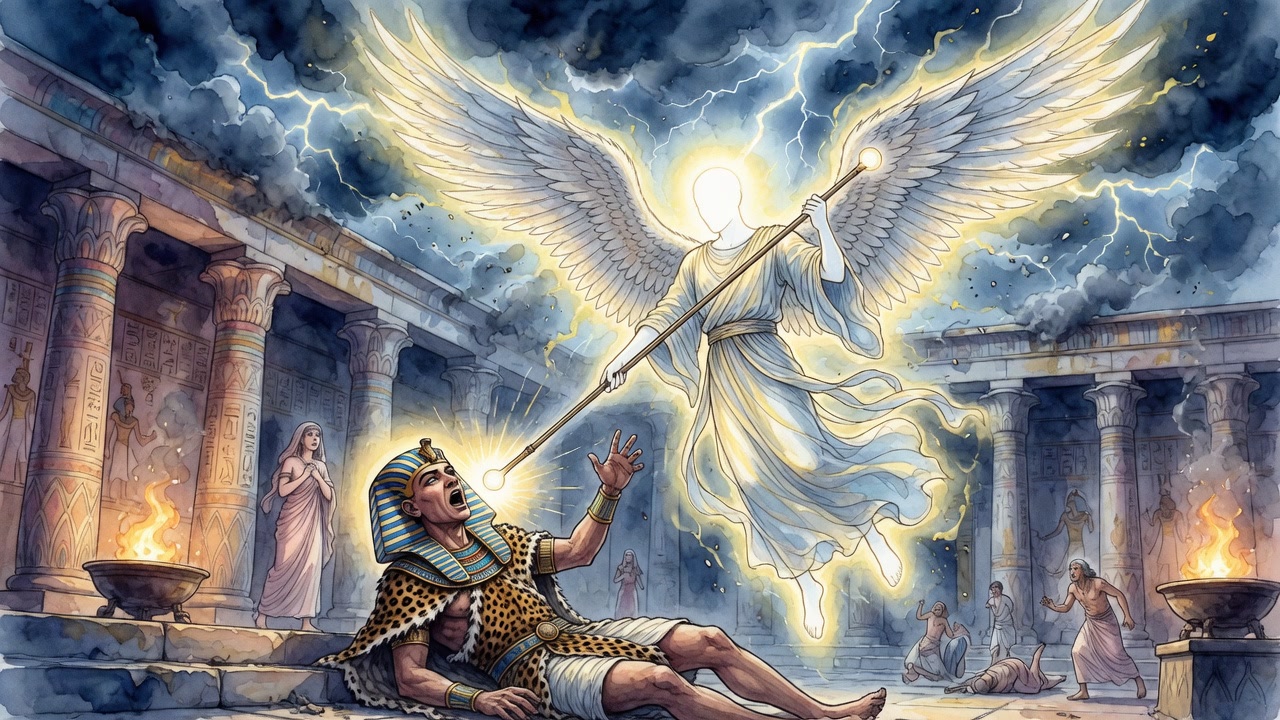
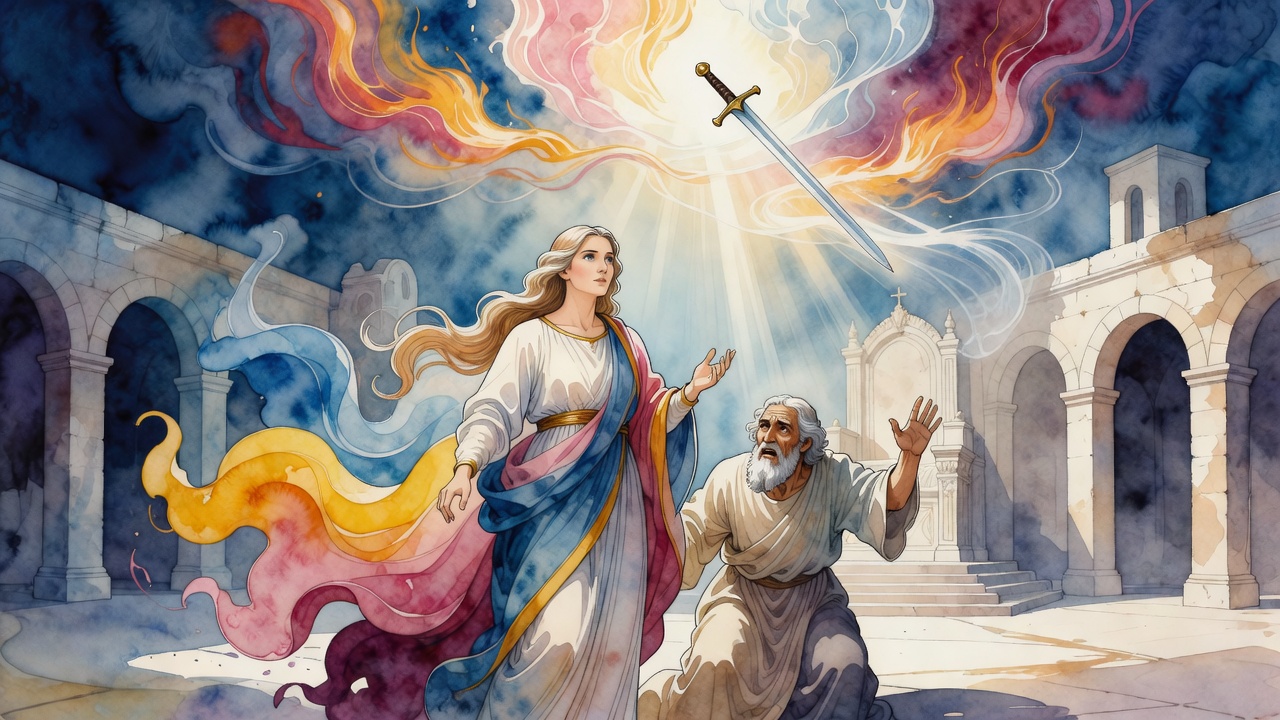
Pharaoh took Sarah into his palace and an angel appeared with a rod. Before striking, the angel stopped and asked the woman what she wanted done.

Curated by Arthur · Told by Maggid ·
Table of Contents
  1. The Most Powerful Man in the World
  2. The Rod That Appeared in the Dark
  3. What the Midrash Says About the Chamber
  4. The Return

The Most Powerful Man in the World

Pharaoh had heard about Sarah before she arrived. Beauty like hers traveled ahead of itself, carried in the reports of soldiers and traders and anyone who had passed through Canaan and seen the woman traveling with the man she said was her brother. By the time Abraham and Sarah entered Egypt, there were people at court who had already been preparing the king's interest.

Abraham had made a calculation. He was a foreigner in a land ruled by a man who could take anything he wanted, including another man's wife. The danger of traveling as Sarah's husband was that a ruler who wanted her might simply remove the husband from the equation. The danger of traveling as her brother was different in kind: a suitor might negotiate, might offer gifts and wait for approval, and in the waiting there might be a way through. It was not a clean choice. It was the calculation of a man who needed time and had no other way to buy it.

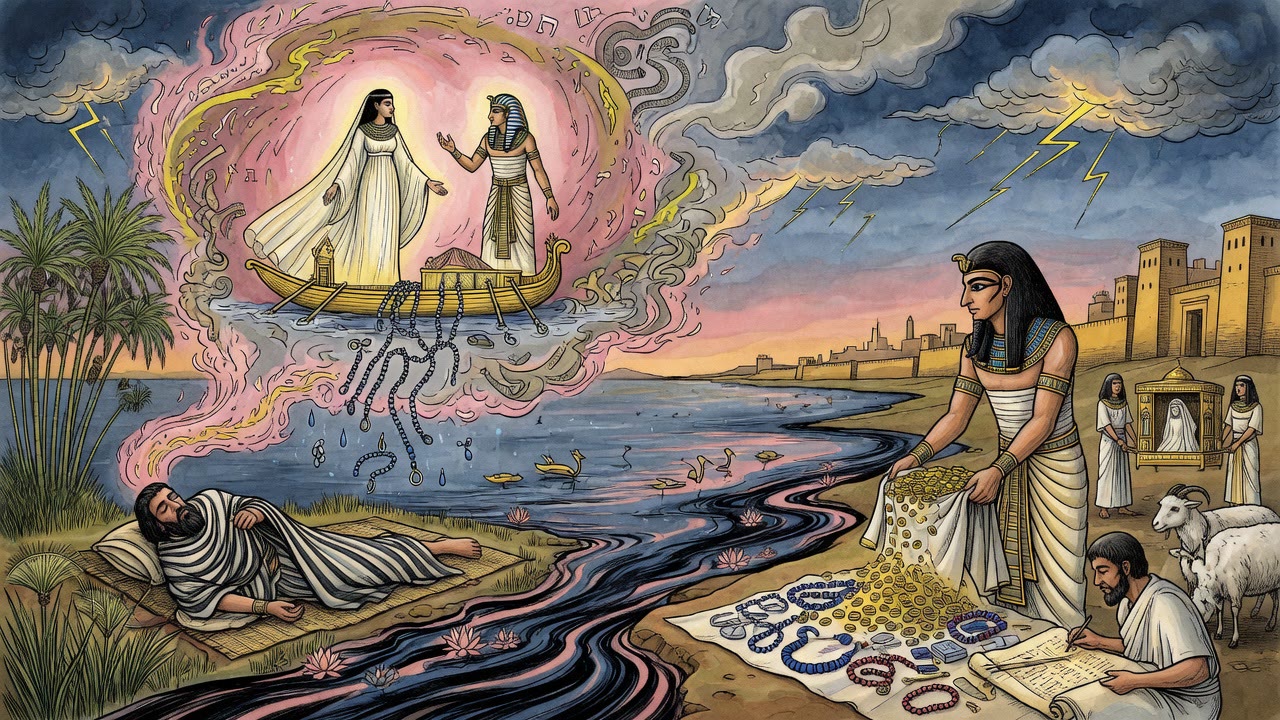
Pharaoh took Sarah anyway. He brought her into his house and sent back generous gifts to her supposed brother: sheep and cattle and donkeys and servants, male and female, and camels. The court of Egypt had received a beautiful woman and was paying her family's price. Abraham accepted the gifts and waited to see what God would do.

The Rod That Appeared in the Dark

What God did was send an angel. The Legends of the Jews records the scene in Pharaoh's chambers: a night visit, an attempt to approach the woman the king had taken as his own, and then suddenly the presence of an angel with a rod, standing between Pharaoh and Sarah in the dark.

The angel did not strike immediately. This is the detail that the tradition finds most important. Before the rod fell, the angel stopped and asked Sarah what she wanted. The king of Egypt was standing in his own palace with divine power positioned against him, and the question of what happened next was placed in the hands of the woman he had taken without asking. Sarah answered. She directed the angel: "Strike." And the rod came down.

It came down every time Pharaoh tried again. The afflictions the Torah mentions in passing, the plagues on Pharaoh's household, were not a single event but a series of interventions, each one triggered by an attempt to reach the woman who had been placed under protection. The angel checked in with Sarah each time. Her word remained the condition of the action.

What the Midrash Says About the Chamber

Bereshit Rabbah, preserving the teaching of Reish Lakish in the name of bar Kappara, adds an unpleasant physical detail: Pharaoh suffered from skin disease. The affliction was not abstract or invisible. It made him physically unable to do what he had intended to do, and it marked him in a way his court could not ignore. Whatever the king had planned when he brought Sarah into the palace, his body was now working against the plan.

But the midrash also asks what Sarah was doing during all of this. She was not passive. She sat and prayed through the night. She called out and was answered. The angel stood between her and harm for the entire duration of her time in the palace, from the first night to the morning when Pharaoh, sick and confused and unable to understand what was happening to his household, summoned Abraham and returned Sarah to him with questions he could not quite form into the right accusation.

The Return

Abraham had not sent messages. He had not negotiated. He had stood outside the palace with the gifts Pharaoh had given him and waited. The Legends of the Jews records that Pharaoh's generosity had availed nothing, that all the charm and the gifts and the preparation had produced nothing but a woman who could not be touched and a king who was covered in welts and did not know why.

When Pharaoh finally understood that the woman he had taken was a wife and not a sister, his question was simple: "Why did you do this to me?" Abraham had no good answer that he was willing to give in a place where the wrong answer could get him killed. He took Sarah and took the gifts and left Egypt. The cattle and the servants and the camels were all still his. The angel had served as protection and witness. Sarah had directed the angel's hand. The most powerful man in the world had been stopped in his own bedroom by a rod he could not see, held by a hand he could not argue with, acting on orders from a woman he had tried to own.


← All myths
From the tradition

Sources

2 sources

The texts this telling draws on, in full. Open a card to read inline, or expand it for a wider, quieter read.

Legends of the Jews 5:99Legends of the Jews

Abraham, fearing for his life in a foreign land, tells everyone that his wife, the stunning Sarah, is actually his sister. A classic "mistaken identity" situation. Except… it's not exactly a mistake, is it? It's a calculated risk. Pharaoh, naturally, is immediately smitten and takes Sarah into his house.

Pharaoh’s intentions are clear, but divine intervention has other plans. According to Legends of the Jews, as retold by Louis Ginzberg, Pharaoh’s “free-handed generosity availed naught.” Basically, all his charm and kingly gifts did him absolutely no good.

Why? Because an angel with a stick showed up. Seriously.

The scene. It's nighttime. Pharaoh is about to, shall we say, "approach" Sarah, and suddenly BAM! An angel appears, armed and ready. If Pharaoh even thinks about touching Sarah's shoe – to remove it, perhaps – the angel whacks him on the hand. Reach for her dress? Another blow.

It’s almost comical, this divine slapstick. But there's a serious point. Each time the angel is about to strike, he apparently turns to Sarah and asks for permission! Should he deliver the blow? Should he give Pharaoh a moment to reconsider? The power dynamic is fascinating, isn't it? Sarah, the captive, is somehow in control.

But the angel with the stick wasn't the only problem for Pharaoh. Oh no. A far more pervasive plague descended upon him and his entire court. Leprosy. Yes, you read that right. Not just Pharaoh, but his nobles, his servants, even the walls of his house and his very bed were afflicted! Suddenly, "indulging his carnal desires" was the least of his worries.

And when did all this happen? The night of the fifteenth of Nisan (the first month of the Hebrew calendar, in springtime). The very same night, Legends of the Jews points out, that God would later visit the Egyptians to redeem the children of IsraelSarah’s descendants. Talk about a cosmic connection.

So, what’s the takeaway? Perhaps it’s that even the most powerful ruler is ultimately subject to a higher power. Or maybe it's that even in the most precarious situations, a person – like Sarah – can possess a quiet strength that shapes the course of events. Whatever it is, it's a reminder that the stories we tell are often far stranger – and more meaningful – than we might initially think.

Full source
Bereshit Rabbah 41:2Bereshit Rabbah

Take the tale of Pharaoh and Sarah in Genesis. We know the basic outline: Abraham and Sarah enter Egypt, Abraham says Sarah is his sister, Pharaoh takes Sarah into his house, and then… well, then things get interesting.

What exactly happened in Pharaoh's palace? The Torah tells us that God afflicted Pharaoh and his house, but the details are left tantalizingly vague. That's where the Midrash (rabbinic interpretive commentary) comes in – specifically, Bereshit Rabbah, a treasure trove of rabbinic interpretations of Genesis.

The Rabbis of the Midrash weren't content with just the surface narrative. They wanted to know: What kind of affliction? How did it affect everyone? And what was Sarah doing the whole time?

Reish Lakish, quoting bar Kappara, offers a rather unpleasant detail: Pharaoh was stricken with raatan. Now, raatan is described as a type of skin disease. Rabban Shimon ben Gamliel adds a particularly cringe-worthy note: he recalls an elder, suffering from a skin disease, telling him that of all twenty-four types, raatan was the worst when it came to, shall we say, conjugal relations. Ouch.

But it gets even more widespread. Rabbi Aḥa suggests that even the beams of Pharaoh's palace were afflicted! The Midrash makes a direct connection between the Torah's phrase "and his household [beito]" and the literal meaning of beito – "his house." So, according to this interpretation, the divine affliction wasn't limited to people; it extended to the very structure itself. And the gossip was spreading: “…over the matter of Sarai, Abram’s wife.” The only explanation anyone could come up with for diseased house beams was divine intervention.

Rabbi Berekhya uses a striking image: "All the insolent ones have come in to touch the noblewoman’s shoe." It's a saying, a proverb, really, about low-ranking people behaving with outrageous disrespect towards someone of high status – like a princess. The Midrash applies this to Pharaoh's household, suggesting they were acting inappropriately towards Sarah.

And what about Sarah herself? The Midrash paints a picture of her in desperate prayer all night. "Master of the universe," she cries, "Abraham departed [from our home country] with a promise [of divine protection], and I departed only on faith. Abraham departed outside the cage, but I am in the cage." In other words, Abraham had God's explicit promise, while she only had her own belief. He was out in the open, but she was trapped in Pharaoh's palace, surrounded by…well, the Midrash calls them "beasts."

But God reassures her: "Everything I do, I do on your behalf." That's a powerful statement about divine providence and the unseen forces working to protect the righteous.

Rabbi Levi adds another layer. He says that throughout the night, an angel stood by Sarah with a rod, ready to strike at her command. "If you say: Strike, I will strike; if you say: Cease, I will cease." The phrase "over the matter of Sarai" (al devar Sarai) is cleverly reinterpreted to mean "by Sarai's word." Pharaoh was punished so severely, the Midrash argues, because Sarah repeatedly told him she was married, but he wouldn't leave her alone.

Finally, Rabbi Elazar, citing Rabbi Eliezer ben Yaakov, offers a contrasting view on the afflictions themselves. He suggests that Pharaoh was actually afflicted with leprosy (nega’im, which can refer to leprosy), while Avimelekh (in a similar story later in Genesis) suffered from obstruction of bodily orifices. How do we know which affliction goes where? From the repeated phrase "al devar" – "over the matter of." A verbal analogy, linking the two stories.

So, what do we take away from all this? More than just a lurid tale of disease and palace intrigue. The Midrash invites us to look deeper, to consider the emotional and spiritual dimensions of the story. It reminds us that even in moments of apparent helplessness, like Sarah in Pharaoh's house, divine forces are at work, responding to our prayers and defending the righteous. It's a powerful reminder that even when we feel trapped in a cage, we are not alone.

Full source