4 min read

Three Angels at Abraham's Tent Each Carried One Task

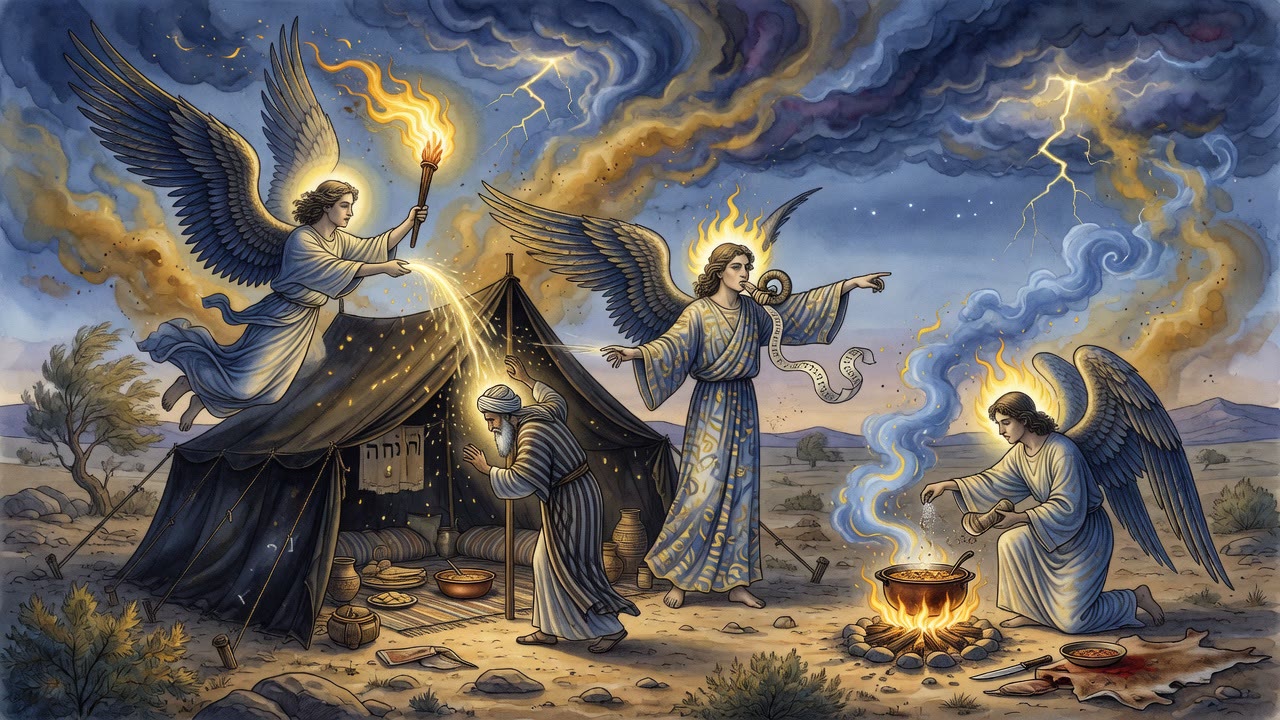
Three strangers arrived at Abraham's tent in the midday heat. The rabbis said each one carried a single divine assignment and could not carry more.

Curated by Arthur · Told by Maggid ·
Table of Contents
  1. The Man Who Ran in the Heat
  2. Why Three and Not One
  3. The Angel Who Left Early
  4. When Abraham Raised the Knife
  5. The Angel at the End of Abraham's Life

The Man Who Ran in the Heat

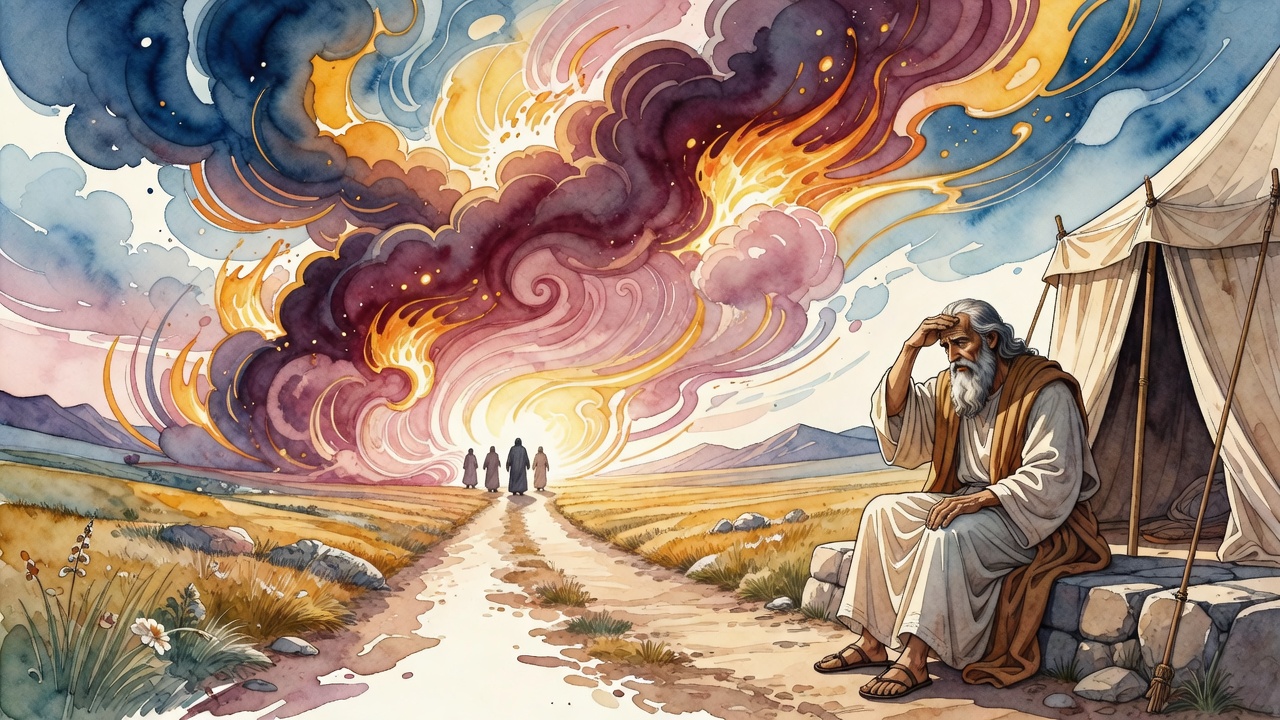
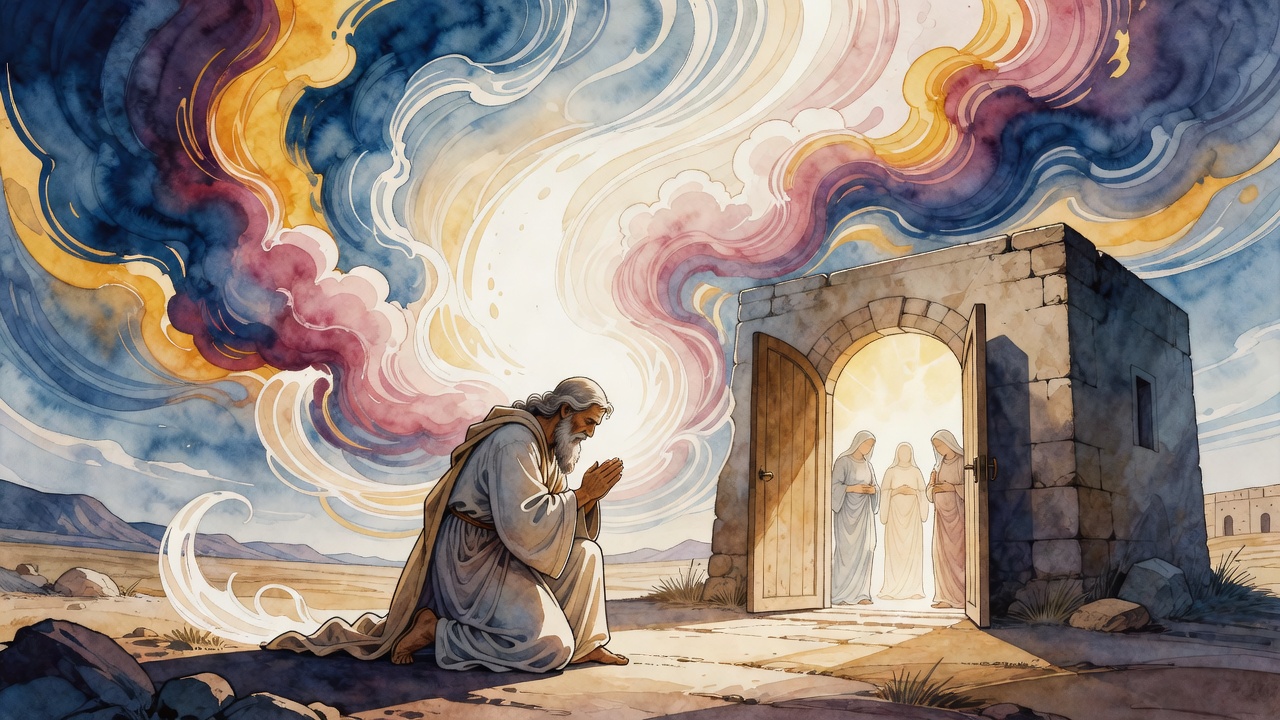
He had undergone circumcision three days earlier and was ninety-nine years old, and when he saw three strangers approaching through the midday heat he ran to meet them. The rabbis noticed the running. They always noticed the running. A man in his condition, at that age, with a wound three days old, who ran to offer hospitality, the running meant something.

The three men accepted Abraham's invitation and sat under the tree while he brought water for their feet and arranged for food to be prepared. Sarah baked bread. A tender calf was slaughtered. Abraham stood beside them under the tree while they ate. None of this tells you who they were. The Midrash assumed that was obvious. The question it pressed on was why there were three of them.

Why Three and Not One

God could have sent a single angel to accomplish all three tasks. One messenger for the announcement to Sarah, one for the rescue of Lot, one for the destruction of Sodom, but one being could carry all of that. The rabbis rejected this solution. An angel, in the rabbinic understanding, was not a multipurpose divine agent. Each angel had one mission. One message. One assignment. When the mission was complete, the angel ceased.

The Midrash on Genesis made this explicit: an angel does not carry two errands at once. The being who told Sarah she would have a son could not also destroy Sodom. These were fundamentally different acts, announcement and annihilation, and they required different messengers. The structure of the visit itself demonstrated something about the nature of divine action.

The Angel Who Left Early

One of the three did not go to Sodom. He had delivered his message, the son is coming, the barren woman will conceive within the year, and his mission was finished. He went on to heal Abraham of his circumcision wound and then departed. The other two went south toward the cities of the plain.

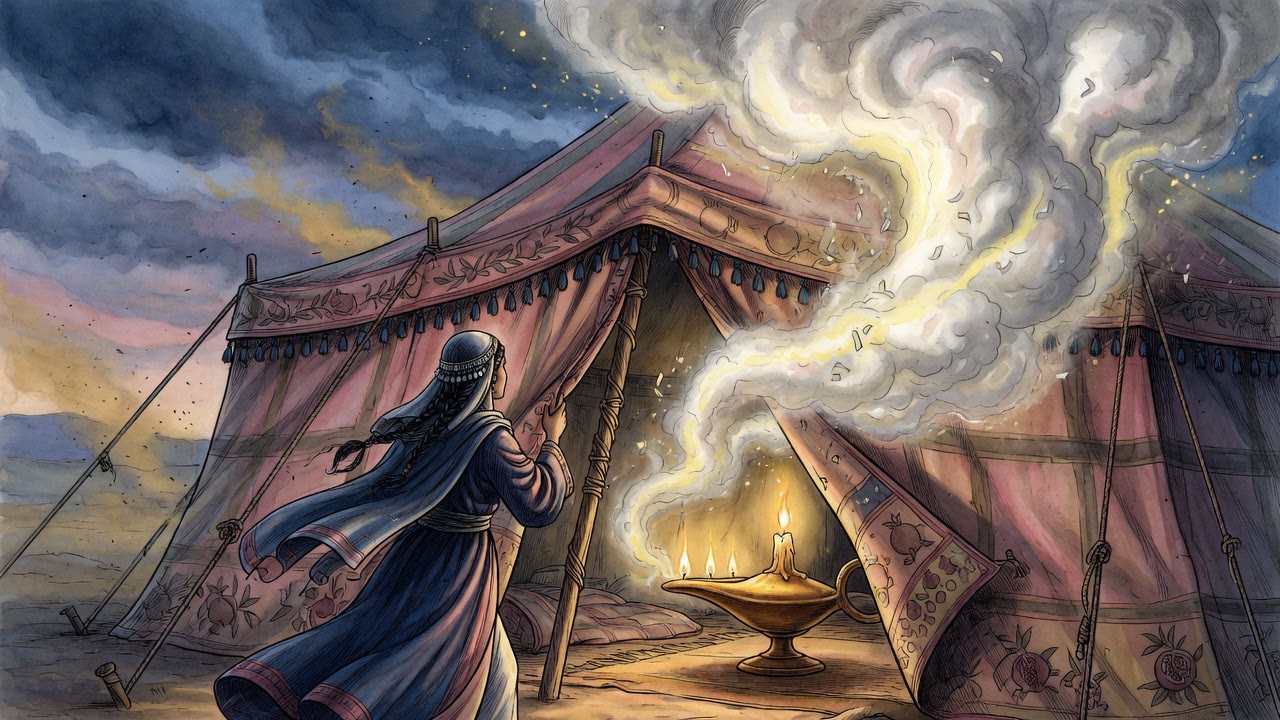
Sarah had laughed from inside the tent when she heard the announcement. Not in celebration. She had calculated her own age and Abraham's age and found the arithmetic impossible. The angel's answer came back through Abraham: is anything too difficult for the Lord? That was the full message. It did not argue with her calculation. It asked whether the calculation was the relevant question.

When Abraham Raised the Knife

There was a third time, years later, when an angel arrived with a single and specific task. Abraham had climbed a mountain with his son and reached the moment the whole journey had been building toward. The knife was in his hand. And the angel called out from heaven and told him to stop. Do not send your hand against the boy. The ram is in the thicket behind you.

One call. One command. The angel had nothing else to say. The ram was already there, already caught, already prepared. Everything necessary had been positioned before Abraham arrived at the summit. The angel's job was only to speak the single word that would make Abraham look up from his son and find what was waiting for him.

The Angel at the End of Abraham's Life

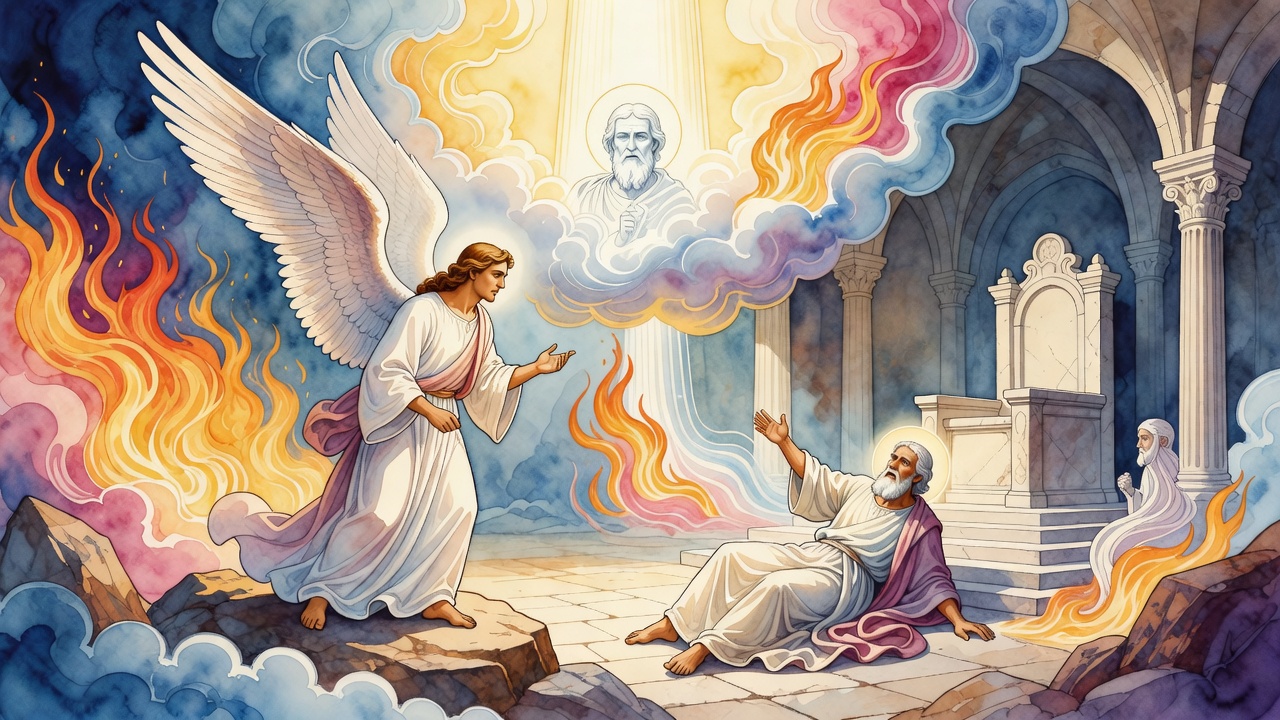
When the time came for Abraham to leave the world, God did not send any ordinary messenger. The Angel of Death came, but came under specific instruction: make it gentle. Abraham was a man who had spent his life practicing hospitality toward strangers, and the tradition held that this earned him a departure that matched how he had lived. The Angel of Death arrived with the same single-purpose structure that governed all angelic missions. This one task was to bring Abraham's soul across without violence, without fear, without anything that contradicted the mercy that had been the first principle of his life.


← All myths

From the tradition

Sources

5 sources

The texts this telling draws on, in full. Open a card to read inline, or expand it for a wider, quieter read.

Jasher 18Book of Jasher

Book of Jasher turns to Three Angels Visit Abraham Before Sodom's Doom.

The tradition turns to the Book of Jasher. Now, this isn't part of the canonical Hebrew Bible, the Tanakh. It's considered a work of Jewish folklore and legend, a kind of midrashic (rabbinic interpretive commentary) expansion on biblical narratives.

Chapter 18 of Jasher dives into familiar territory. Remember how God commanded Abraham to circumcise himself and all the males in his household? Jasher elaborates: "And Abraham rose and did all that God had ordered him… And there was not one left whom he did not circumcise." Ishmael, Abraham's son, was thirteen at the time.

Then, on the third day after the circumcision, when Abraham was sitting at the door of his tent, recovering in the heat, God appeared to him in the plain of Mamre. Three angels, “ministering angels,” were sent to visit. Abraham, ever the hospitable host, rushed to greet them. He bowed, invited them in, offered them water to wash their feet, and placed them under a tree. He then ordered a calf to be prepared, and told Sarah to bake cakes. He brought them butter, milk, beef, and mutton, and they ate.

After the meal, one of the angels declared, "I will return to thee according to the time of life, and Sarah thy wife shall have a son.” This, of course, is the promise of Isaac's birth, a pivotal moment in the Abrahamic narrative.

But then, the story takes a dark turn.

The Book of Jasher abruptly shifts focus to the wickedness of Sodom and Gomorrah. We already know of the cities' impending doom, but here, we get a glimpse of the specific sins that warranted such divine judgment. "In those days all the people of Sodom and Gomorrah… were exceedingly wicked and sinful against the Lord… and their wickedness and crimes were in those days great before the Lord.”

The text paints a disturbing picture. Four times a year, the people would gather in a valley with springs and lush vegetation for festivals of "rejoicing." But these weren't innocent celebrations. During these gatherings, they would engage in widespread sexual immorality, with men taking each other's wives and daughters without protest. It's a stark depiction of moral decay.

And it gets worse.

The Book of Jasher details the Sodomites' abhorrent treatment of strangers. When a traveler came to their cities with goods to sell, the people would forcibly take his merchandise, giving him only a pittance in return. If the traveler complained, each person would claim to have taken only a small amount, mocking him. Then, they would drive him out of the city with noise and commotion.

The narrative then zooms in on one particularly unsettling incident. A traveler from Elam, passing through Sodom at sunset, found himself without lodging. A wicked man named Hedad offered him shelter, but with ulterior motives. He stole the traveler's fine mantle and cord. The next day, when the traveler asked for his possessions back, Hedad claimed he was interpreting a dream: the cord symbolized a long life, and the mantle, a fruitful vineyard. Hedad then demanded payment for his “interpretation.”

When the traveler protested, he was dragged before Serak, the judge of Sodom. But instead of justice, he encountered further corruption. The judge sided with Hedad, praising his supposed dream-interpreting skills. The traveler, distraught, was driven from the city, lamenting his experience in "the corrupt city of Sodom."

What’s striking about this account is the emphasis on the systemic nature of the evil in Sodom. It wasn't just a few bad apples; the entire society, from the ordinary citizens to the judge, was complicit in injustice and cruelty. The story of the traveler and Hedad, in particular, highlights the perversion of hospitality and the complete absence of moral compass.

As we reflect on this chapter from the Book of Jasher, we are left with a chilling reminder of the potential for societal corruption. It begs the question: what are the subtle ways injustice can become normalized within a community? And what responsibility do we have to challenge such norms, even when they are deeply entrenched?

Full source
Chronicles of Jerahmeel XXXIVChronicles of Jerahmeel (Gaster, 1899)

The night Abraham was born, a star appeared in the sky and swallowed four other stars from the four corners of heaven. Nimrod's astrologers saw it and rushed to the king with a warning: a child had been born who was destined to inherit both this world and the world to come. They urged Nimrod to pay off the parents and kill the boy immediately.

Terah, Abraham's own father, was standing right there in court. He deflected with a parable about a mule offered barley in exchange for its head. "If you kill the son," he said, "who will enjoy the reward you give his parents?" The astrologers saw through him at once. Terah rushed home and hid his son in a cave for three years.

When Abraham emerged, he searched for the true God. He prayed to the sun all day, then switched to the moon at night. By the next morning, watching both rise and set, he concluded that neither was lord of the world, both were servants of a higher power. His father pointed him to the household idols instead. Abraham brought offering after offering to the stone figures. They did not eat. They did not drink. They did not answer.

The spirit of prophecy fell on him. Abraham set the idols on fire and burned them all. When Terah demanded an explanation, Abraham told him the large idol had attacked the smaller ones. "Fool," his father said, "how can a statue that cannot see or move do anything?" Abraham replied: "Then why do you worship them?"

Terah dragged Abraham before Nimrod, who demanded to know who created the heavens. "I did," Nimrod declared. Abraham challenged him: "Then command the sun to rise in the west." Nimrod was struck silent. His astrologers heated a furnace for seven days and threw Abraham in. The angels competed to rescue him, but God insisted on going Himself, "I am One in My world, and he is one in his generation." God descended in His own glory and brought Abraham out without a single burn.

Full source
Pirkei DeRabbi Eliezer 31:9Pirkei DeRabbi Eliezer

Pirkei DeRabbi Eliezer turns to The Chilling Moment Abraham Raised the Knife.

One of the most striking accounts comes from Pirkei DeRabbi Eliezer, a fascinating text that expands upon biblical narratives. Chapter 31 plunges us right into the heart of the drama.

The scene: Isaac, fully aware of what’s about to happen, speaks to his father. He says, "O my father! Bind for me my two hands, and my two feet, so that I do not curse thee." Isaac is worried that in his fear, in the very throes of death, he might accidentally say something disrespectful, something that would violate the commandment to honor one's parents (Exodus 20:12). He's prioritizing that commandment even as his life hangs in the balance.

He’s essentially saying, “Tie me up tight, Dad, so I don’t mess this up."

Pirkei DeRabbi Eliezer continues, describing how Abraham binds his son, placing him on the altar. Abraham then arranges the wood and the fire. He prepares everything meticulously. He even "strengthened his two arms and his two knees upon him.” Can you feel the weight of that moment? The sheer physical and emotional effort it would have taken?

The text then tells us, "Like a high priest he brought near his meal offering, and his drink offering." This isn’t just a father about to sacrifice his son; it's a ritual, a sacred act, in Abraham’s mind.

And then, the most agonizing line: "…and he stretched forth his hand and took the knife."

The narrative then shifts to the heavens. "And the Holy One, blessed be He, was sitting and beholding the father binding with all (his) heart and the son bound with all (his) heart." God is watching. Observing this ultimate test of faith.

But He’s not the only one.

"And the ministering angels cried aloud and wept," the text says. "Behold, the Erelim cry without; the angels of peace weep bitterly" (Isaiah 33:7). Erelim is a term for angelic beings, and even they are overwhelmed by the scene unfolding below. Their cries fill the heavens.

The angels plead before God. "Sovereign of all the worlds! Thou art called merciful and compassionate…have mercy upon Isaac, for he is a human being, and the son of a human being, and is bound before Thee like an animal."

They remind God of His own attributes, of His compassion. They highlight Isaac's humanity, his vulnerability. They drive home the horror of the situation by comparing him to an animal bound for sacrifice.

The angels continue, quoting (Psalm 36:6): "O Lord, Thou preservest man and beast." They are essentially asking, "Where is your compassion now? Where is your protection?"

This passage from Pirkei DeRabbi Eliezer isn’t just a retelling of a familiar story. It's a deep dive into the emotional and spiritual turmoil of the Akeidah. It forces us to confront the difficult questions: What does faith truly demand? What is the nature of divine mercy? And how close can we come to the edge before intervention arrives? It's a powerful reminder that even in the most challenging moments, the possibility of compassion and intervention remains.

Full source
Testament of Abraham 1-4Testament of Abraham

When the time came for Abraham to leave this world, God didn't send just any messenger. He summoned the Angel of Death himself. But God, in His infinite compassion, knew that Abraham, a man of unwavering faith and kindness, deserved a peaceful transition. So, God instructed the Angel of Death to "hide your ferocity, cover your decay, and put on your youthful beauty… take him with soft speech." (Tree of Souls, Schwartz, Myths of Isaac 345).

The scene: Abraham is sitting at the entrance to his tent in Mamre, when a sweet odor wafts towards him. He looks up and sees the Angel of Death approaching, not as a terrifying specter, but in "great glory," radiant and beautiful.

The Angel of Death kneels before Abraham, saying, "Most righteous Abraham, I am the bitter cup of death." Abraham, however, is taken aback. "No," he replies, "you have the glory and beauty of an angel." The Angel insists, "I am telling you the truth. I have come for your holy soul."

Abraham, as you might expect, wasn't quite ready to go. He refuses, going into his house, with the Angel of Death following close behind. The Angel declares, "I will not depart until I take your spirit."

Now, Abraham, ever the negotiator, makes a request: "I beg you, heed me and show me your ferocity." The Angel of Death hesitates. "You could not bear to behold it, righteous Abraham." But Abraham, confident in his connection to the Divine, insists, "Yes, I can, because the power of God is with me."

And so, the Angel of Death transforms. He sheds his youthful beauty and dons his "robe of tyranny," becoming gloomy and ferocious. He reveals to Abraham "seven fiery heads of dragons and other faces, most horrible, each one fiercer than the other, including the face of a lion, the face of a homed serpent, and that of a cobra." (Tree of Souls, Schwartz, Myths of Isaac 345). Can you picture the sheer terror of such a sight?

Overwhelmed, Abraham pleads, "I beg you, Death, hide your ferocity and put on the form of youthful beauty that you had before." The Angel of Death complies, and Abraham retreats to his room, lying down to rest.

The Angel of Death then approaches him with a final, deceptive gesture: "Come, kiss my right hand, and may life and strength come to you." But this was a ruse. When Abraham kissed the Angel's hand, his soul cleaved to it, drawn from his body.

But even in this moment of transition, there's a sense of grace. The angel Michael, accompanied by a multitude of angels, appears. They gently carry Abraham's precious soul away, cradled in "divinely woven linen." (Tree of Souls, Schwartz, Myths of Isaac 345).

What does this story tell us? Perhaps it's about the inevitability of death, even for the most righteous among us. Or maybe it's about the importance of facing our mortality with courage, knowing that even in death, there can be beauty and peace. It certainly highlights Abraham's unique relationship with God, allowing him to even briefly glimpse the true face of death itself. And ultimately, it reminds us that even in the face of loss, there is always the promise of divine comfort and eternal life.

Full source
Pirkei DeRabbi Eliezer 29:5Pirkei DeRabbi Eliezer

It's far more than just a nice story about hospitality. According to Pirkei DeRabbi Eliezer, a fascinating early medieval text that weaves together biblical narrative and rabbinic interpretation, it's a pivotal moment revealing the power of brit milah, circumcision.

Rabban Gamaliel, son of Rabbi Jehudah the Prince, paints a vivid picture. Imagine Abraham, three days after his circumcision. Ouch. He was "very sore," deliberately so, to test his faith. And what does God do? He intensifies the heat! Pirkei DeRabbi Eliezer says God "pierced one hole in the midst of Gehinnom (the place of spiritual purification after death)," often translated as hell, making the day as scorching as a day reserved for the wicked.

There he is, Abraham, sitting at the entrance of his tent, seeking relief from the blazing heat. (Genesis 18:1) tells us, "And he sat at the tent door in the heat of the day." But this isn't just about physical discomfort. It's a setup for something far more profound.

Then comes the twist. God, kadosh baruch hu, the Holy One, blessed be He, says to the ministering angels: "Come, let us descend and visit the sick, for the virtue of visiting the sick is great before Me." The Creator of the universe, demonstrating the importance of compassion and care. And they descend, as the Torah says, "And the Lord appeared unto him" (Genesis 18:1).

But here’s the real kicker, the moment that highlights the transformative power of circumcision. God says to the angels: "Come and see the power of circumcision! Before Abraham was circumcised, he fell on his face before Me." This is a reference to (Genesis 17:17), "And Abraham fell upon his face," after God revealed the covenant. But now, after the brit milah, "he sits and I stand."

Wait, what? God stands? How do we know this? Pirkei DeRabbi Eliezer directs us to (Genesis 18:2): "And he looked, and, lo, three men stood over against him." These "men," of course, are the angels, but the implication is clear: God is among them, standing in Abraham's presence.

So, what does this all mean? Pirkei DeRabbi Eliezer suggests that circumcision elevates Abraham’s status, bringing him closer to God. It's a physical act, yes, but it's also a profound spiritual transformation. Before the brit, Abraham prostrates himself. Afterward, he is elevated to a level where God Himself, in a sense, stands in his presence. It emphasizes the immense value placed on this act of covenant. The act of circumcision isn't just a ritual; it's a gateway to a deeper relationship with the Divine. It's a powerful evidence of the idea that physical acts can have profound spiritual consequences. And it reminds us that even in moments of discomfort and trial, like Abraham's post-circumcision pain, the opportunity for divine encounter is always present.

Full source