Parshat Vayera6 min read

Lot Hid the Angels While Sodom Burned His Daughter for Bread

In a city where feeding a stranger means death by fire, Lot hides two angels and his daughter Plotit smuggles bread to a starving man.

Curated by Arthur · Told by Maggid ·
Table of Contents
  1. The Hospitality Lot Stole From His Uncle
  2. The Law That Made Bread a Capital Offense
  3. Plotit and the Jug at the Well
  4. The Cry That Reached the Throne
  5. The Two Who Sat at the Feast Knowing

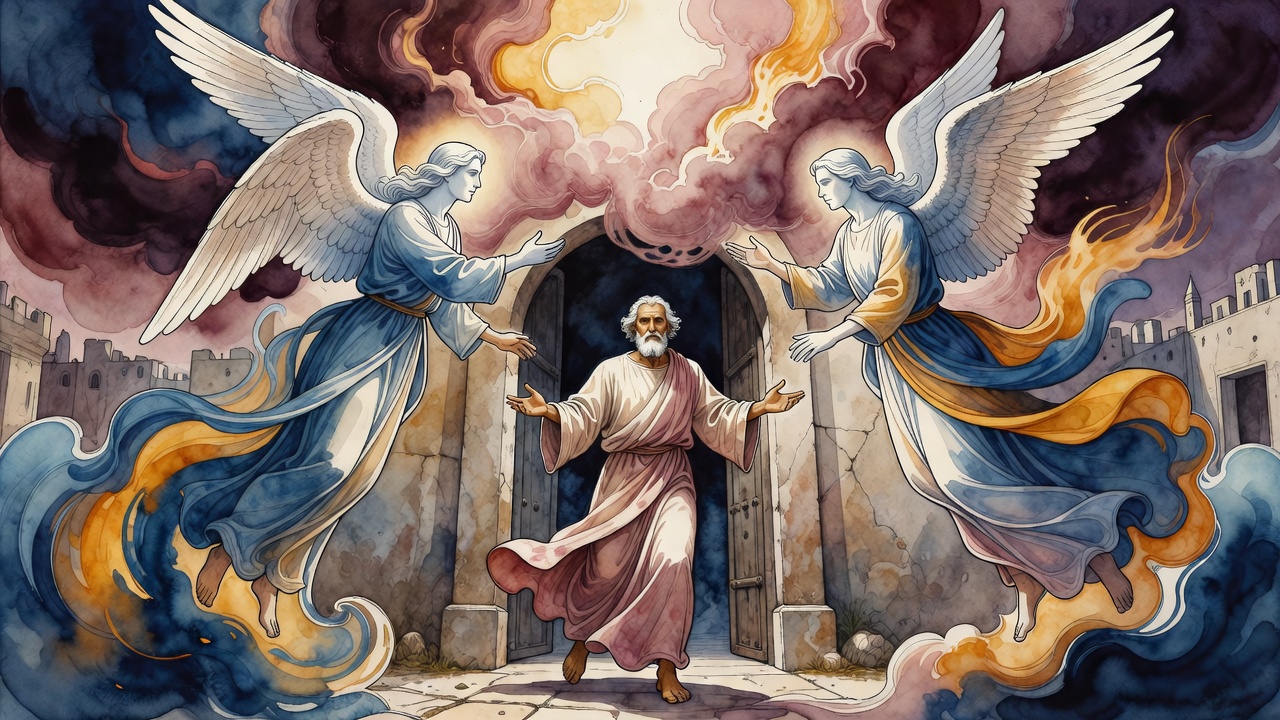
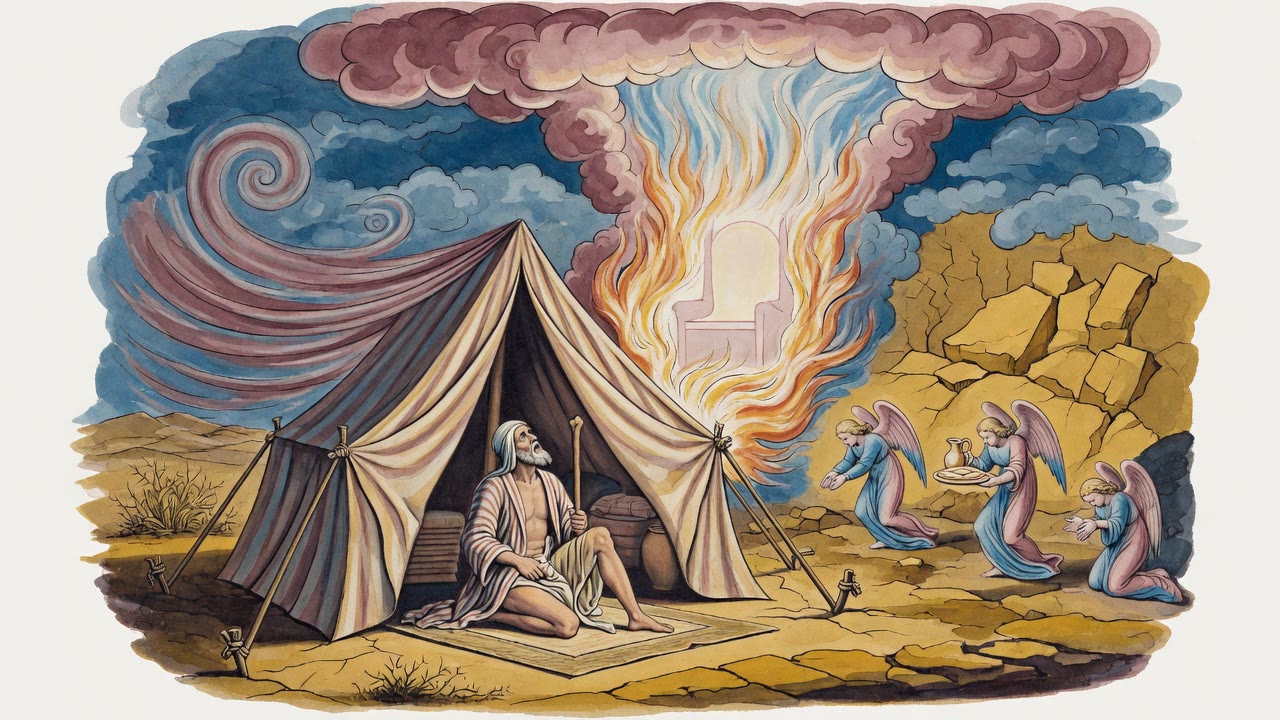
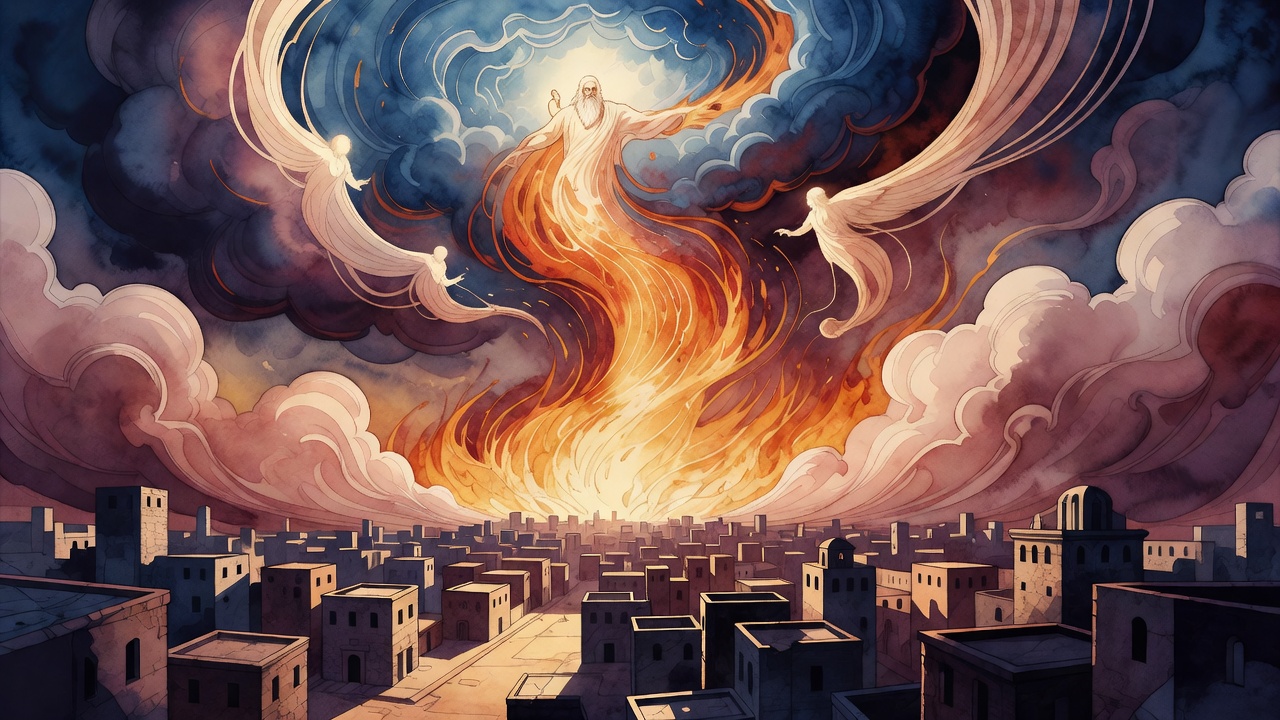
The sun went down on Sodom, and Lot was sitting in the gate where the judges sat, because that was where strangers entered, and where strangers entered they had to be stopped. Two travelers came through the dusk on the road from the hills. They wore the faces of men, but they were the two angels left over from the three who had eaten at Abraham's tent that morning. The first had already gone north to tell Sarah she would bear a son, and gone. These two had come down with the evening, one to overturn the city and one to pull Lot out of the wreck of it.
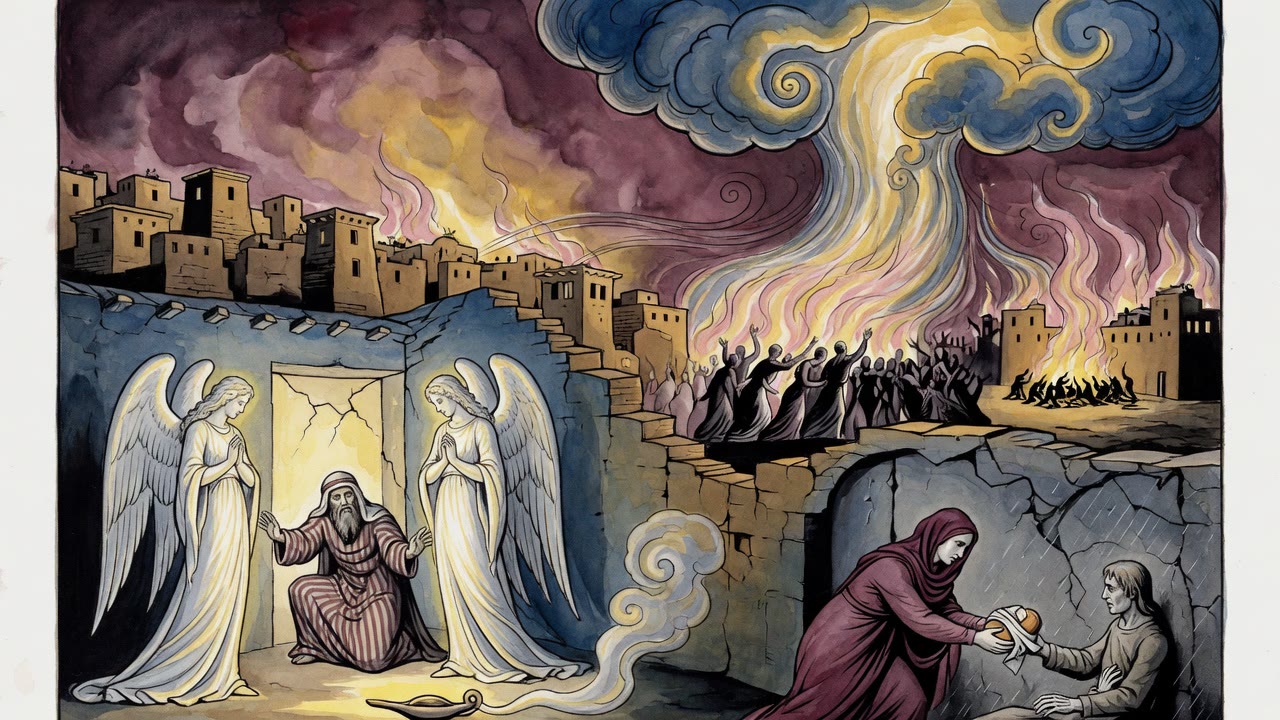
Lot saw them and ran. He bowed his face to the ground in the gateway and begged them. "Turn aside, I pray you, into your servant's house. Spend the night. Wash your feet." He had lived in this valley for years, and he knew exactly what the gate of Sodom did to a man who arrived after dark with no roof of his own.

The Hospitality Lot Stole From His Uncle

"No," the angels said. "We will spend the night in the square." It was the right answer to give. A man may refuse the request of someone beneath him, but not of someone above him, and the angels were testing whether Lot would let strangers sleep in the open the way Sodom wanted them to sleep, exposed, until the city's law could find them. Lot pressed. He took hold of them. He urged them so hard they finally turned and went into his house.

There is a saying. Rub against a man covered in oil and the oil comes off on you. Lot had rubbed against Abraham for years, watched him chase three strangers down to wash their feet and feed them bread. The greasiness had come off on him. So Lot baked unleavened bread that night and set a feast, and the angels, who do not eat, ate, because a guest does not refuse the custom of the house he enters. The doors closed. For one hour, inside one house in Sodom, a stranger was being fed, and that was a crime the city killed for.

The Law That Made Bread a Capital Offense

Sodom had passed it openly, cried it through the streets. "Anyone who puts a piece of bread into the hand of a poor man or a hungry one shall be burned." This was not cruelty by accident. The richest valley in the world, watered like the garden of the Lord, had reasoned its way to the conclusion that nothing was owed to anyone, that a hungry stranger at the gate was a thief of the city's abundance, and that mercy itself was the dangerous thing to be hunted down and put to the fire.

So the gate where Lot sat was not a welcome. It was a trap dressed as a threshold. The judges sat in it to catch exactly the kind of man Lot had just dragged across his own doorstep.

Plotit and the Jug at the Well

Lot had a daughter named Plotit, married into one of the great houses of Sodom. She had seen a poor man in the street, wasted to nothing, his body failing in front of her, and her soul turned over inside her. She could not put bread in his hand. The whole city would see. So she did it underneath the thing everyone watched her do anyway. Every day she went out to draw water, and every day, down in the jug among the rags, she hid a little of everything in her house, and she carried the water to the well and the food to the dying man, and she fed him.

He did not die. That was the problem. The men of Sodom looked at a starving beggar who kept on living and asked the only question their law allowed. "Who is keeping this one alive?" They watched. They followed the girl with the water jug. They found the bread under the rags.

The Cry That Reached the Throne

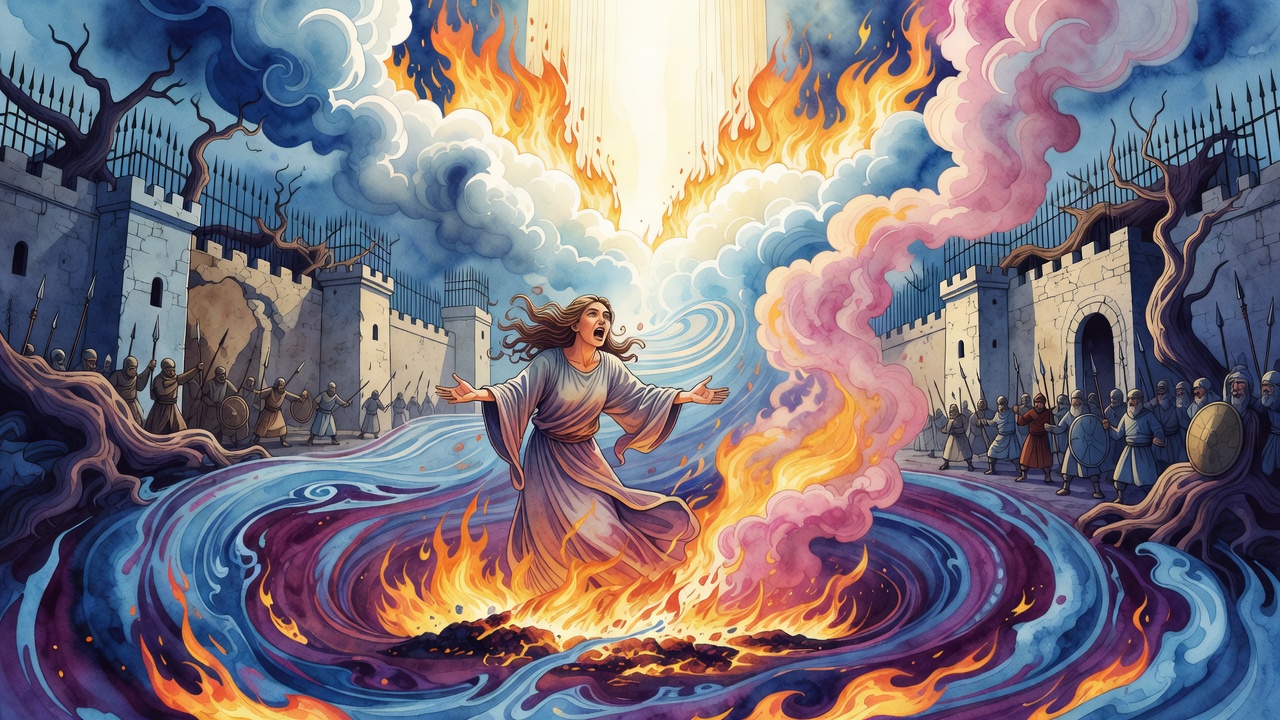
They brought Plotit out to be burned, with fire, the heaviest death they knew, the one they thought was reserved for the worst of sins. The fire was coming for the girl whose only crime was that a man she pitied was still breathing.

And Plotit lifted her face. "Master of the worlds," she said, "carry out my justice and my judgment." Her voice went up off that wall and did not stop at the clouds. It went up past the angels and stood in front of the Throne of Glory, one girl's cry, naming what had been done to her in the streets of the richest city on earth.

Then the word came down out of heaven, and it was strange, because it was singular. "Let Me go down now and see whether they have done altogether according to her cry." Not their cry. Her cry. The whole verdict on Sodom, the fire and the brimstone and the overturning of the foundations, hung on the outcry of one burned woman, and God said her name in it without saying her name. He had come down to see if the city had really done this. It had.

The Two Who Sat at the Feast Knowing

That is the night the two angels were spending inside Lot's house, eating bread they did not need, while outside the gate the city was busy being itself. One of them carried Sodom's death folded inside him. The other carried Lot's rescue. Neither could do the other's work, because an angel is sent for one thing and one thing only, and these two had been sent down the same road on opposite errands.

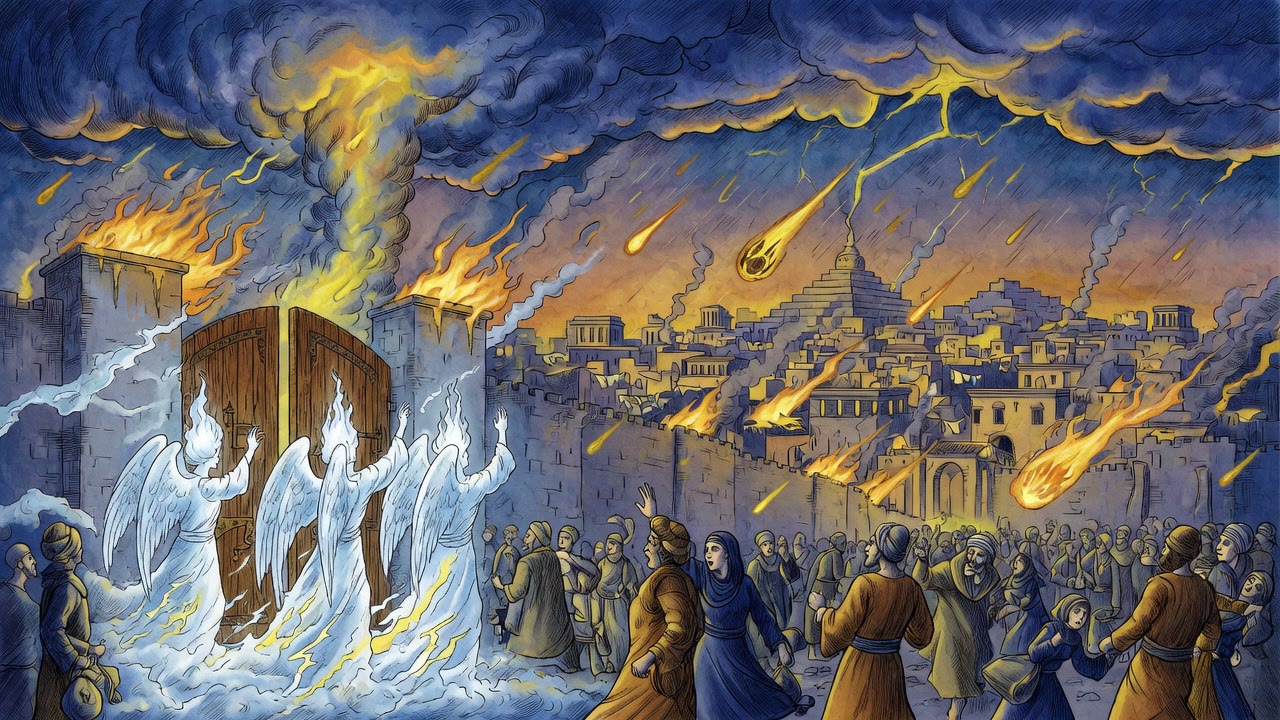
When the morning came they would seize Lot by the hand and his wife and his daughters and drag them out of the valley, not because Lot was righteous enough, but because far away Abraham had argued for him, and God remembered Abraham and sent Lot out of the middle of the overthrow. Then the fire fell, and the brimstone, on the gate and the judges and the well and the law that had burned a girl for hiding bread in a water jug.


← All myths
From the tradition

Sources

4 sources

The texts this telling draws on, in full. Open a card to read inline, or expand it for a wider, quieter read.

Midrash Tanchuma, Vayera 8Midrash Tanchuma

"And the two angels came to Sodom" (Genesis 19:1). What is written above this matter? "And Abraham drew near and said: Will You indeed sweep away?" Rabbi Pinchas the priest bar Chama said: The Holy One, blessed be He, does not desire to condemn any creature, as it is said: "For I do not desire the death of him who dies" (Ezekiel 18:32). And likewise He says: "For You are not a God who delights in wickedness" (Psalms 5:5). And He says: "As I live, says the Lord GOD, I do not desire the death of the wicked" (Ezekiel 33:11). And what does He desire? To justify His creatures, as it is said: "The LORD desires, for the sake of His righteousness" (Isaiah 42:21). Know this, that at the time the creatures sin and provoke Him, and He is angry with them, what does the Holy One, blessed be He, do? He goes back and seeks an advocate for them to plead their merit, and He provides a path before the advocate. And likewise you find in the days of Jeremiah, who said: "Roam about the streets of Jerusalem and look now and know, and seek in its broad places, if you can find a man, if there is one who does justice, who seeks faithfulness, and I will pardon her" (Jeremiah 5:1).

And likewise when the Sodomites sinned, He revealed it to Abraham so that he would plead their merit, as it is said: "And the LORD said: Shall I hide?" Immediately Abraham began to plead advocacy on their behalf, as it is said: "And Abraham drew near and said: Will You indeed sweep away the righteous with the wicked?" And "drawing near" refers only to prayer, as it is said: "And it came to pass at the offering of the afternoon sacrifice that Elijah the prophet drew near and said: O LORD, God of Abraham, Isaac, and Israel, etc." (I Kings 18:36).

"Will You indeed sweep away the righteous with the wicked?" What is its meaning? He said to Him: It is a harsh thing. Does a being of flesh and blood sweep away [indiscriminately]? Perhaps You too will thus sweep away the righteous with the wicked? Just as You judge the wicked, so You judge the righteous? "The blameless and the wicked You destroy?" "Far be it (chalilah) from You to do." It is written "chalalah," as you say: "A whore or a profaned woman (chalalah)" (Leviticus 21:7). Is it not profane (chol) for You? Thus did You do to the generation of the Flood and to the generation of the Dispersion? I am astonished. This is not Your way.

"From doing this thing" is not said here, but rather "like this thing" (cf. Genesis 18:25): neither this nor anything like it. "Shall the Judge of all the earth not do justice?" "Perhaps there are fifty, etc." And the LORD said: "If I find in Sodom." He opened and went down from fifty to ten, for ten have power to end the calamity. Since He did not find [them], "And the LORD went His way when He had finished, etc." What is written afterward? "And the two angels came to Sodom."

See the humility of the Holy One, blessed be He. Rabbi Berekhiah said: It is the way of the world that when two people are standing and conversing and one of them wishes to take leave of the other, the lesser one takes permission from the greater. And the Holy One, blessed be He, when He spoke with Abraham and wished to take leave of him, as it were He took permission from Abraham, as it is said: "And the LORD went His way." When? "When He had finished speaking," and afterward, "And Abraham returned to his place" (Genesis 18:33).

Immediately, "And the two angels came to Sodom in the evening." And where did the third go? Is it not written, "And he lifted up his eyes and looked, and behold, three men" (Genesis 18:2)? Rather, it comes to teach you that the three of them were sent on three missions. The one came to bring tidings to Sarah, and he said to her: "I will surely return to you at this season next year, and behold, Sarah your wife shall have a son" (Genesis 18:10). He performed his mission and departed. The second went to overturn Sodom, as it is said: "And he said to him: Behold, I have granted you favor concerning this matter also, etc." (Genesis 19:21). "We have granted you favor, we overturn" is not said here. And one came to deliver Lot from the midst of the overthrow, and each and every one performed his mission and departed.

Full source
Midrash Tanchuma, Vayera 9Midrash Tanchuma

And the two angels came to Sodom (Gen. 19:1). May it please our master to teach us the number of death penalties the Beth Din (the court of seventy-one members) was empowered to impose? Our masters taught us as follows: Four death penalties were imposed by the Beth Din: stoning, burning, decapitation, and strangulation. Which one is the most severe? The rabbis held that death by stoning was the most severe, since it was the punishment inflicted upon blasphemers and idolaters. R. Simeon the son of Yohai maintained that death by fire was the severest punishment because it was inflicted upon the daughter of a priest who was guilty of unchastity. Proof of the seriousness of unchastity is that it was punishable by death through fire. R. Joshua the son of Levi declared in the name of Bar Kappara that the Holy One, blessed be He, forgives everything but licentiousness. R. Judah the son of Nehemiah stated: The Holy One, blessed be He, rained fire and brimstone upon the inhabitants of Sodom, and burned them to death, because they committed acts of sexual immorality, as it is said: And the Lord caused to rain down upon Sodom and upon Gomorrah brimstone and fire (Gen. 19:24).

After they sinned, the Holy One, blessed be He, commanded his angels: “Go, destroy it.” Then they fulfilled their mission, as it is said: And the two angels came to Sodom. Scripture states elsewhere in allusion to this verse: He sent forth upon them the fierceness of His anger, wrath, and indignation and trouble (Ps. 78:49). What is meant by the fierceness of His anger? R. Simeon the son of Yohai said: Five plagues resulted from His anger, as it is said: How much more when I send My four judgments against Jerusalem, the sword and the famine and the wild beast and the pestilence (Ezek. 14:21). What is the fifth plague? The drought. How do we know this? R. Simeon the son of Yohai explained: It is written: The anger of the Lord be kindled against you, and He shut up the heavens, so that there shall be no rain (Deut. 11:17).

The word wrath (avera) indicates that He was filled with wrath against them, just as a pregnant woman (uvara) (is filled out). The word anger (zaam) implies that the Holy One, blessed be He, cursed them (from zaam = “curse”), as it is said: How shall I curse them whom the Lord hath not cursed? (Num. 23:8).

However, even when the Holy One, blessed be He, is angry, He remains merciful. He remembered Lot and rescued him because of the merit of Abraham, as is said: And it came to pass, when God destroyed the cities of the Plain, that God remembered Abraham and sent Lot out of the midst of the overthrow (Gen. 19:29). In the Mishnah (the earliest code of rabbinic law) it was said that one should save the Sefer Torah case as well as the Sefer Torah, and the tefillin (leather phylacteries worn during prayer) case as well as the tefillin. It teaches us: Happy are the righteous and those who cling to them. Scripture states: And God remembered Noah and every living thing and all the cattle (ibid. 8:1), all because of the merit of Noah. Similarly, God remembered Abraham and sent out Lot (ibid. 19:29). Woe to the wicked and to those who cling to them, as it is said: And He blotted out every living substance which was upon the face of the ground, both man and cattle (ibid. 7:23). It states: I will blot out man whom I have created (ibid. 6:7). The angels of destruction came as the emissaries of the Holy One, blessed be He, in order to destroy Sodom.

Full source
Midrash Tanchuma, Vayera 11Midrash Tanchuma

And the two angels came to Sodom … and he said: “Behold now, my lords, turn aside, I pray you, into your servant’s house, and tarry all night, and wash your feet” (Gen. 19:1–2). There is a proverb which says: Associate with a greasy man and you too will become greasy. Because Lot associated with Abraham he learned to welcome travelers. And they said: “Nay” (ibid.): From this episode our sages taught that one may refuse the request of one’s inferior but not of one’s superior. It is written concerning Abraham that he said: And I will fetch a morsel of bread, and stay ye your heart … and they said: “So do as thou hast said” (ibid. 18:5), but in reference to Lot it is written: And he urged them greatly; and they turned into his house … and they ate (ibid. 19:3). Surely, ministering angels do not partake of food. This was done only in order to teach us that proper behavior requires that no man should deviate from the custom of the land. You learn this lesson from Moses as well. It is written that after he ascended the mountain: And he was there with the Lord forty days and forty nights, and he did neither eat bread nor drink water (Exod. 34:28). If it was customary to eat and drink there, he would have done so. Therefore concerning the angels who came to visit Abraham, to destroy Sodom and to rescue Lot, it is written: He made them a feast and baked them unleavened bread, and they ate (Gen. 19:3).

Full source
Yalkut Shimoni on Torah 83:3Yalkut Shimoni on Torah

Rabbi Yehudah says: They proclaimed in Sodom, "Anyone who hands a piece of bread to a poor or needy person shall be burned in fire." Plotit, the daughter of Lot, was married to one of the prominent men of Sodom. She saw a certain poor man, wasted away, in the street of the city, and her soul grieved over him. What did she do? Every day, when she went out to draw water, she would put into her jug some of everything that was in her house and feed that poor man. They said, "From where is this poor man living?" And when they came to know the matter, they brought her out to be burned. She said, "Master of the worlds, carry out my justice and my judgment!" And her cry rose up before the Throne of Glory. At that hour the Holy One, blessed be He, said, "Let Me go down now [and see] whether the men of Sodom have done according to the cry of this young woman; [if so] I will overturn its foundations." Scripture does not say "according to their cry" (ke-tza'akatam) but "according to her cry" (ha-ke-tza'akatah) (Genesis 18:21).

Full source