6 min read

Memukhan Offers Vashti's Head on a Platter

Drunk on matching goblets, Ahashverosh wants Vashti shown. Memukhan offers her head on a platter and seals the refusal into irrevocable Persian law.

Curated by Arthur · Told by Maggid ·
Table of Contents
  1. Goblets Matched to the King
  2. The Queen Who Would Not Walk In
  3. A Head on a Platter
  4. Angels Count the Offerings
  5. The Same Sentence, Returned
Memukhan Offers Vashti's Head on a Platter Click for full size

Goblets Matched to the King

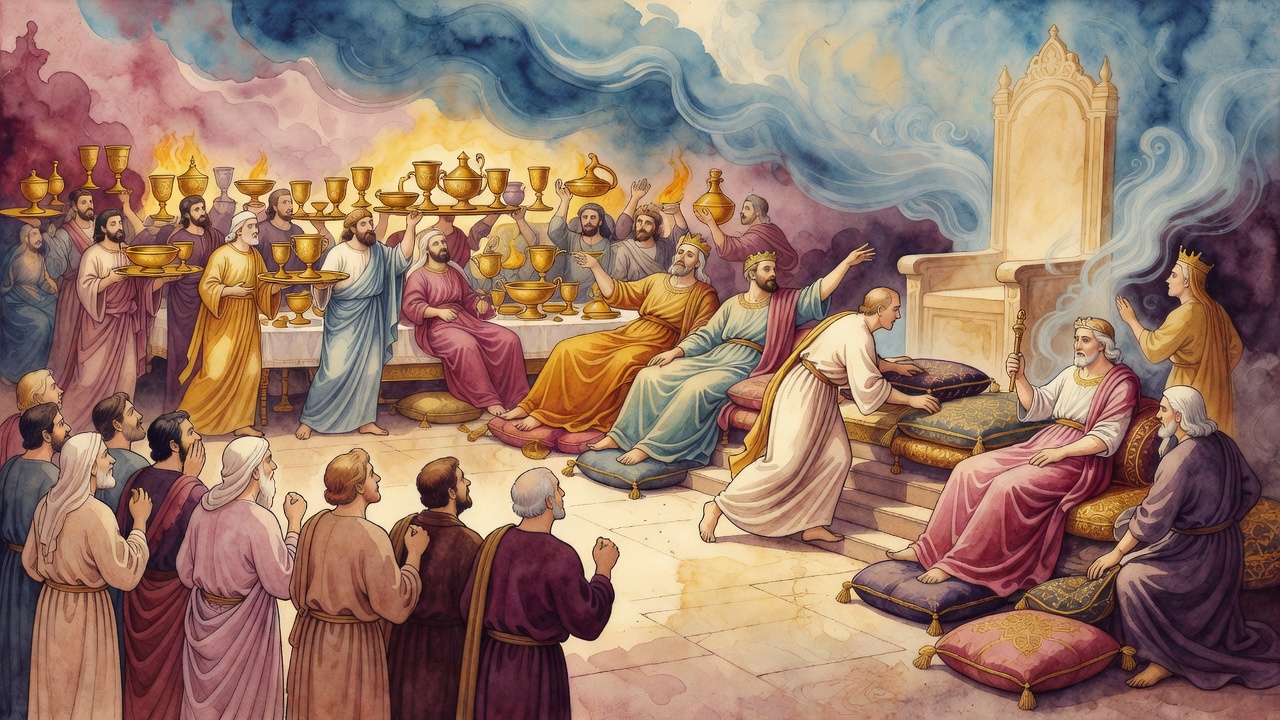
Ahashverosh lifted his cup and the stewards watched his hand. Whatever filled that royal goblet filled every goblet in the hall. Not like Belshazzar of Babylon, who drank in front of a thousand nobles while keeping the best pour for himself. The Persian king poured "according to the hand of the king," so each guest matched him cup for cup until the marble floor swam.
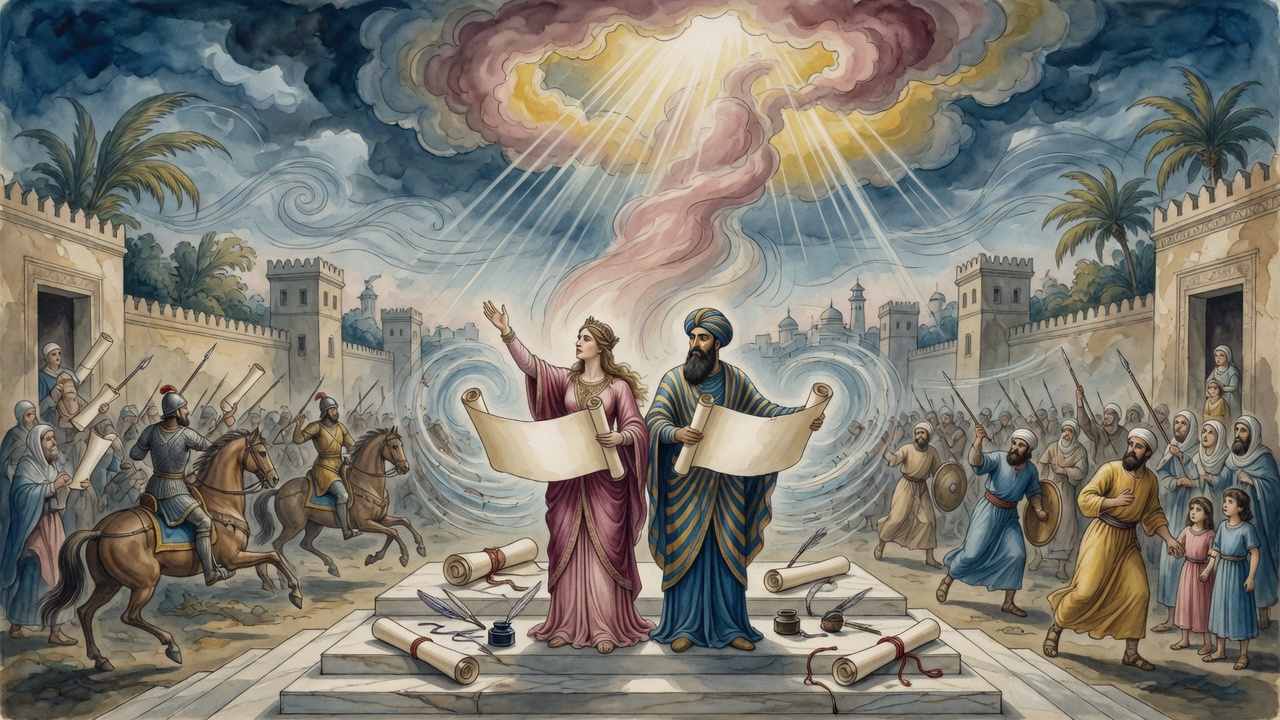
The drinking was as customary, without coercion. Medes ate first and drank later. Persians drank first. Kutites who would not take wine from skins received it in earthenware. No one forced the huge Persian goblet on a guest who did not want it. The house glittered with jewels and pearls. Children sat near their fathers. The comfort of that wicked man was complete.

Then the king wanted Vashti.

Musicians kept time with the pouring. A man who had come from a far province tasted the same vintage as the man on the throne and felt, for one night, that empire could be shared by the mouth. Lamps doubled in the wine's shine. The stewards moved like a second clock under the first.

The Queen Who Would Not Walk In

He sent for her to be brought wearing the crown, to show the peoples her beauty. She refused. The refusal cracked the feast open. The seven who stood closest to him leaned in: Karshena over the vetch, Shetar over the wine, Admata over the land surveys, Tarshish over the beryl house, Meres blending spices for the fowl, Marsena blending fine flours, Memukhan ready with everything his wife had prepared.

Those close to him brought the calamity close to themselves. They were household officers with little names that the midrash would later tear apart like roots. In that hour they were only men who smelled of wine and fear, because a queen had said no to a king who had just proved he could match the world cup for cup.

Ahashverosh's face went from flush to white. A feast built on matched generosity could not survive a matched refusal. Servants froze with pitchers half tilted. The silence after "no" was louder than the drums.

A Head on a Platter

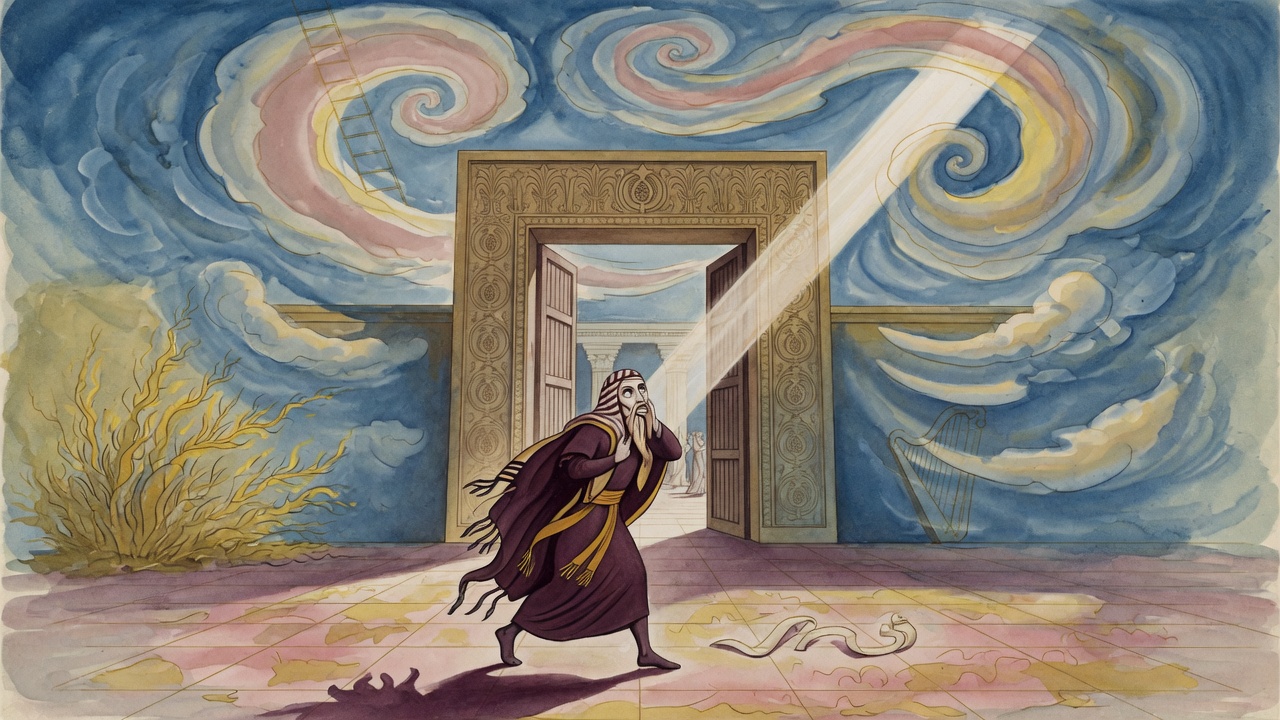
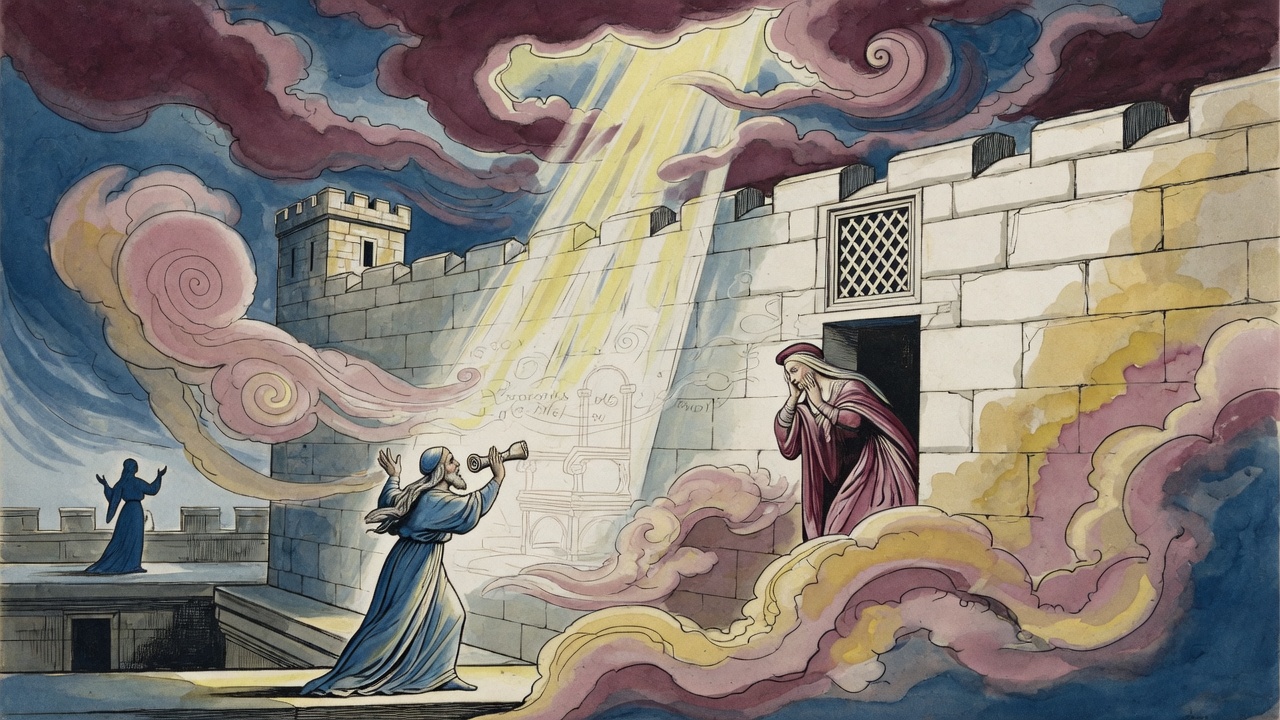
Memukhan spoke first, and the room tightened. "My master the king, let the word emerge from your mouth, and I will bring in her head to you on a platter." Not exile. Not a private divorce. A platter. He wanted the refusal written into the laws of Persia and Media so it could never be abrogated. Vashti would never enter the king's presence again. The queenship would pass to another worthier than she.

Ahashverosh liked words that could not be unsaid. The decree left his mouth. Scrolls would ride to every province. For one woman's refusal, every household in a hundred and twenty-seven provinces would be told who ruled the house.

Memukhan did not look at the empty place where a queen might have stood. He looked at the law as if it were already carved. Couriers would leave with sealed leather while the tables still held bread. Rav Huna would later call that sensibility warped. In the moment it felt to the king like order restored with iron.

Angels Count the Offerings

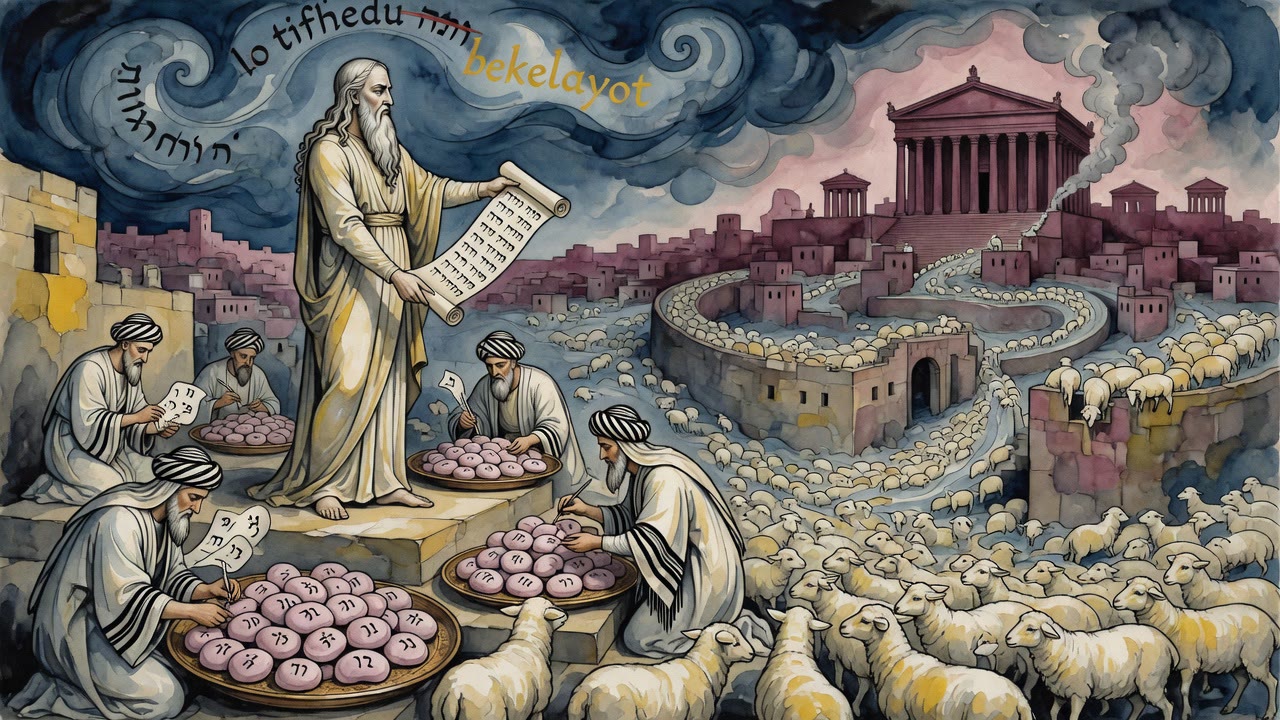
Above the banquet the ministering angels did not care about Persian etiquette. They stood before the Holy One, blessed be He, and named the seven counselors as if each name were a stolen Temple rite. If Ahashverosh's counsel stood, who would sacrifice the year-old bull? Who would offer two doves? Who would build an earthen altar? Who would wear the stones of the breastplate? Who would blend spices and fine flour and establish the altar on its foundations?

Karshena. Shetar. Admata. Tarshish. Meres. Marsena. Memukhan. On earth they were stewards of feed and wine and land. In heaven their names sounded like a ledger of what Israel still owed God. The angels' fear was not for Vashti's neck. It was for a world in which the people of the offerings vanished under a king's whim.

The angels' fear was not for Vashti's neck alone. It was for a world in which the people of the offerings vanished under a king's whim, and the smoke that rises from an altar went out for good. Heaven counted bulls and doves while earth counted goblets.

The Same Sentence, Returned

The Holy One answered for Israel with a list of endearments: My children, My companions, My intimates, My beloved, descendants of Abraham who loved Me. The horn of the people would be raised. On the ground, a different economy of words was already at work. The language that once took the kingdom from Esther's ancestor Saul, "and has given it to another who is worthier than you," was the same language Memukhan used to strip Vashti. The midrash hears the wound and the bandage in one formula. He causes pain and He bandages. He crushes and His hands heal.

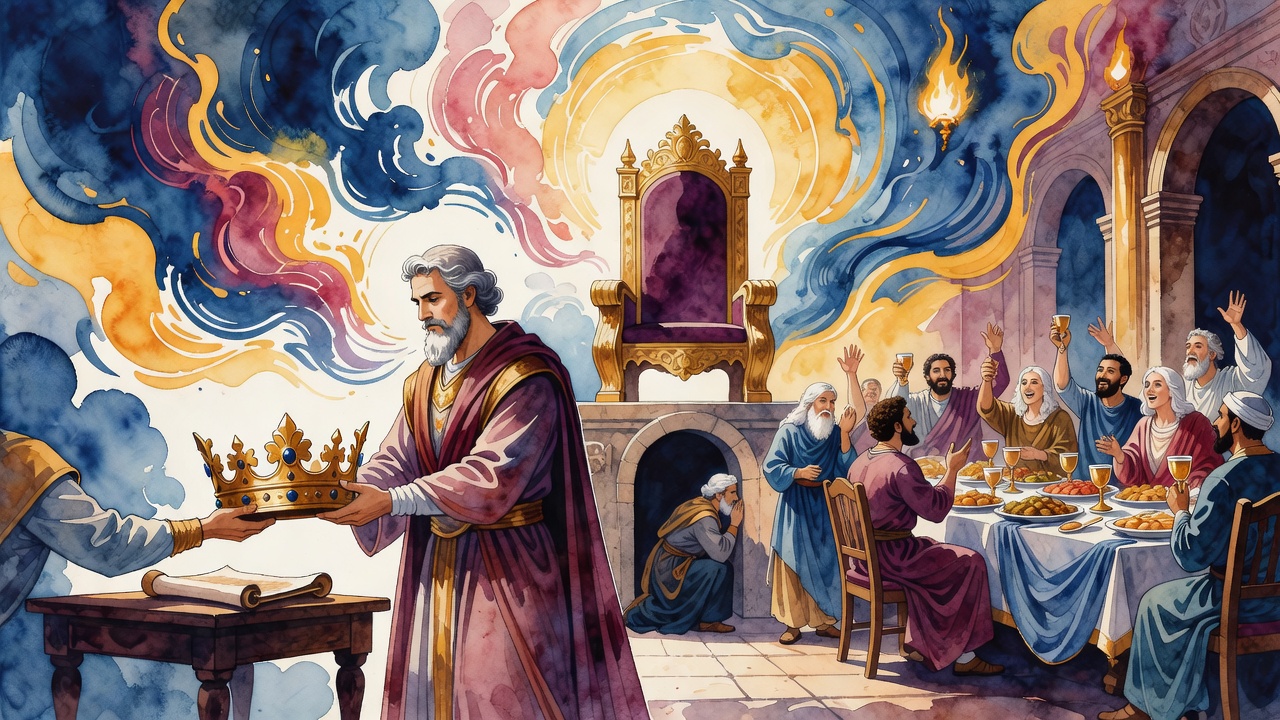
Vashti's head may or may not have reached a platter. The irrevocable sentence did. The feast that began with matched goblets ended with a law no Persian could break, and with a vacant throne waiting for a girl from the exile who had not yet entered the story.

Outside, the night air smelled of spilled wine and horses. Inside, Memukhan wiped his mouth and called it justice. The vacant seat waited for a woman who had not yet been named in the hall, and the irrevocable words rode out under Persian stars.


← All myths
From the tradition

Sources

4 sources

The texts behind this telling. Some cards carry a translation of the source; others are our own retelling of it, and each card says which. Every card links out to the original.

Esther Rabbah 4:9Esther Rabbah

Retold in our words. Read the original at the link below.The Sefaria Midrash Rabbah, 2022 · CC-BY

“If it please the king, let a royal edict be issued before you, and let it be written into the laws of Persia and Media, so that it cannot be abrogated, that Vashti shall never [again] enter the presence of King Aḥashverosh, and may the king grant her queenship to another who is worthier than she” (Esther 1:19).He [Memukhan] said to him: ‘My master the king, let the word emerge from your mouth, and I will bring in her head in to you on a platter.’ “And let it be written into the laws of Persia and Media, so that it cannot be abrogated…” – Rabbi Ḥanina son of Rabbi Abbahu said: It is written: “For He causes pain and He bandages; He crushes and His hands heal” (Job 5:18). In the language that [announced that] the kingdom was being taken from her [Esther’s] ancestor, as Samuel said to him [Saul]: “And has given it to another, who is worthier than you” (I Samuel 15:28), in the same language, the kingdom was returned to him [to Saul, through his descendant Esther]; that is what is written: “And the king will give her queenship to another who is worthier than she” [that being Esther].

Full source
Esther Rabbah 4:2Esther Rabbah

Retold in our words. Read the original at the link below.The Sefaria Midrash Rabbah, 2022 · CC-BY

“Those close to him” (Esther 1:14) – they brought the calamity close to themselves. “Karshena” – who was appointed over the vetch3A plant used as animal feed. [karshinin]; “Shetar” – who was appointed over the wine [shetiya];4Shetiya means drink. “Admata” – who was appointed over land [adama] surveying; “Tarshish” – who was appointed over the house [which was tiled with tarshish – beryl]; “Meres” – who would blend [memares] the [spices for the] fowl; “Marsena” – who would blend [memares] the fine flours; “Memukhan” – the chief food supplier, whose wife would prepare everything they needed.5It is not clear whether there is a play on words also with the name Memukhan. Perhaps his role is related to the word mukhan, meaning prepared. The ministering angels said before the Holy One blessed be He: ‘If the counsel of that wicked one [Aḥashverosh] is realized, who will sacrifice offerings before You?’ “Karshena” – who will sacrifice the year-old [shana] bull before You? “Shetar” – who will sacrifice two doves [shenei torim] before You? “Admata” – who will build an earthen [adama] altar before You? As it is written: “You shall make for me an earthen altar” (Exodus 20:21). “Tarshish” – who wears priestly vestments and serves before You? As you say: “A beryl [tarshish], and an onyx, and a chalcedony” (Exodus 28:20). “Meres” – who will blend [memares] spices for the fowl before You? “Marsena” – who will blend [memares] the fine flour before You? “Memukhan” – who will establish [mekhin] the altar before You? As you say: “They established [vayakhinu] the altar on its foundations” (Ezra 3:3).At that moment, the Holy One blessed be He said regarding Israel: They are My children, they are My companions, they are My intimates, they are My beloved, they are the descendants of My beloved, who is Abraham, as it is written: “Descendants of Abraham who loved me” (Isaiah 41:8). I will exalt their horn, as you say: “He exalted the horn for his people” (Psalms 148:14).6“Horn” in this verse is a metaphor for glory or renown.Another interpretation: “Karshena” – the Holy One blessed be He said: I will spread vetch [karshinin] before them and will eradicate them [mashiran] from the world. “Shetar” – I will give them to drink [lishtot] a cup of poison [tarela]; “Admata Tarshish” – I will make their blood [damam] flow as free as water [like the sea of Tarshish]. “Meres, Marsena, Memukhan” – I will stir [memares], twist [mesares], and crush [mema’ekh] their lives within their bowels. Where was the doom of all of them arranged? Rabbi Hoshaya said: It is from Isaiah the prophet, that is as you say: “Prepare a slaughter for his sons for the iniquity of their fathers, that they not rise and inherit the earth…” (Isaiah 14:21).

Full source
Esther Rabbah 2:12Esther Rabbah

Retold in our words. Read the original at the link below.The Sefaria Midrash Rabbah, 2022 · CC-BY

This teaching from Esther Rabbah, the midrashic commentary on the Scroll of Esther, examines the description of the great feast that King Ahasuerus held in his palace, where Scripture reports "abundant royal wine, in keeping with the king's bounty." The rabbis read every phrase of the Megillah closely, and here they compare Ahasuerus to an earlier monarch whose banquet ended in catastrophe.

The comparison is with Belshazzar of Babylon. Of him it is written, "King Belshazzar made a great banquet for his thousand nobles, and before the thousand he drank wine" (Daniel 5:1). The midrash notices a telling contrast in how the two kings drank. Belshazzar drank wine before his thousand nobles, that is, he drank in their sight while keeping the best for himself, displaying his greatness over them rather than sharing with them.

Ahasuerus, by contrast, served wine "in keeping with the king's bounty," which the rabbis read through a play on the Hebrew. The word for "in keeping with" sounds like "according to the hand of the king," and they take it to mean that the wine was poured according to the number of goblets in the king's own hand. In other words, Ahasuerus allowed each of his guests to drink exactly as much as he himself drank, withholding nothing. Where Belshazzar flaunted his superiority, Ahasuerus extended his generosity, letting his nobles match the royal portion cup for cup. The midrash uses the small grammatical hint to draw a moral distinction between two kings and two styles of rule.

Full source
Esther Rabbah 2:13Esther Rabbah

Retold in our words. Read the original at the link below.The Sefaria Midrash Rabbah, 2022 · CC-BY

“The drinking was as customary, without coercion, for so did the king establish with all the stewards of his house, to do as every man desired.” (Esther 1:8). “The drinking was as customary, without coercion” – in accordance with the custom of each place. There is a place where people wish to eat and then to drink, and there is a place where one drinks and then eats. According to the custom of every nation; like those Kutites, who do not drink wine from wineskins, they brought them wine in earthenware vessels. “Without coercion” – undiluted wine; Rav said: “Without coercion” – [no one was coerced] to drink wine of libation. Rabbi Binyamin Bar Levi said: There was no coercion [to drink] with a large goblet, because there [in Persia] they would drink excessively; therefore, there was no coercion to drink from a large goblet.15It was customary for Persians to drink from an unusually large cup. “For so did the king establish [yissad]” – Rabbi Shmuel bar Naḥman said: Come and see the comfort of that wicked one, as his house was ornamented [meyusad] with jewels and pearls. “With all the stewards of his house” – to arrange for the prominent subjects of the kingdom, so each and every one of them would be able to enjoy himself with his children and the members of his household.

Full source