5 min read

Moab and Midian Feared the Power in Israel's Mouth

Old enemies joined forces when they learned Israel's strength lived in prayer, so Balak searched for a mouth that could curse.

Curated by Arthur · Told by Maggid ·
Table of Contents
  1. The Old Hatred Bent Under Fear
  2. The Enemy Became Useful
  3. Balak Bought a Mouth
  4. Israel Sought the Presence
  5. The Curse Met the Path of Prayer

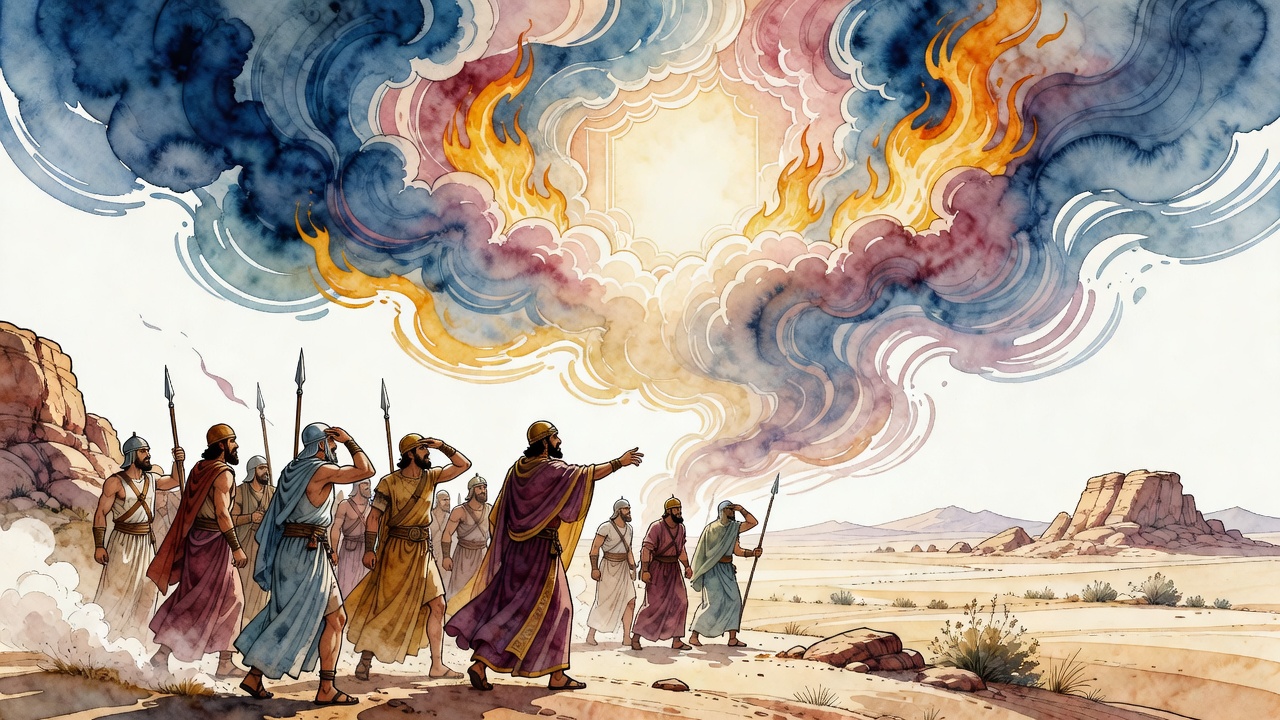
Moab smelled Israel before it understood Israel. The camp had crossed battle after battle and left kings flattened behind it. Sihon was gone. Og was gone. The land around Moab felt suddenly thin, like grass before an ox's mouth.
The Old Hatred Bent Under Fear

Moab and Midian were no natural allies. Old memory held a wound: a Midianite king had once struck Moab in Moab's own field. Nations can keep such injuries alive for generations. Court messengers know which road not to take. Kings know which names sour the room.

Fear bent that memory. Balak looked at Israel and saw not a wandering people but a hunger moving toward his borders. If Moab waited alone, the force that had swallowed stronger kings would arrive at his fields next. A hated neighbor was still a neighbor. A wolf at one door would soon learn the path to the other.

The Enemy Became Useful

So Moab sent for Midian. The old quarrel did not disappear. It was covered, like a blade under a cloak. Moab needed information. Moses had lived in Midian. His greatness had ripened there among people who had watched him before his name terrified kings. If anyone could explain Israel's strength, Midian might.

The answer came stripped bare. His strength is in his mouth. Not in iron. Not in numbers. Not in horses pulling chariots. Speech had carried Israel through danger: prayer, blessing, command, the mouth that stood before God and would not let go.

Balak Bought a Mouth

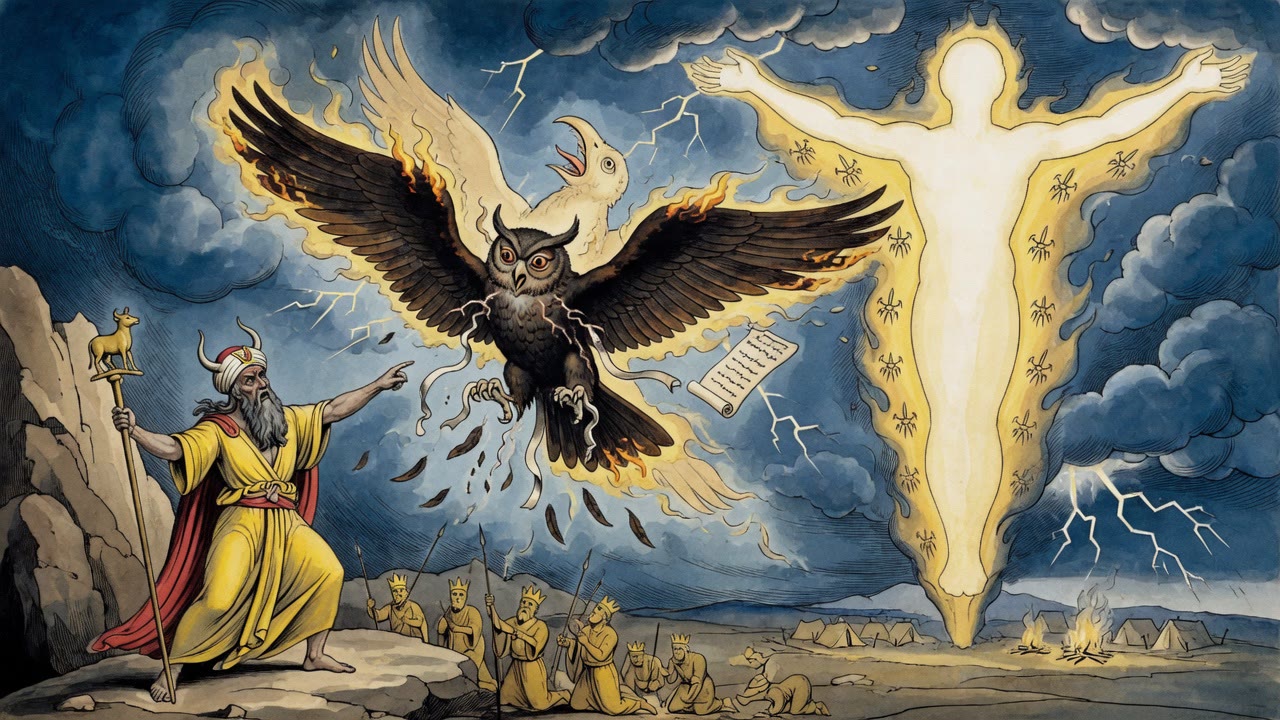
Balak understood the shape of the war. If a mouth opened the heavens, he would hire a mouth to close them. Balaam's value was not his sword arm. It was the terror people felt when his blessing or curse left his lips.

The alliance was ugly and practical. It resembled two fighting dogs when a wolf runs at one of them. The second dog does not become kind. It calculates. If the wolf eats my enemy today, it will have the strength to eat me tomorrow. So it bares its teeth beside the one it hated yesterday.

Balak did not want a battle song. He wanted a sentence shaped like a spear, aimed at the unseen place where blessing held the camp together. If Israel lived by speech, then one purchased speech might pry open the bond between heaven and the tents below. Fear made the plan feel logical. It also made it crude.

Israel Sought the Presence

Across the border, Israel's power was not a trick. A mouth can curse, but a mouth can also petition. In the hidden order of prayer, Israel turned toward the Shekhinah (שכינה), God's presence dwelling with them in exile. They did not storm the King's chamber as strangers. They spoke to the Presence that suffered with them and asked Her to seek the King with them.

That movement changed the battlefield. Moab imagined speech as a weapon purchased from outside the camp. Israel carried speech as dependence, hunger, and covenant. The mouth rose because the people could not save themselves by mouth alone. They needed the Presence to draw nearness down. That was the strength Midian named without fully understanding it.

The Presence was not distance dressed as royalty. She was nearness in exile, the chamber of divine attention turned toward the camp. Israel's mouth did not climb alone. It rose through relationship, through the Presence that carried their lack upward and drew mercy downward.

The Curse Met the Path of Prayer

Balak wanted a clean reversal. Bring the prophet. Pay the fee. Point his face toward the camp. Let speech strike speech until Israel's protection cracked.

But the war of mouths did not belong to Balak. A curse is not strong because a frightened king wants it. A blessing is not weak because it rises from tents in the wilderness. The mouth that prays is tethered to something higher than itself, and the Presence does not become an errand-runner for panic.

Moab and Midian stood together because fear had made old hatred too expensive. They had diagnosed one thing correctly: Israel's survival had a mouth at its center. They misread the rest. The mouth was not magic for hire. It was the edge of a people leaning toward God, and heaven leaning back.


← All myths
From the tradition

Sources

2 sources

The texts this telling draws on, in full. Open a card to read inline, or expand it for a wider, quieter read.

Bamidbar Rabbah 20:4Bamidbar Rabbah

Our story today, drawn from Bamidbar Rabbah 20, a section of the classical Midrash (rabbinic interpretive commentary), plunges us right into such a situation – a tale of Moabites, Midianites, a rising Israelite nation, and a king named Balak.

The setup? The Israelites, fresh off victories, are causing major anxiety for their neighbors. As (Numbers 22:4) tells us, "Moab said to the elders of Midian: Now this assembly will lick clean all our surroundings, as the ox licks clean the grass of the field."

Wait a minute. Why are the elders of Midian even there, in Moab? That’s the first question the Midrash asks. It seems a bit odd, doesn't it? Aren't these two groups usually at odds?

Bamidbar Rabbah suggests they were witnessing something extraordinary: Israel's seemingly unnatural victories. The Moabites, spooked, figured the Midianites, who had previous dealings with Moses, might have some insight into what made the Israelite leader tick. "Their leader achieved prominence in Midian," they reasoned, "we will ascertain from them what are his attributes."

And what did the Midianite elders reveal? "His power is only in his mouth." In other words, they believed Moses's strength lay in his ability to speak, to command, to perhaps even… pray. This is crucial.

But here's where it gets really interesting. The Midrash throws us a curveball: "Moab said to the elders of Midian – but do you not find that the Midyanites waged war against the Moavites, as it is stated: 'Who smote Midyan in the field of Moav' (Genesis 36:35), and the enmity between them is permanent." So why the sudden collaboration?

The Midrash offers a vivid analogy: two dogs fighting. A wolf attacks one, and the other dog realizes, "If I don't help him, the wolf will finish him off today and come for me tomorrow." Self-preservation trumps old rivalries. That fear, that common threat, forced Moab and Midian into an uneasy alliance.

The "licking clean" imagery is fascinating. The Moabites fear Israel will consume everything around them, like an ox devouring grass. But the Midrash takes it a step further: "just as the ox, its might is in its mouth, so, too, these, their power is in their mouths." Remember what the Midianite elders said about Moses? The Israelites’ power, according to this interpretation, wasn't just military; it was spiritual. It was in their prayers, their pronouncements, their very words.

And the ox imagery continues. "Just as the ox, in everything that it licks clean there will be no sign of blessing; these too, in every nation that they touch, there will be no sign of blessing." A bleak prophecy, suggesting that Israel's influence might leave a lasting, perhaps negative, impact on other nations. Furthermore, "Just as an ox gores with its horns; these, too gore with their prayers, as it is stated: 'And his horns are the horns of the wild ox' (Deuteronomy 33:17)." Their prayers, their connection to the Divine, are a force to be reckoned with.

Finally, the Midrash touches on Balak himself. (Numbers 22:4) identifies him as "Balak son of Tzipor," king of Moab. But was he always king? (Joshua 13:21) mentions him as a prince of Midian. Bamidbar Rabbah addresses this apparent contradiction. Drawing on other Midrashic sources, like Bamidbar Rabbah 20:25, which mentions Balak as the father of Tzur's daughter, it suggests that Balak ascended to the throne after Sihon was killed. The circumstances, the power vacuum, propelled him to leadership.

So, what do we take away from this Midrash? It's a story about fear, alliances of convenience, and the perceived power of a rising nation. It's about how those on the outside often misinterpret the source of strength within a community. And perhaps most importantly, it reminds us that even enemies can find common ground when faced with a shared threat. It leaves you wondering, doesn't it – what unlikely alliances are being forged right now, born out of fear and a desperate need for survival?

Full source
Tikkunei Zohar 43:6Tikkunei Zohar

The Tikkunei (spiritual repair) Zohar, a central text of Kabbalah, offers a powerful image of this very feeling. It speaks of Israel, the collective soul, seeking to petition the King – that is, God. But instead of addressing Him directly, they turn to Her.

Who is this "Her"?

The verse they recite comes from the Song of Songs (6:1): "Where has your beloved gone? To where has your beloved turned, that we may seek him with you?" They are addressing the Shekhinah, the Divine Presence, the feminine aspect of God. Think of it like this: God's presence is always with us, but sometimes, because of our actions, it feels distant, veiled. The Shekhinah is the aspect of God most intimately connected to the world, the one who suffers with us in exile.

Why do they ask Her? The Tikkunei Zohar answers: "For it is because of You, that He descends upon us." It's through the Shekhinah that the Divine blessing and presence manifest in our world. She is the conduit, the bridge between the infinite and the finite.

The text goes on to say, powerfully, "For He does not depart from us, except that we have not behaved respectfully towards You." Ouch. It's a direct link between our actions and the perceived distance from the Divine. When we act without reverence, without mindfulness, we create a separation, a barrier that obscures the light.

But it's not a permanent separation.

The Tikkunei Zohar continues, "For it is because of You, that He is held captive with us, all six days..." This is a profound and somewhat startling image. The Shekhinah, representing God's presence, is "held captive" with us during the week, during the mundane activities of our lives. This captivity is mirrored in the verse from Ezekiel (46:1): "...it shall be closed for the six days of work, and on the Sabbath day it shall be open, and on the day of New Moon, it shall be open."

What does this mean? The gates are "closed" during the week, symbolizing a diminished awareness of the Divine. We're caught up in the hustle and bustle, the distractions and demands of daily life. But on Shabbat, the Sabbath, and on Rosh Chodesh, the New Moon, the gates "open." These are times set aside for reflection, for connection, for consciously inviting the Divine Presence back into our awareness. These are moments where we can more easily reconnect with the Shekhinah.

So, what's the takeaway? Perhaps it's a reminder that the Divine isn't some distant, unreachable entity. God, through the Shekhinah, is intimately involved in our lives, even – especially – when we feel most disconnected. The key is to cultivate reverence, to act with mindfulness, and to create space in our lives for connection. To seek Her, so that we may find Him.

Full source