5 min read

Mordecai Named Every Fallen Oppressor to Esther

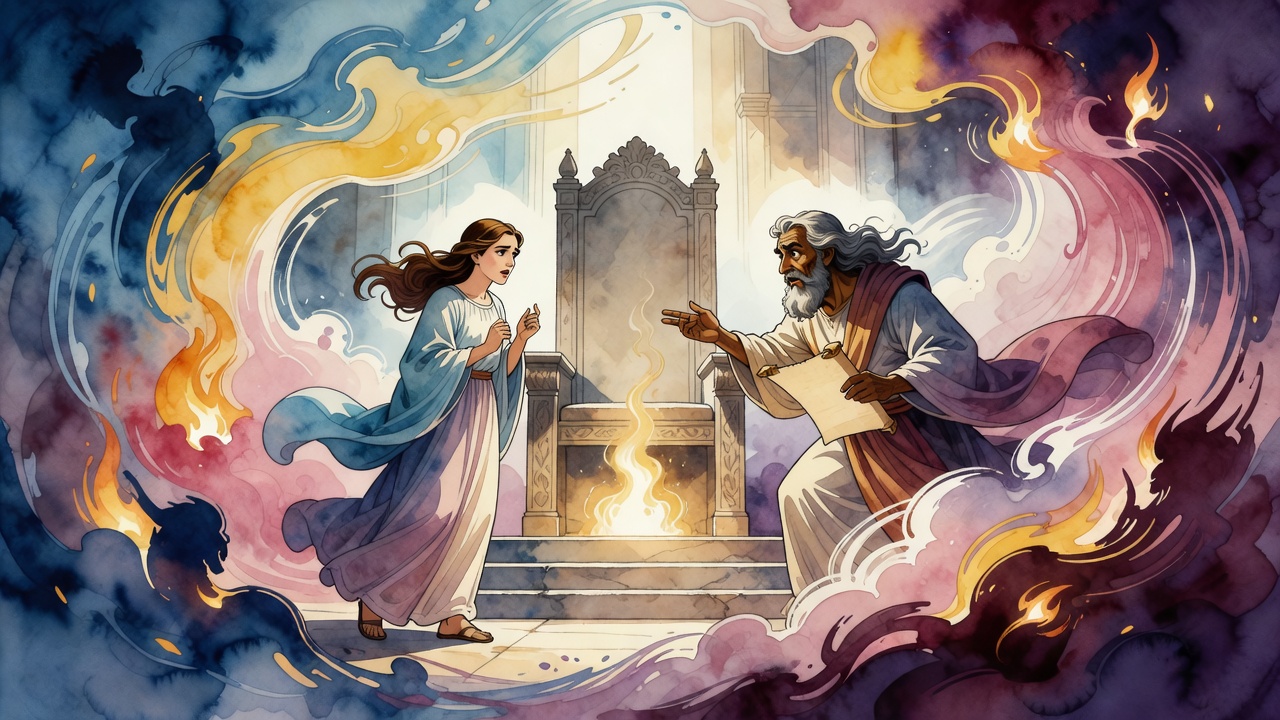
Esther hesitated before the throne. Mordecai answered with a catalog of vanquished enemies from Amalek to Sisera, and said the palace would not save her alone.

Curated by Arthur · Told by Maggid ·
Table of Contents
  1. Do Not Trust the Crown Alone
  2. From Saul's Mercy to Haman's Silver
  3. The Lamb Bound for Keeping
  4. Rise Before the Throne
Mordecai Named Every Fallen Oppressor to Esther Click for full size

Do Not Trust the Crown Alone

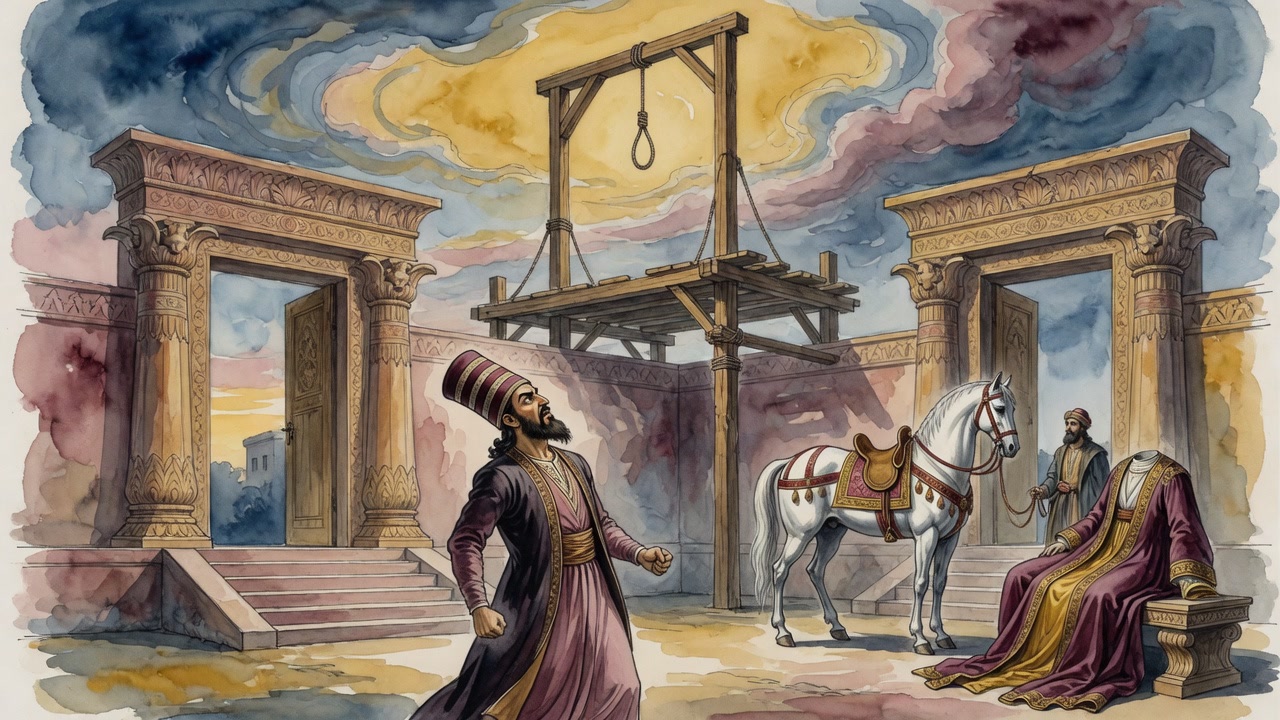
Word reached Mordecai that Esther hesitated to risk herself before the king. The palace walls felt thick enough to keep death outside. The law of death for uninvited approach felt thicker than the walls. Servants moved like shadows trained to forget what they heard. Mordecai answered with a warning shaped from the long memory of Israel's wars, not from court etiquette.

Do not imagine, he said, that the crown will shield you alone while the rest of your people are weighed like silver in a vizier's hand. If a single Jew is dragged into exile, the palace will not save you. Then he unrolled the catalog of fallen oppressors, name after name, until the present danger stood in a line of corpses that had once looked unbeatable from the height of their chariots and thrones.

From Saul's Mercy to Haman's Silver

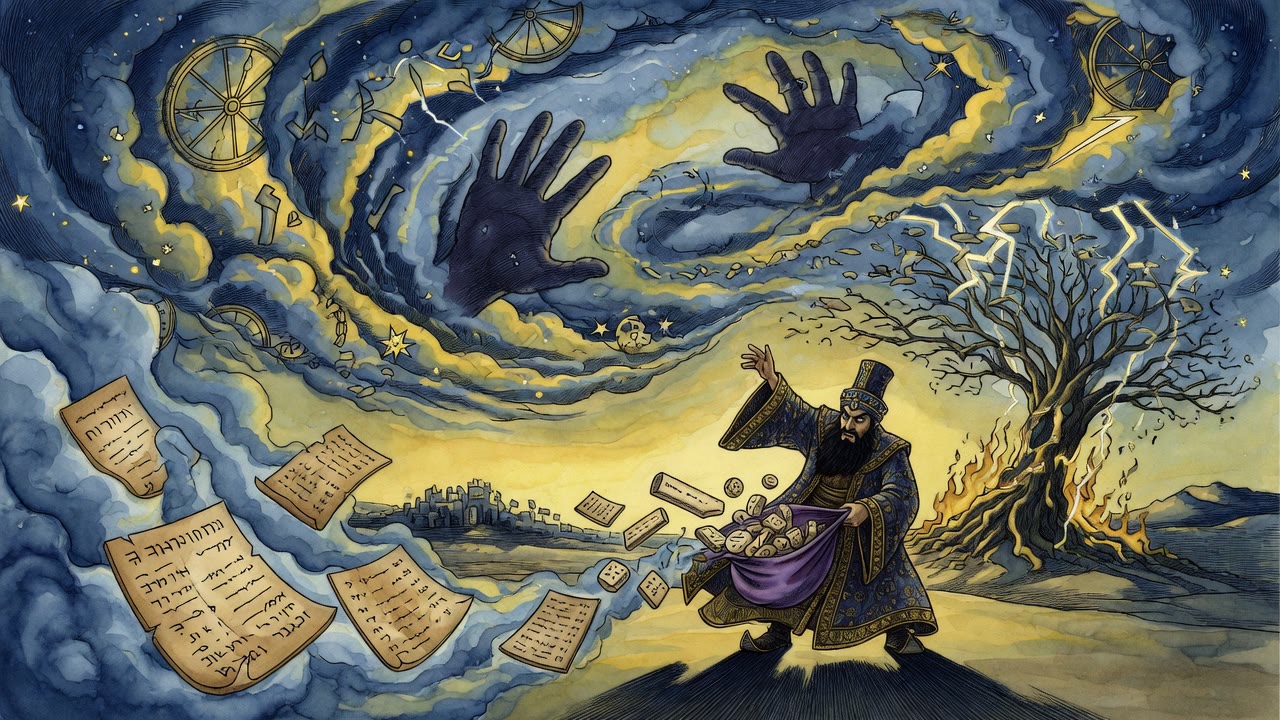
The present danger began with King Saul, who spared what the prophet Samuel commanded him to destroy. From that mercy the house of Amalek survived like a weed left in a field, and from Amalek came Haman, son of Hammedatha, who weighed out ten thousand talents of silver to buy Israel's death as if a people were a cargo that could be priced.

Amalek was the first to strike, warring against Joshua son of Nun at Rephidim while Israel was still raw from Egypt, until the prayer of Moses with raised hands blotted out his memory for a time. By whom is Haman strong, Mordecai pressed, making Esther see the pattern. By the thirty-one kings Joshua felled at heaven's word. By Sisera, who came with nine hundred iron chariots and dammed the rivers so Israel's wives could not purify and bear children, yet was delivered into a woman's hand and killed in a tent with a peg. By the giants who fought Israel and fell to David and his men. The God who judged the first will judge the last. Rise, and beg mercy from your Father in heaven before the silver finishes its purchase.

The Lamb Bound for Keeping

Long before Shushan, Israel tied Egypt's god to their bedposts from the tenth of the month, and Egyptians who saw the lamb bound felt their souls leave them in fear of a people who could leash what they worshiped. The lamb's taking on the tenth later stood for Israel at the Jordan, and its eating returned in Esther's day, when sleep fled from the king and the night became a courtroom. The same tenth cut down Haman and his ten sons on the wood he had raised for Mordecai.

God handed the month to Israel, not Israel to the month. Time itself could wait for the court that sanctifies it. The midrash names the final empire with the sharpest image: the lamb roasted whole, head and legs and innards, becomes the fourth kingdom with its dukes and wealth thrown entire into judgment, nothing left outside the fire. The first redemption was eaten in haste with belts tightened. The last one will not be flight at all. The LORD Himself will go before Israel, and haste will become procession.

Rise Before the Throne

Esther heard the catalog and the calculus until the palace shrank. Privilege was not a separate covenant written on gold. One Jewish body in chains would pull the queen's body into the same accounting, crown or no crown. Haman's silver sat on the scales opposite the memory of Sisera's chariots and Amalek's first ambush and thirty-one kings who also thought they would last. Mordecai did not offer comfort. He offered history with teeth, and a command disguised as kinship. The names he recited were not museum pieces. They were proof that Heaven had closed accounts before and would close this one too.

She would still have to walk the corridor. She would still risk the golden scepter's refusal and the law that killed the unbidden. But she would not walk it thinking her crown was thicker than the people outside the gate who fasted while she delayed. The God who dropped thirty-one kings and a general with iron wheels could drop a vizier who bought death with talents of silver and a smile at banquets.

Mordecai named the dead enemies so the living one would not look final. In Shushan a queen stood up because a cousin refused to let fear edit the past. Every fallen oppressor became a rung on the ladder she climbed toward the throne room, and the tenth day that once bound a lamb in Egypt found a new body for judgment in Persia's court. The scepter waited. So did the gallows. Between them walked a woman who had just been taught that history is a weapon if you remember it in the right order.


← All myths
From the tradition

Sources

2 sources

The texts behind this telling. Some cards carry a translation of the source; others are our own retelling of it, and each card says which. Every card links out to the original.

Targum Sheni on Esther 4:13:1-5Targum Sheni on Esther

Translation of the source text.Berlin, 1898 · Public Domain

And Mordecai sent word back to Esther: Do not imagine in yourself and say that I have been raised up to royalty to be queen, and do not think in your heart and say, I have no need to seek mercy on behalf of the house of Israel. For if the foot of even one of the Jews goes forth into exile, do not think in yourself that you will be delivered from the king's house out of all the Jews. From the dread of Saul, your father's father, who brought this evil upon Israel, for had he upheld the thing that Samuel the prophet told him, Haman the wicked would not have come forth against us from the seed of the house of Amalek. This son of Hammedatha would not have come forth against us, and would not have sold us for ten thousand talents of silver from the hands of King Ahasuerus, and the Holy One, blessed be He, would not have delivered Israel into the hands of two wicked men. For from the beginning none came against the house of Israel except Amalek, the father's father of Haman the wicked, and he made war with Joshua son of Nun at Rephidim, and through the prayer that Moses our teacher prayed the remembrance of the house of Amalek was blotted out. Now rise and seek mercy from before your Father who is in heaven on behalf of the people of the house of Israel, for He who executed judgment upon the first ones will execute judgment upon the last ones. By whom is Haman the wicked strong, or by whom is the decree upheld? By Amalek the father's father, who came against the house of Israel, and the Holy One, blessed be He, drove him out. By whom is he strong? He is strong from the thirty-one kings who came against the house of Israel, and Joshua son of Nun went out against them by the word of heaven and killed them. By whom is he strong? He is strong from Sisera. For he came against the house of Israel with nine hundred chariots of iron, and he held back against the house of Israel pools of water by some means, so that they could not immerse, and their wives could not go to their husbands, and they would not be redeemed and would not multiply in the world; the Holy One, blessed be He, delivered him into the hand of a woman, and she killed him. By whom is he strong? He is strong from the sons of the giants who came and made war with the house of Israel and were delivered into the hand of David and into the hand of his servants, and they killed them.
Full source
Yalkut Shimoni on Torah 191:3Yalkut Shimoni on Torah

Translation of the source text.Torat Emet (Yalkut Shimoni) · CC-BY-NC

From where do we know that days are not counted into years? As it is said, "for the months of the year" (Exodus 12:2): months you count for years, but you do not count days for a year. "This month shall be for you" (Exodus 12:2): it is handed into your hands, and you are not handed into its hand. An incident with Rabbi Chiyya the Great: the moon rose on the eve of Rosh Hashanah, and sailors walked by its light for three mil. Rabbi Chiyya saw it, took pebbles and dust, and threw them at it. He said: tomorrow we seek to sanctify you, and you have risen now? Immediately it was swallowed in its place. The Holy One, blessed be He, said to Israel: in this month you are redeemed. They said to Him: will You say that we are redeemed while we will be enslaved another time? He said to them: renew your deeds. Until now you had a head and a first. "Head" is the kingdom of Babylon, as it is said, "you are the head of gold" (Daniel 2:38), this is Nebuchadnezzar. "First" is Esau, as it is said, "the first came out ruddy" (Genesis 25:25).

"Speak to all the congregation of the children of Israel, saying: on the tenth of this month" (Exodus 12:3). Rabbi Yochanan said: is the lamb not best only straight from its fold? Yet you say from the tenth. Rather, this teaches that they would tie it to the legs of Israel's beds from the tenth, and the Egyptians would enter and see them, and their souls would fly from them. Rabbi Chiyya son of Rav Adda read, "Draw out and take for yourselves sheep" (Exodus 12:21): each one would draw out the god of an Egyptian and slaughter it before him, and the bedpost would speak against him. Rabbi Chelbo said in the name of Rabbi Yochanan: here it says, "on the tenth of the month," and there it says, "the people came up from the Jordan on the tenth of the month" (Joshua 4:19). Rabbi Chiyya said in the name of Rabbi Yochanan: its taking stood for them at the Jordan, and its eating stood for them in the days of Haman, "they shall eat the flesh on that night" (Exodus 12:8), and "on that night the king's sleep fled" (Esther 6:1). Rabbi Berekhiah said in the name of Rabbi Avin: "Let them take for themselves each man" means the Holy One, blessed be He, of whom it is written, "the LORD is a man of war" (Exodus 15:3). "A lamb for a father's house": Rabbi Yudan said in the name of Rabbi Simon: no person ever lodged in Jerusalem with sin in his hand, for the morning daily offering atoned for sins of the night, and the afternoon daily offering atoned for sins of the day. What is the reason? "Righteousness lodged in her" (Isaiah 1:21), read it as, a righteous one lodged in her.

Who exacts payment for you from Media? The tenth. Rabbi Avin said: the tenth came, when Haman and his ten sons were cut off. Who exacts payment from them? Their council, Mordecai and Esther, Mordecai outside and Esther inside. Who exacts payment for you from Greece? The sons of the Hasmoneans, who offered two daily offerings every day. Who exacts payment for you from the fourth kingdom? Natruna, and "it shall be for you as a keeping" (Exodus 12:6). "Do not eat any of it raw" (Exodus 12:9): do not seek it half-roasted. "Its head with its legs and with its innards" (Exodus 12:9): it and its dukes, governors, and generals, "your wealth and your merchandise" (Ezekiel 27:27). "And thus shall you eat it" (Exodus 12:11). Rabbi Shmuel bar Nachmani said: because in this world, "you shall eat it in haste" (Exodus 12:11), but in the time to come, "you shall not go out in haste, nor go by flight, for the LORD will go before you" (Isaiah 52:12).

Full source