Parshat Ki Tisa6 min read

Moses Buries the Five Angels of Wrath in Moab

Israel danced around the calf, and heaven sent five named angels to wipe out the nation. One man ran ahead of the executioners.

Curated by Arthur · Told by Maggid ·
Table of Contents
  1. The Letters Fled From the Stone
  2. The Race Against the Descending Angels
  3. The Oath Sworn on the Name
  4. The Plea of the Fathers' Three Deaths
  5. The Grave Sealed With an Oath

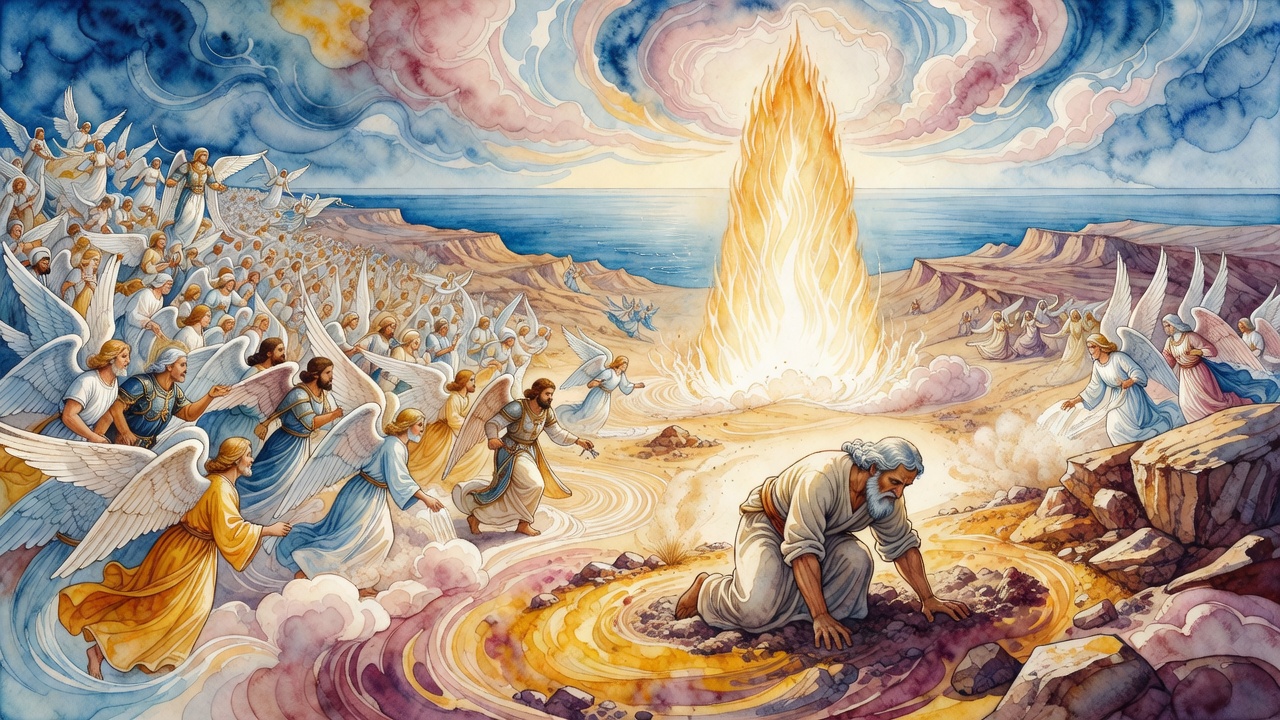
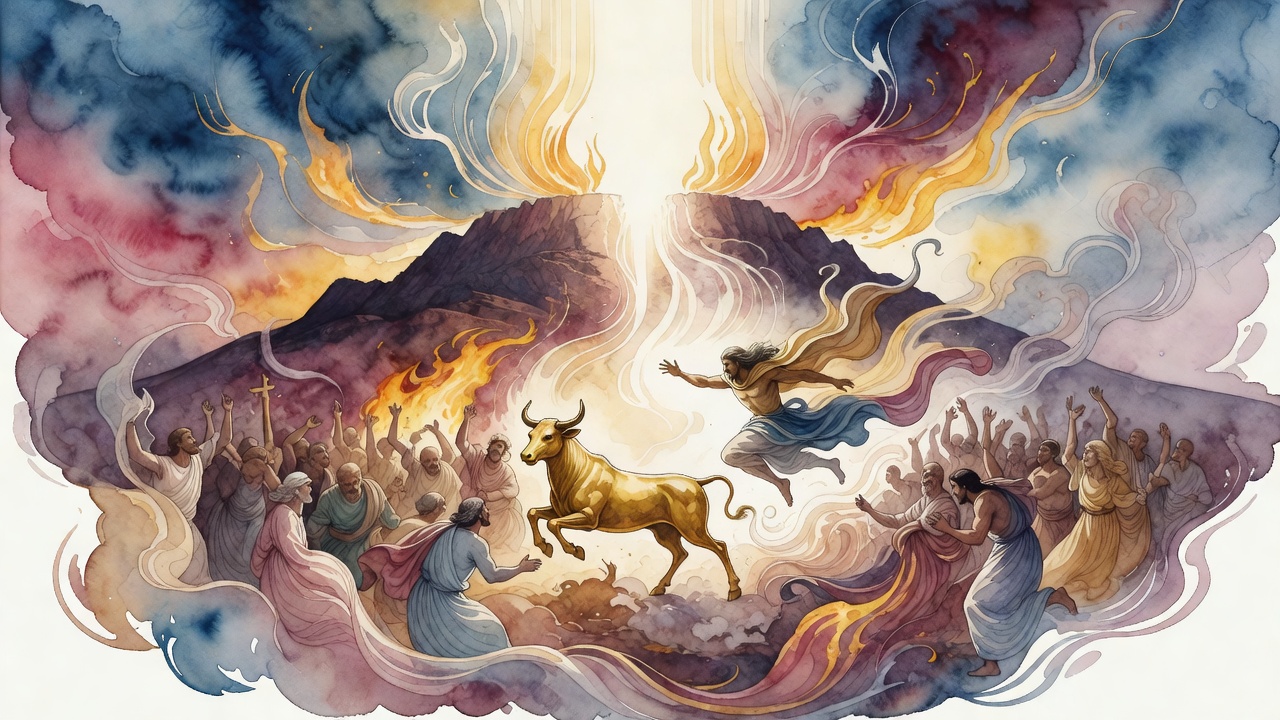
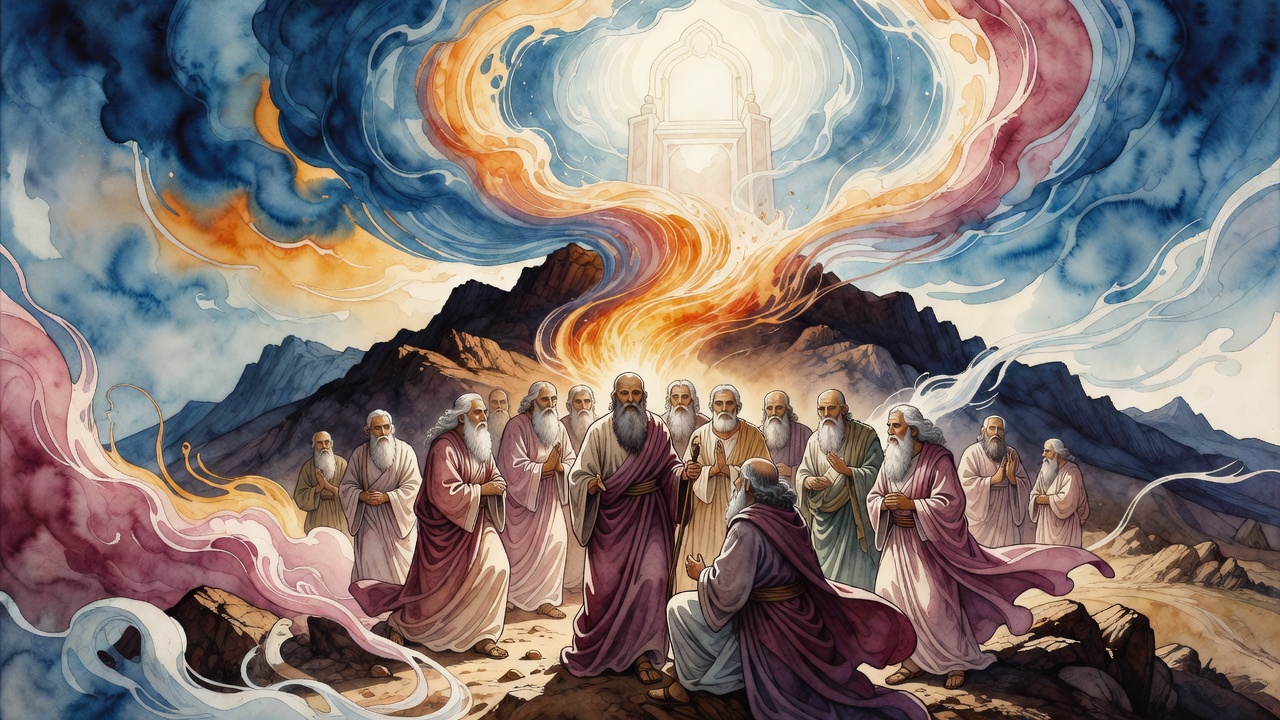
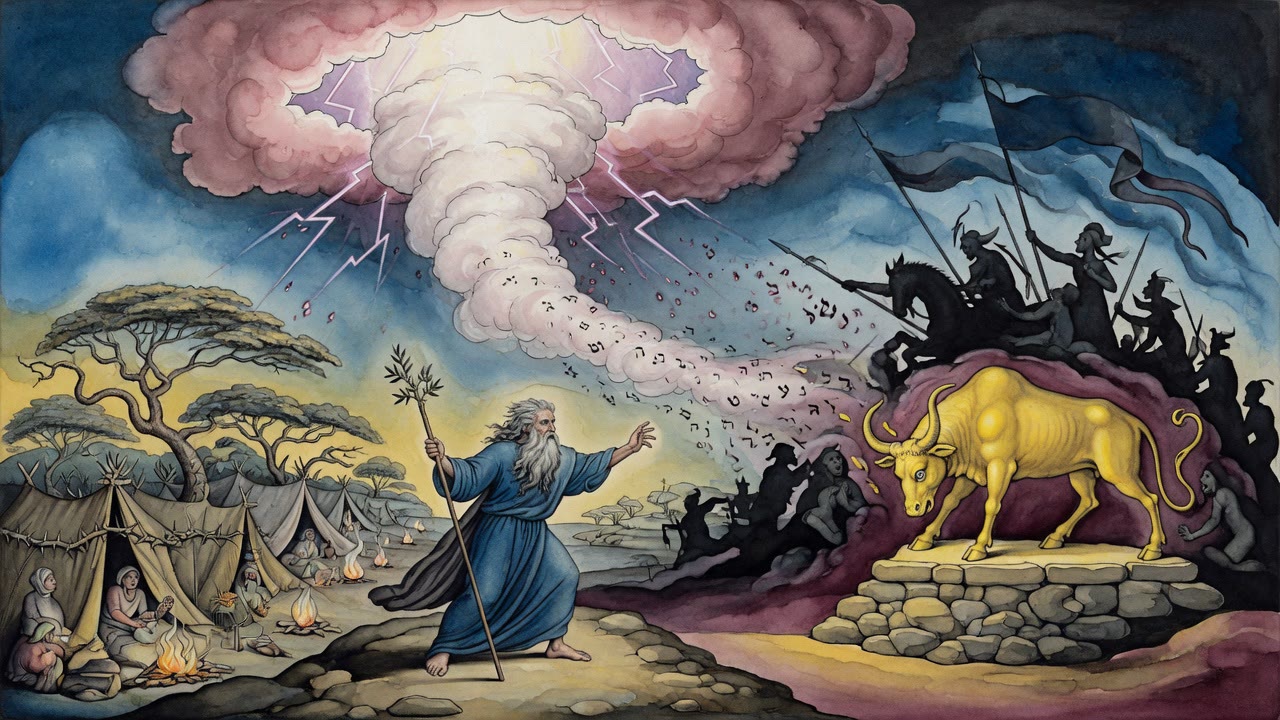
Moses was already halfway down the mountain when the sky split open behind him. The decree had gone out. Below, the camp still rang with music, gold catching the sun, the bull-shaped idol streaked with the smoke of sacrifice. Above, five shapes came down through the cloud like falling iron, and each one had a name.
Wrath. Burning. Relentlessness. Destruction. Indignation. Five angels of annihilation, dispatched not to warn Israel but to end it. The Hebrew of the verse only said that God was angry enough to destroy. The Aramaic translators heard that anger and gave it bodies, faces, and a target.

The Letters Fled From the Stone

Moses had carried the two tablets down from the summit, the writing of God cut clean through the stone front to back. Then he saw the calf, and the dancing, and the people he had pulled out of Egypt bowing to a thing they had melted in a fire.

His hands opened. The tablets fell. But before they struck the ground, the letters lifted off the stone and rose into the air, the sacred writing fleeing the slabs as though it could not bear to be present for what Israel had done. What hit the rocks was only stone. The words had already gone home. Moses stood holding nothing, and the five executioners kept descending.

The Race Against the Descending Angels

He did not run toward the people. He ran toward the Name.

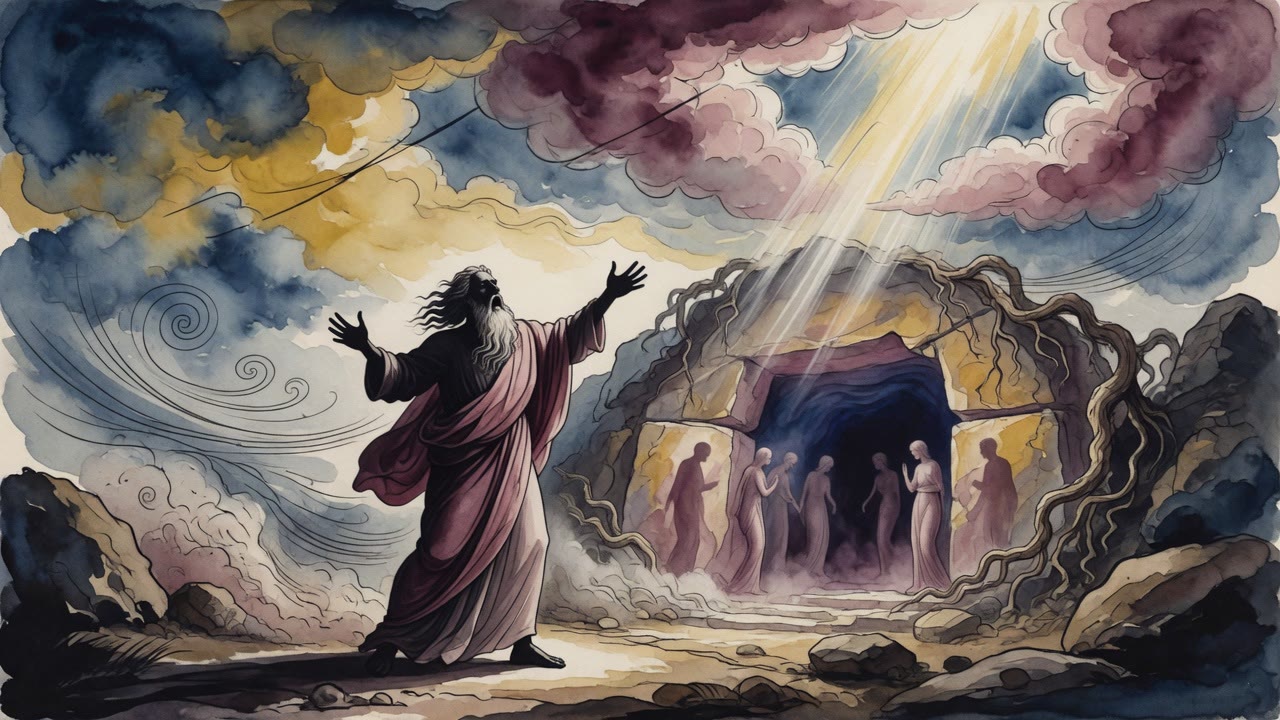
Moses made memorial of the great and glorious Name, the ineffable Name no mouth speaks, and he flung it up against the angels like a wall thrown across a flood. The Name does not change. It is not exchanged. It was the one thing in creation older and harder than the wrath coming down. And as the syllables left him, far off in the field of Machpelah the ground stirred over an old burial cave.

"Abraham, Isaac, and Jacob," Moses cried toward the graves, "awake from your slumber and behold your children." He had an argument ready, and it was not about Israel at all. It was about an oath.

The Oath Sworn on the Name

"You did not swear to them by the heavens and the earth," Moses said, "for the heavens vanish like smoke and the earth wears out like a garment. You did not swear by the sun and the moon, for the moon will be confounded and the sun ashamed. You did not swear by the mountains and the hills, for the mountains depart and the hills are removed. You did not swear by the sea, for in the end the sea is dried up." He let the list fall away, one perishable thing after another, until only one thing was left standing. "You swore by Your great and holy Name, which does not change and is not exchanged, that You would multiply their seed like the stars."

The dead patriarchs rose into prayer. Abraham, who had walked into a furnace for love of heaven. Isaac, who had laid his own neck on the wood. Jacob, whose years were few and evil, every one of them spent in exile. Three witnesses standing in the breach, and as they stood, three of the five angels were turned back. Relentlessness, Destruction, Indignation: restrained, halted in the air, sent no further.

But Wrath and Burning came on.

The Plea of the Fathers' Three Deaths

Moses fell on his face, and now he bargained against two angels for the body and breath of a whole nation. He matched each angel to a father and each father to a death already suffered.

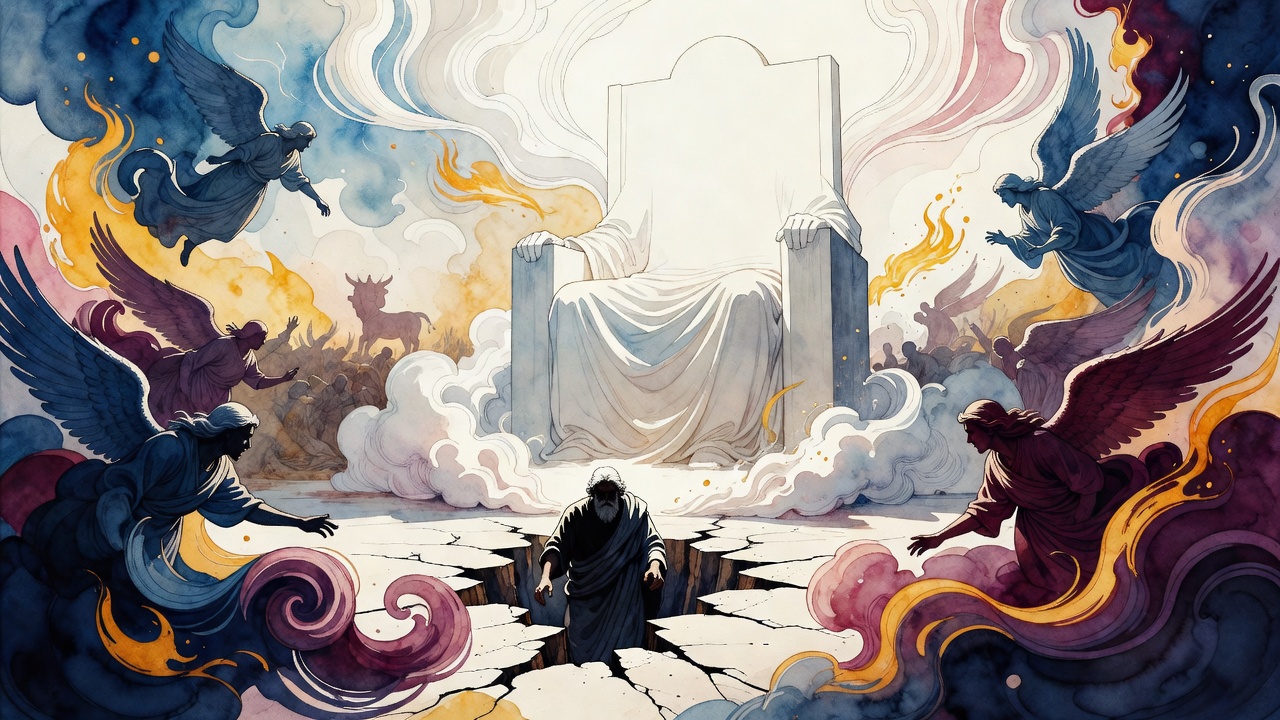
"If they are liable to burning," he said, "remember Abraham, who was cast into the fiery furnace for love of You and did not burn. If they are liable to slaying, remember Isaac, who gave his neck to the knife over the unity of Your Name. If they are liable to exile, remember Jacob, whose days were pains in a foreign land. For the sake of the fathers, forgive the sons." Fire answered fire. The merit of Abraham caught Burning by the wrist. The bared throat of Isaac stood against Wrath. And the two last angels, the most terrible of the five, stopped where they were.

Moses had multiplied his prayers until he was like a man sick thirty days, no strength left to stand. But the angels were no longer falling. They hung in the air over Moab, harmless now, drained of their commission, five instruments of heaven with nothing left to do.

The Grave Sealed With an Oath

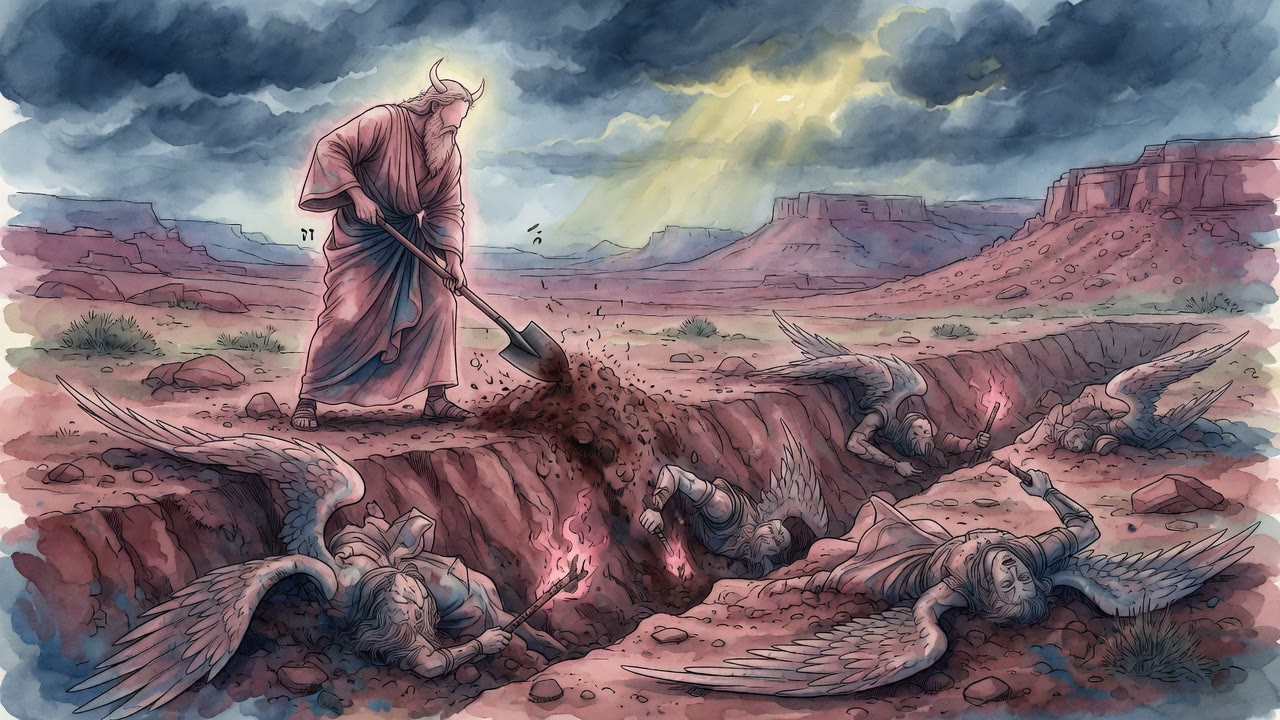
So Moses dug.

He dug a grave in the land of Moab, and into the earth he put the five angels of destruction, Wrath and Burning and Relentlessness and Destruction and Indignation, and over them he swore by the great and tremendous Name. He buried the wrath of God in the ground and sealed it with the same Name that had stopped it.

Then he turned back to the camp, where the work of the calf was not finished and the waters were already rising against the guilty. The tablets lay broken at the foot of the mountain, the letters gone, the people still dancing. But the sky above Moab was empty. Somewhere under the soil of a foreign country, five named angels lay buried beneath an oath, and the nation that had earned them was still, against everything, alive.


← All myths
From the tradition

Sources

3 sources

The texts this telling draws on, in full. Open a card to read inline, or expand it for a wider, quieter read.

Targum Jonathan on Deuteronomy 9Targum Jonathan

The Targum Jonathan on (Deuteronomy 9) contains one of the most dramatic expansions in all of Aramaic literature. When Moses recalls the golden calf, the Hebrew says God was angry enough to destroy Israel. The Targum names the instruments of that anger: five destroying angels, each with a name, Wrath, Burning, Relentlessness, Destruction, and Indignation.

Five angels. Sent to annihilate the entire nation. This is not in the Hebrew Bible at all. The Targum translators created an angelic hit squad to dramatize how close Israel came to extinction after worshipping the calf.

What happened next is even more remarkable. Moses heard the decree and "made memorial of the great and glorious Name", he invoked the ineffable Name of God. Then Abraham, Isaac, and Jacob rose from their graves and stood in prayer before God. Three of the five angels were restrained. But Wrath and Burning remained. Moses prayed again. They too were restrained. And then Moses "digged a grave in the land of Moab and buried them, swearing by the great and tremendous Name."

Moses buried the angels. He physically interred the forces of divine destruction in the earth, sealing them with an oath. The Targum is saying that somewhere in Moab, five angels of annihilation lie buried, neutralized by the prayers of the patriarchs and the courage of one man who knew God's Name.

The golden calf episode gets another addition. Moses says he "cast the two tables from my two hands and broke them. And you looked on while the tables were broken and the letters fled away." The letters flew off the tablets. The Hebrew says Moses broke the tablets. The Targum says the sacred writing itself escaped, as if the divine words refused to be present for Israel's shame.

The chapter ends with Moses on his face for forty days, bargaining with God. His argument is strategic: if you destroy Israel, the Egyptians will say "power failed before the Lord to bring them into the land." Moses does not appeal to Israel's merit. He appeals to God's reputation. It works.

Full source
Midrash Aggadah, Exodus 32:12Midrash Aggadah

"Turn from Your fierce wrath." Since he had multiplied supplications and was not answered, immediately Moses said: Master of the universe, You do not accept my prayer. Immediately he turned his face toward the cave of the patriarchs, and said: Master of the universe, remember those to whom You swore by Yourself. You did not swear to them by the heavens and by the earth, which pass away, as it is said, "For the heavens shall vanish away like smoke, and the earth shall wax old like a garment" (Isaiah 51:6); and You did not swear to them by the sun and the moon, which pass away, as it is said, "Then the moon shall be confounded, and the sun ashamed" (Isaiah 24:23); You did not swear to them by the mountains and by the hills, which pass away, as it is said, "For the mountains shall depart, and the hills be removed" (Isaiah 54:10); and You did not swear to them by the sea, for in the end it is to be dried up, as it is said, "And the sea shall be utterly dried up." Rather, You swore only by Your great and holy Name, which does not change and is not exchanged, that You would multiply their seed like the stars of the heavens. And now, Abraham, Isaac, and Jacob, awake from your slumber and behold your children! Immediately, "And the LORD relented of the evil which He had said He would do to His people" (Exodus 32:14).

Full source
Midrash Aggadah, Exodus 32:11Midrash Aggadah

"And Moses besought" (Exodus 32:11). He said before Him: Master of the Universe, why are You angry at Israel? The Holy One, blessed be He, said: Because they made the Calf. Moses said before the Holy One, blessed be He: Had You commanded them, they would not have transgressed Your commandments. He said to him: But did I not command them at the Ten Commandments? Moses said to Him: Master of the Universe, You commanded me, You did not command them, for You wrote in the Ten Commandments, "I am the LORD your God" (Exodus 20:1), a command to me and not to them; for had it been to them, You should have said, "I am the LORD your God, who brought you out." [So too:] "You shall have no other gods," "You shall not take up the name of the LORD your God," "Keep the day of the Sabbath," "Six days shall you labor and do all your work," "Honor your father and your mother," "You shall not murder," "You shall not commit adultery," "You shall not steal," "You shall not bear witness," "You shall not covet", if so, You did not command anyone but me.

And further Moses said: Master of the Universe, perhaps they made a calf but did not bow down to it? The Holy One, blessed be He, said to him: "And they bowed down to it." He said to Him: Perhaps they bowed down to it but did not sacrifice to it? He said: "And they sacrificed to it." [He said:] And perhaps they sacrificed but did not receive it as a god? He said to him: "And they said, These are your gods, O Israel." At that moment Moses became like a sick man who has been ill thirty days and has no strength to stand on his feet. Therefore it is said "vayechal", like illness [reading vayechal, "he besought," as from choleh, "sick"].

Another interpretation: "And Moses besought." Moses our teacher, peace be upon him, said: Master of the Universe, if they are liable to burning, remember Abraham, who was cast into the fiery furnace for love of You; and if they are liable to slaying, remember Isaac, who gave his neck to be slaughtered over the unity of Your Name; and if they are liable to exile, remember Jacob their father, all of whose days were pains in exile, as it is said, "few and evil" (Genesis 47:9), for the sake of the fathers, forgive the sons.

Another interpretation: "And Moses besought." He said before Him: Master of the Universe, far be it from You to uproot a nation such as this from the world. "Why, O LORD, should Your anger burn," etc. Remember for them what they believed at the Sea, as it is said, "And they believed in the LORD and in Moses His servant" (Exodus 14:31), and they accepted Your kingship over them willingly.

Full source