Moses Carried the Lamb Before God Called His Name
Before the burning bush, before the plagues, God watched Moses chase one exhausted lamb across the desert to find out what kind of man he was.
Table of Contents
 Click for full size
The Flock in the Wilderness of Midian
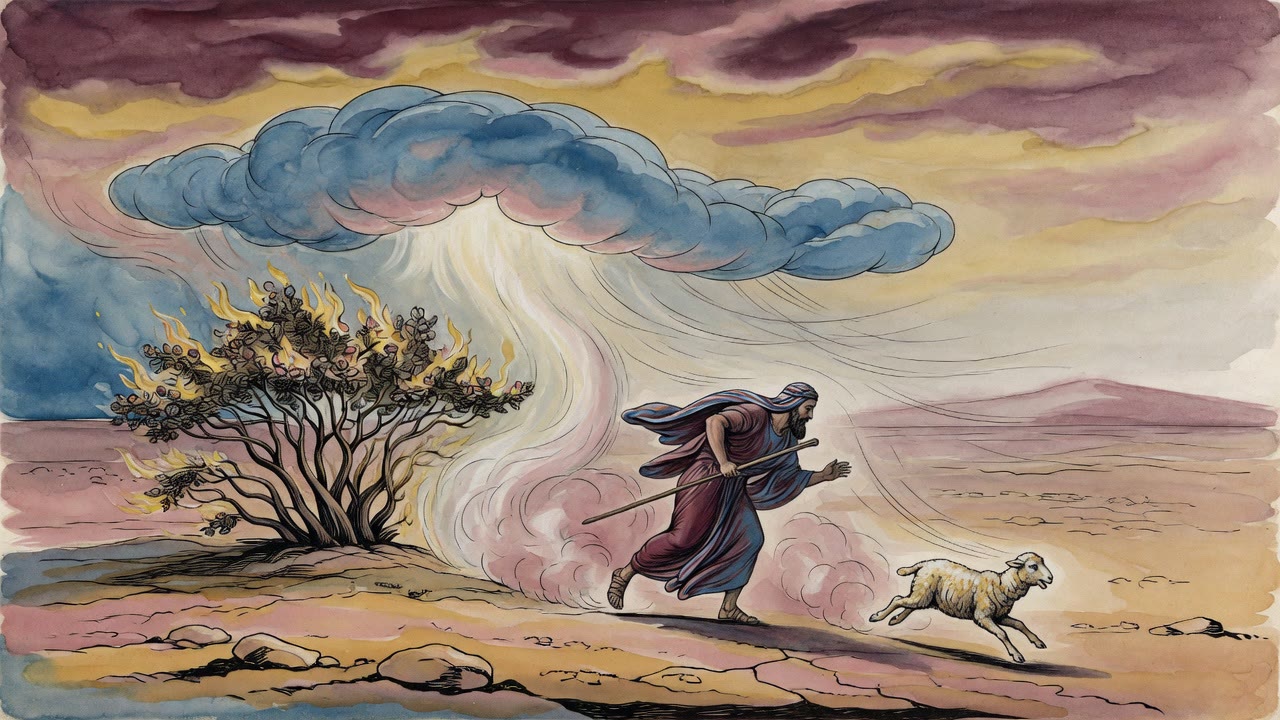
The lamb ran just before dawn.
Moses had been moving his father-in-law's flock in tiers the way a careful man feeds a household: youngest animals first, to the tenderest grass, where their small mouths could manage it. Then the older animals to the rougher growth. Then the full-grown adults last, to the tough, wiry tufts that the weak could not stomach. It was not an efficient way to graze a flock. It took longer and demanded more from the shepherd. But each animal got what it could actually use, not what was simplest to give, and Moses did it every morning without thinking much about it.
Then one young lamb broke from the back of the herd and ran.
It was not a panicked run, not a predator-flush. The animal simply went, veering off the path into open rough ground, heading away from the flock at a steady trot. Moses watched it for a moment. He could have let it go, or called the other animals forward and circled back later. Instead, he followed it.
The Long Chase
The ground was hard and uneven, thorn-scrub and loose stone, the kind of terrain that punishes a man's ankles if he moves quickly. Moses moved quickly anyway. The lamb did not slow. It kept its distance, not fleeing exactly, just going, as if it had somewhere in mind. The distance between them stayed roughly the same for a long time: too far to grab, close enough that turning back felt wrong.
He followed it across a dry wash, over a low ridge, and down the other side into a hollow he had not walked into before. There, at the bottom, a small pool had collected from somewhere, still and dark in the early light. The lamb reached it and stopped. It lowered its head and drank.
Moses stopped too, breathing hard.
He stood there watching the animal drink, and something he could not have named moved through him. The lamb was thirsty. That was all. It had smelled water from wherever water can be smelled in the desert, and it had needed to drink badly enough to run. Moses had not known. He had set the flock's course without knowing this one animal had a need the morning's path did not reach.
"You ran because you were thirsty," he said, not to anyone in particular. "You must be tired now."
He bent down. He lifted the lamb onto his shoulders and held its legs across his chest. Then he began the walk back, the lamb's weight settling against the back of his neck, warm and steady.
What God Saw From Above the Hollow
A voice came, not loud. The tradition holds it this way: God looked down at the man carrying the animal back across the rough ground and said, this is the one. The man who shows such mercy to a lamb, give him my flock (Exodus 3:1-4).
That word, mercy, is not soft in the original. It is the same root as the compassion a mother has for the child she formed. It names a response to someone else's helplessness that does not calculate whether a response is owed. Moses had not stopped to decide the lamb deserved his effort. He had simply gone. He had simply carried it.
The flock was Israel. The pasture was a generation in bondage. And the test was not given in a court or a council. It was given in an empty hollow, with nobody watching, over an animal that could not thank him.
Beloved by Every Living Thing
The praise that Ben Sira gives Moses in the second century BCE is unusual in its reach (Ben Sira 45:1). It does not say Moses was respected by the people or obeyed by the nations. It says he found grace in the eyes of all life. Not some life. Not human life. All of it.
The lost lamb is one answer to that claim. A man who adjusts his path for the youngest animals in his flock, who chases one thirsty creature into rough country and carries it home on his shoulders, is not simply a competent shepherd. He has arranged himself inside the world in a particular way. Things that cannot speak their need are not invisible to him. He notices the lamb the way he will later notice a slave people no one else notices, the way he will insist on arguing with God when the argument is costly (Numbers 11:2).
Ben Sira says Moses was beloved by God and by man, and that he is remembered for good (Ben Sira 45:1). The lamb was neither man nor God. The grace that extended to it is the grace that made the other two possible.
The Servant Who Slows the King Down
There is an older image of Moses that deepens what the lamb story reveals. A king, setting out to give inheritance to his son, tells his servant: stop me if I go too quickly. Not because the servant is wiser or more powerful. Because the king knows his own eagerness will outrun his judgment, and he trusts the servant to hold the pace.
God speaks to Moses through this image in the tannaitic tradition: Moses, you are the servant who slows the king. When Israel camps, you hold the ark. When Israel travels, you release it (Numbers 9:23). The momentum of the divine will is enormous. Moses is the man positioned to steady it against human need.
That is the same thing the lamb story says in a smaller key. Moses in the hollow, carrying an animal that cannot carry itself, is not performing virtue. He is being himself. And being himself, without audience, without calculation, is what God saw and wanted for the larger task.
Before the Fire
The burning bush did not come to a warrior or a prince. It came to a shepherd who was already late getting back to the herd. Moses arrived at Horeb with a lamb on his shoulders, having followed it farther than his route required, and the fire was already there, already burning and not consuming, already waiting for him to look up (Exodus 3:2).
He put the lamb down. He turned toward the fire. And the voice from inside it knew his name before he said a word.
← All myths