6 min read

Moses Placed God Even in the Empty Space

Yitro, Naaman, and Rahab climb toward one God. Moses goes further and names the Lord even in the empty space of the world.

Curated by Arthur · Told by Maggid ·
Table of Contents
  1. Yitro Stops at Greater Than
  2. Naaman Claims the Earth Alone
  3. Rahab Names Both Realms
  4. Empty Space and a Healing Tongue

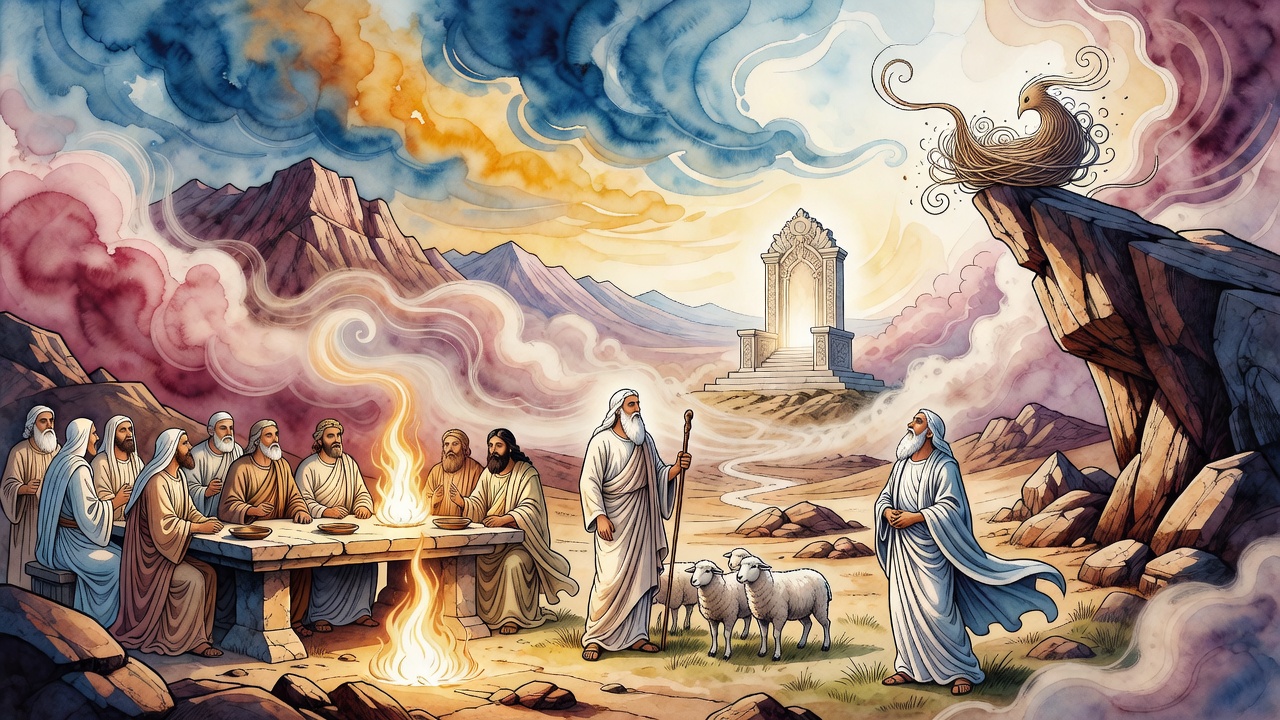
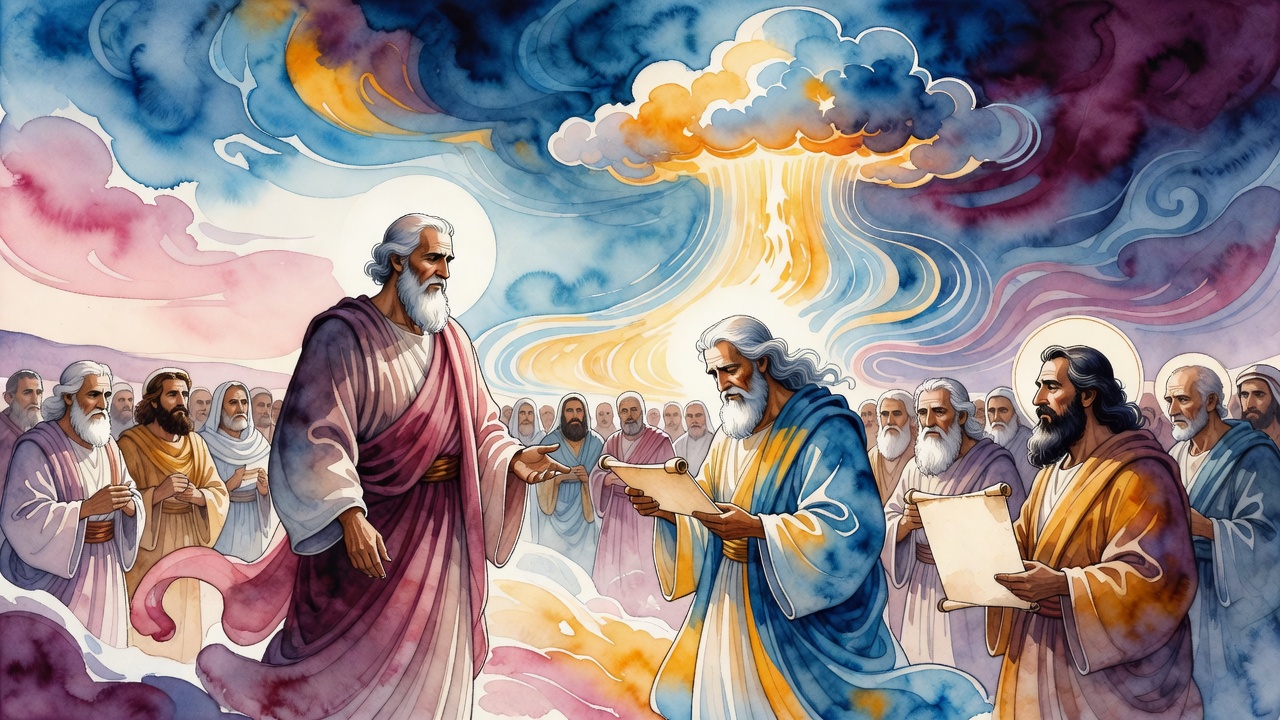
Moses stood on the far side of the Jordan with a nation that still remembered bricks and calves and quail that turned to plague. Wind moved the tents. He did not open with comfort. He opened with a sentence that left no corner for a rival god to hide. "Know this day, and restore it to your heart, that the Lord, He is God in heaven above and upon the earth beneath; there is no other" (Deuteronomy 4:39).
Moses Placed God Even in the Empty Space Click for full size

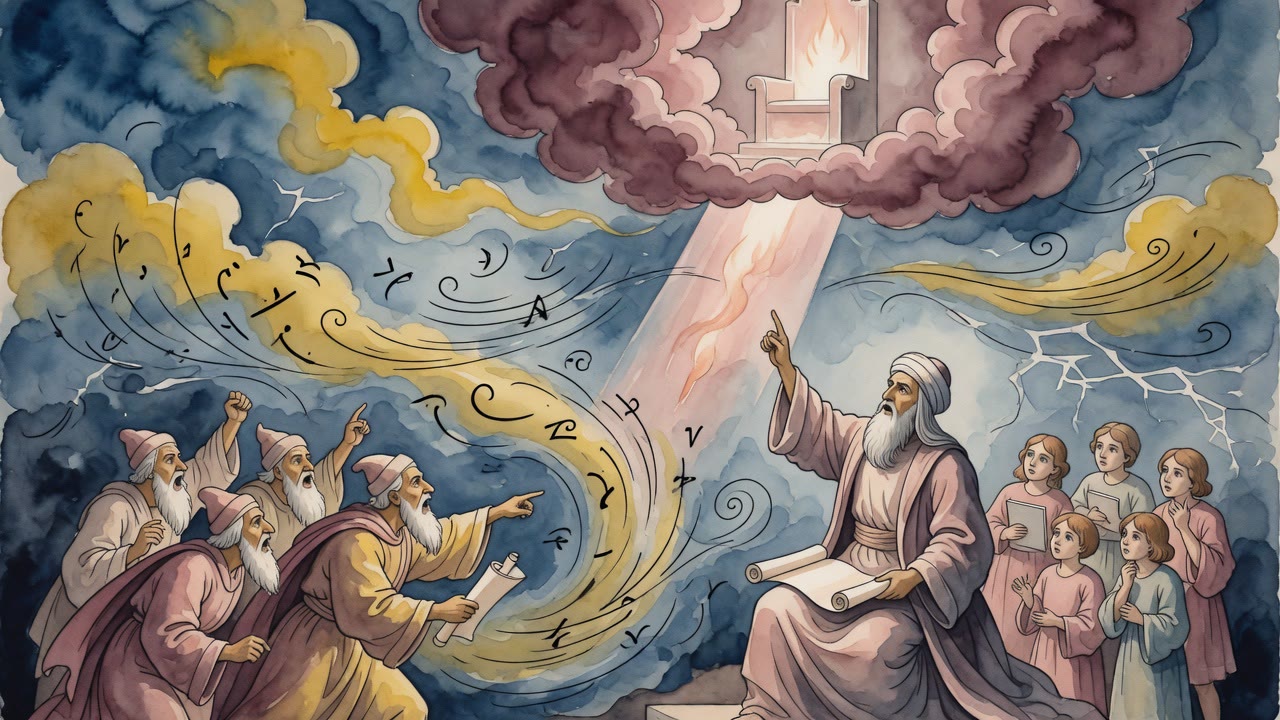
Then he pushed past the verse's edges. No other, even in the empty space of the world. Not only sky. Not only soil. The gaps between, the void where a frightened mind might invent a lesser power, the silence between stars. Full. A child in the front row blinked. An elder pressed a fist to his chest as if to keep the words from escaping.

Yitro Stops at Greater Than

Yitro had come out of Midian after the sea closed over Egypt's chariots. He heard what God did for Israel and brought Moses's wife and sons through the wilderness until the mountain of God rose in front of them. When he arrived he said, "Now I know that the Lord is greater than all the gods" (Exodus 18:11). Greater. The word still left other gods on the board, smaller pieces, but pieces. Yitro's mouth praised. Yitro's map of heaven still held neighbors.

He ate bread with the elders before God. Smoke from the sacrifice rose. He gave Moses counsel about judges and weary lines of petitioners who waited from morning until the sun fell. He was not a villain. He was a first rung. A man who had served many powers learned to rank the God of Israel highest and stopped there, honest and incomplete. Moses embraced him and still climbed higher in speech when the time came to teach the plains.

Naaman Claims the Earth Alone

Naaman, the Aramean general, came down from his pride into the Jordan seven times and rose with skin like a child's. Leprosy left him in the water. He stood dripping on the bank, armor stacked useless on the shore, and said, "Behold, now I know that there is no God in all the earth, except in Israel" (2 Kings 5:15). No God in all the earth. The claim was fierce. It still left the heavens unclaimed, as if another court might sit above the clouds with a different seal.

He wanted two mules' burden of Israelite earth to take home so he could bow on holy soil even in a foreign court. He bargained for partial exception when his king leaned on his arm in a house of idols. Healing had opened his mouth. Fear of palace politics still narrowed it. Earth he would cede to Israel's God. Heaven he left in a fog. Servants loaded the dirt. The general rode north with sacks thumping against the mules and a confession that stopped at the ground.

Rahab Names Both Realms

On the wall of Jericho, Rahab hid two spies under flax while the king's men searched the streets with torches. Her house clung to the wall like a nerve. She had heard of the Reed Sea and of the kings east of the Jordan who fell. Her chest tightened when she spoke, not from theology but from the sound of an army still days away and from the boots already in her alley.

"The Lord your God, He is God in heaven above and on earth below," she said (Joshua 2:11). Both realms. No leftover sky for a rival. She tied a scarlet cord in the window and waited for the city to fall around her. A woman of Jericho outran Yitro's "greater than" and Naaman's earth-only confession. She put the whole map in one Name while her neighbors still trusted stone walls and the thickness of baked brick.

When the walls fell, her household lived. The cord held. Her words had already held more than the mortar. The spies kept the bargain. Smoke rose from other roofs. Her window stayed marked.

Empty Space and a Healing Tongue

Moses on the plains of Moab took Rahab's double claim and refused even the blank places. Heaven above. Earth below. No other, even in the empty space of the world. The people listening had walked through a desert full of empty space. They knew what void felt like underfoot and overhead. He filled it while the river behind him still waited uncrossed and the land ahead still held walls like Jericho's.

Rabbi Meir heard another mercy in the same verse. You and your heart know what you did, God says, and you know the suffering brought upon you did not match the full weight of the deed. The climb toward knowing God runs beside a restraint in punishment. Full presence. Measured blows. A people under a lighter rod than their sins could have earned still had to name who held the rod.

Elsewhere the sages argued how far Torah's words may travel. Rabban Gamliel held that a Torah scroll may be written in Greek, the tongue of Yefet, so that the speech of Shem can dwell in Yefet's tents (Genesis 9:27). A healing tongue is a tree of life (Proverbs 15:4). The language that names the Lord in heaven and earth can unencumber a mouth locked by fear or habit. Moses needed Israel able to say what Rahab said, and more. Empty space included. Bar Kappara's reading of Yefet in Shem's tents made room for that speech to cross borders without losing the Name.

He finished the teaching with dust on his sandals and the river still at his back. A woman near the edge of the crowd mouthed Rahab's words with him, heaven and earth, then stopped when he spoke of empty space and had to learn the rest. Yitro's ranking, Naaman's earth, Rahab's double map, and Moses's void all stood in one chain. The nation that would enter the land carried a confession with no attic left for idols, no cellar, no gap between stars. When later mouths suffered and still knew the blow was lighter than the sin, they stood inside that same fullness. God was not only above and below. God was also where nothing else would fit, and the tongue that could say so was itself a kind of cure.


← All myths

From the tradition

Sources

2 sources

The texts behind this telling. Some cards carry a translation of the source; others are our own retelling of it, and each card says which. Every card links out to the original.

Devarim Rabbah 1:1Devarim Rabbah

Retold in our words. Read the original at the link below.The Sefaria Midrash Rabbah, 2022 · CC-BY

The book of Devarim, Deuteronomy, opens with the simple phrase, "These are the words…" And immediately, the ancient interpreters of our tradition, the rabbis of the Midrash (rabbinic interpretive commentary), latch onto this. Devarim Rabbah, a collection of rabbinic teachings on Deuteronomy, dives right in. "These are the words" – and then, seemingly out of nowhere, a halakhic discussion begins. (Halakha, by the way, refers to Jewish law). The question? Is it permissible for a Jew to write a Torah scroll in any language?

the Sages taught that while tefillin (phylacteries) and mezuzot must be written in Hebrew, a Torah scroll could be written in another language. But then Rabban Gamliel throws a wrench in the works. He says, no, even Torah scrolls are only permitted to be written in Greek! (Megillah 8b). Why Greek?

Well, Bar Kappara offers a beautiful interpretation based on the verse, “May God expand Yefet, and may he dwell in the tents of Shem” (Genesis 9:27). He suggests this means that the words of Shem (from whom the Israelites descend) can be stated in the language of Yefet (from whom the Greeks descend). (See (Genesis 10:2), 11:10–27).

The Midrash doesn't stop there. It goes even deeper, exploring the inherent power of the Torah's language itself. The Holy One, blessed be He, said, "See the language of the Torah, how dear it is, that it cures the tongue!” Where do we find this idea? In (Proverbs 15:4): “A healing tongue is a tree of life.” And a tree of life, as (Proverbs 3:18) tells us, is none other than Torah itself.

So, the language of the Torah, according to this understanding, has the power to "unencumber the tongue." It frees us to speak, to express ourselves, to connect.

The Midrash continues, painting a vivid picture of the future, when the Holy One will take “excellent trees” from the Garden of Eden – trees whose very leaves will be for healing (Ezekiel 47:12). Rabbi Yoḥanan and Rabbi Yehoshua ben Levi debate: is it a medicine, or something more? One says that anyone mute who tastes of it will be cured and immediately articulate matters of Torah. This idea comes from the phrase "on this side and on that side" in (Ezekiel 47:12), which the Midrash connects to the description of the Tablets of the Covenant in (Exodus 32:15): “Tablets that were inscribed on both sides, from this side and from that side they were inscribed."

Rabbi Levi offers a final, powerful proof. Why search elsewhere, he asks? Look at Moses himself! Before receiving the Torah, he says, Moses declared, "I am not a man of words" (Exodus 4:10). But after receiving the Torah, his tongue was cured, and he began to speak. How do we know? Because the Torah itself tells us: "These are the words that Moses spoke."

It’s a remarkable transformation. From someone who felt incapable of speech to the greatest prophet, the one who delivers the very word of God.

So, what does this all mean for us? Perhaps it's a reminder that language is more than just a tool for communication. It’s a sacred gift, a potential source of healing and transformation. The words we choose, the way we speak, can either liberate or constrict us. And the Torah, in its very essence, offers us a path towards that liberation, towards finding our own voice and speaking our own truth.

Full source
Devarim Rabbah 2:28Devarim Rabbah

Retold in our words. Read the original at the link below.The Sefaria Midrash Rabbah, 2022 · CC-BY

It all starts with the verse from Deuteronomy, "You shall know this day, and restore to your heart" (Deuteronomy 4:39). Rabbi Meir interprets this in a fascinating way. He suggests that God is saying, "You and your heart know the actions that you performed, and that the suffering I brought upon you did not correspond to the severity of your actions." In other words, even in times of hardship, God acknowledges a sense of fairness, a sense that the punishment should fit the crime. It’s a surprisingly empathetic view of the Divine.

Then, the text moves on to exploring different levels of acknowledging God's presence in the world. It’s a fascinating climb, starting with Yitro, Moses’ father-in-law. Remember him? He initially acknowledges God's greatness, saying "Now I know that the Lord is greater than all the gods" (Exodus 18:11). But, as Etz Yosef points out, the implication is that he still believes in the existence of other gods!

Next, we have Naaman, the Aramean general. He takes it a step further, declaring, "Behold, now I know that there is no God in all the earth, except in Israel" (II (Kings 5:1)5). Progress. But again, there's a catch. As Etz Yosef clarifies, Naaman only acknowledges God's uniqueness on earth, leaving open the possibility of other deities in the heavens!

Then comes Rahab, the woman of Jericho. She gets it right, proclaiming, "Because the Lord your God, He is God in Heaven above and on earth below" (Joshua 2:11). Finally! A complete acknowledgment of God's sovereignty in both realms.

But Moses? He takes it even further. He places God "even in the empty space of the world," stating, "That the Lord, He is the God in Heaven above and upon earth below; there is no other." The text asks, "What is, 'there is no other'?" and answers: "Even in the empty space of the world." It's a powerful image of God's all-encompassing presence, filling every void and corner of existence.

Rabbi Hoshaya then brings in a beautiful parallel. God says, "Give her from the fruit of her hands" (Proverbs 31:31), a reward for righteous deeds. And then God says, because Moses attested to God saying, "There is no other," God, in turn, attests to Moses: "There has not risen another prophet in Israel like Moses" (Deuteronomy 34:10). It’s a divine acknowledgement of Moses' unique role, a reward for his unwavering faith. A mutual admiration society of the highest order, you might say.

Finally, the text shifts to the concept of justice and retribution. It references the verse, "So that it will be good for you, and you will extend your days" (Deuteronomy 22:7). But the people of Israel question this, pointing out the existence of accidental manslaughter and blood vengeance. "Master of the universe," they say, "is this extended days? A person kills a person unwittingly, the blood redeemer pursues him to kill him, and everyone dies before his time."

God responds to this very real concern, saying to Moses, "As you live, they are speaking correctly. Go and designate cities of refuge for them," as it is stated: "Then, Moses designated." So, even in the face of seemingly unfair circumstances, God provides a solution, a way to ensure justice and protection.

What does it all mean? Perhaps it's a reminder that acknowledging God's presence is a journey, a gradual unfolding of understanding. Or maybe it's a comforting thought that even when we feel overwhelmed by life's challenges, there's a divine ear listening, a divine hand ready to offer refuge and a path towards justice. And perhaps, just perhaps, the universe isn't piling on as much as we think.

Full source