Parshat Yitro5 min read

Jethro Made Moses Ask Heaven Before Judging

Jethro watched Moses judge from dawn to dark, then demanded a system of officers and God's consent before any reform.

Curated by Arthur · Told by Maggid ·
Table of Contents
  1. Dawn to Dark at One Seat
  2. No Reform Without a Nod
  3. The Highest Title in a Mouth
  4. Counsel That Cuts Both Ways
  5. After the Officers Stood
Jethro Made Moses Ask Heaven Before Judging Click for full size

Dawn to Dark at One Seat

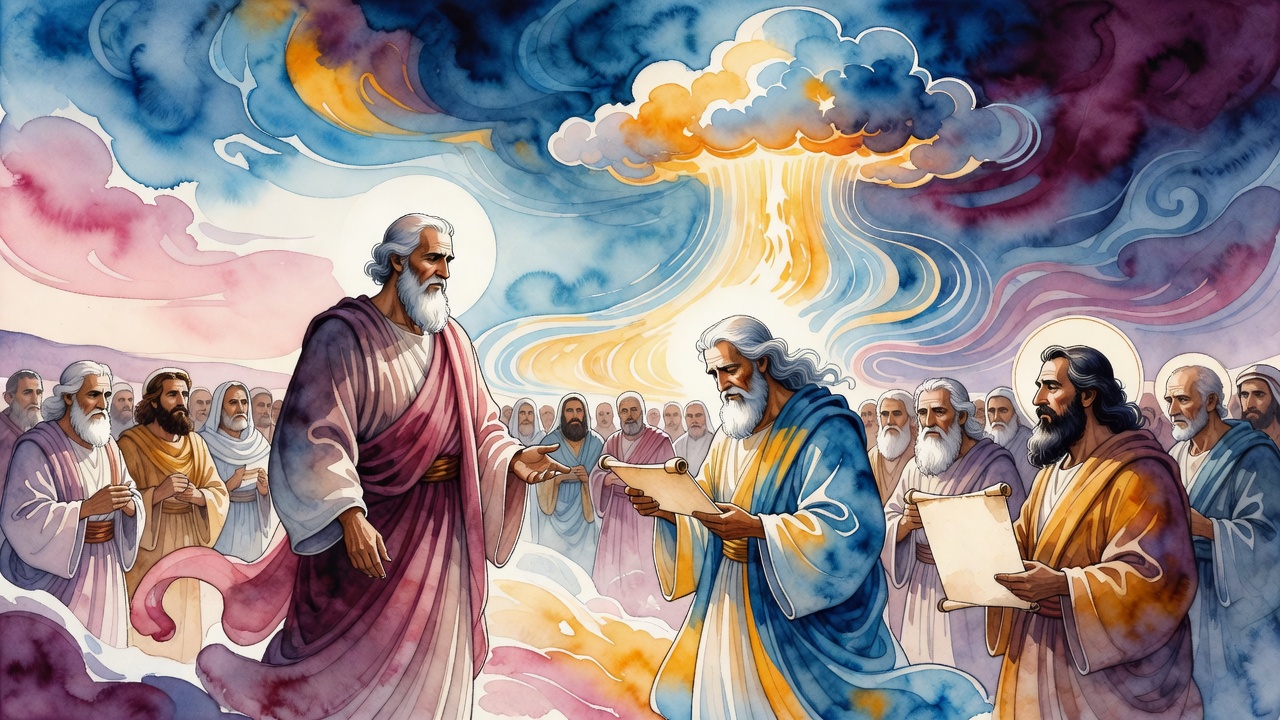
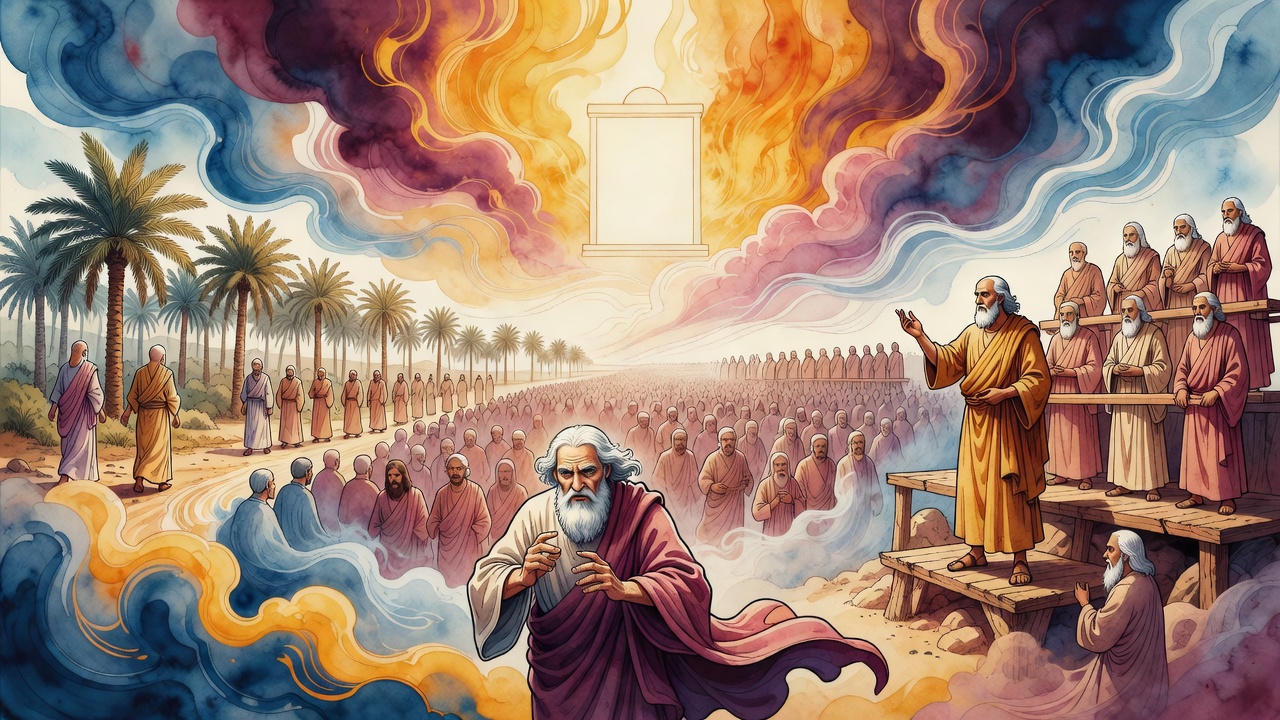
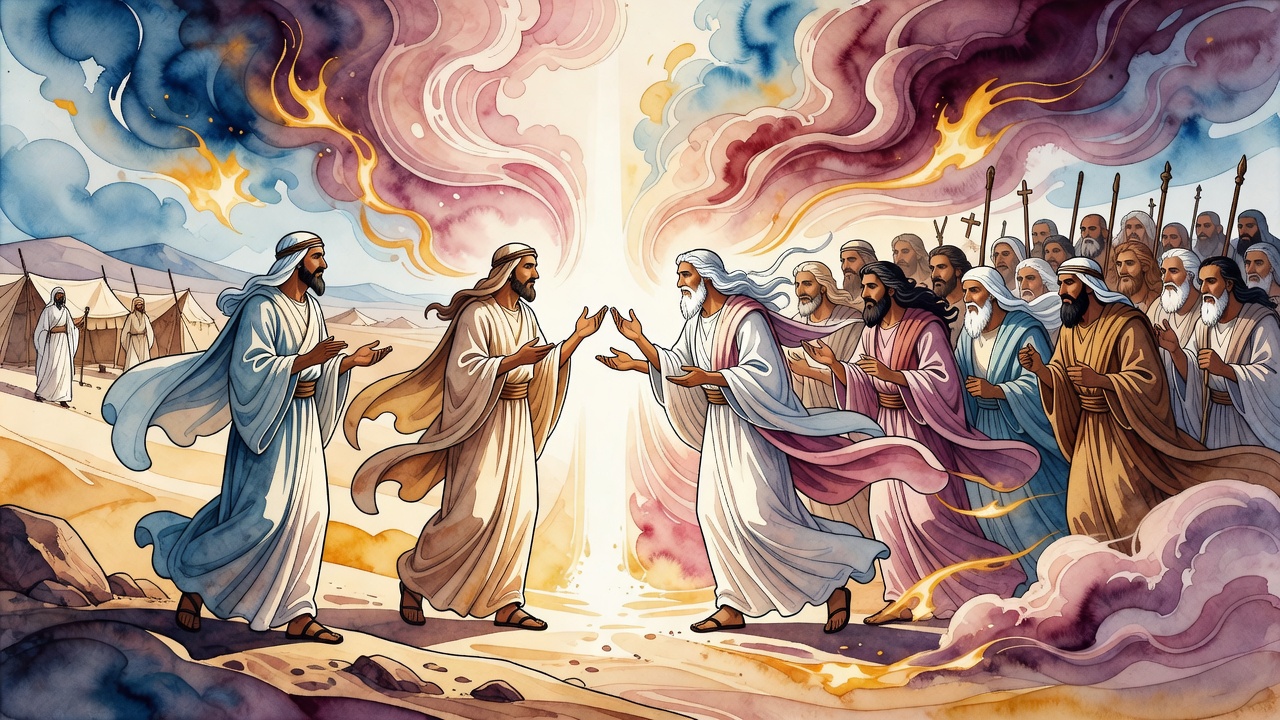
Jethro stood at the edge of the crowd and watched Moses break. From morning until evening the people pressed for judgment. One man. Endless cases. A father-in-law who had known Midianite flocks saw a leader drowning in his own usefulness.

Quarrels over water, boundaries, insults, and borrowed tools piled at the same pair of knees. Moses heard them all. His face aged a year in a day. Jethro did not flatter. He proposed officers over thousands, hundreds, fifties, and tens, a lattice of judges so the prophet would not die on his feet. The plan was clean enough for any court of nations.

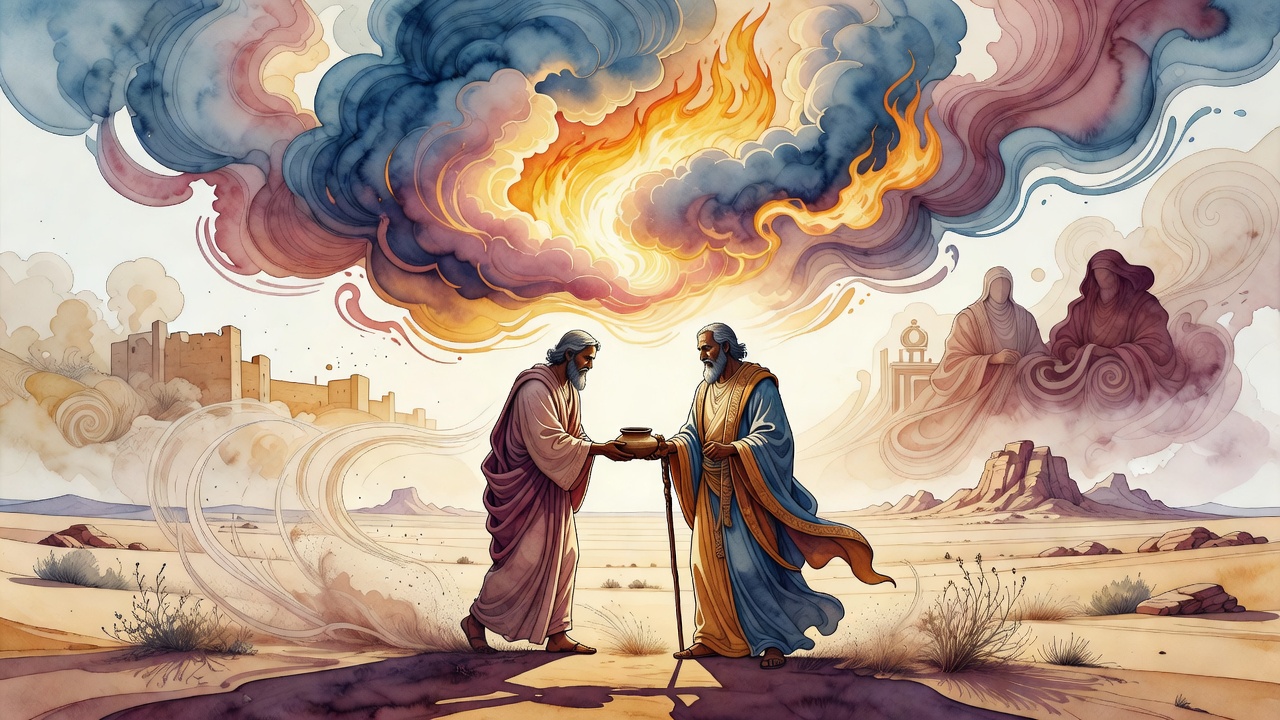
Then Jethro set a lock on it. "If you would do this thing," he said, take counsel first with the Omnipotent. Efficiency without a nod from Heaven was, in his eyes, already a failed reform.

Moses listened to the man who had once given him a well, a wife, and a flock to keep.

No Reform Without a Nod

The Mekhilta seizes that condition. Practical sense is not enough in Israel. Institutional cleverness that skips Heaven will not hold. "If He consents to you, you will be able to bear up. If not, you will not be able to bear up." The sentence is operational, not polite. A judicial system that lacks divine authorization will crush the man who carries it, no matter how elegant the org chart.

Moses could have waved the advice through as family talk. He took it upward. The judicial map that still shapes Jewish memory of wilderness courts begins as a Midianite priest's observation sealed by divine yes. Burden shared becomes burden allowed.

Officers took their places. Hard cases still climbed to Moses. Ordinary noise stopped lower down. The camp learned that justice could have layers without losing holiness, provided the top of the design had been shown to God first.

Jethro's caveat outlived Jethro's visit. Every later impulse to reorganize Jewish life without asking still collides with that Midianite "if."

The Highest Title in a Mouth

Elsewhere the Sifrei lingers on a quieter honor. Scripture names him "the father-in-law of Moses," and the sages call that the highest tribute of all. Not priest of Midian. Not prince of tents. Kin to the man who speaks with God. The title is a crown made of relationship rather than office.

Moses invites him along the road. "We are traveling," he says, toward the Land in the hearing of the camp. Rabbi Shimon bar Yochai objects with a hard fact. Moses himself will not cross the Jordan. Even his bones will stop short. Why say "we"?

Perhaps to steady the people. If the one who split the sea speaks as if he walks with them into orchards, they will not despair when the road lengthens. Perhaps the "we" is leadership language, a shepherd refusing to sound already buried. The invitation to Jethro stays warm either way. Come. Share good with this people. Do not return only to your own tents while this camp still needs wise eyes.

A man honored as Moses' father-in-law is being asked to keep investing counsel, not only to collect a compliment and ride home.

Counsel That Cuts Both Ways

Jethro's genius was double. He saw the human limit in Moses' face, and he saw the divine limit on human schemes. Appoint the officers. Ask the Owner of the people first. The same man who receives the title "father-in-law of Moses" refuses to let even Moses reorganize Israel by charisma alone.

Moses, who will later outrank the fathers in midrashic contests of greatness, still listens to a guest who watched him tire. Greatness here looks like an ear bent toward in-law advice and then toward Heaven. Pride would have said, I speak with God daily, I do not need your flowchart. Wisdom said, stay for the evening case load and tell me what you see.

The courts filled with men who could bear what one mouth could not. Israel learned shared judgment as a sacred technology, not a bureaucratic accident.

Somewhere in the arrangement was love. A father-in-law does not watch a daughter's husband destroy himself without speaking.

After the Officers Stood

Morning lines shortened. Hard cases still climbed to Moses like goats on a cliff path. Ordinary quarrels stopped at the tens and fifties. Jethro could have left with pride in a flowchart. The tradition keeps his caveat louder than his org chart. Do nothing that must last if God has not nodded.

He may have returned to Midian with stories of a people learning to judge itself. He may have stayed longer under the title that made him family to prophecy. Either way, the wilderness courts outlasted his shadow. Moses kept the top of the pyramid and lost the privilege of drowning alone in petty suits.

The people judged under a system born from watching one man exhaust himself for justice, then asking whether Heaven wanted that exhaustion shared. Every healthy Jewish court since has owed something to a Midianite who refused to let love stay silent while a prophet burned out at the gate.


← All myths
From the tradition

Sources

2 sources

The texts behind this telling. Some cards carry a translation of the source; others are our own retelling of it, and each card says which. Every card links out to the original.

Mekhilta Tractate Amalek 4:21Mekhilta DeRabbi Yishmael

Retold in our words. Read the original at the link below.Mechilta, translated by Rabbi Shraga Silverstein · CC-BY

Jethro, the father-in-law of Moses, watched Moses judging the people alone from morning until evening and proposed a radical restructuring of the judicial system. He recommended appointing judges over thousands, hundreds, fifties, and tens. But before Moses could implement any of it, Jethro added a crucial caveat: "If you would do this thing", go first and take counsel with the Omnipotent.

The Mekhilta zeroes in on this condition. Jethro's advice was practical, sensible, and efficient. Any management consultant would approve. But Jethro understood something that pure pragmatism misses: in Israel, no institutional reform proceeds without divine authorization. The plan had to be presented to God before it could be presented to the people.

The text draws out the stakes with stark clarity. "If He consents to you, you will be able to bear up. If not, you will not be able to bear up." This is not polite religious language. It is a statement of operational reality. A judicial system that God endorses will function. One that He does not endorse will collapse, no matter how logically sound its design.

Jethro's wisdom, then, was double. He saw the structural problem: one judge for millions of people was unsustainable. And he saw the spiritual requirement: the solution had to come with God's approval or it would fail. The Mekhilta preserves this moment as a model for all leadership decisions in Israel. Good ideas are not enough. Divine consent is the load-bearing element. Without it, even the most brilliant reform crumbles under its own weight.

Full source
Sifrei Bamidbar 78:3Sifrei Bamidbar

Retold in our words. Read the original at the link below.Sifrei by Rabbi Shraga Silverstein · CC-BY

A fascinating moment from the book of Bamidbar (Numbers), chapter 10, verse 29, where Moses makes a heartfelt plea to his father-in-law, Yitro (Jethro).

The verse reads, "the father-in-law of Moses." And the Sifrei Bamidbar calls this "the highest tribute of all, to be called 'the father-in-law of Moses.'" What a compliment!

Moses is inviting Yitro to join the Israelites on their journey, saying, "We are traveling," implying, "immediately to Eretz Yisrael (the Land of Israel)." But things get complicated.

According to R. Shimon b. Yochai, the Torah already tells us, in Devarim (Deuteronomy) 4:22, that Moses himself won't cross the Jordan. So, why would he say "we are traveling" to Eretz Yisrael? The text emphasizes that even his bones wouldn't cross the Jordan!

The Sifrei Bamidbar offers a few compelling explanations. Perhaps Moses included himself to reassure the people. He didn't want them to think, "If the one who brought us out of Egypt can't enter, what hope do we have?" Another reason? So that Yitro wouldn't think, "If Moses isn't going, why should I?"

The sages offer a third, even more poignant idea: Moses, in his dedication and perhaps a moment of… what, wishful thinking? … "lost sight" of the decree. He momentarily believed he would enter with them. Can you imagine the emotional weight of that? To lead your people to the promised land, and for a moment, feel like you're going with them, only to remember the truth?

Then there's the sticky issue of who gets a piece of the land. Moses says they're going "to the place of which the L-rd said: It will I give to you." But what about converts, gerim? The text acknowledges that "proselytes have no portion in it." Doesn't that seem unfair?

So how do we reconcile this with (Ezekiel 47:23), which says, "And it shall be, with the tribe with which the proselyte dwells, there shall you give his portion"? If converts can't inherit land, what "portion" are we talking about?

The Sifrei Bamidbar offers two interpretations. First, it suggests it's about atonement. A convert living among the tribe of Judah is atoned for with the communal offerings of that tribe. Similarly for Benjamin, and so on. Another interpretation? It speaks of burial rights. Converts are allotted burial in Eretz Yisrael. Even if they don't get land in life, they find a place in the land in death.

Now, back to Moses's invitation: "Come with us and we will do good with you." Seems like a nice gesture. So, what's the big deal?

The text answers that it follows a fortiori – if you do good to a member of your household, how much more so should you do good to a "member of the household" of Him who spoke and brought the world into being! Yitro isn't just a guy; he's connected to the Divine.

Finally, Moses says, "for the L-rd has spoken good for Israel." But wait, hadn't the L-rd always spoken good for Israel? The Sifrei Bamidbar explains that the Lord commanded Israel to do good to the converts, to treat them with humility.

So, what do we take away from this? This isn't just a historical anecdote. It's a reminder of the complexities of leadership, the importance of inclusivity, and the ongoing negotiation between divine promise and human reality. And maybe, just maybe, it reminds us to hold onto hope, even when the path ahead is uncertain.

Full source