5 min read

Yitro Counted Judges Then Walked Into Israel

Moses heard cases until his hands shook. Yitro counted six hundred thousand men, built tiers of judges, then led his Kenite house up from the date palms.

Curated by Arthur · Told by Maggid ·
Table of Contents
  1. The Line That Would Not End
  2. The Arithmetic of a People
  3. What a True Judgment Does
  4. The Departure No One Believed
Yitro Counted Judges Then Walked Into Israel Click for full size

The Line That Would Not End

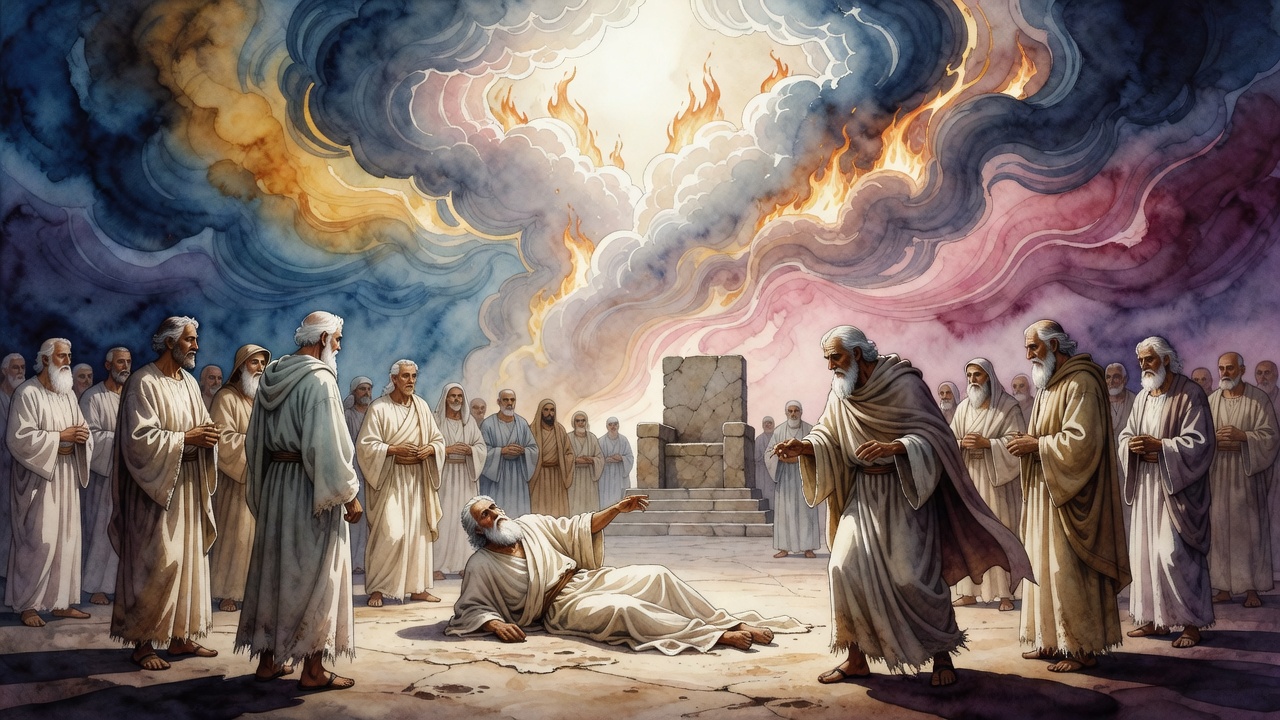
Moses sat while the sun climbed and the line did not thin. A man with a claim about a borrowed donkey. A woman with a quarrel over water. Two brothers who would not share a tent pole. The desert heat stuck the dust to his throat. By afternoon his voice cracked on rulings he had already given three times in different words.
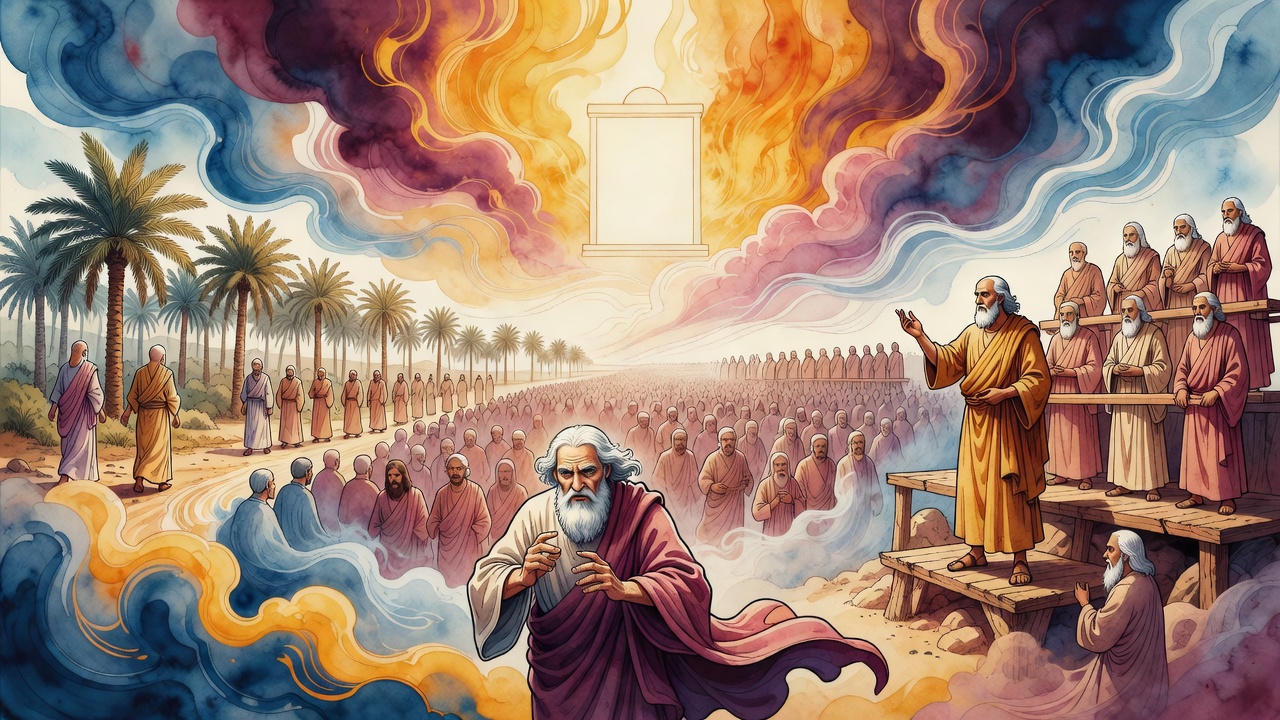
Yitro watched from the edge of the camp, Midianite cloak still strange among Israelite tents. He did not see holiness in exhaustion. He saw a structure about to break. "You will wear yourself out," he said, and the words landed like a hand on a shoulder that had forgotten it had bones. Moses looked up. For a moment the prophet who faced Pharaoh looked like any overworked elder at a market gate.

Around them the camp hummed with new freedom and old habits of complaint. Freedom without courts is only a wider field for the strong. Yitro had seen enough of Midianite tents to know that. Children ran between the waiting adults, and even their games sounded like arguments about turns and water and shade.

The Arithmetic of a People

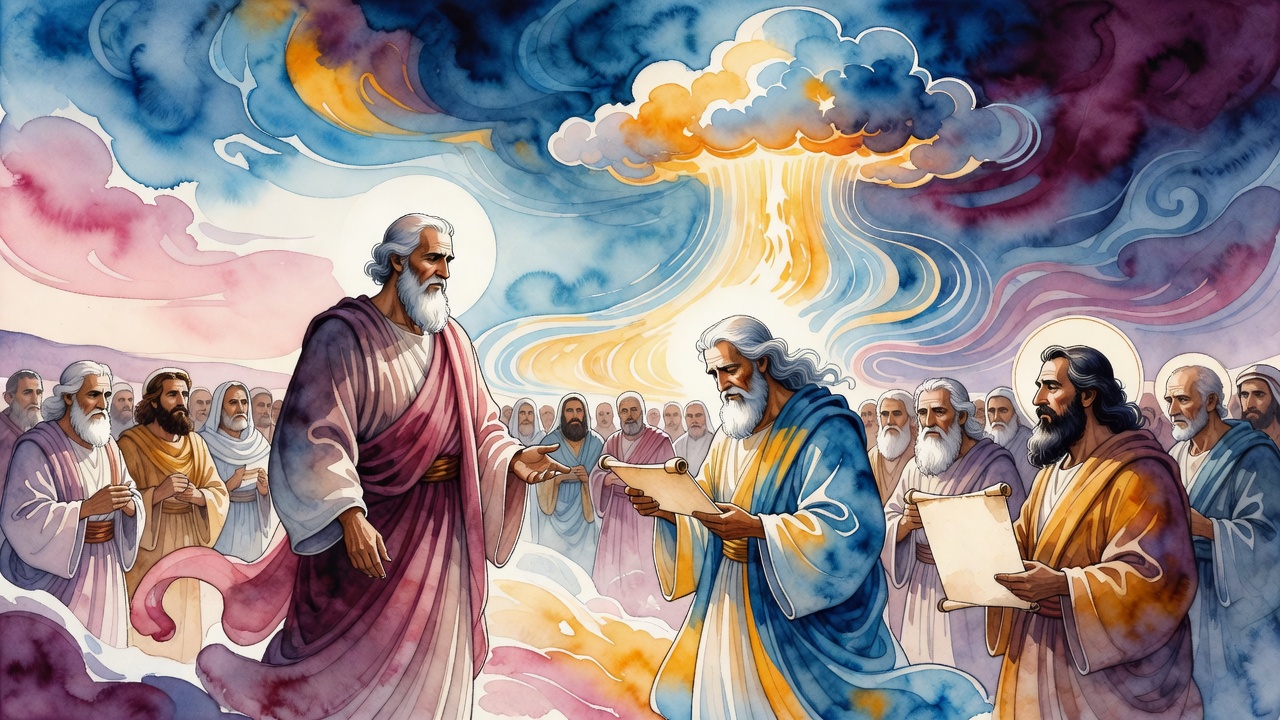
Yitro did not offer poetry. He offered numbers. Six hundred thousand men of military age. Officers of thousands, six hundred. Officers of hundreds, six thousand. Officers of fifties, twelve thousand. Officers of tens, sixty thousand. Add them and the camp would hold seventy-eight thousand six hundred judges, roughly one for every eight Israelites. The plan sounded like a census of responsibility. Moses heard it as permission to breathe.

The people still came, but they came to layers now. Small wounds stopped at the tens. Larger ones climbed. Only the hard cases reached the man who had stood before Pharaoh. Moses told his father-in-law the crowds did not come for gossip. They came to seek God, to learn what the Holy One required in each knot of life. Yitro nodded. Seeking God and finding a fair seat are not enemies if the seats are many enough.

He watched a young officer of tens settle a quarrel over a torn cloak before noon. The loser paid. The winner left without a swagger that invited a second fight. Moses, freed of that hour, turned back to a case that needed the edge of prophecy. The pyramid of seats held under the same sun that had once cooked his throat dry.

What a True Judgment Does

Some feared that every ruling would plant a feud. One man leaves smiling. One man leaves ordered to pay. The deeper teaching already lived in the practice Yitro forced into being. A judgment of truth does not sow war. It makes peace. The winner is satisfied, and the loser, if the law is clean, can stand under the same sky without the poison of a crooked scale.

Yitro pressed further. Judges must sit "at all times," not as idlers with empty days, but as scholars freed for the work, riding from town to town with law like light on a dark road. Moses was to teach statutes and judgments, and also "the way they shall walk." That way was not only decree. It was loving kindness. Visit the sick. Sit with the suffering. Bury the dead who cannot repay. Strict justice and open hands were to share the same officers.

An officer of fifties left court one evening and walked straight to a tent where a fever burned. He sat until the fever broke. The next morning he fined a man who had lied about a boundary stone. Same hands. Same day. Yitro plan was never only math. It was a people trained to hold a scale and a cup of water without choosing one forever against the other.

The Departure No One Believed

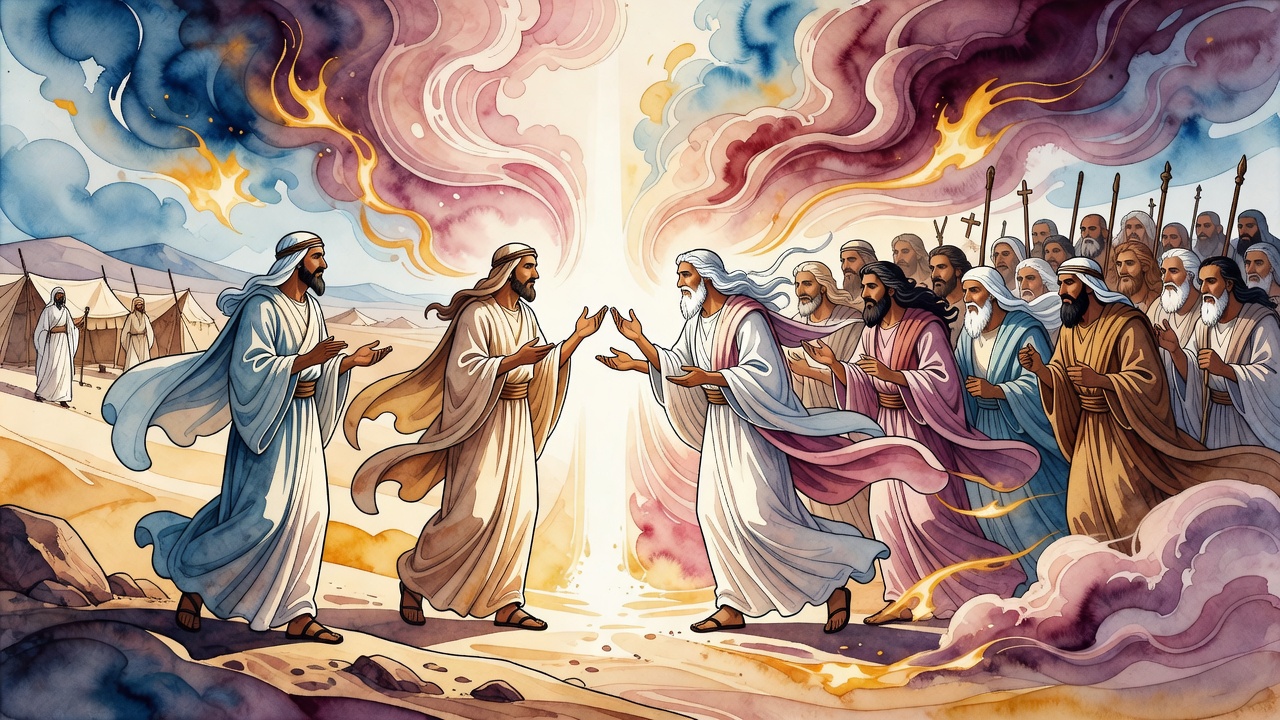
When the courts held, Yitro spoke of leaving. Some later would think he only meant to go, that the intention stayed a polite farewell. The book of Judges answers them. The children of the Kenite, Moses' father-in-law, went up from the city of date palms, from Jericho, and settled with the people (Judges 1:16). They did not vanish into Midian dust. They climbed into Israel story and stayed.

Yitro packed more than tents. He packed a people who had learned to judge in tiers and to walk in kindness. Moses stood at the edge of the camp and watched the Kenite line move toward the date palms, then beyond them into the life of Israel. Zipporah father did not take the courts with him. He left them planted.

At dusk an officer of hundreds returned with dust on his beard and quiet in his walk. Two families would sleep without knives under their mats. That was the math Yitro wanted. Moses tested the structure by sending away a case he would once have kept. The officer of tens handled it. Moses felt a strange lightness, then recognized it as rest. Dust rose behind the Kenite caravan. A child waved without knowing he waved at future neighbors. The line of litigants still formed each morning. It no longer ended only at one man knees.


← All myths

From the tradition

Sources

5 sources

The texts behind this telling. Some cards carry a translation of the source; others are our own retelling of it, and each card says which. Every card links out to the original.

Mekhilta Tractate Amalek 4:17Mekhilta DeRabbi Yishmael

Retold in our words. Read the original at the link below.Mechilta, translated by Rabbi Shraga Silverstein · CC-BY

Yithro's plan for restructuring Israel's judicial system was built on precise mathematics. He told Moses to appoint "officers of thousands, officers of hundreds, officers of fifties, and officers of tens" (Exodus 18:21). The Mekhilta works out exactly what this meant in practice.

The population of Israel at this time was six hundred thousand men of military age. Dividing that number into groups of one thousand yields six hundred officers of thousands. Dividing into groups of one hundred yields six thousand officers of hundreds. Dividing into groups of fifty yields twelve thousand officers of fifties. And dividing into groups of ten yields sixty thousand officers of tens.

The total number of officers across all four tiers: seventy-eight thousand and six hundred. That is an enormous judicial infrastructure, roughly one judge for every eight Israelites. Yithro was not proposing a minor delegation of authority. He was proposing the creation of an entire bureaucratic system, a layered hierarchy of courts that could handle disputes at every level of complexity.

The genius of the system was that most cases would never reach Moses. An officer of tens could resolve a simple dispute between neighbors. An officer of fifties could handle more complex matters. Only the most difficult cases, "the hard things," as the Torah calls them, would be escalated up the chain until they reached Moses himself. This freed Moses to focus on what only he could do: receive the Torah from God and teach it to the nation.

Full source
Mekhilta DeRabbi Shimon Ben Yochai 18:22Mekhilta DeRabbi Shimon Ben Yochai

Translation of the source text.Mechilta de-Rabbi Simon b. Jochai, ed. D. Hoffmann, Frankfurt 1905 · Public Domain

"And they shall judge the people at all times" (Exodus 18:22). Rabbi Yehoshua says: people who are free from their own work, that they may judge Israel at all times. Rabbi Elazar of Modiin says: people who are free from their own work and occupy themselves with Torah, they shall judge Israel at all times. And so it says, "You that ride on white donkeys" (Judges 5:10) - these are the disciples of the sages who travel from city to city and from province to province and occupy themselves with Torah and make it as bright as noon. "You that sit on rich carpets" - who sit and judge a judgment of truth according to its truth. "You that walk by the way" - these are the masters of Scripture. "By the way" - these are the masters of Mishnah. "Tell of it" - for all their conversation is in Torah.

Another interpretation: "And they shall judge the people at all times" - Scripture speaks of monetary cases, that they judge them every day by Torah law, even on the eve of the Sabbath; but by the words of the scribes one does not judge on the eve of the Sabbath. Another interpretation: "And they shall judge the people at all times" - monetary cases one judges by day and concludes by night.

"And it shall be that every great matter they shall bring to you, but every small matter they shall judge themselves" (Exodus 18:22). You say great matters they shall bring to you and small matters they shall judge themselves; or is it rather matters concerning great people they shall bring to you and matters concerning small people they shall judge themselves? When it says, "The hard matter they shall bring to Moses" (Exodus 18:26), behold, no "great matter" is meant except great matters. Great matters they shall bring to you, and small matters they shall judge themselves.

"If you do this thing, and God commands you, then you will be able to endure" (Exodus 18:23). He said to him: go out and consult the Almighty; if He agrees with you, you can endure, and if not, you cannot endure. "And also all this people shall come to their place in peace" - Aaron, Nadab and Abihu, and all the elders of Israel shall come to their place in peace.

Rabbi Simai says: one who judges a judgment of truth according to its truth appears as though he casts envy among people, but in fact he only sets peace among them, as it says, "These are the things you shall do: speak truth to one another; render in your gates judgment that is true and makes for peace" (Zechariah 8:16). I know only that the one who takes the money he is owed has peace; how do I know that even the one obligated to pay money, that his end too is peace? As it says, "And also all this people shall come to their place in peace." I know only this for the litigants; how do I know it also for all Israel? Scripture teaches, "May he judge your people with righteousness, and your poor with justice" (Psalm 72:2) - and what is written after it? "May the mountains bear peace to the people." I know only this for human beings; how do I know that justice is peace even for beasts and wild animals and all living creatures? Scripture teaches, "With righteousness shall he judge the poor, and decide with equity for the meek of the earth... and righteousness shall be the belt of his loins" (Isaiah 11:4-5) - and what is written after it? "The wolf shall dwell with the lamb, and the leopard shall lie down with the kid... they shall not hurt nor destroy in all My holy mountain, for the earth shall be full of the knowledge of the LORD" (Isaiah 11:6-9). This knowledge is justice, as it says, "Did not your father eat and drink and do justice and righteousness? Then it was well with him. He judged the cause of the poor and needy; then it was well. Is not this to know Me? says the LORD" (Jeremiah 22:15-16).

Great is justice, for whoever hates it, there is no cure for his wound, as it says, "Shall one who hates justice govern?" (Job 34:17) - and binding is nothing but healing, as it says, "He heals the broken-hearted and binds up their wounds" (Psalm 147:3).

Full source
Mekhilta Tractate Amalek 4:27Mekhilta DeRabbi Yishmael

Retold in our words. Read the original at the link below.Mechilta, translated by Rabbi Shraga Silverstein · CC-BY

One might think that Yitro, the father-in-law of Moses, only intended to depart and rejoin his own people but never actually carried it out. To prove that he and his descendants did go and settle among Israel, it is therefore written (Judges 1:16) “And the children of the Kenite, the father-in-law of Moses, went up from the city of date-palms,” that is, from Jericho, and the verse adds “and they went and settled with the people.” The Mekhilta then reads the word “the people” in this verse as signifying wisdom, here meaning the study of Torah. The proof is brought from (Job 12:2) “Truly you are a people, but will wisdom die with you?” where “people” and “wisdom” stand parallel to one another.

The sages press the wordplay further. Read the word not as “tamuth,” meaning “will die,” but as “tumath,” meaning “will be put to death.” From this they draw a teaching about the fragility and value of a sage’s learning. So long as a sage lives, his wisdom endures and continues to give light to those around him. But when he dies, his wisdom is lost with him, as though it were put to death along with its bearer. The descendants of Yitro chose to settle near Israel precisely to draw close to this living wisdom of the Torah, recognizing that such learning must be received from a teacher while he yet lives, before it departs from the world with him.

Full source
Mekhilta DeRabbi Shimon Ben Yochai 18:15Mekhilta DeRabbi Shimon Ben Yochai

Translation of the source text.Mechilta de-Rabbi Simon b. Jochai, ed. D. Hoffmann, Frankfurt 1905 · Public Domain

"And Moses said to his father-in-law: Because the people come to me to seek God" (Exodus 18:15). Judah, a man of Kfar Ani, asked Rabban Gamliel about this matter: What did Moses see that made him say, "Because the people come to me to seek God"? He said to him: And if not, what should he have said, "Because the people come to me to seek"? By saying "God," he spoke well.

Full source
Mekhilta DeRabbi Shimon Ben Yochai 18:20Mekhilta DeRabbi Shimon Ben Yochai

Translation of the source text.Mechilta de-Rabbi Simon b. Jochai, ed. D. Hoffmann, Frankfurt 1905 · Public Domain

"And you shall warn them of the statutes" (Exodus 18:20): these are decrees. "And the laws": these are rulings. So said Rabbi Yehoshua. Rabbi Elazar of Modi'in says: "the statutes": these are testimonies, as it is said (Leviticus 18:30), "and you shall keep My charge, not to do any of the abominable customs." "And the laws": these are decrees. "And you shall make known to them the way in which they shall walk": this is a decree, as it is said (Deuteronomy 5:30), "in all the way that the LORD your God has commanded you, you shall walk." "And the deed that they shall do": this is the good deed. So are the words of Rabbi Yehoshua. Rabbi Elazar of Modi'in says: "and you shall make known to them": make known to them their livelihood. "The way": this is acts of loving kindness. "They shall walk": this is visiting the sick. "In it": this is burying the dead. "And the deed": this is judgment. "That they shall do": this is going beyond the strict letter of the law.

Full source