Parshat Yitro6 min read

They Watched the Voice Carve Itself in Fire

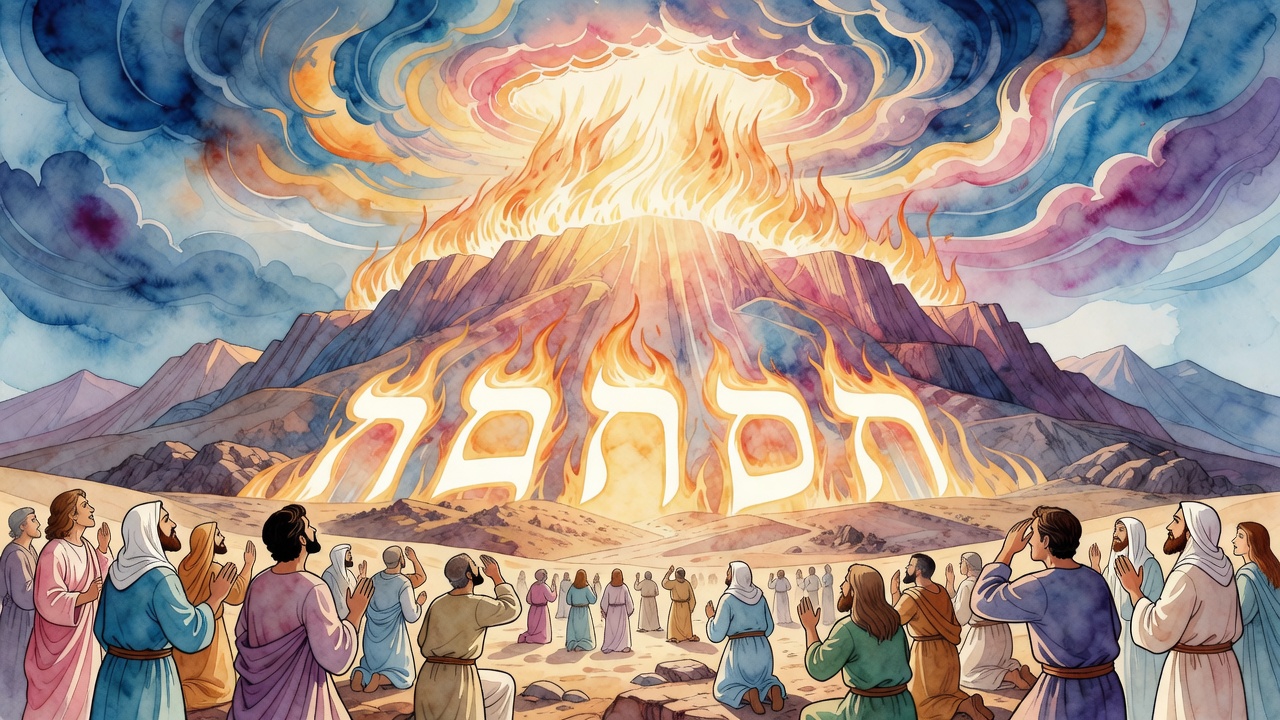
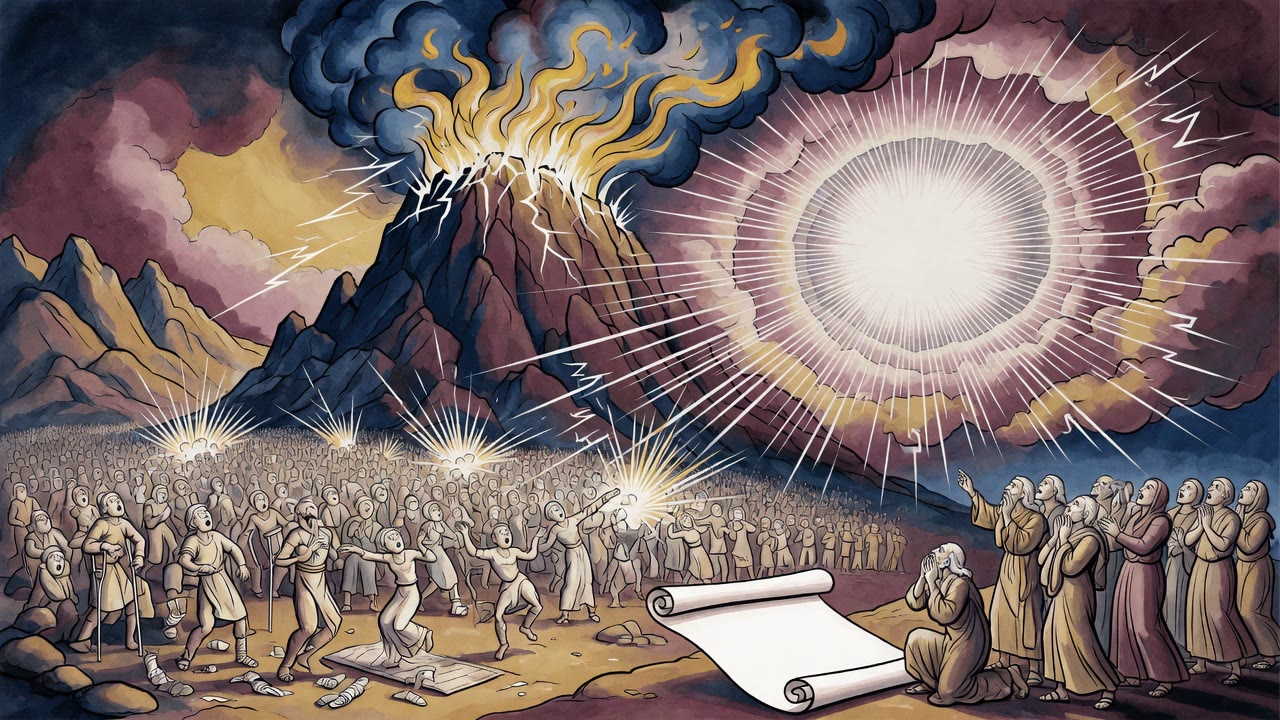
At Sinai the people saw sounds and lightnings unlike any storm, each voice calibrated to every heart while fire hewed words into stone before their eyes.

Curated by Arthur · Told by Maggid ·
Table of Contents
  1. Morning, and Nothing Hidden
  2. Not One Bolt Like Another
  3. He Saw the Sound
  4. Sounds of Sounds
  5. They Stood Far Off, and Moses Went In
They Watched the Voice Carve Itself in Fire Click for full size

Morning, and Nothing Hidden

They had washed their clothes two days earlier and had kept away from the mountain since, because a boundary had been set around the foot of it and anyone who crossed it was to be stoned or shot through, man or beast. On the third day it came, and it came in the morning.

That mattered to the man standing near the boundary more than he could have said at the time. It was full daylight. He could see the faces of the men on either side of him, and they could see his, which meant that afterward not one of them could tell him he had been asleep and dreamed it, and he could not tell himself that either. Nothing was smuggled in under a cover of dark. Whatever happened on that mountain happened in front of everybody, in ordinary light, with the whole camp standing in the open where it could be counted.

Then the thunder started, and the shofar (a ram's horn) under it, getting louder instead of dying away, which no horn does when a man is blowing it.

Not One Bolt Like Another

He had watched weather all his life and he started counting, since counting is what a frightened man does with his hands full of nothing.

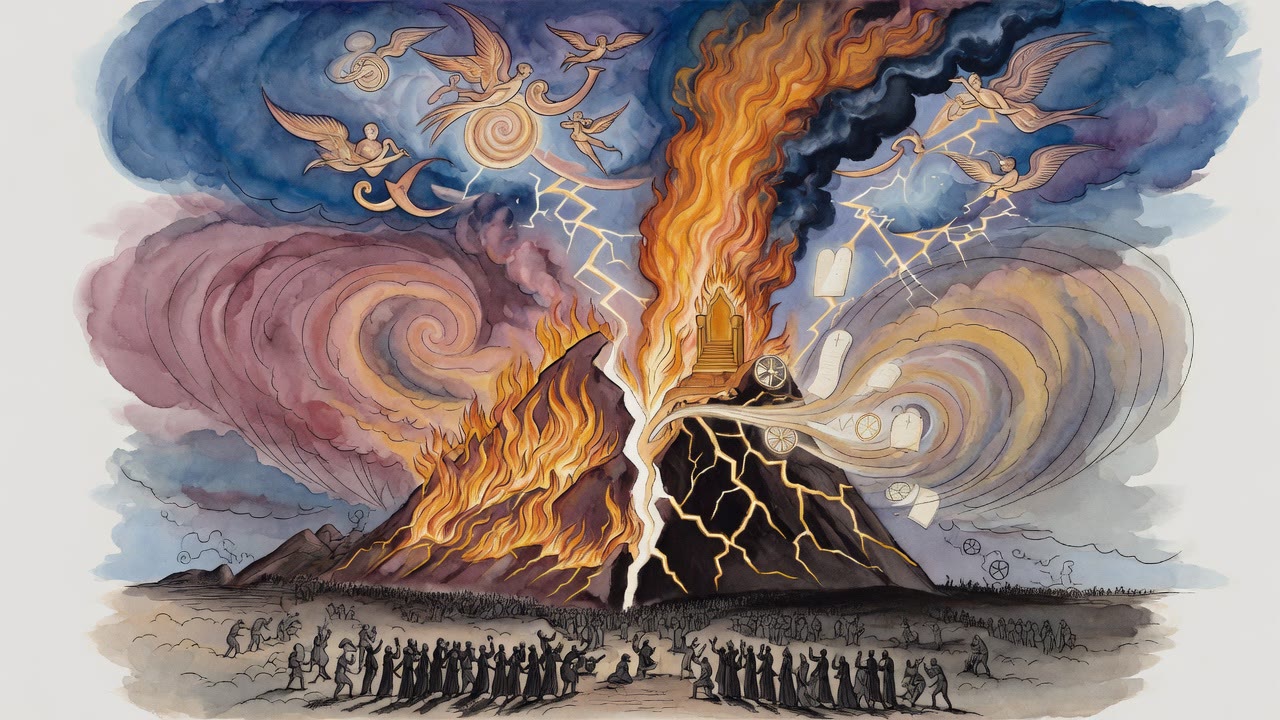
The first bolt went down white and straight. The next one did not look like the first. Neither did the one after it. In an ordinary storm the lightning repeats itself until a man stops looking, the same flash out of the same kind of cloud, so he learns the rhythm and turns his back on it and finishes his work. Here every stroke arrived with its own character, and none of them came twice, and after a while he stopped counting, since counting assumes the things being counted are the same thing.

Above all of it the cloud on the peak went from grey to something thicker, the arafel, dark enough that the top of the mountain simply stopped existing. Light and dark had divided the mountain between them and both of them were wrong. The bolts lit the sky and left that cloud exactly as black as it had been.

He Saw the Sound

The first word came, and he saw it.

It did not arrive at his ears and stop there. It went out over the camp and into the rock, and the letters opened in the stone while the word was still being spoken, cut and burning at the edges, the way a flame takes a line across cloth. He was looking at speech. His ears were full and his eyes were doing work they had no business doing, and the two would not sort themselves out into their proper places no matter how he tried.

His legs went out from under him and he was on his knees in the sand without having decided anything.

The tablets were not being prepared somewhere for later. They were being written in front of him, at speed, by the voice itself, and every letter that opened in the rock was a letter he could not afterward pretend he had not watched arrive.

Sounds of Sounds

The old man beside him went down at a different moment, and the boy behind them did not go down at all.

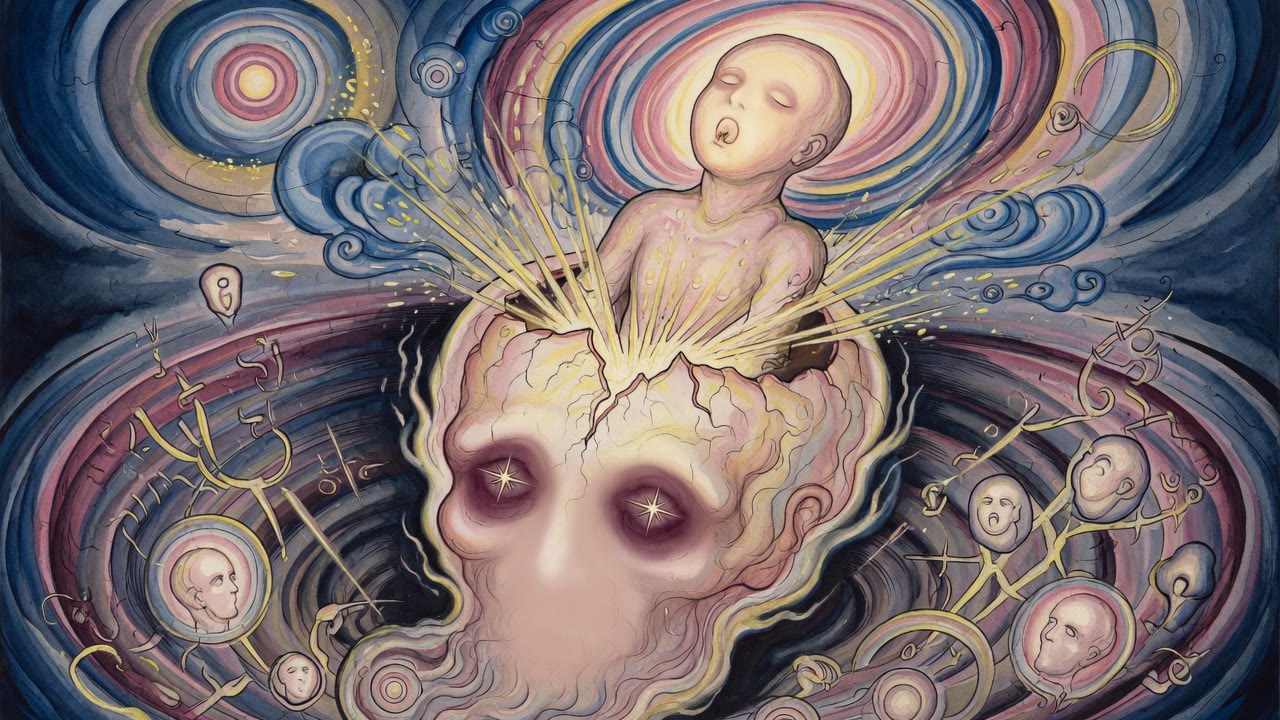
Afterward, in the tents, they tried to lay the accounts side by side and could not make them match. The old man had heard weight, so much of it that his chest had felt pressed. The boy had heard something a boy could carry and had stood through the whole thing with his mouth open. One woman said a single word had arrived at her separately from the rest of them, in her own hearing, as though it had been aimed. Nobody could catch anybody else out in a lie, because each account held together on its own and none of them fit together, and they all came from the same hour on the same plain under the same mountain.

There had been one voice. It had come to each of them in the measure that person was able to take, which is why it multiplied into sounds inside sounds and flames inside flames without ever splitting into two gods.

They Stood Far Off, and Moses Went In

Seeing the sound is what broke them. The people moved backward as one body and stood a long way off, and from there they sent word to Moses that he should speak with them himself, since they would hear a man, and let God not speak with them any more, because they would die of it.

So the words came through one man after that.

Moses went the other way, toward the mountain, past the boundary and up, while the whole camp watched him get smaller against the rock. He came to the edge of the arafel and did not stop at it. The cloud took him the way water takes a stone, and the camp stayed where it was, far back, looking at the place on the mountain where the dark had closed.


← All myths
From the tradition

Sources

4 sources

The texts behind this telling. Some cards carry a translation of the source; others are our own retelling of it, and each card says which. Every card links out to the original.

Mekhilta Tractate Bachodesh 9:1Mekhilta DeRabbi Yishmael

Retold in our words. Read the original at the link below.Mechilta, translated by Rabbi Shraga Silverstein · CC-BY

(Exodus 20:15) describes an extraordinary moment at Sinai: "And all the people saw the sounds and the lightnings." The people did not merely hear the divine voice, they saw it. Rabbi Yishmael and Rabbi Akiva disagreed about what this means.

Rabbi Yishmael took the conservative approach: the people saw what was visible, the lightning and fire. And heard what was audible, the sounds and words. "Saw the sounds" is a compressed way of saying they perceived the full sensory experience, each sense operating in its normal domain.

Rabbi Akiva went further. He taught that the Israelites literally saw what should only be audible. They saw sound. Every word that left the mouth of God did not simply vibrate through the air, it was inscribed visibly on the stone tablets. As (Psalms 29:7) says, "The voice of the Lord hews with flames of fire." God's voice was so powerful that it carved itself into physical reality.

Rabbi Akiva's reading transforms Sinai into a synesthetic event, a moment when the ordinary boundaries between the senses broke down. Sound became sight. Words became fire. The voice of God did not just communicate information; it physically altered the material world. The tablets were not inscribed after the revelation by some secondary process. They were written in real time, by the force of God's own speech, as the people watched letters of fire burn themselves into stone.

Full source
Mekhilta Tractate Bachodesh 9:2Mekhilta DeRabbi Yishmael

Retold in our words. Read the original at the link below.Mechilta, translated by Rabbi Shraga Silverstein · CC-BY

"And all the people saw", the sounds of sounds and the flames of flames. The Mekhilta asks: how many sounds were there at Sinai, and how many flames? The answer is not a specific number but a principle: each person heard according to his own power to absorb the experience.

The proof is (Psalms 29:4): "The voice of the Lord in power, the voice of the Lord in majesty." The psalm does not say "in His power" but "in power", without a possessive pronoun. The rabbis interpreted this to mean: in the power of each individual listener. God's voice at Sinai was not a single uniform broadcast. It calibrated itself to each person's capacity.

An elderly person heard one thing. A young person heard another. A child heard according to a child's understanding. The same divine utterance registered differently in every mind and heart that received it. The sounds multiplied into "sounds of sounds" and the flames into "flames of flames", an infinite cascade of revelation, personalized for every Israelite standing at the foot of the mountain.

This teaching has radical implications for the nature of revelation. The Torah was not given as a single fixed message that every person received identically. It was given as a living communication that adapted to its audience. The voice of God was simultaneously one and many, unified in its source but infinitely varied in its reception. Every person at Sinai received the Torah they were capable of receiving, and all of those receptions were equally valid.

Full source
Mekhilta Tractate Bachodesh 3:21Mekhilta DeRabbi Yishmael

Retold in our words. Read the original at the link below.Mechilta, translated by Rabbi Shraga Silverstein · CC-BY

When God descended upon Mount Sinai to give the Torah, the mountain erupted with phenomena that defied nature. The Mekhilta de-Rabbi Ishmael pauses on the word "lightnings" in (Exodus 19:16), berakim in Hebrew. And makes a startling observation: "one different from the other." The lightnings at Sinai were not uniform. Each bolt was unique, distinct from the one that came before and the one that followed.

Ordinary lightning in a thunderstorm repeats itself. Flash after flash, bolt after bolt, each one essentially the same phenomenon of electrical discharge. But the lightnings at Sinai were different. Each one carried its own character, its own message, its own aspect of divine revelation. The rabbis saw in this detail evidence that the Sinai event was entirely supernatural, not a particularly intense thunderstorm, but a theophany without parallel in the natural world.

The Mekhilta continues: "And a heavy cloud upon the mountain", this was the arafel, the thick, impenetrable mist that shrouded the peak of Sinai. The text connects this cloud to (Exodus 20:18): "And Moses drew near to the arafel." While the people stood below, trembling at the lightnings and the sound of the shofar, Moses alone walked forward into the darkness. The arafel was not merely weather. It was the boundary between the human and the divine, a curtain of darkness that hid the presence of God from mortal sight.

Together, the unique lightnings and the thick darkness paint a picture of Sinai as a place where normal reality broke down. The mountain was simultaneously illuminated by supernatural light and shrouded in supernatural darkness. Moses entered the arafel and emerged with the Torah, carrying divine law out of a cloud that no other human being could penetrate.

Full source
Mekhilta Tractate Bachodesh 1:19Mekhilta DeRabbi Yishmael

Retold in our words. Read the original at the link below.Mechilta, translated by Rabbi Shraga Silverstein · CC-BY

The Mekhilta methodically eliminates every possible misunderstanding about how the Torah was given at Sinai. Each wrong assumption is raised and then demolished by a specific verse.

One might think the Torah was given at night, in darkness, in secret, when no one could see what was happening. The Torah therefore states (Exodus 19:16): "And it was on the third day, when it was morning." Morning. Daylight. Full visibility. God did not whisper His revelation in the dark. He delivered it in the blazing light of day, when every eye could witness what was occurring.

One might think the Torah was given in silence, transmitted telepathically, or through quiet meditation, or in the still small voice that Elijah would later hear at Horeb. The Torah therefore states (Exodus 19:16): "And there were thunders and lightnings." The giving of the Torah was the loudest event in human history. Thunder crashed. Lightning split the sky. The mountain itself shook. Silence was the last thing present at Sinai.

Perhaps the thunders were merely atmospheric noise, impressive but unintelligible, sound without meaning. One might think the people did not actually hear or understand what was happening. The Torah therefore states (Exodus 20:15): "And all the people saw the thunders and the lightnings." They saw sound. They perceived the thunder with their eyes. And the Psalmist confirms the overwhelming nature of the experience (Psalms 29:4): "The voice of the Lord in majesty." The Torah was given in broad daylight, with deafening thunder, and the people both heard and saw every moment of it.

Full source