Parshat Eikev5 min read

The Manna in the Desert Tasted Like Whatever You Wanted

In the desert, manna appeared at every door each morning except Shabbat. The taste changed with each bite to match what you desired, unless you were wicked.

Curated by Arthur · Told by Maggid ·
Table of Contents
  1. The Bread That Was There When They Woke
  2. The Properties of the Bread
  3. Where It Came From and How It Fell
  4. The Jar Kept Beside the Ark
  5. What the Manna Was Not

The Bread That Was There When They Woke

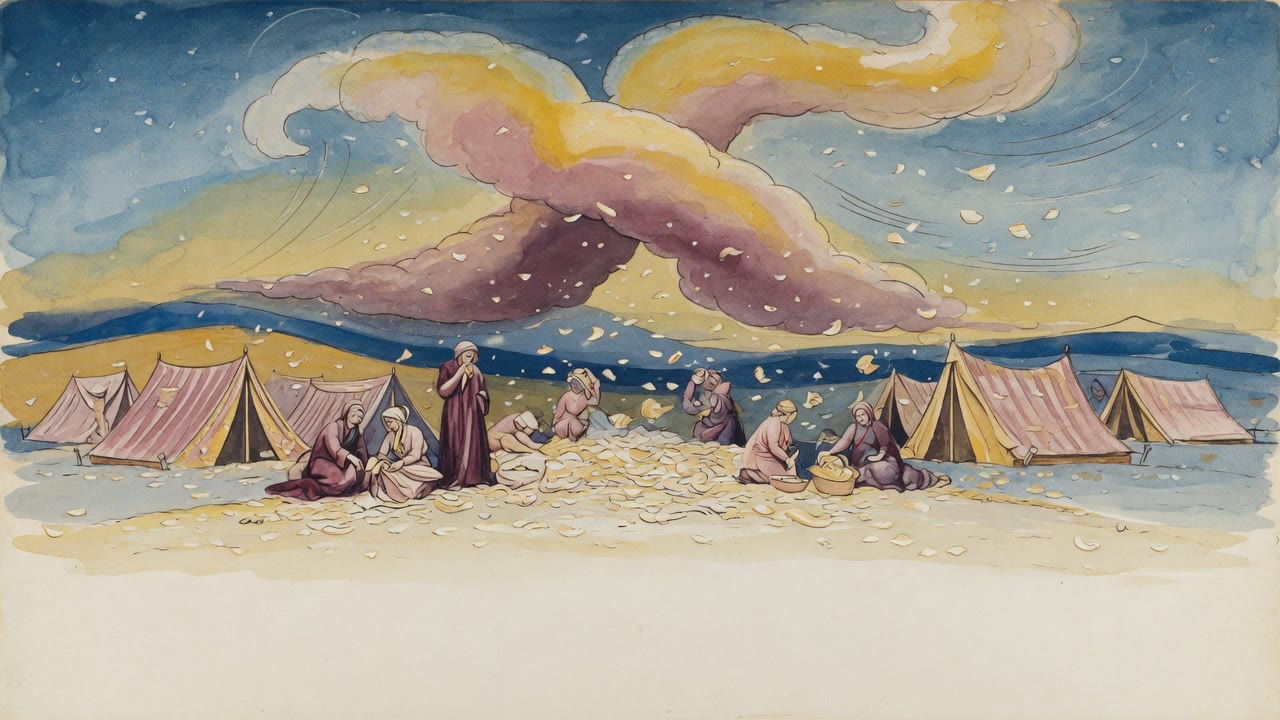
Israel woke the first morning in the wilderness and found the ground covered with something thin and white, like frost but softer. They looked at it and said to each other: man hu, what is this? That question became the food's name. Manna. The bread of what-is-this, the bread of not-knowing.

Moses told them: this is the bread God has given you to eat. He said it would fall every morning and they should collect what they needed for the day, no more. On the sixth day they should collect double, because none would fall on the seventh. Anyone who stored extra would find it rotten by morning. The instructions were specific and the people tested every single one of them, repeatedly, until they had confirmed all the boundaries by violating them.

The Properties of the Bread

The tradition developed in detail what the manna was and was not. It was not one food with one taste. It was a food that became whatever you wanted it to be in the eating. An infant tasted it the way an infant needs food to taste. A nursing woman tasted it the way a nursing woman tastes things. An old man who could no longer eat rough food found it soft. A young man who wanted something substantial found it filling in the way meat fills you.

The wicked did not have this luxury. For those who had acted badly, the manna arrived not at their doorsteps but at a distance, and it needed to be ground before it could be eaten. The effort of going to find it and processing it manually was built into the food's behavior. The miraculous bread was not neutral. It responded to the person who ate it.

Where It Came From and How It Fell

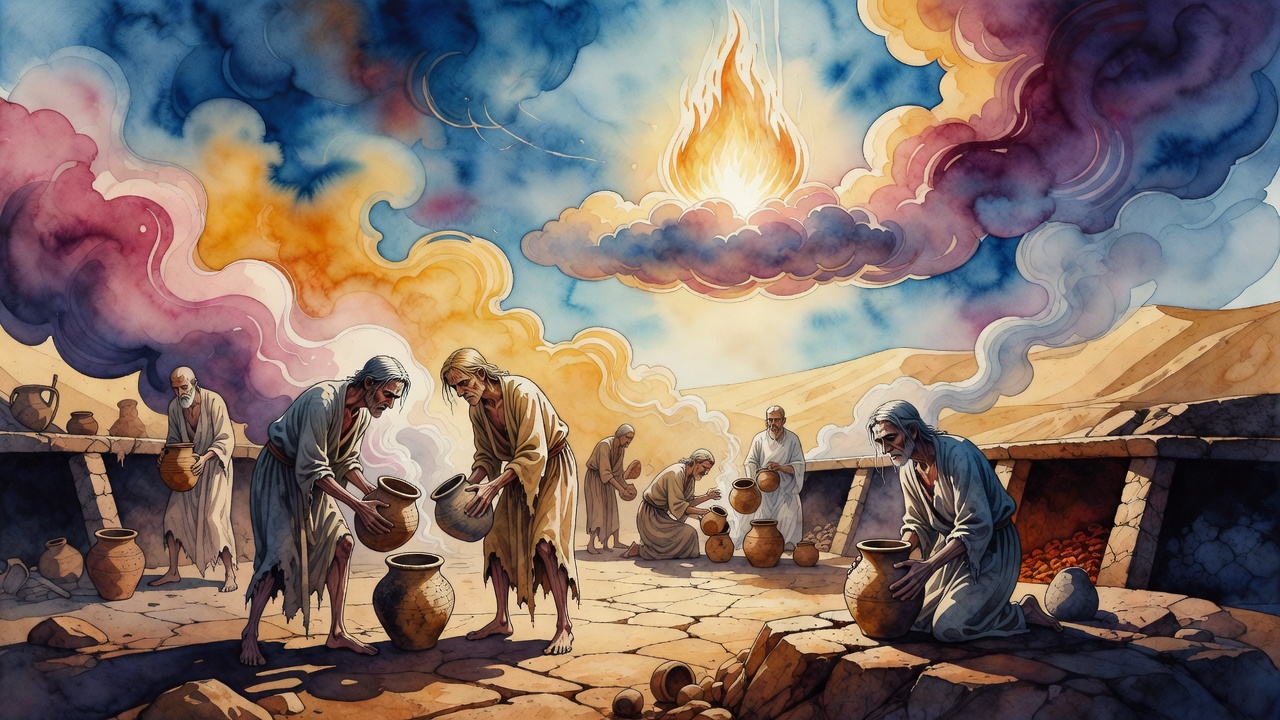
The manna did not fall directly onto the ground. The tradition describes a layered delivery. First dew fell and covered the earth. Then the manna fell on top of the dew. Then another layer of dew fell on top of the manna. It arrived, in other words, protected on both sides, the way something precious is packed for transport. The desert floor was cleaned by the lower dew; the manna rested on that clean surface; the upper dew kept it from dirtying in the air.

For the righteous it appeared at their tent entrances. They stepped outside in the morning and it was there. For those in the middle, spiritually speaking, they went to the edge of the camp to find it. For the wicked it was out in the open desert, requiring a journey.

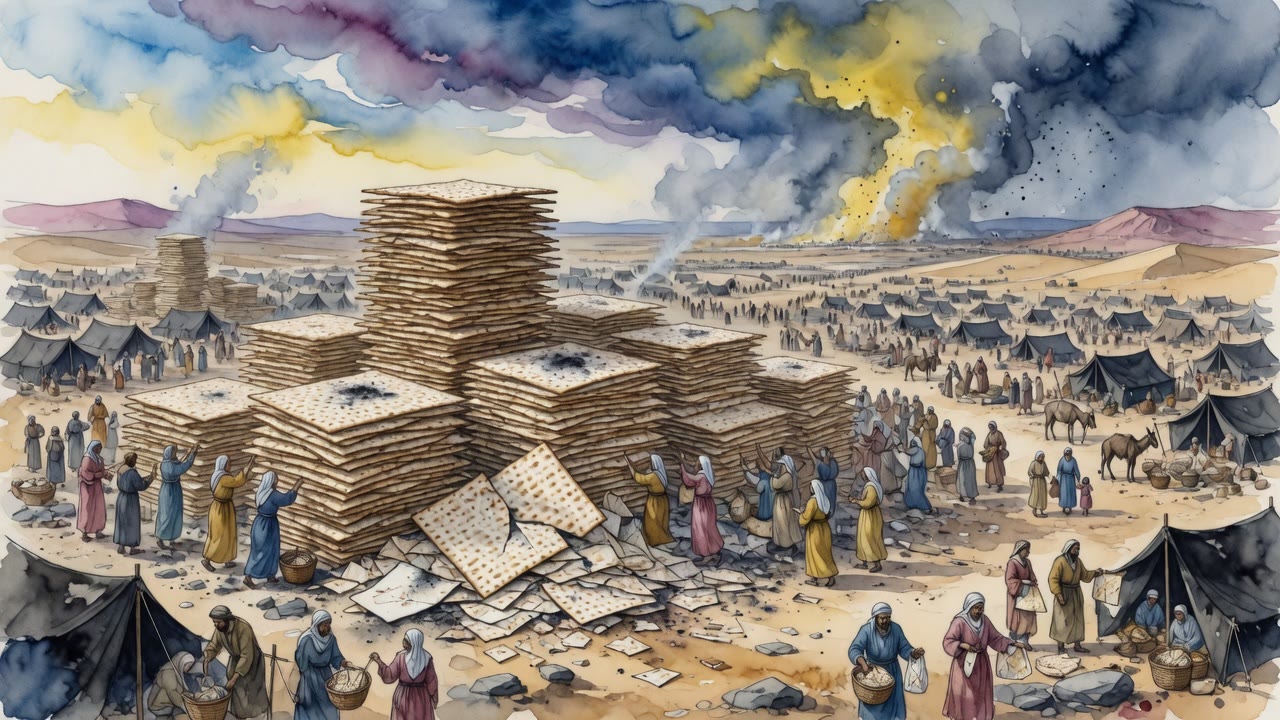
On the sixth day the portion was double what appeared on ordinary days. The rabbis preserved the arithmetic of this: six hundred thousand households, each collecting enough for a family, every day for forty years. The sheer volume of the enterprise was understood as evidence of the absolute nature of the commitment God had made. This was not emergency rations. This was a sustained forty-year provision that never failed once.

The Jar Kept Beside the Ark

God told Moses to preserve a portion of the manna for future generations, so that they would be able to see what their ancestors had been fed in the wilderness. Moses gave an omer of it to Aaron, who placed it in a golden jar. The jar was kept beside the Ark of the Covenant in the Tabernacle and later in the Temple.

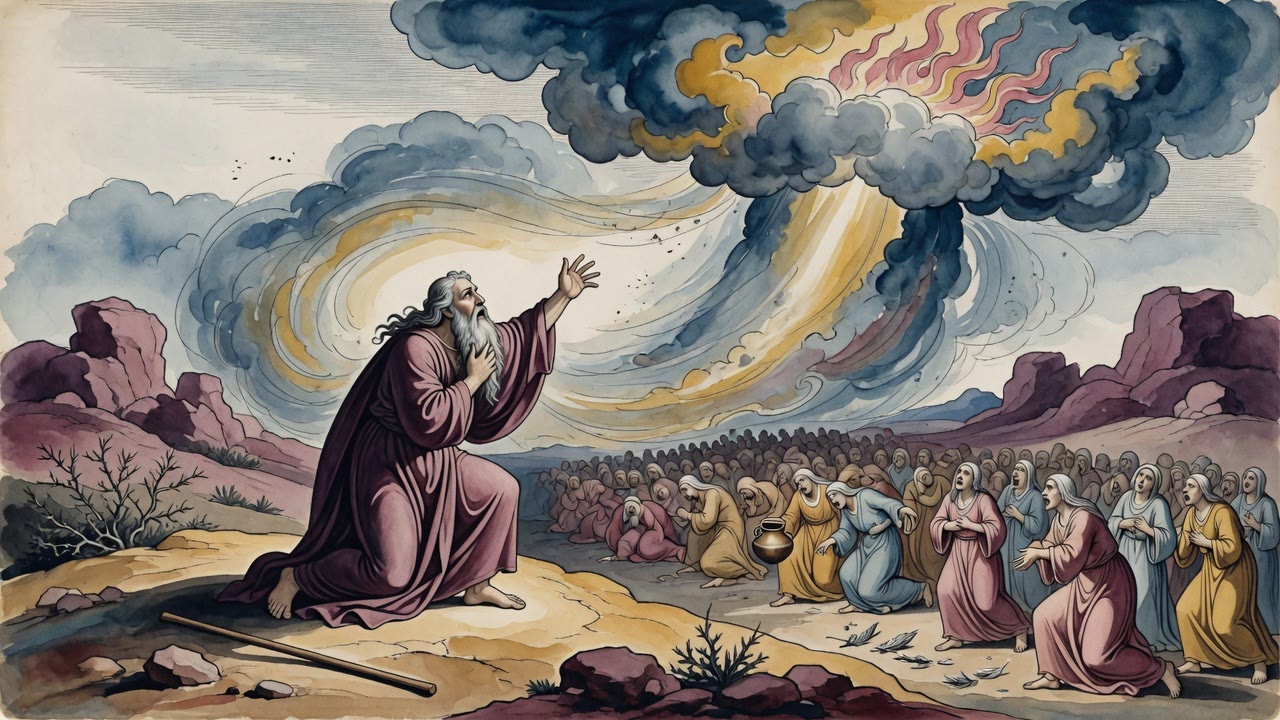
The tradition holds that this jar endured for centuries. When the prophet Jeremiah stood before the people in a generation that had forgotten the wilderness, he took out the jar of manna and held it up: you think it is hard to study Torah? Look what your ancestors ate. Look what fed them. Look what sustained them while God's word was all they had.

What the Manna Was Not

The manna did not fall on Shabbat. This was one of the earliest observable structures of the Shabbat prohibition: the world itself rested, including the food delivery from heaven. The people who went out looking for manna on Shabbat found nothing and came back to Moses. Moses told them: how long will you refuse to keep my commandments and my instructions? The food was the teaching. The day it did not fall was as instructive as the days it did.

The manna also did not survive as an ongoing supply after Israel entered the land. The day after they ate from the produce of Canaan, the manna stopped. Forty years of provision, ending the morning it was no longer needed. The tradition found this precision characteristic: the miracle maintained itself for exactly the duration of the need and not one day longer.


← All myths
From the tradition

Sources

9 sources

The texts this telling draws on, in full. Open a card to read inline, or expand it for a wider, quieter read.

Legends of the Jews 1:91Legends of the Jews

No matter what you were in the mood for, one bite would satisfy that desire perfectly.

Well, according to tradition, the Israelites experienced just that with the manna (מָן), the miraculous food they ate in the desert after the Exodus.

It wasn't just sustenance; it was a taste of the divine.

The amazing thing about the manna wasn't just that it appeared out of nowhere. The real miracle, as Ginzberg beautifully retells in Legends of the Jews, was its flavor. It required no cooking, no baking, no preparation of any kind. Yet, it held within it the potential for every conceivable flavor. for a second. Every single dish, accessible in one single bite.

All you had to do was think of a dish, and the manna would instantly taste like it. Craving roasted lamb? Manna tasted like roasted lamb. Yearning for lentil soup? Instantly, lentil soup.

But the wonder didn't stop there. The taste of the manna also changed depending on who was eating it. As we find in Midrash Rabbah, it tasted different to each person based on their age and needs.

For little children, it tasted like milk – a perfect, gentle nourishment. For strong youths, it tasted like bread, providing the energy they needed. For old men, it tasted like honey, a sweet and comforting treat. And for the sick, it tasted like barley steeped in oil and honey, a soothing and medicinal flavor.

Isn't that incredible?

The manna wasn't just food; it was a personalized, divine provision perfectly tailored to each individual's needs and desires. It makes you think about the ways that the divine, however you understand it, might be present in our lives, offering exactly what we need, even when we don't realize it. Perhaps, if we pay close enough attention, we can taste the manna in our own lives, that perfect flavor of provision, perfectly suited just for us.

Full source
Legends of the Jews 1:101Legends of the Jews

The story goes that God, wanting to leave a lasting reminder of His power for generations to come, instructed Moses to place a jar of manna, that miraculous food that sustained the Israelites in the desert, before the Aron HaKodesh, the Holy Ark. Think of it: a tangible piece of divine intervention, right there in the most sacred space. According to Legends of the Jews, this task was actually carried out by Aaron in the second year of their desert wanderings.

Fast forward centuries later. The prophet Jeremiah, a figure of immense importance in Jewish history, is urging the people to immerse themselves in Torah study. Sounds simple. Except, they hit him with a very real concern: "How can we possibly make a living if we spend all our time studying?"

It’s a timeless question, isn't it? How do we balance the demands of the physical world with the call of the spiritual?

Jeremiah, wise and inspired, had an answer ready. He brought forth that very same vessel of manna, the one placed there long ago by Aaron. Imagine the impact! Holding up this ancient relic, he proclaimed, "O generation, see ye the word of the Lord; see what it was that served your fathers as food when they applied themselves to the study of the Torah. You, too, will God support in the same way, if you will but devote yourselves to the study of the Torah."

The message is clear, and it resonates even today. When we prioritize Torah, when we dedicate ourselves to learning and growing in our understanding of God's word, we are not left to fend for ourselves. We are supported. We are nourished, just as our ancestors were in the desert.

It's not always about literal manna falling from the sky, of course. It’s about trusting that when we dedicate ourselves to something sacred, something bigger than ourselves, the universe conspires to provide what we need. The Zohar tells us that the light of Torah is itself a source of sustenance.

This little legend, recounted in Ginzberg's retelling in Legends of the Jews, isn't just a historical anecdote. It's a powerful reminder that faith and dedication are not empty gestures. They are a pathway to a deeper connection with the Divine, a connection that sustains us in ways we may not even realize.

So, what "manna" are we seeking today? What are we willing to dedicate ourselves to, trusting that the rest will fall into place?

Full source
Legends of the Jews 1:94Legends of the Jews

Not just any breakfast, but manna, that heavenly food that sustained the Israelites in the desert for forty years.

In Ginzberg’s retelling in, Legends of the Jews, life with manna was… well, pretty easy. You could roll out of bed, say your morning prayers, maybe recite the Shema (that central Jewish prayer affirming God's oneness), and then just… walk outside. There it was. Manna for you, manna for the kids, manna for everyone. No grocery shopping, no cooking, no arguments about who's doing the dishes.

It first appears this would lead to a nation of couch potatoes. And you wouldn't be entirely wrong. Apparently, some people were so lazy that they wouldn't even bend over to pick it up! So, what happened? The manna, bless its miraculous heart, simply fell right into their hands.

What about leftovers? What happened to all the manna after breakfast? Ginzberg tells us that the manna lasted until about the fourth hour of the day, and then it would melt. But even in its melted form, it was still part of the miracle. It flowed into rivers… rivers that the pious will drink from in the world to come. Imagine: rivers of sweet, heavenly manna.

Did everyone get to enjoy this miraculous treat? Well, not exactly. The non-Jews, the "heathen" as the text calls them, were certainly aware of the manna. In fact, it descended from such great heights that kings from the East and West could witness Israel receiving its daily miracle. But if they tried to taste it themselves, that delicious, sweet flavor turned bitter in their mouths.

They could only partake indirectly. They would catch the animals that drank from the manna-fed streams. And even second-hand, the taste was so amazing that they exclaimed, "Happy is the people that is in such a case!" It's quite a picture, isn't it? A whole nation sustained by a daily miracle, a taste of paradise, and even those outside the community recognizing the blessing.

What does this story tell us? Perhaps it's about gratitude, about recognizing the blessings we receive, even the ones that seem to fall right into our laps. Or maybe it's about the unique connection between the Jewish people and the Divine. Either way, it leaves you wondering: if manna fell today, would we appreciate it? Would we even notice?

Full source
Legends of the Jews 1:92Legends of the Jews

The familiar telling remembers the manna, that miraculous food from heaven, but the stories surrounding its arrival are just as fascinating as the food itself!

You’re stranded in the desert. No grocery stores, no restaurants, nothing but sand and sun. Then, out of nowhere, food starts appearing. But it's not just any food; it's manna – mann in Hebrew, meaning "what is it?" because that's exactly what the Israelites exclaimed when they first saw it (Exodus 16:15).

The taste of manna was miraculous enough. But according to the legends, the way it descended from heaven was equally astounding. It wasn’t just a haphazard drop. Oh no, it was a carefully orchestrated event, a divine delivery service if you will.

First, a north wind would come roaring in. But not to bring more hardship. According to the legends, its purpose was to sweep the desert floor clean, like a divine housekeeper preparing for a special guest. Then came a rain, washing the sand, ensuring absolute purity.

But here's where it gets even more interesting. After the cleaning, dew would descend. But this wasn't just any dew. It congealed, solidifying into a firm surface – a divine tablecloth, if you will – ready to receive the heavenly sustenance.

According to Ginzberg's retelling in Legends of the Jews, the protection didn’t stop there. To prevent insects or vermin from contaminating the precious manna, this frozen dew formed not just a tablecloth, but also a cover, essentially encasing the manna in a protective casket. Think of it as divine Tupperware, safeguarding the food from any soiling or pollution from above or below.

So, there it was, this miraculous food, delivered with such care and precision. It’s a beautiful image, isn't it? A reminder that even in the most desolate circumstances, divine providence can provide not just sustenance, but also protection and even a touch of elegance. It makes you wonder, doesn't it, about the unseen forces at work in our own lives, the subtle ways we are cared for, even when we least expect it.

Full source
Legends of the Jews 1:96Legends of the Jews

The answer, of course, is manna. But the legends surrounding this heavenly food are even more astonishing than you might imagine. feeding 600,000 people, plus their families, every single day, for forty years! The logistics alone are mind-boggling. But according to the legends, the amount of manna (מָן), that divinely provided sustenance, was always perfectly proportional to the need.

Ginzberg, in his Legends of the Jews, drawing from various Midrashic (rabbinic interpretive commentary) sources, paints a picture of abundance so staggering that it almost defies comprehension. He tells us that enough manna fell each day to satisfy the needs of sixty myriads – that's six hundred thousand – of people for two thousand years! Imagine the sheer volume! And, amazingly, the manna that fell specifically around Joshua’s dwelling was enough to sustain the entire congregation!

What's even more fascinating is the egalitarian nature of this miracle. The manna didn't discriminate. It fell in equal measure to everyone. We find this echoed in (Exodus 16:18). After gathering their portions, everyone measured what they had collected, and they found that each person had exactly one omer (עֹמֶר), a specific unit of measure. No more, no less. Can you A daily miracle of perfect distribution.

The legends take the manna story even further. Beyond sustenance, it served as a tool for justice! Midrashic tradition suggests that the manna played a role in settling marital disputes. Imagine a couple appearing before Moses, each accusing the other of infidelity. Moses, wise as he was, wouldn’t immediately render a verdict. Instead, he’d tell them, "Tomorrow morning, judgment will be given."

The next morning, the location of the manna's descent would reveal the truth. If the wife's portion fell before the husband's house, it was a sign that he was in the right. But if her manna landed before her parents’ home, it indicated her innocence. The location of the manna acted as a divine lie detector!

It's a powerful image, isn't it? The everyday miracle of sustenance intertwined with the pursuit of justice and truth. The manna, in these legends, isn’t just about physical nourishment. It's a symbol of divine providence, equality, and even a guide to moral clarity. It invites us to consider: what if the solutions to our daily challenges, and even our most complex moral dilemmas, were as readily available as the manna, if only we knew how to look for them?

Full source
Legends of the Jews 1:97Legends of the Jews

The most obvious miracle, of course, was its very existence. But the story gets even richer when we consider the details.

In ancient texts, manna didn't fall every day. Specifically, it skipped the Sabbaths and holy days. But don't worry, God had a plan! On the day before these special days, a double portion would appear. Imagine the relief of knowing you wouldn't have to forage on the day of rest!

There's more. The Zohar, that foundational text of Jewish mysticism, tells us that on those days when the double portion fell, the manna itself was different. It sparkled with a brighter color, and its taste was even more exquisite than usual. A subtle, yet significant way God marked the sacred time.

Human nature being what it is, the Israelites weren't always so patient. Ginzberg, in his comprehensive "Legends of the Jews," recounts how, even after being told that no manna would fall on the Sabbath, some people still went out to gather it on the very first Sabbath morning. Moses, bless his heart, had to stop them.

They tried again that evening! Again, Moses intervened, saying, "Today you shall not find it in the field." Can you imagine the panic that must have set in? Would the manna stop altogether?

Moses, ever the steadfast leader, calmed their fears. "Today you shall not find any of it," he assured them, "but assuredly tomorrow; in this world you shall not receive manna on the Sabbath, but assuredly in the future world."

It’s a powerful statement, isn't it? A promise that while the rules of the physical world apply in this life, a different kind of sustenance, a different kind of blessing, awaits us in the world to come. As we find in Midrash Rabbah, this also becomes an understanding of the importance of keeping Shabbat (the Sabbath) and the reward that comes with it.

It makes you wonder, doesn't it? What does that "manna of the future world" taste like? Perhaps it's not a physical food at all, but something far more profound: the fulfillment of our souls.

Full source
Legends of the Jews 1:88Legends of the Jews

They're complaining, as people do when they’re hungry and thirsty and unsure of what tomorrow holds. They should have been praying! But instead of getting angry, God, in a moment of profound grace, says to MOSES, "They act according to their lights, and I will act according to Mine; not later than to-morrow morning manna will descend from heaven."

Manna. That miraculous bread from heaven. But where did it really come from?

The Midrash offers a beautiful connection to ABRAHAM. Remember the Akeidah, the binding of ISAAC? When God called to Abraham to sacrifice his son, Abraham responded, "Hineni," "Here I am." It was a moment of ultimate devotion, a willingness to give everything. According to this Midrashic (rabbinic interpretive commentary) tradition, God promised manna to Abraham's descendants using the same words, "Here I am," as a reward for his readiness.

Isn’t that stunning? A direct line from Abraham’s faith to the sustenance of his descendants generations later. It makes you think about the ripples of our actions, doesn't it?

But the connections don't stop there. The Rabbis see even more echoes of Abraham’s hospitality in the desert miracles. Remember how Abraham welcomed the three angels? He personally fetched bread for them. God, in turn, caused bread to rain from heaven. Abraham ran before them; God moved before Israel. Abraham had water fetched; God brought water from the rock through MOSES. Abraham offered them shade under a tree; God spread a cloud over Israel. It’s a beautiful symmetry, a divine mirroring of human kindness.

We find this idea beautifully elaborated in the Midrash. God says to MOSES, “I will immediately reveal Myself without Jacob, 'I will rain bread from My treasure in heaven for you; and the people shall go out and gather a certain rate every day.'"

What does it all mean? Perhaps it’s a reminder that even when we falter, even when we complain, the divine is ready to meet us, to provide. And perhaps it’s a call to remember the power of our actions, the way even small acts of faith and kindness can resonate through time, nourishing not only ourselves but also those who come after us. The legacy of ABRAHAM, the faith of MOSES, and the grace of the Divine all converge in the desert, reminding us that even in the most barren landscapes, sustenance and hope can be found.

Full source
Yalkut Shimoni on Torah 258:2Yalkut Shimoni on Torah

Another interpretation: it should not have said "from heaven" but "from the earth," for it is not the way of bread to come up except from the earth. This is what the verse says: "Whatever the LORD desired, He did" (Psalms 135:6). When He wished, He split the sea before Israel and made it dry land; and when He wished, He made it sea again. It is the way of the heavens to bring down dew and rain, and of the earth to bring forth bread, as it is said, "the earth, from it comes forth bread"; yet when He wished, He brought the bread down from the heavens, as it is said, "Behold, I will rain bread from heaven for you," and the dew came up from the earth, as it is said, "And the layer of dew went up" (Exodus 16:14, below). It is written, "And the king allotted them [a daily portion]", that is, by measure; but when I brought down the manna for them, it came down as the rain comes down, without limit. Zavdi ben Levi said: the manna would come down two thousand cubits; each day it would remain until four hours, and once the sun came upon it, it would melt and become streams upon streams, flowing and running down. And for whom is it now prepared? For the righteous in the world to come. Whoever believes is worthy and eats of it; and whoever does not believe, of him it is said, "Let him not look upon the rivers, the flowing streams of honey and curds" (Job 20:17). And since it came down in the streams, the nations of the world would come to drink of it, and in their mouths it became bitter as wormwood, as it is said, "And the manna was like coriander seed" (Numbers 11:7); but for Israel it became in their mouths like honey, as it is said, "and its taste was like wafers made with honey." And Rabbi Yehudah the Levite son of Rabbi Shalom said: the reckoning is that the manna came down for Israel each day, food enough for two thousand years, and its height was sixty cubits. It is written concerning the Flood, "On this day all the fountains of the great deep were broken up, and the windows of heaven were opened" (Genesis 7:11), and it is written concerning the manna, "He commanded the skies above and opened the doors of heaven" (Psalms 78:23). What would the nations of the world do? They would hunt a deer that had drunk of it, and taste in it the taste of manna, and they would say, "Happy the nation for whom it is thus." Rabbi Yose son of Rabbi Hanina said: not as the old man tasted it did the infants taste it. The infants would taste in it the taste of milk, as it is said, "and its taste was like the taste of cake baked with oil" (Numbers 11:8); and the young men would taste in it like honey, as it is said, "and its taste was like wafers made with honey"; and the elders would taste in it like bread, as it is said, "Behold, I will rain bread for you"; and the sick man would taste it like fine flour mixed with oil and honey, like this gruel that they make for a sick person, as it is said, "and they cooked it in a pot" (Numbers 11:8). And from where do we know that there was in it the taste of fine flour and honey? As it is said, "And My bread which I gave you, fine flour and oil and honey" (Ezekiel 16:19). Whoever was diligent would go out and gather from the field, as it is said, "And the people shall go out and gather"; and the average ones would go out to the entrance of their tents and gather; and the lazy ones would lie upon their beds and stretch out their hands, and it would come down into their hands, as it is said, "And the layer of dew went up" (Exodus 16:14, below).

Full source
Sifrei Bamidbar 89:1Sifrei Bamidbar

The Torah tells us, "The people would stroll out and gather it" (Numbers 11:8). But did they grumble about the effort? Sifrei Bamidbar cleverly uses another verse, "And the people will go out and gather it" (Exodus 16:4), to suggest the opposite. Imagine this: each person could sit right at their tent door and collect enough manna for themselves and their family. And because it melted in the sun, it was a fresh, daily miracle.

The text asks: "Now (did we not learn that) it never 'descended' to a mill?" Of course, it didn't literally fall into a millstone! The point is that the manna could be transformed into anything one would grind in a mill. Or beat in a mortar. The text emphasizes that the manna adapted to their needs. And it wasn't just limited to these methods. Sifrei Bamidbar stretches our imagination even further.

Think about this: "All the forty years that Israel was in the desert a woman had no need of spices, but was 'decorated' (i.e., perfumed) by the manna!" The manna wasn't just sustenance; it was luxury, fragrance, and everything they needed. The source of this idea? The peculiar phrase "or beat it," which hints at more than just food preparation. We learn that during this time of wandering, the Israelites lacked nothing. As (Deuteronomy 2:7) says, "These forty years the L-rd has been with you. You have lacked nothing." Imagine wanting grapes, and suddenly, there they are! Figs appear just as you crave them. It sounds like paradise!

What about the taste? The text explains that "its taste was like the 'leshad' of oil." Leshad, we're told, is an acronym for layish (dough), shemen (oil), and dvash (honey). Dough kneaded with oil and honey, that was the inherent, base flavor of manna, meant to be eaten with pure intention. The text offers more interpretations, describing the manna like a breast (shad) to an infant. Just as a breast sustains a baby, so too did the manna sustain the entire nation. And just as a baby can suckle all day without harm, the Israelites could eat manna all day without any ill effects.

Here's a truly beautiful idea: the manna, like a mother's milk, adapted to their needs. It could change into any taste they desired, except for the taste of the five grains forbidden during Passover, as the text notes.

The text adds a sobering thought: The Israelites suffered when the manna ceased (Joshua 5:12), just as an infant suffers when separated from the breast. The manna wasn't just food; it was comfort, security, and a constant reminder of God's presence.

Sifrei Bamidbar also paints a vivid picture of the manna's arrival. It descended with the dew, blanketing the camp at night. It fell "upon the thresholds and the doorposts," implying abundance. We're told that a layer of dew acted as a protective barrier, keeping the manna pure. People would recite the Shema prayer and then collect their portion before the sun melted it away.

Rabbi Shimon asks a profound question: Why didn't the manna fall just once a year? His answer is striking: "So that their hearts turn to their Father in heaven (for their food)." It was a daily reminder of their dependence on God. Imagine a king who feeds his son only once a year, the son would only visit on that day! But if the king feeds him daily, the son will visit every day. The manna was meant to foster a constant connection.

There's a counter-argument to this idea, that people might visit the king only for the stipend. But the text counters that the manna was meant to be eaten fresh, still warm.

Rabbi Dostai b. R. Yannai offers another perspective, wondering why there are no hot springs in Jerusalem like there are in Tiberias. He suggests it’s so that people wouldn't visit Jerusalem solely for the springs, making their pilgrimage opportunistic. The daily manna, similarly, encouraged a constant, genuine connection with the Divine.

So, what does all this tell us? The manna wasn't just about physical sustenance. It was about connection, gratitude, and a daily reminder of the miracle of life itself. It was about turning our hearts toward something greater than ourselves. And perhaps, in our own lives, we can find our own "manna", those daily blessings that, if we pay attention, can nourish not just our bodies, but our souls.

Full source