Parshat Yitro5 min read

Bilam Praised Yitro for Walking Out of Pharaoh's Council

Two advisers sat in the room where Egypt decided what to do with the Hebrews. One walked out. Years later the other opened his mouth to curse him.

Curated by Arthur · Told by Maggid ·
Table of Contents
  1. The Room Where Egypt Decided
  2. The Priest of Midian Set Him Over the Flock
  3. Aaron and All the Elders Came to His Table
  4. The Curse That Would Not Come Out Straight
  5. The Bird and the King's Statue
Bilam Praised Yitro for Walking Out of Pharaoh's Council Click for full size

The Room Where Egypt Decided

The last Hebrew to stand in that throne room had come up out of a pit and a prison. Joseph was thirty when he stood before Pharaoh, and he got there because he worked in Potiphar's house when nobody was watching him work, and because the woman who tried to bury him with a story in the dark could not finally make him stand in front of her instead of in front of a king.

Generations later a different Pharaoh filled the same room with advisers and asked what to do about the Hebrews, who had gotten numerous. Bilam was in the room. So was a Midianite priest named Yitro.

What came out of that meeting was the decree that put Hebrew infants in the river. Bilam stayed for it. Yitro did not.

The Priest of Midian Set Him Over the Flock

Yitro went home to Midian and his seven daughters and his wells, and one day a man came out of Egypt with a killing behind him and sat down at one of those wells. Yitro fed him. Then Yitro asked him to stay.

The word Scripture uses for what Moses did next binds two ways at once, an oath sworn and a house settled into, the same word a host uses when he tells a traveler at dusk to stop walking and lie down. Moses swore himself to that household. He took Zipporah. And his father-in-law handed him the flock.

So the man who would take a nation out of Egypt spent forty years learning the work on somebody else's sheep, counting them at dusk, carrying the ones that could not keep up, running down the one that bolted into the rocks. He was tending, and he went on tending, worthy at the beginning of it and worthy at the end.

Aaron and All the Elders Came to His Table

Then the news reached Midian: a sea that stood up, an army that did not come back, bread falling in a wilderness.

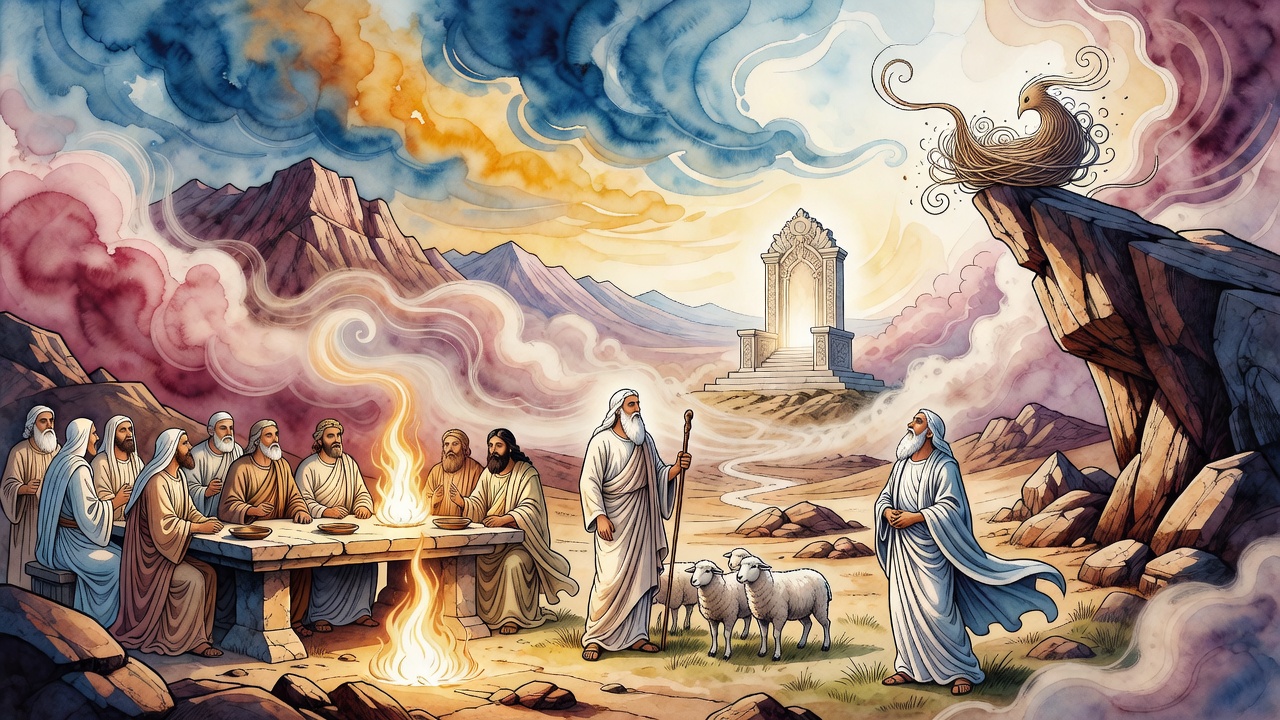
Yitro packed and went out to find him. What happened when he arrived is the part the sages will not let anyone skim. Aaron came. And all the elders of Israel came. The whole leadership of a people that had been slaves under the decree Yitro had walked out of came and sat down to eat bread with a Midianite priest, because he had bound his house to Moses.

He had not bought that table with gold. He had married a daughter to a man Heaven had already picked, and the honor came toward his house the way water comes toward low ground.

The Curse That Would Not Come Out Straight

Balak's silver bought the wrong prophet. Bilam went up on the heights to curse Israel and blessings kept coming out of him instead, three times, until the king who hired him was slapping his own hands together in rage.

Bilam looked out over the camps and kept speaking. He saw Amalek and had no trouble at all: first among the nations, and its end is oblivion. The curse came out of him clean and whole.

Then he saw the Kenites, and the Kenites were Yitro's line, and what came out was this. Mighty is your dwelling. Set your nest in the rock.

He could hear himself. He knew exactly who he was praising, and he could not stop, so he put the knife in sideways instead. "Kenite," he said, "you sat in that counsel with us." The room in Egypt. The decree. "Who seated you with the mighty of the world?"

The Bird and the King's Statue

There is a hunter, and there is a bird he has been running down all afternoon, and the bird finally drops out of the air and settles on a statue of the king.

The hunter stops. He has the bird. It is right there, close enough to reach, and he cannot reach for it, because the thing it is sitting on is the king's own image and a man who chips a king's face off a statue does not go home that night.

So he stands in the road with his hands empty and says the only thing left to say. "What a fine flight that was, that you flew."

Bilam stood on the height with a mouth full of somebody else's words and said the same thing in better poetry. The adviser who got up and left the room had landed somewhere no hired curse could follow, on a rock, at a table with Aaron and the elders of Israel, and the one who stayed in the room had to stand there in the open and admire the flight.


← All myths

From the tradition

Sources

3 sources

The texts behind this telling. Some cards carry a translation of the source; others are our own retelling of it, and each card says which. Every card links out to the original.

Shemot Rabbah 27:3Shemot Rabbah

Retold in our words. Read the original at the link below.The Sefaria Midrash Rabbah, 2022 · CC-BY

It’s a recurring theme in Jewish tradition, and one particularly striking example comes to us from Shemot Rabbah, a collection of rabbinic interpretations on the Book of Exodus.

Remember him? He was Moses’ father-in-law, a Midianite priest. “Yitro… heard,” the verse says (Exodus 18:1). Heard what? He heard about all the miracles God performed for the Israelites, and it sparked something within him. Shemot Rabbah points out just how much goodness and blessing flowed to Yitro simply because he became associated with Moses through marriage. "Aaron and all the elders of Israel came" (Exodus 18:12) to acknowledge and honor him. That's quite an entrance!

Let's shift our focus to another character: Bilam. Bilam, in stark contrast to Yitro, was a prophet hired to curse Israel. Yet, something fascinating happened. Not only did he fail to curse them, he ended up blessing them! It seems that even a person steeped in negativity can be swayed by the presence of righteousness, or at least prevented from enacting evil.

The story doesn't end there. Bilam's narrative takes another interesting turn when he sees Amalek, a nation known for their antagonism towards Israel. “He looked at Amalek, and took up his parable, and said: Amalek was the first of the nations; but its end will be oblivion” (Numbers 24:20). A curse! But what's really interesting is what he says about Yitro, or rather, the Kenites, Yitro's people. “He saw the Kenite, and took up his parable, and said: Mighty is your dwelling; set your nest in a rock” (Numbers 24:21).

Why the sudden praise for Yitro? According to Shemot Rabbah, Bilam essentially says to Yitro: "Kenite, you participated with us in the counsel; who seated you with the mighty of the world?" It's a loaded question! The Midrash (rabbinic interpretive commentary) suggests that Pharaoh had convened advisors, including both Yitro and Bilam, to figure out how to deal with the Israelites (see Shemot Rabbah 1:9).

The text then offers a vivid analogy: a bird fleeing a hunter seeks refuge on a royal statue. The hunter, hesitant to damage the statue, now praises the bird's escape. In the same vein, Bilam, witnessing Yitro's elevated status, compliments him, saying, "Mighty is your dwelling."

What's the deeper message here? It seems to be about the power of association. Yitro, initially an outsider, becomes elevated through his connection to Moses and the Israelites. His wisdom and righteousness, even if nascent, protected him from harm. Even Bilam, steeped in negativity, recognizes and acknowledges Yitro's elevated position.

The story reminds us that the company we keep matters. It shapes us, influences us, and can even protect us. And perhaps, just perhaps, even the most hardened hearts can be softened by the presence of goodness. So, who are you surrounding yourself with? Are they lifting you higher, or dragging you down?

Full source
Midrash Tanchuma Buber, Shemot 11:4Midrash Tanchuma Buber, Shemot

Translation of the source text.Midrash Tanchuma (Buber), Public Domain, on Sefaria · CC-BY-SA

(Exodus 2:21:) "Then Moses consented (wa-yo'el) to dwell with the man." Rabbi Judah says: What is the meaning of "consented" (wa-yo'el)? That he swore an oath to him, as it is said (I Samuel 14:24): "And Saul made the people swear (wa-yo'el)." He accepted upon himself to dwell with him; and "consented" (wa-yo'el) means nothing other than an expression of dwelling, as it is said (Judges 19:6): "And now, please consent (ho'el) and spend the night."

(Exodus 2:21, continued:) "And he gave Zipporah his daughter to Moses." Once he took his daughter, he appointed him to shepherd his flock, as it is said (Exodus 3:1): "Now Moses was tending the flock." What is the meaning of "was tending"? Rabbi Yohanan said: Everyone of whom "was" is stated, he was so at his beginning and he was so at his end; he was worthy at his beginning and worthy at his end. The Rabbis say: Everyone of whom "was" is stated nourished and sustained.

They said to him: But behold (Genesis 3:1): "Now the serpent was more cunning." He said to them: He too was prepared for punishment. They said to him: But it is written (Genesis 4:2): "And Cain was a tiller of the ground." He said to them: He too was prepared for exile. They said to him: But it is written (Jeremiah 38:28): "And it was when Jerusalem was captured." He said to them: It was a good sign for her, for had Jerusalem not been captured, the enemies of Israel would have been consumed. Rabbi Levi said: Everyone of whom "was" is stated saw a new world; therefore (Exodus 3:1): "Now Moses was tending the flock."

Full source
Midrash Tanchuma Buber, Vaera 17:1Midrash Tanchuma Buber, Vaera

Translation of the source text.Midrash Tanchuma (Buber), Public Domain, on Sefaria · CC-BY-SA

Another interpretation of "Rise early in the morning" (Exodus 9:13). This is what Scripture says: "Do you see a man diligent in his work? [He shall stand before kings; he shall not stand before obscure men]" (Proverbs 22:29). Rabbi Judah and Rabbi Nehemiah. Rabbi Judah says: It speaks of Joseph at the time when he was sold into Egypt. "Diligent in his work", "and he came into the house to do his work" (Genesis 39:11). "He shall stand before kings" (Proverbs, ibid.), this is Joseph. What is written concerning him? "And Joseph was thirty years old [when he stood before Pharaoh king of Egypt]" (Genesis 41:46). "He shall not stand before obscure men" (Proverbs, ibid.), this is the wife of Potiphar.

Full source