6 min read

One Voice Split Between Midian and Egypt

A single divine utterance splits in two. Moses hears return to Egypt. Aaron hears go meet him. Other prophets get only night and dream.

Curated by Arthur · Told by Maggid ·
Table of Contents
  1. Two Brothers, One Thunder
  2. Words Like Arrows
  3. The Kiss at the Mountain
  4. Four Times He Forced an Answer
  5. Night for Every Other Mouth

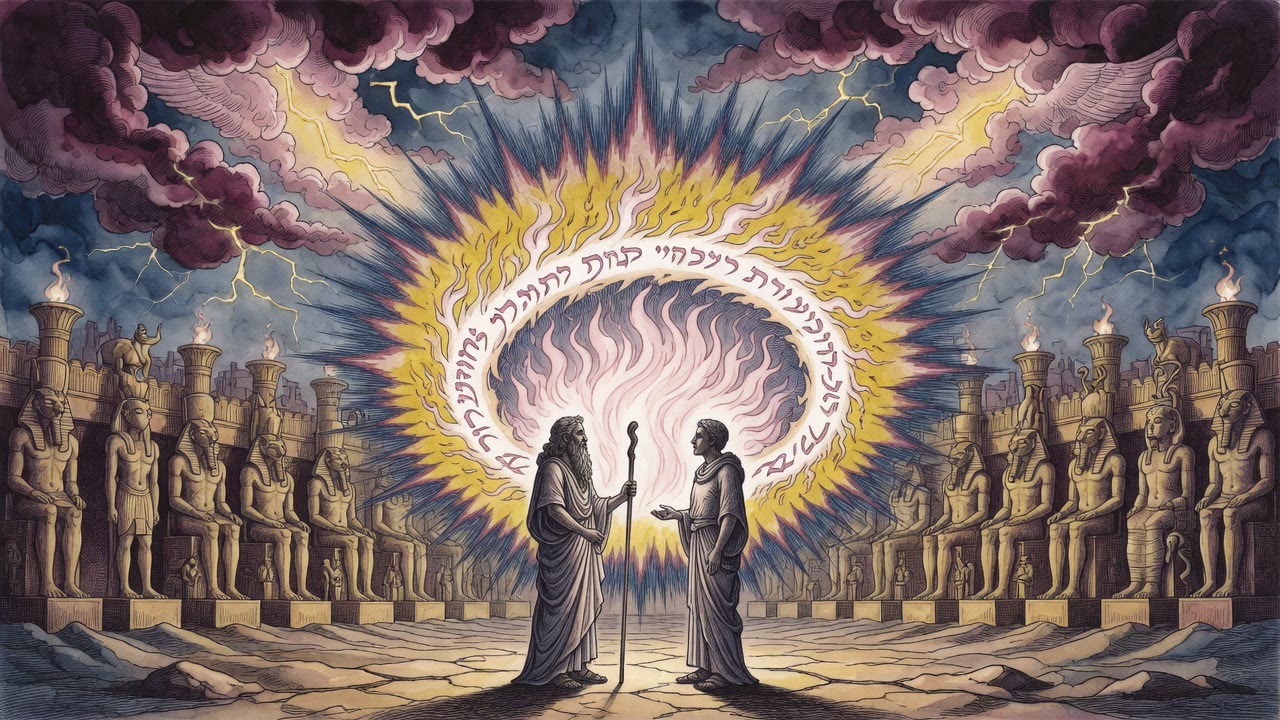
Moses stood in Midian with the staff still smelling of sheep and the memory of a bush that would not burn out. Egypt waited like a closed throat. Pharaoh still sat on the throne Moses had fled, and fear of that throne held him harder than any rope. He had argued at the bush until his voice was raw: slow of speech, no man of words, send someone else.
One Voice Split Between Midian and Egypt Click for full size

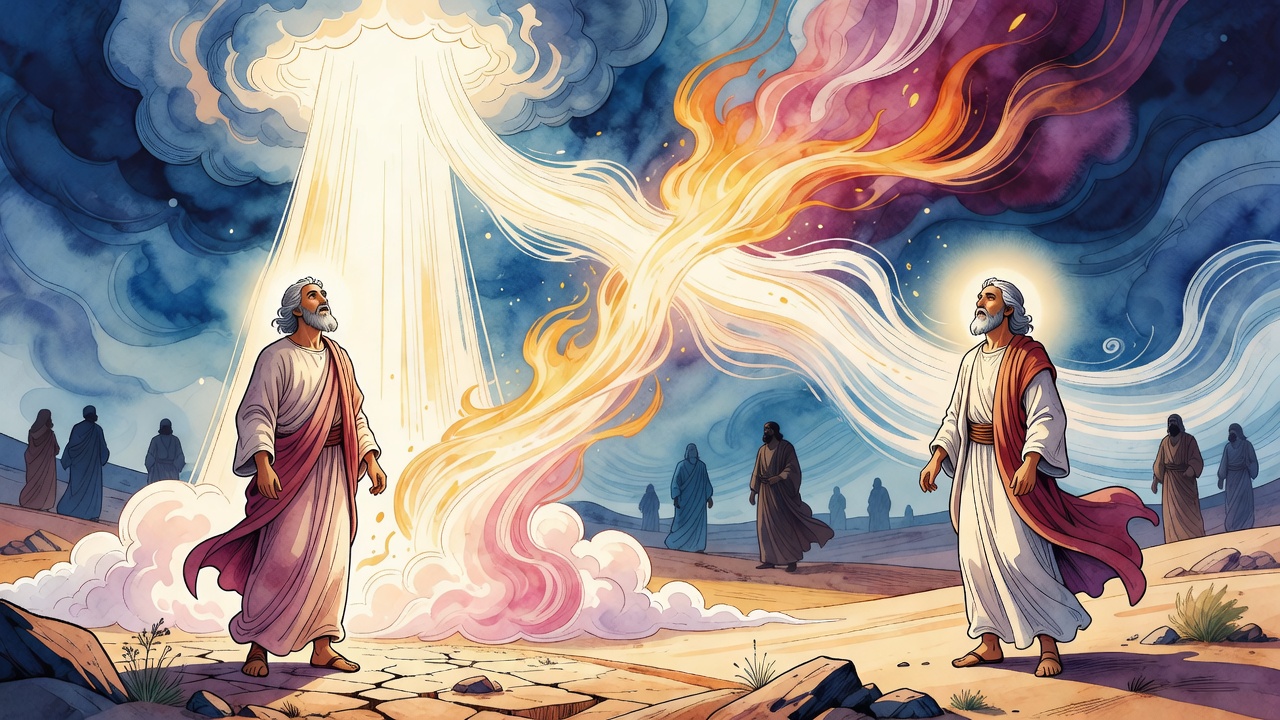
Then the air changed. Not wind. A voice left heaven as one sound and did not stay one sound.

It split.

Two Brothers, One Thunder

In Midian, Moses heard only his half: "Return to Egypt." Far away in the brick country, his brother Aaron heard only the other half: "Go to meet Moses toward the wilderness" (Exodus 4:27). Neither brother heard what was meant for the other. Scripture says God thunders wondrously with His voice, and the sages found the wonder here, not in volume but in aim: one utterance dividing clean, each man receiving exactly the word with his name on it and not a syllable more.

The stretch of voice between the two halves belonged to no one. It crossed dunes and scrub and empty miles without a listener. If Moses had heard Aaron's half, he might have waited for rescue. If Aaron had heard Moses' half, he might have stayed in Egypt counting plagues that had not yet begun. Each man received only the step in front of him, and the sealed middle of the sentence was the wilderness itself, the measured gap that would close when the brothers met.

Words Like Arrows

Moses still held his oldest excuse, a mouth that stumbled. Heaven's answer was not a speech course. Inside God's promise to teach him what to say, the sages heard the same root Hebrew uses for an arrow loosed at Sinai (Exodus 19:13). I will shoot My words into your mouth like an arrow. The speech would not have to climb out of Moses' struggling effort. It would arrive from above, swift, landing where it must.

That promise ended the long argument. "And Moses went and returned to Jether his father-in-law" (Exodus 4:18). The verse marks the turn quietly. The reluctant shepherd packed for the border he had once crossed as a fugitive, still reasoning like a man staring uphill: if Israel, his own kin, would not listen to him, how much less Pharaoh. The logic of despair did not cancel the commission. It only named the size of the work.

The Kiss at the Mountain

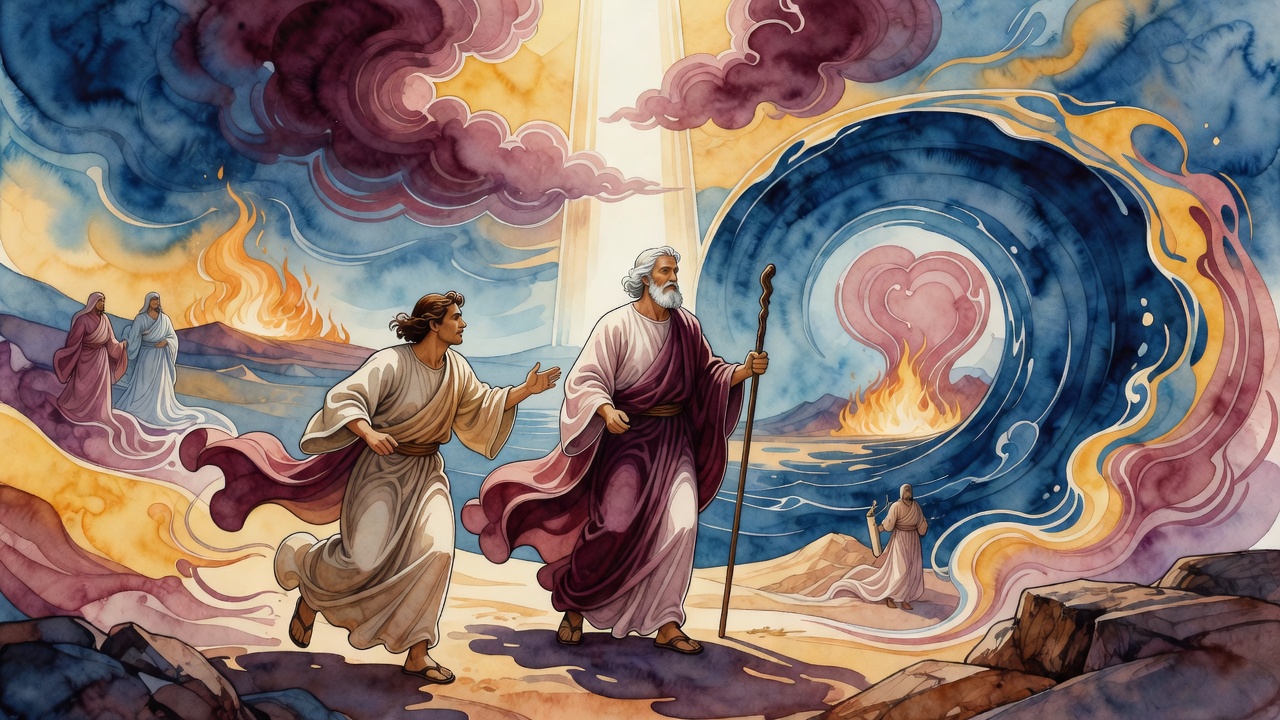
Aaron left the brick pits at dawn without knowing Moses had been ordered home. Dust stuck to his ankles until the Nile smell thinned and the desert smell rose. The two men moved on separate clocks that were one clock, and when they met at the mountain of God, each certain he alone had been summoned, the other's face proved the speech had been larger than either hearing.

They kissed. The midrash hears four virtues colliding in that embrace: kindness and truth have met, righteousness and peace have kissed. Righteousness and truth for Moses, the faithful servant. Kindness and peace for Aaron, who walked in upright quiet. One would take leadership and the other the priesthood, and neither envied the other; each rejoiced in his brother's greatness as if the gift increased his own store. Israel later sighed in the Song's language, oh that you were as a brother to me, and the rabbis heard in it a wish for leaders like these two.

Four Times He Forced an Answer

The man who had pleaded that he had no words became the man who would not release heaven without them. Rabbi Elazar ben Azariah counted four moments where an extra "saying" in the verse marks Moses insisting: answer me. At the start, with Israel deaf to his message, he demanded to know whether God truly meant to redeem them, and was told, now you shall see. When Miriam was struck with leprosy, he cried out until healing was spoken. Near his death he pressed for a shepherd to follow him, and the answer was Joshua. When he begged to enter the land, he forced the verdict from God's mouth even though the verdict was no.

The arrow cut both ways. God shot speech into Moses, and Moses shot questions back until the air between them filled with answers, hard and soft alike.

Night for Every Other Mouth

When God drew the line between Moses and every other prophet, He did not soften it. "If there be a prophet among you, I the Lord make Myself known unto him in a vision, I do speak with him in a dream" (Numbers 12:6). Mark the hour, the sages said. The ordinary prophet is reached at night, through gauze, perceiving the way a sleeper perceives and knowing even then that he dreams. Moses heard his summons while the sun still owned the sand, and Aaron's feet left Egypt under the same open sky.

Daylight had its own limit. Years later Moses grew bold at Sinai and asked to see the glory itself, the face behind the world's justice, and the answer came back: "no human shall see Me and live" (Exodus 33:20). Even the deathless angels cannot look full on the Shekhinah (שכינה), God's dwelling presence. Enough voice to move two brothers across a wilderness toward one ridge. Never enough sight to make trust unnecessary. The redemption of Israel began in that gap, with a split sentence, two roads, and the silence of the syllables no ear was meant to catch.


← All myths
From the tradition

Sources

6 sources

The texts behind this telling. Some cards carry a translation of the source; others are our own retelling of it, and each card says which. Every card links out to the original.

Midrash Aggadah, Exodus 4:27Midrash Aggadah

Translation of the source text.Midrash Aggadah (Buber), Public Domain, on Sefaria · CC-BY-SA

"And the LORD said to Aaron, etc." (Exodus 4:27). This is what is written: "God thunders wondrously with His voice" (Job 37:5). When did the Holy One, blessed be He, work wonders with His voice? At the hour when the Holy One, blessed be He, sought to send Moses on a mission, that he should go and redeem Israel from Egypt. Now Moses was in Midian, for he was afraid to go before Pharaoh. When the Holy One, blessed be He, revealed Himself to him and said to him, "Return to Egypt," the utterance was divided into two parts and into two sayings: and Moses was hearing in Midian, "Return to Egypt," while Aaron was hearing, "Go to meet Moses toward the wilderness" (Exodus 4:27); and what was in the middle, they heard nothing at all.

Full source
Yalkut Shimoni on Torah 174:2Yalkut Shimoni on Torah

Translation of the source text.Torat Emet (Yalkut Shimoni) · CC-BY-NC

"And the LORD said to Aaron, Go to meet Moses in the wilderness." This is what Scripture says, "God thunders marvelously with His voice" (Job 37:5). When did the Holy One, blessed be He, work marvels with His voice? At the hour when the Holy One, blessed be He, sought to send Moses on the mission to redeem Israel, and he was in Midian, He said to him (above, verse 19), "Return to Egypt." The utterance split into two voices and became a double countenance, and Moses heard, "In Midian, go, return to Egypt," and Aaron heard, "In Egypt, go to meet Moses in the wilderness." And what was in the middle they did not hear. Thus, "God thunders marvelously with His voice." This is what Scripture says (Song of Songs 8:1), "Oh that you were as a brother to me." Israel said to the Holy One, blessed be He, "Oh that You were as Moses and Aaron," as it is said (Psalms 133:1), "How good and how pleasant it is for brothers to dwell together," for they loved one another and cherished one another. For when Moses took the kingship and Aaron the priesthood, they did not envy one another, but each rejoiced in the greatness of the other. "Should I find you outside, I would kiss you", "And he went and met him at the mountain of God and kissed him." This is what Scripture says (Psalms 85:11), "Kindness and truth have met; righteousness and peace have kissed." "Righteousness", this is Moses, as it is said, "He did the righteousness of the LORD." "Peace", this is Aaron, as it is said (Malachi 2:6), "in peace and uprightness he walked with Me." "Kindness", this is Aaron, as it is said (Deuteronomy 33:8), "and of Levi he said, Your Tummim and Your Urim be with Your pious one." "Truth", this is Moses, as it is said, "in all My house he is faithful." Every kiss of frivolity (is in remez 124).

Full source
Yalkut Shimoni on Torah 171:5Yalkut Shimoni on Torah

Translation of the source text.Torat Emet (Yalkut Shimoni) · CC-BY-NC

Another interpretation: "I will shoot My words into your mouth like an arrow," for "and I will teach you" [ve-horeitikha] means nothing other than the language of "he shall surely be shot through" [yaroh yiyareh] (Exodus 19:13). And once the Holy One, blessed be He, assured him that He was with him, he accepted upon himself to go, as it is said, "And Moses went and returned to Jether his father-in-law" (Exodus 4:18).

Full source
Yalkut Shimoni on Torah 177:3Yalkut Shimoni on Torah

Translation of the source text.Torat Emet (Yalkut Shimoni) · CC-BY-NC

(Exodus 6:12-13) "And Moses spoke before the LORD, saying, Behold, the children of Israel have not listened to me." Rabbi Elazar ben Azariah says: In four places Moses made requests before the Omnipresent, and He answered him on his questions. As it is said, "And Moses spoke before the LORD, saying": there is no need for Scripture to say "saying," except that he said to Him, Answer me whether You are redeeming them or not, until the Omnipresent answered him, "And the LORD said to Moses, Now you shall see."

Similarly, "And Moses cried out to the LORD, saying" (Numbers 12:13): there is no need for Scripture to say "saying," except that he said to Him, Answer me whether You will heal her or not, until the Omnipresent answered him, "If her father had but spit in her face" (Numbers 12:14). Similarly, "And Moses spoke to the LORD, saying, Let the LORD appoint" (Numbers 27:15-16): there is no need to say "saying," except that he said to Him, Answer me whether You will appoint leaders over them or not, until He answered him, "Take to yourself Joshua son of Nun." Similarly, "And I pleaded with the LORD at that time" (Deuteronomy 3:23): there is no need to say "saying," except that he said to Him, Answer me whether I will enter the land or not, until He answered him, "Enough for you," and so forth, "Joshua son of Nun, who stands before you, he shall go in there" (Deuteronomy 1:38).

"Behold, the children of Israel have not listened to me": this is an argument from the lesser to the greater [kal vachomer], how then shall Pharaoh listen to me? (Written under entry 151.)

Full source
Midrash Aggadah, Exodus 33:20Midrash Aggadah

Translation of the source text.Midrash Aggadah (Buber), Public Domain, on Sefaria · CC-BY-SA

"And He said: You cannot see My face" (Exodus 33:20). Because he had asked, "Show me, I pray, Your glory" (Exodus 33:18), the Holy One, blessed be He, said to him, "You cannot see My face," and so forth. This teaches that Moses sought to see why there is a righteous person for whom it goes ill, and a wicked person for whom it goes well. He said to him: You cannot fathom the depth of the attribute of justice.

Another interpretation: He sought to see and to gaze upon the appearance of the Shekhinah, and permission was not granted to him, as it is said, "for no human shall see Me and live" (Exodus 33:20). And from here we have learned that at the hour of death all human beings shall see Him, as it is said, "before Him shall bow down all who go down to the dust, and the one whose soul He does not keep alive" (Psalms 22:30).

Another interpretation: "for no human shall see Me", this refers to the one taken from the four elements. "And live", these are the angels, who live forever, for they too are not able to see the face of the Shekhinah.

Full source
Midrash Aggadah, Numbers 12:6Midrash Aggadah

Translation of the source text.Midrash Aggadah (Buber), Public Domain, on Sefaria · CC-BY-SA

"If there be a prophet among you, the Lord make Myself known unto him in a vision, I do speak with him in a dream" (Numbers 12:6). He does not speak with him by day, but at night and in a dream. And it is not made known to him in a vision that he is seeing Me; rather, it appears to him as if he sees Me, yet he does not see Me, but only as one who is dreaming, and it appears to him that he is dreaming.

Full source