Aaron Ran to Meet Moses Without Resentment
Moses tried to hand the mission back. Aaron had prophesied in Egypt for eighty years, and Moses feared taking his brother's place.
Table of Contents
 Click for full size
Moses Ran Out of Excuses
Moses had already said he was nobody. He had already said the people would not believe him. He had already said his mouth was slow and his tongue was heavy, and each time the voice in the burning thornbush answered him and the excuse fell apart. So he tried the last one, which was not an argument at all. "Send by the hand of whoever You are going to send."
Later readers heard laziness in that line. The old teachers heard a debt.
Moses had an older brother in Egypt. Aaron had been standing in front of brickmakers with a word from God for eighty years while Moses kept another man's sheep in Midian. Eighty years of that work, done in a country that punished it. Now the deliverance was being handed to the younger brother who had been gone for most of it, and Aaron would have to watch his own field pass to a man arriving from the desert with a staff and a stammer.
Moses would rather refuse God than walk into that.
The Record of Brothers
He had cause to expect the worst, and so did everyone else. Israel would later put its longing to God as a wish, that You were like a brother to me, and then the people looked at what brothers had actually done in their own book and the wish curdled in their mouths.
Cain rose up against Abel in a field and left him there. Ishmael made sport with Isaac, and the sages read that word the way it reads elsewhere in Scripture, where young men make sport with drawn swords and nobody walks home. Esau said in his heart that he would kill Jacob as soon as the mourning for their father was finished. Ten brothers stripped Joseph, dropped him into a dry pit, and sat down nearby to eat their bread.
That was the record. A brother was a knife waiting for a soft hour.
Glad in His Heart
God did not answer Moses with reassurance about the mission. He answered with a promise about a body.
"He is already coming out to meet you, and when he sees you he will be glad in his heart."
The teachers took hold of that last phrase and would not let it go. It does not say glad with his mouth, which any man can arrange for a morning. It does not say simply glad, which can be worn like a coat over anything. It says glad in the heart, the one room where a man cannot lie to himself about what his brother's promotion costs him.
Moses went.
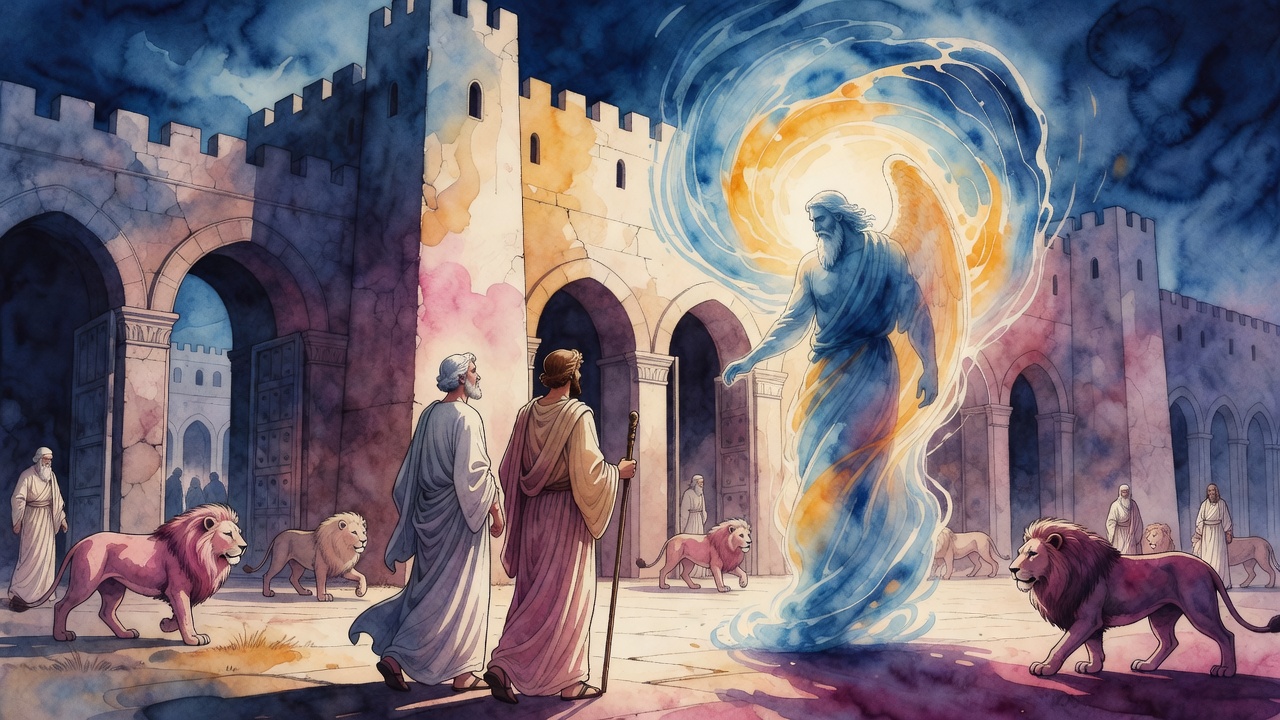
Aaron was already walking. He had been given his own instruction, go into the wilderness and meet your brother, and he crossed the sand to the mountain where the bush had burned and put his arms around the man who had come to take his work, and kissed him.
Forty Parasangs of Voice
What the two of them settled in that sand had to hold a nation on a road.
The first march out of Egypt ran from Rameses to Succoth, forty parasangs, something over forty miles, and Moses spoke at one end of that column and was heard at the other. The teachers refused to be impressed by their own claim, and reached for the plagues to make it ordinary. Moses had once thrown a fistful of soot toward the sky and it came down as boils on every body in a country that takes forty days to cross. If a handful of ash could cover Egypt, a voice could cover a day's walk.
Nobody packed. Not one household in that column carried provisions for a wilderness. What they took out was dough that never rose, flattened and scorched on coals, and those burnt cakes fed them twice a day for thirty days until the manna started falling. No one stopped at the gate to ask how a family crosses a desert on that. Centuries later a prophet stood in Jerusalem and shouted their walk back at a city that had forgotten it.
The Sea Borrowed a Heart
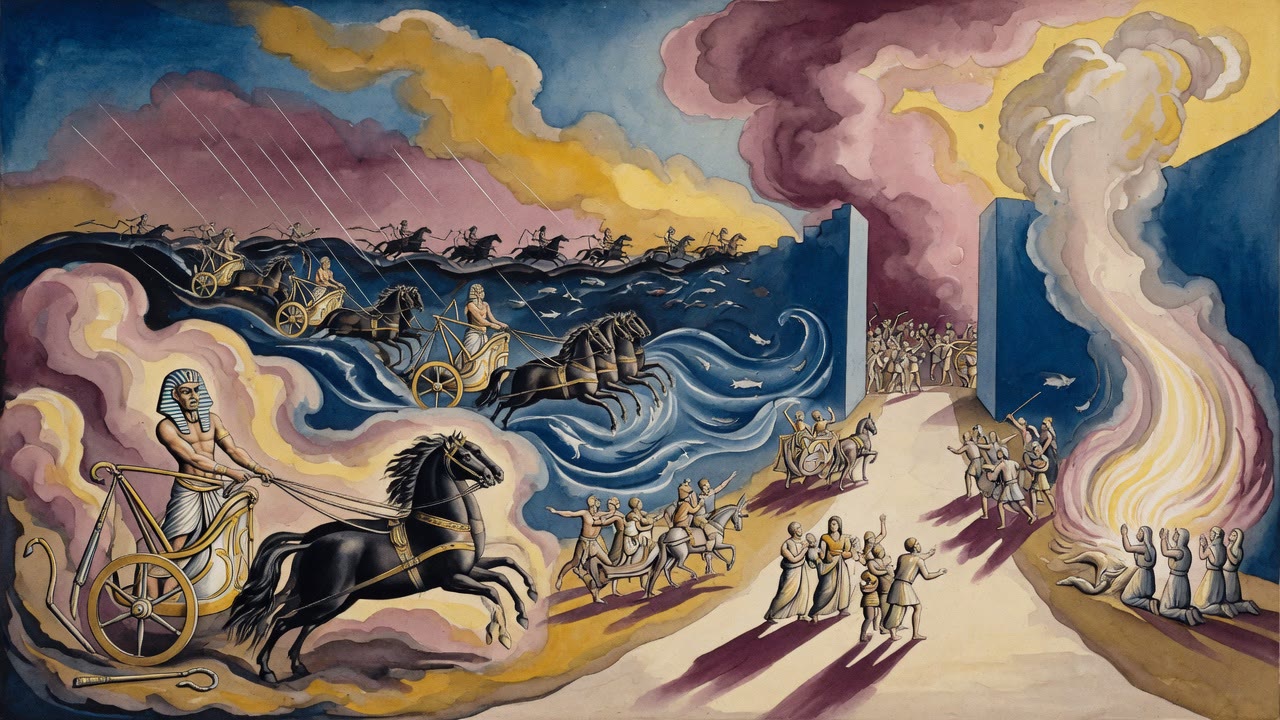
Then the water. The deeps stood up and set hard, and what they set into was less a wall than a vault, a curved roof of frozen water hanging over the chasing army. It congealed, the verse says, in the heart of the sea, and the teachers took the anatomy seriously. A man's heart sits at about two thirds of his height. The water hardened at two thirds of its depth, exactly where a heart would be.
The sea has no heart. One was lent to it. A terebinth has no heart either, and Absalom hung dying in the heart of that tree after cheating three hearts, his father's, the court's, and Israel's. Heaven has no heart, and the mountain burned to the heart of heaven at Sinai, and that same heaven later dropped bread on a people who took the Torah with all of theirs.
So the sea, carrying a heart it did not own, came down on men who owned hearts and had spent them breaking children on brick quotas.
The Stones Over Aaron's Heart
Rabbi Simeon ben Yohai closed the account with a piece of jewelry.
The heart that can be glad at a brother's height, he said, will one day be glad at its own. Years after the wilderness meeting, when Moses held the leadership and Aaron the priesthood and neither one wanted the other's, twelve stones were set in gold and fastened to Aaron's chest. The breastplate of judgment. The Urim and Thummim went into its fold, and it rested on exactly the heart that had run out to the desert without a knife in it.
← All myths