6 min read

The Egyptian Horse That Answered from the Depths

At the sea an Egyptian rebukes his horse for rushing into the water. The horse answers that it sees the heights of the universe in the deep.

Curated by Arthur · Told by Maggid ·
Table of Contents
  1. Pharaoh Boasted Over the Water
  2. Waves Like Mares, Horses Like Stallions
  3. The Horse Speaks
  4. The Host Closes the Road

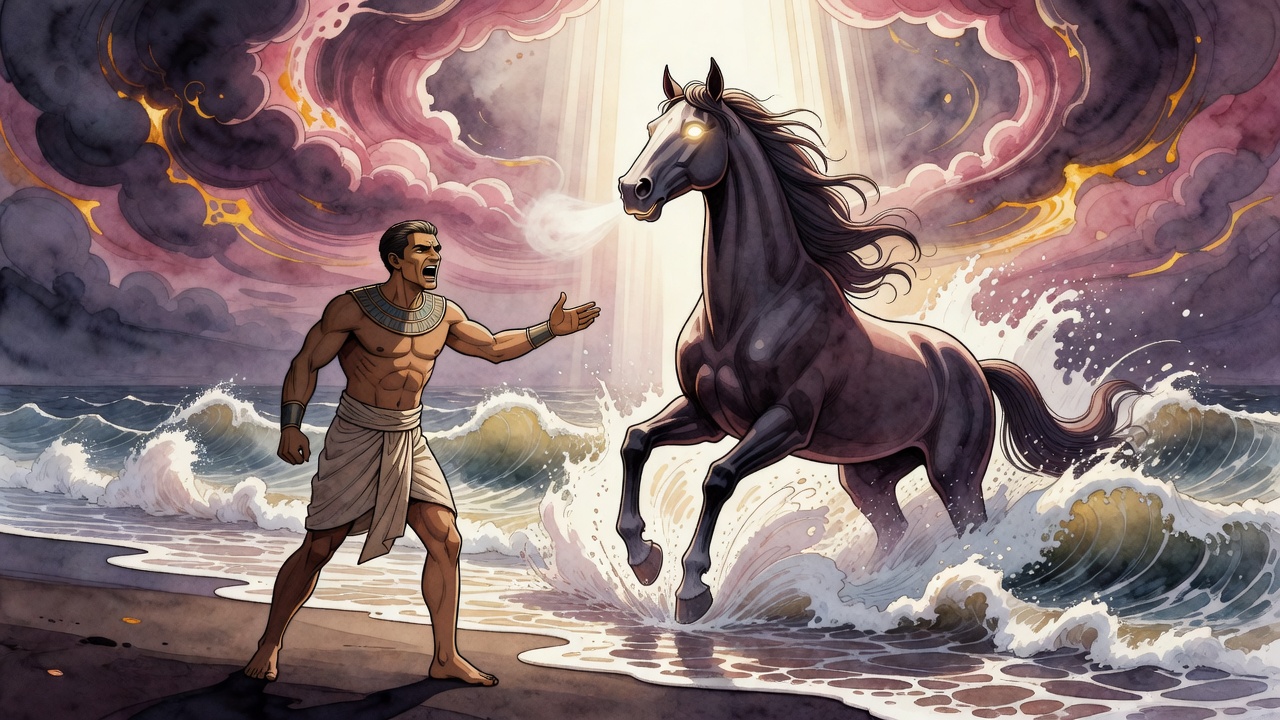
The charioteer hauled on the reins until the leather bit his palms. His horse would not turn. Ahead, the waves of the sea rose and fell like the necks of mares, white foam on dark flanks, and every stallion in Pharaoh's line leaned toward that motion as if the water itself had gone into heat.
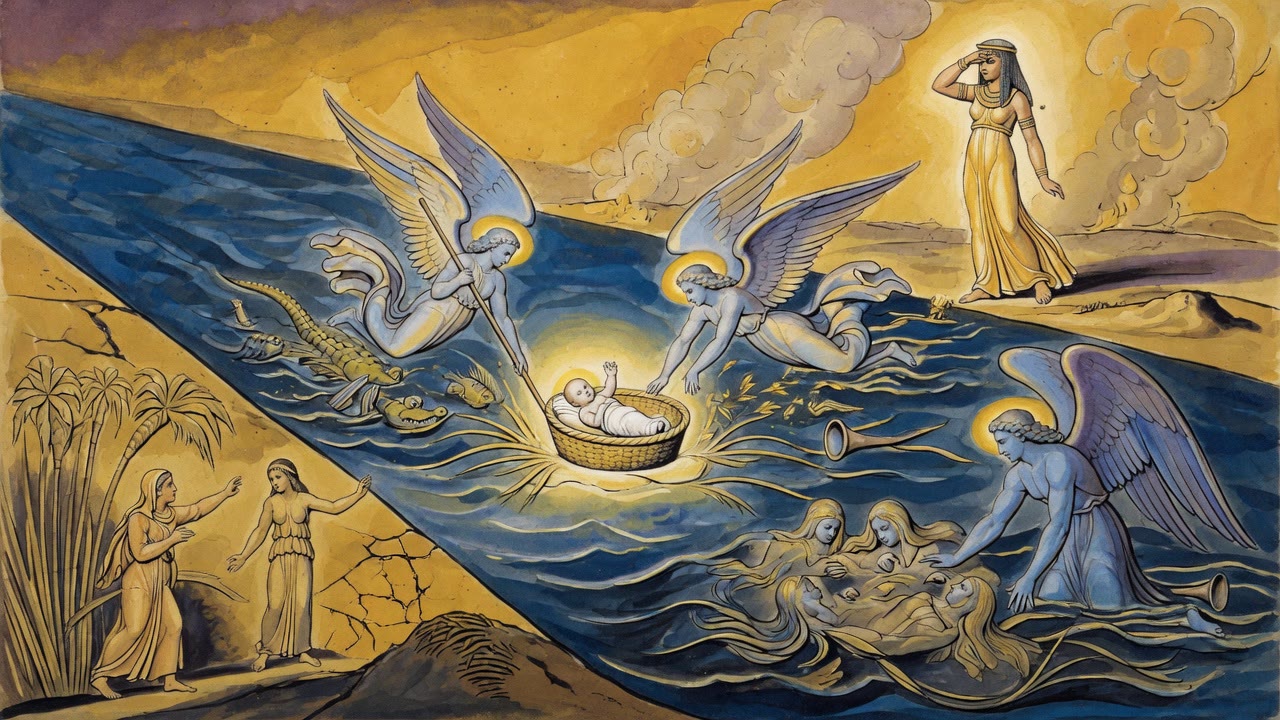
The Egyptian Horse That Answered from the Depths Click for full size

Yesterday he had dragged this same horse to a trough and the animal had set its feet and refused. Now it drove him toward drowning.

Pharaoh Boasted Over the Water

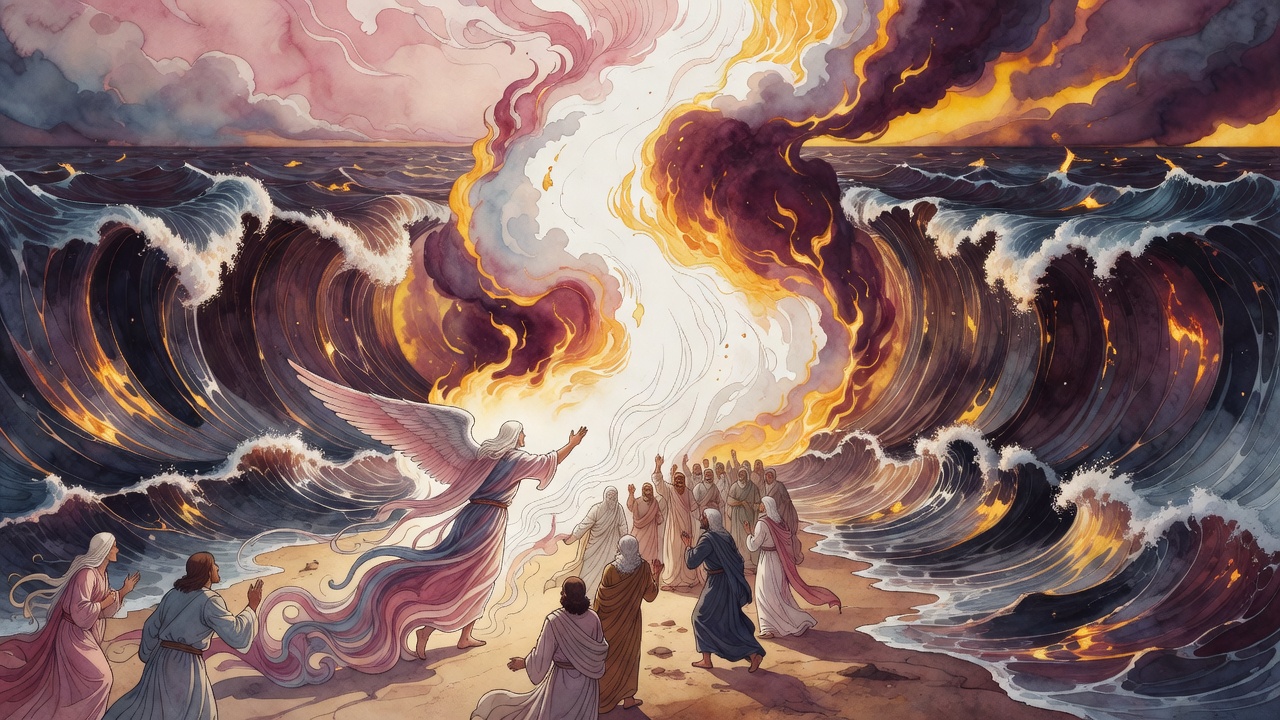
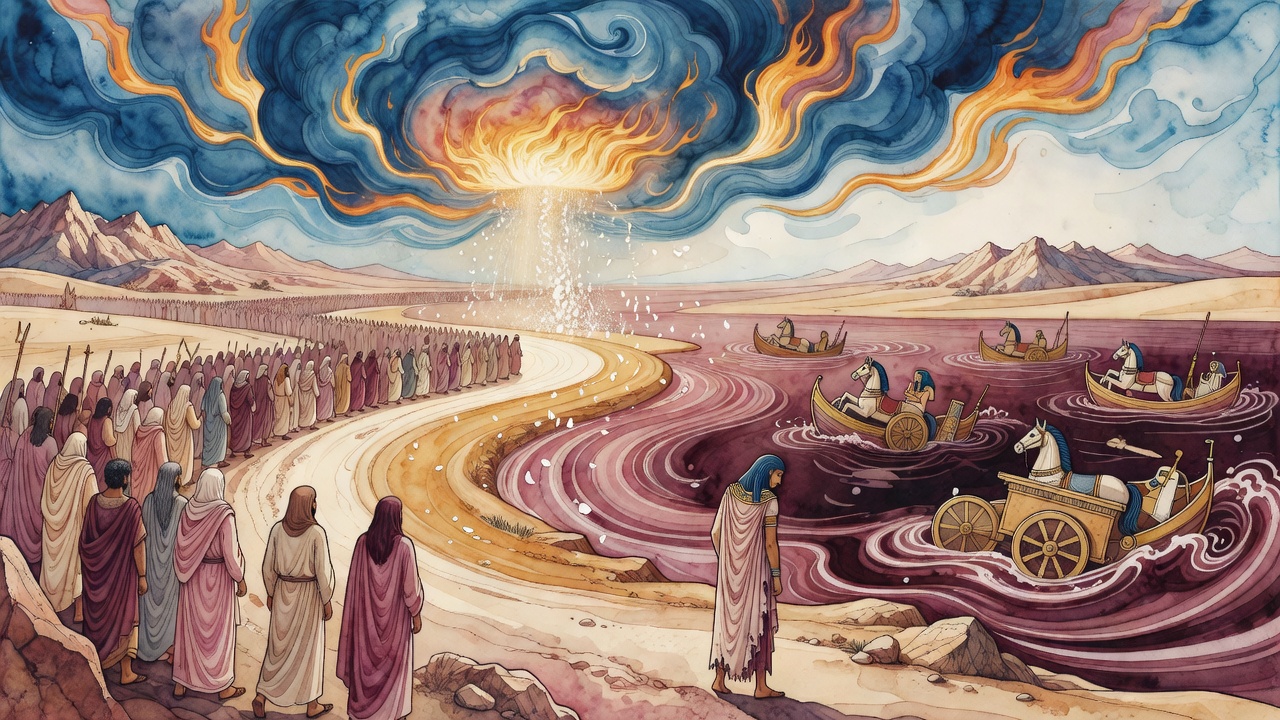
Behind the chariots, Pharaoh still rode as if the road belonged to him. Israel had fled into a corridor of standing water. The walls of sea held like glass. The Egyptian line poured onto the seabed, wheels grinding over wet sand, and Pharaoh's mouth filled with triumph. He had chariots. He had horses. He had the finest captains left in Egypt after the plagues had torn the land open.

He lifted his voice over the rush of hooves and mocked the One who claimed the wind. Did that God have wings? Did He have a cherub to ride? Pharaoh's army was flesh and iron. The sea was only a road someone else had opened for him.

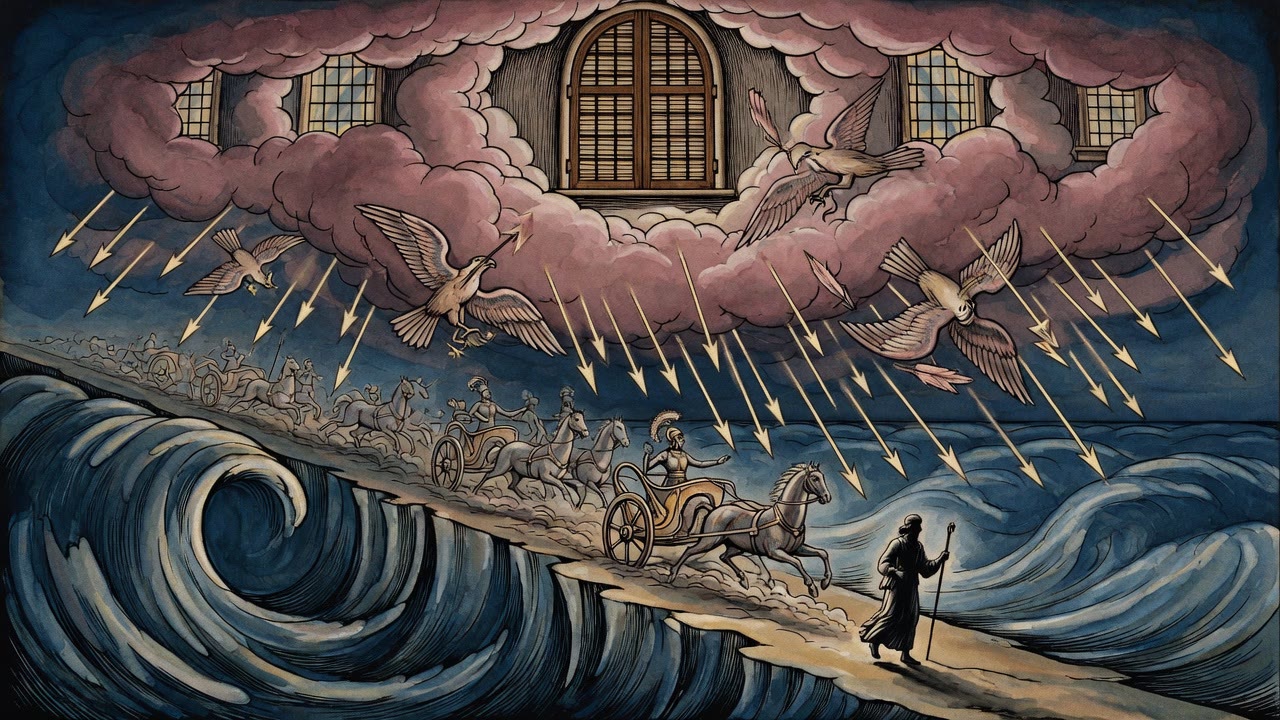
Above the water, something answered without words. The Holy One took a cherub and a wind from between the wheels of the divine chariot and cast them down into the sea. The air changed. Salt stung the charioteer's eyes. The walls of water, which had looked like a miracle of escape, began to look like bait.

Waves Like Mares, Horses Like Stallions

The waves of the sea became mares. The horses of Egypt became lustful stallions. They did not need a whip. They chased the motion of the water the way a stallion chases a mare across a field, blind to the ditch at the end of the run.

The charioteer felt it in the animal under him before he understood it with his mind. The horse's neck stretched. The bit became useless. Foam flew from the mouth that had refused ordinary water the day before. All along the line the same fever took hold. Horses that had been trained to halt on a breath now surged as if the deep were a meadow.

He shouted. He cursed. He yanked the left rein hard enough that a lesser mount would have spun. This one only dug deeper into the wet sand and drove toward the place where the wall of sea still shimmered. Sand sprayed his shins. A wheel from the chariot beside him locked, freed, locked again. Somewhere a captain screamed for the line to hold formation, and the formation was already a stampede.

"Yesterday I led you to drink," he gasped at the beast, "and you would not follow me. Now you rush toward the water to sink me in the sea?"

The Horse Speaks

The horse answered.

Not with a neigh, and not with the sound a man invents when he wants an animal to seem clever. Plain speech came out of the horse's mouth, the way speech once came out of Balaam's donkey when the road itself was about to kill a rider who would not see.

"Look at what is in the sea," the horse said. "The heights of the universe I see in the sea."

The charioteer looked, because terror makes a man obey even a horse. In the green wall of water he saw more than fish and sand. He saw height folded into depth, the rumo shel olam, the heights of the world, pressed into the surface as if the sea had become a mirror held up to heaven. Rama bayam: cast into the sea. Re'eh ma bayam: see what is in the sea. The same mouth of water that would throw him down was already showing him what ruled the throw.

He tried once more to turn. The horse would not turn. The stallions of Egypt kept chasing the mare-waves. The road behind them was already a funnel. Israel stood on the far bank with dry sandals and faces still white from the night. Between the two peoples the seabed narrowed to a throat.

The walls of water remembered their first command, and began to forget the second.

The Host Closes the Road

God does not only move water. He counts angels around a single good deed, and He can throw half a camp of heaven around a life thick with mitzvot. He can also divert a cherub and a wind when an empire needs to learn the difference between a road and a trap. The elements are not free agents. They sit when He says sit. They stand when He says stand. They become wind and fire when that is the shape the work requires.

On the seabed the work was drowning.

The walls came down in a roar that filled the skull before it filled the lungs. Iron rims locked. Horses reared and found no air. A chariot flipped and pinned a driver under a wheel that still spun once, uselessly, in the surge. Captains who had driven slaves with a lash now clawed at harness leather that would not unbuckle. The charioteer went under with his mount, still hearing the last sentence the animal had spoken, still seeing height inside the water that closed over his face. His hands opened. The reins floated away like dead snakes.

On the eastern shore Moses and Israel stood dry. The Song rose: "The horse and his rider He cast into the sea" (Exodus 15:1). Pharaoh's gladness at the chase had already been answered. God's own gladness stood over the wreck, exaltation over the very power that had boasted it owned the wind.

The last thing the sea held of Egypt was not a banner. It was a horse that had seen more than its rider, and a rider who learned too late that the depths can carry the heights.


← All myths
From the tradition

Sources

3 sources

The texts behind this telling. Some cards carry a translation of the source; others are our own retelling of it, and each card says which. Every card links out to the original.

Shemot Rabbah 23:14Shemot Rabbah

Retold in our words. Read the original at the link below.The Sefaria Midrash Rabbah, 2022 · CC-BY

It all starts with the verse, "For He is exalted." The Rabbis ask, what does that truly mean?

Rabbi Pappos offers a beautiful and subtle reading of the verse from (Song of Songs 1:9): "I have likened you, my love, to a mare [lesusati] in Pharaoh’s chariots." Now, He points out that the word lesusati is written without a vav, a Hebrew letter that often functions as a vowel. This allows us to read it differently: lesisati, meaning "My gladness." God is saying that He finds gladness, even exaltation, in the face of Pharaoh's power. How can that be?

The Midrash (rabbinic interpretive commentary) in Shir HaShirim Rabba (Song of Songs Rabbah) expands on this idea. It portrays Pharaoh boasting over the sea, confident in his might as he chases the fleeing Israelites. But God responds, essentially, "Do you have wind, do you have wings? I am far more powerful!" The verse cited is from (Psalms 18:11): "He rode upon a cherub and flew; He swooped down upon the wings of the wind."

Immediately, the Holy One, blessed be He, diverted them – the cherub and the wind – and brought them from between the wheels of the divine chariot and diverted them to the sea.

So, what's the connection to the mare, to lesusati? The Midrash continues: "I have likened you, my love." The waves of the sea were like mares, and the horses of the wicked Egyptians like lustful stallions, and they pursued [the waves] until [the Egyptians] sank to the bottom of the sea, as it is stated: "The horse and his rider He cast into the sea [rama bayam]" (Exodus 15:1).

Here’s a poignant little detail. The Egyptian would say to his horse, "Yesterday, I would lead you to have you drink water, and you would not follow me. Now you come rushing toward the water to sink me in the sea?" As if even the horse is in on God’s plan!

And the horse, in this telling, responds: "Rama bayam, look at what is in the sea [re’eh ma bayam], the heights of the universe [rumo shel olam] I see in the sea [bayam]."

What a powerful image! The horse, usually a symbol of earthly power and war, suddenly has divine insight. It sees beyond the immediate danger, beyond Pharaoh's arrogance, to the very heights of the universe reflected in the sea. It sees God's plan unfolding.

So, what does all this mean for us? Maybe it's about recognizing that even in the face of overwhelming odds, even when we feel pursued and trapped, there's a bigger picture. Maybe it's about finding that spark of "gladness," that lesisati, in the knowledge that we are not alone, and that even the horses might be seeing something we don't.

Sometimes, true power is the quiet, unwavering force that can turn the very waves into divine agents, revealing the heights of the universe in the depths of the sea. And maybe, just maybe, that power is on our side.

Full source
Shemot Rabbah 25:2Shemot Rabbah

Retold in our words. Read the original at the link below.The Sefaria Midrash Rabbah, 2022 · CC-BY

Rabbi Simon, quoting Rabbi Eliezer, starts with a verse from Hosea (12:6): “The Lord is the God of hosts [tzevaot], the Lord is His designation.”

The word tzevaot, "hosts," is key here. Rabbi Eliezer, as presented in Shemot Rabbah, understands it to mean that God carries out His will – His tzivyono, if you will – upon all of creation. Everything is under God's command.

What does that really mean?

The text goes on to illustrate this point with some pretty amazing examples, starting with the angels. According to this interpretation, God doesn't just create angels and then let them do their own thing. No, no. God actively directs them. Sometimes, He makes them sit, referencing the angel in (Judges 6:11) who "came and sat beneath the terebinth." Other times, He makes them stand, like the seraphs – those fiery, winged angels – described in (Isaiah 6:2). And then there's (Zechariah 3:7), where we read "I will grant you movement among those standing," clearly a reference to angelic beings.

And it gets even wilder! The passage suggests that God can even alter their forms. Sometimes, they appear as women, as in (Zechariah 5:9): “Behold, two women emerged and wind was in their wings." Other times, they appear as men, like the "three men" who visit Abraham in (Genesis 18:2). And perhaps most strikingly, God can transform them into elemental forces, like wind and fire, echoing (Psalm 104:4), "He renders His angels winds, flaming fires His servants.”

So, the angels aren't autonomous beings. They are extensions of God's will, shaped and directed by Him.

But it doesn't stop with the celestial realm! The text then extends this idea to the physical world. Just as God commands the angels, so too does He command the elements. When He wants, He produces bread from the earth, as (Psalm 104:14) reminds us. He brings down water from the heavens, as described in (Deuteronomy 11:11). He can even raise water from the depths of the earth, like in the story of the well in (Numbers 21:17). And, of course, there's the ultimate example of divine provision: the manna that rained down from heaven, as promised in (Exodus 16:4).

This isn't just about physical power, though. It speaks to a much deeper theological point: the utter and complete sovereignty of God. Everything, from the highest angel to the smallest grain of sand, is ultimately under His control.

This passage from Shemot Rabbah invites us to consider our place in the universe. If everything is ultimately directed by God, what does that mean for our own free will? How do we reconcile the idea of divine control with our own choices and actions? It's a question that has occupied theologians and philosophers for centuries, and one that continues to challenge and inspire us today.

Full source
Shemot Rabbah 32:6Shemot Rabbah

Retold in our words. Read the original at the link below.The Sefaria Midrash Rabbah, 2022 · CC-BY

It hinges on the verse, "Behold, I am sending an angel before you" (Exodus 23:20). But it doesn't stop there. It connects it beautifully with a passage from Psalms: "The angel of the Lord encamps around those who fear Him, and rescues them" (Psalms 34:8).

Think of it like this: if you do one mitzva, one good deed, one act of kindness, the Holy One, blessed be He, sends an angel to protect you. One mitzva, one angel. A bodyguard from on high, specifically assigned to you.

What happens if you do more? What if you dedicate yourself to living a life filled with good deeds?

Shemot Rabbah continues, drawing on another verse from Psalms (91:11): "For He will command His angels on your behalf to protect you in all your ways." This suggests that if you perform two mitzvot (commandments), you get two angels. Double the protection!

But it gets even wilder.

If you perform many mitzvot the Holy One, blessed be He, provides you with half of His camp! Half of His entire angelic host! Now, how many angels is that, exactly? The text references (Psalms 91:7), "A thousand may fall at your side, and ten thousand at your right hand." Then it connects to (Psalms 68:18), "The chariots of God are myriad [ribotayim], thousands of companies.”

Now, ribotayim literally means "tens of thousands." And here's where it gets a little… well, let's just say the rabbis loved a good textual interpretation. There's a fascinating, almost mathematical, aside here. Because plural terms in Hebrew indicate at least two, some understand "tens of thousands and thousands" to mean a grand total of twenty-two thousand. Half of that, then, would be eleven thousand angels! (Shemot Rabbah 32).

Eleven thousand angels watching over you. Protecting you. Because you chose to do good. That’s… a lot of heavenly backup.

The idea that our actions, our choices, have a direct impact on the spiritual realm. That every act of kindness, every mitzva performed, creates a ripple effect, drawing divine protection and support into our lives.

Remember the angels, the unseen forces working on your behalf. Remember that even the smallest act of goodness can bring forth a legion of heavenly guardians. Maybe, just maybe, they're already there.

Full source