Parshat Beshalach5 min read

God Fought Egypt at the Sea With His Name Alone

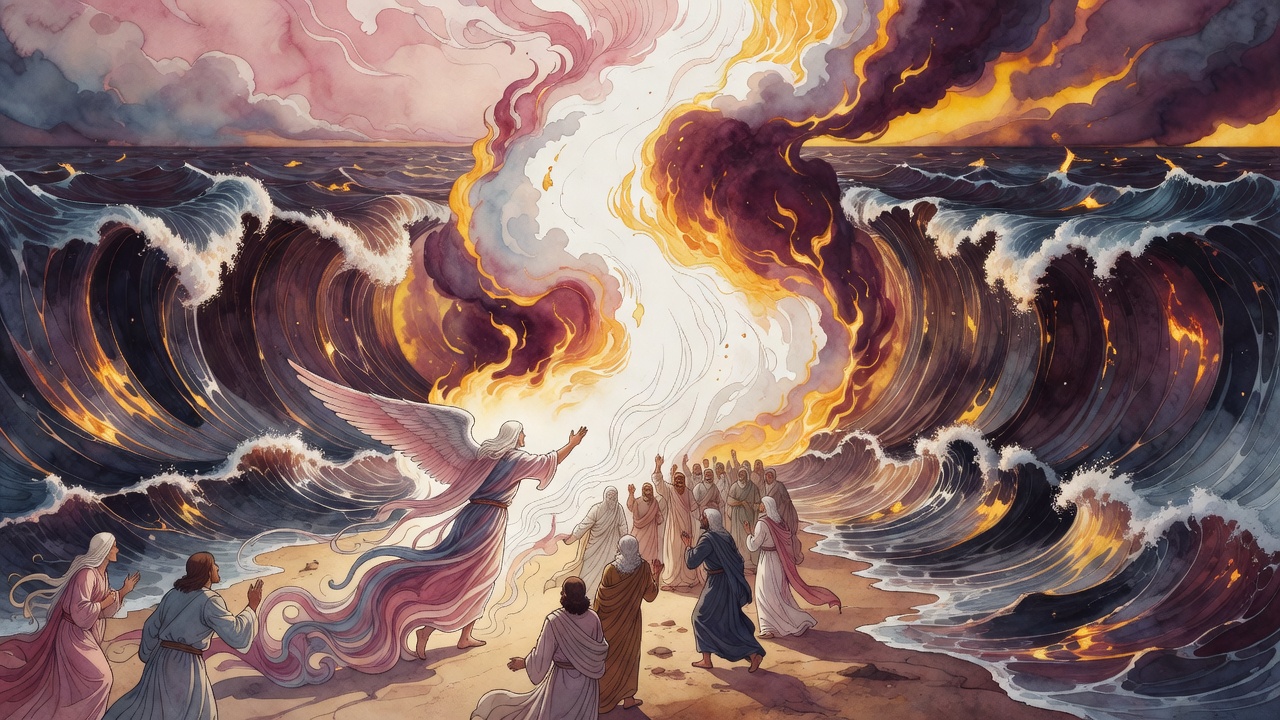
At the sea the Angel of the Lord moved to Israel's rear while the waters stood bound like skins, and God fought with His name, not steel.

Curated by Arthur · Told by Maggid ·
Table of Contents
  1. Weapons That Never Left Heaven
  2. Waters Bound Like Skins
  3. The Right Hand That Waits
  4. Rear Guard and Name

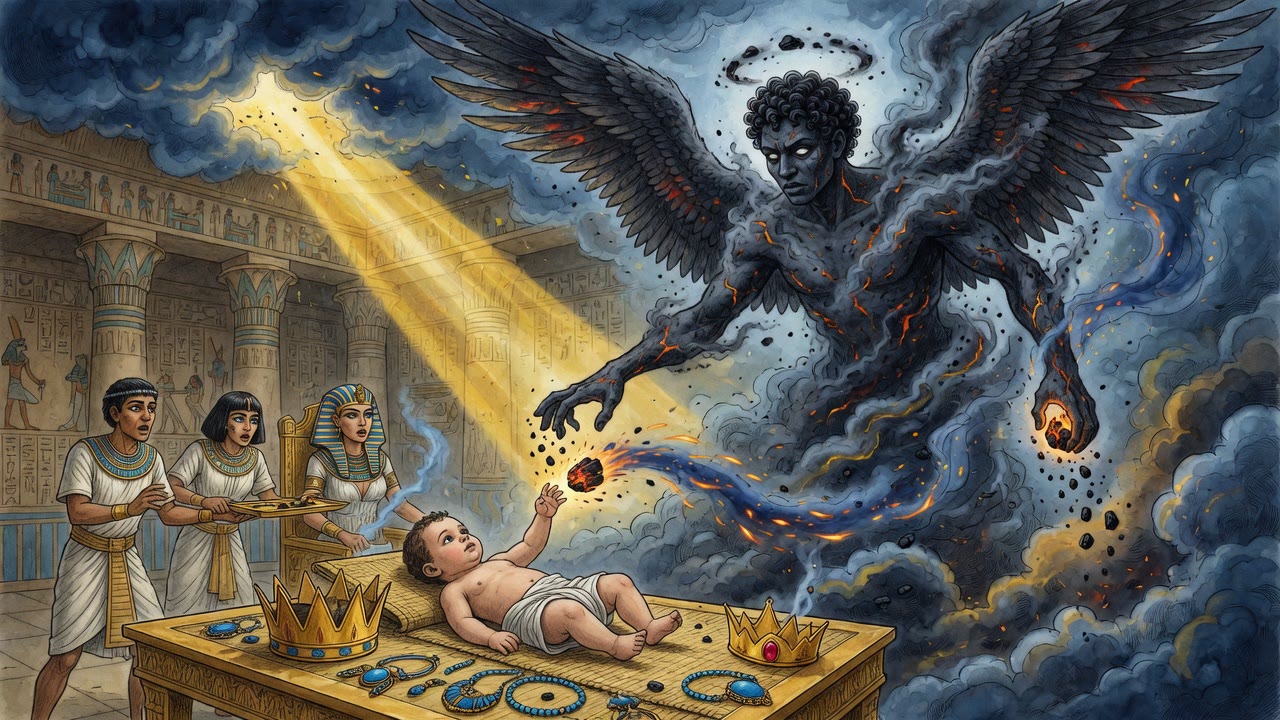
Moses stood with the sea at his back and the chariots of Egypt closing the land. Wind tore at the camp. Children clung to cart rails. Behind them the Mizraee raised arms and threw darts and stones that should have found flesh.

God Fought Egypt at the Sea With His Name Alone Click for full size

They did not.

The Angel of the Lord, who had walked in front of Israel all the way from the brick pits, turned and went to the rear. The pillar of cloud turned with him. Projectiles hit a wall no smith had forged and dropped into the sand. Israel's exposed spine became the heaviest armor on the field.

Weapons That Never Left Heaven

On the shore the singers would later say God is a man of war. In the camps that night men pictured what a man of war should wear: helmet, coat of mail, sword, bow, buckler, shield, a spear that glitters when it turns. The song gave them none of it. The Name alone stood in the gap. The Holy One fights with His name and needs no blade a human hand could hold.

The arsenal imagined and withheld was not empty theater. Whatever Israel would ever need, heaven already held ready. The nations were meant to hear it with their own ears. The One who made the world would war against the proud without borrowing their iron.

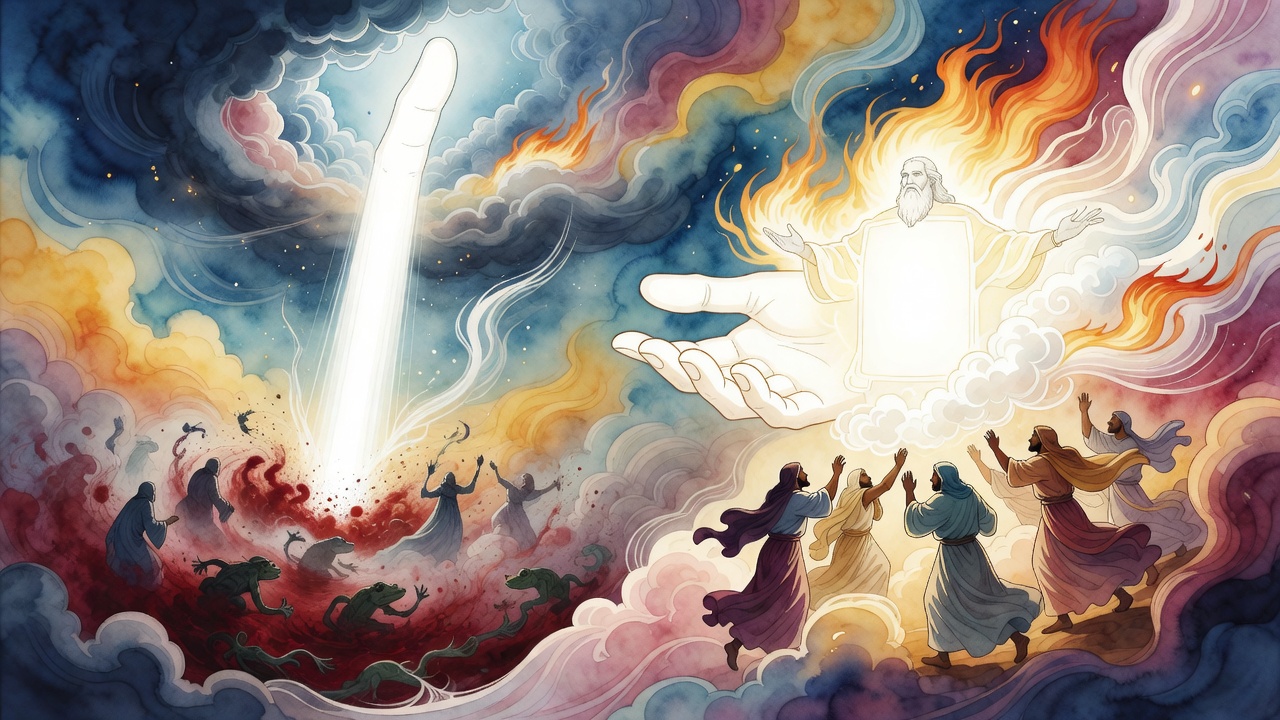
At the sea He looked young, a soldier in full strength. At Sinai He would look aged, wrapped like the Ancient of Days. Two faces. One Name. "The LORD is His name." He does not age out of power the way human fighters do. "I the LORD do not change."

Waters Bound Like Skins

When the path opened, the waters did not simply pile. They stood as if bound in skins that confine flowing liquid, leather sewn tight, pressurized, alive, straining to rush back and drown the road. The depths congealed. The deep itself thickened and held still at the Word from before Him, the same creative speech that once ordered light out of dark.

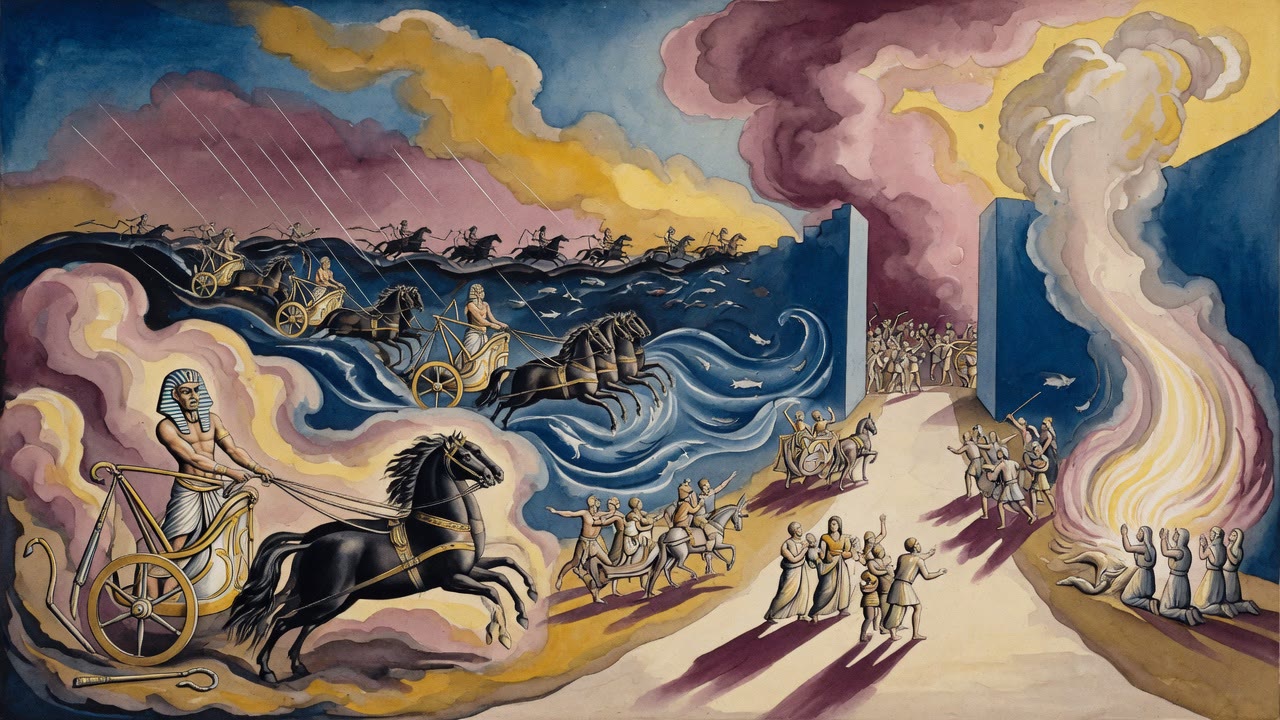
Israel walked between walls that wanted to collapse and could not. Egypt followed into a corridor that was never meant for them. A second act of creation had been spoken over the Yam Suph. Water learned, for a few hours, to behave like sealed hide.

The Right Hand That Waits

The Song praises the right hand glorious in power. The glory is not speed of ruin. It is restraint. Flood generations, Tower builders, men of Sodom, and the Egyptians each received full time to turn before the seal closed. Power that can afford to wait is the greater power.

When Israel does the will of heaven, the left hand becomes a right hand. When they refuse, the right hand draws back and the Merciful One can look like an enemy. The hand that shatters points first at Pharaoh, who boasted he would pursue and overtake. The tense of the song is careful. What looks finished still hangs on conduct.

Rear Guard and Name

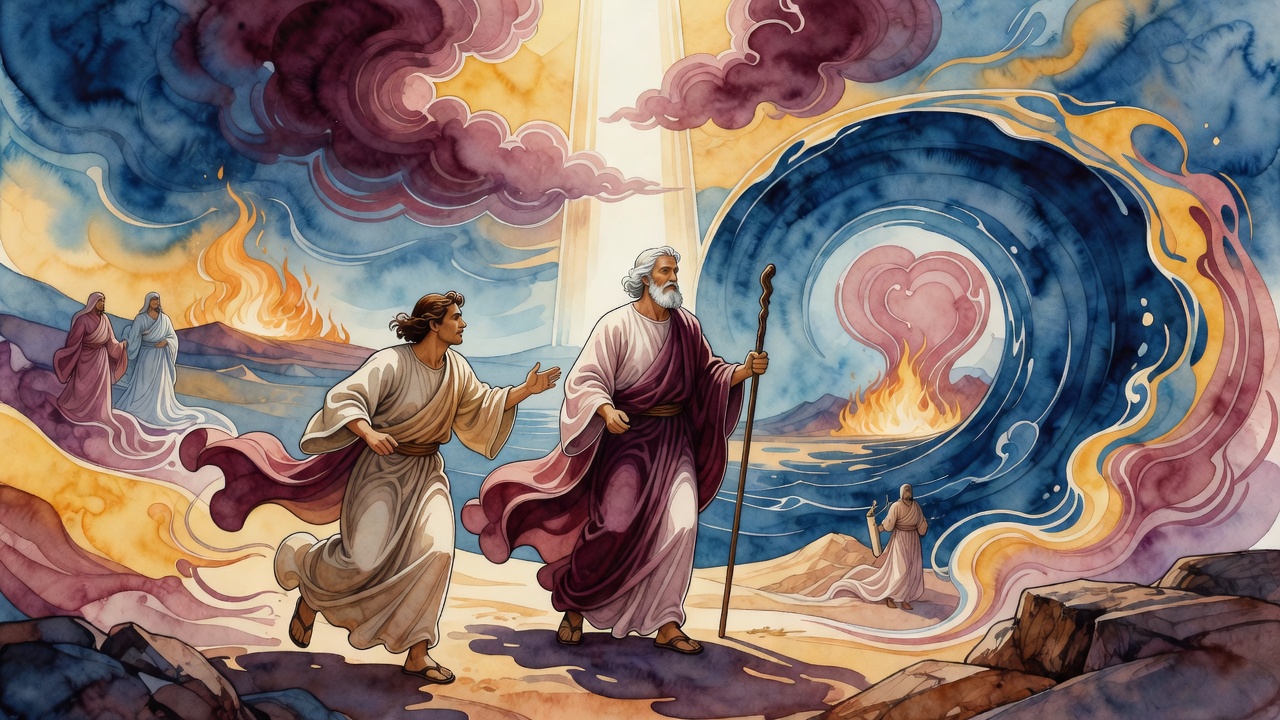
On the night before the walls of water, the angel did not lead from the front. Leadership shifted to defense. The cloud intercepted what Egypt threw. The Name held what no weapon could hold. Moses raised the staff. Israel stepped onto mud that had been seafloor an hour before.

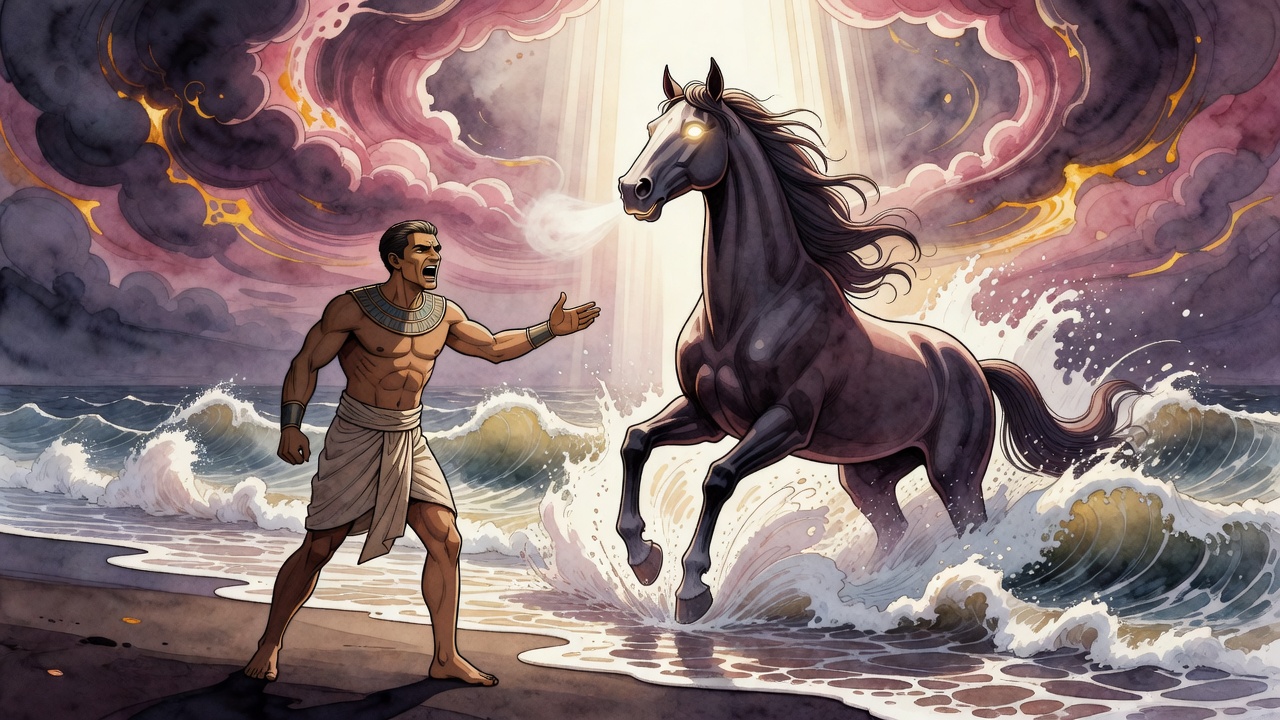
Pharaoh's horses entered the skins' corridor. The Word released what it had bound. Leather-tight water became ordinary flood again. Chariots sank. The rear guard had done its work. The Name needed no spear.

Years later, when the song was taught to children who had never smelled Egyptian leather, the teachers still began with the picture of a warrior whose armory stays invisible. Helmets and mail belong to nations that measure strength by metal. Israel measures it by a Name that rearranges angels and clouds in real time, that clots the deep, that waits through generations of wickedness before it seals a doom, and that can turn from friend to adversary when the people themselves reverse.

Moses did not invent that measure on the shore. He watched it. The darts fell short. The waters stood. The Name went to war without drawing a blade any smith could sharpen. Egypt learned the cost of pursuing a people whose rear was held by glory.

When the last chariot vanished under the flood, Israel stood on the far bank with wet ankles and dry throats. Someone began the song. Someone answered. Between the verses the camp could still see the cloud that had moved to the back when the stones began to fly. Protection had a direction. War had a Name. Both had been enough.

In the morning light the drowned horses lay where the tide left them, and women walked the edge of the water gathering what Egypt would no longer need. A boy asked Moses if the Name could grow tired the way a bowstring grows tired. Moses did not answer with a lecture. He pointed at the cloud still hanging over the camp like a living roof and at the wet sand that had been a road. The boy stopped asking.

Pharaoh's officers, the ones who had not entered the corridor, turned their chariots inland and carried a report no court poet would want to write. They had thrown stones at a cloud. They had watched water stand like sealed skins. They had heard a people sing to a warrior who never drew a blade. That report would travel farther than any spear.


← All myths

From the tradition

Sources

4 sources

The texts behind this telling. Some cards carry a translation of the source; others are our own retelling of it, and each card says which. Every card links out to the original.

Mekhilta DeRabbi Shimon Ben Yochai 15:3Mekhilta DeRabbi Shimon Ben Yochai

Translation of the source text.Mechilta de-Rabbi Simon b. Jochai, ed. D. Hoffmann, Frankfurt 1905 · Public Domain

"The LORD is a man of war; the LORD is His name." This verse is rich in many places. It tells that He revealed Himself to them with every kind of weapon. He appeared to them as a horseman, as it is said, "He rode upon a cherub and flew" (Psalms 18:11). He appeared to them in coat of mail and helmet, as it is said, "He put on righteousness as a coat of mail, and a helmet of salvation on His head" (Isaiah 59:17). He appeared to them as a warrior girded with a sword, as it is said, "Gird Your sword upon Your thigh, O mighty one" (Psalms 45:4). He appeared to them with a bow, as it is said, "You laid bare Your bow" (Habakkuk 3:9). He appeared with buckler and shield, as it is said, "Take hold of shield and buckler" (Psalms 35:2). He appeared to them with a spear, as it is said, "at the flash of Your glittering spear" (Habakkuk 3:11).

I might think that He needs all these weapons; therefore Scripture says, "The LORD is a man of war; the LORD is His name", with His name He makes war, and needs none of these. If so, why did Scripture need to specify all these verses? To say that if Israel should need any one of them, He performs it for them. Woe to the nations of the world for what their ears hear: that He who spoke and the world came to be is destined to make war upon them.

Another interpretation: "The LORD is a man of war; the LORD is His name." Because, when the Holy One, blessed be He, revealed Himself at the Sea, He appeared to them as a young man waging war, as it is said, "The LORD is a man of war"; and He revealed Himself at Sinai as an elder wrapped in a cloak, as it is said, "I beheld until thrones were placed, and the Ancient of Days took His seat; His garment was white as snow, and the hair of His head like pure wool" (Daniel 7:9). One might think they are two powers; therefore Scripture says, "the LORD is His name." Another interpretation: "the LORD is a man of war; the LORD is His name", He waged war in Egypt and He at the Sea, He at the Jordan and He at the streams of Arnon, He in this world and He in the world to come, He in the past and He in the future, as it is said, "See now that I, even I, am He" (Deuteronomy 32:39), and "I, the LORD, the first, and with the last, I am He" (Isaiah 41:4).

Another interpretation: "the LORD is a man of war; the LORD is His name." A warrior may stand in battle with his strength upon him like a man of forty, but he is not like one of sixty or seventy, for as he ages his strength wanes. But He who spoke and the world came to be is not so: "the LORD is a man of war" who fought in Egypt, and "the LORD is His name" in the past and in the future alike, as it is said, "For I the LORD do not change" (Malachi 3:6). Another interpretation: a warrior may stand in battle, and once the arrow leaves his hand he cannot recall it; but He who spoke and the world came to be is not so. When Israel does not do the will of the Omnipresent, a decree goes forth from before Him, as it is said, "If I whet My flashing sword" (Deuteronomy 32:41); if they repent, He recalls it, as it is said, "and My hand takes hold of judgment." I might think He recalls it empty; therefore Scripture says, "I will return vengeance upon My foes", I turn it back upon the nations of the world. Another interpretation: a warrior may stand, and when jealousy and fury clothe him, he does not distinguish even his father or brother or kin, but strikes and goes on in his rage. But He who spoke and the world came to be is not so: "the LORD is a man of war" who wages war, and even so, "the LORD is His name", He is merciful to all His creatures, for what is His name? "The LORD, the LORD, a God merciful and gracious, slow to anger and abounding in steadfast love and faithfulness" (Exodus 34:6).

Full source
Mekhilta DeRabbi Shimon Ben Yochai 15:6Mekhilta DeRabbi Shimon Ben Yochai

Translation of the source text.Mechilta de-Rabbi Simon b. Jochai, ed. D. Hoffmann, Frankfurt 1905 · Public Domain

"Your right hand, O LORD, glorious in power." You are comely and glorious in power, in that You granted respite to the generation of the Flood so that they might repent, and they did not, and You did not seal their doom until they had completed their wickedness. So too with the men of the Tower, and so with Sodom, and so with the Egyptians: ten plagues You brought upon them, and You did not seal their doom until they had completed their wickedness before You.

"Your right hand, O LORD, shatters the enemy." Come and see: when Israel does the will of the Omnipresent, they turn the left hand into a right hand, as it is said, "Your right hand, O LORD, Your right hand, O LORD." And when they do not do His will, they turn the right hand into a left, as it is said, "He drew back His right hand from before the enemy" (Lamentations 2:3). When Israel does the will of the Omnipresent, there is no wrath before Him, "I have no wrath" (Isaiah 27:4); and when they do not do His will, He is filled with wrath against their foes, as it is said, "and the anger of the LORD will be kindled against you" (Deuteronomy 11:17). When Israel does the will of the Omnipresent, He fights for them, "The LORD will fight for you" (Exodus 14:14); and when they do not do His will, as it were, He fights against them, as it is said, "so He turned to become their enemy, and He Himself fought against them" (Isaiah 63:10). And not only that, but they turn the Merciful One into a cruel one, as it is said, "The LORD has become like an enemy" (Lamentations 2:5). When Israel does the will of the Omnipresent, there is no sleep before Him, as it is said, "Behold, He who keeps Israel neither slumbers nor sleeps" (Psalms 121:4); and when they do not do His will, as it were, there is sleep before Him, as it is said, "Then the LORD awoke as one from sleep" (Psalms 78:65), and it says, "and in their provocation My eye lodges" (Job 17:2), as it were, as if there were sleep before Him while Israel is in distress and the nations of the world are at ease.

"Shatters the enemy." This is Pharaoh, as it is said, "The enemy said, I will pursue, I will overtake" (Exodus 15:9). And some say it is Esau, as it is said, "Because the enemy said of you, Aha!" (Ezekiel 36:2). It is not written, "You shattered the enemy," but "You will shatter the enemy", in the future to come; and so it says, "In wrath You will tread the earth, in anger You will trample the nations" (Habakkuk 3:12).

Full source
Targum Pseudo-Jonathan on Exodus 15:8Targum Pseudo-Jonathan on Exodus

Retold in our words. Read the original at the link below.The Targum of Jonathan ben Uzziel, trans. J. W. Etheridge, London, 1862 · Public Domain

The Hebrew of the Song of the Sea says the waters "piled up." Targum Pseudo-Jonathan gives us a different picture entirely, more vivid and more strange: For by the Word from before Thee the waters became heaps; they stood, as if bound like skins that confine flowing water, and the depths were congealed in the flood of the great sea.

Bound wineskins. That is the Targum's image. Picture a leather skin sewn tight, swelling with liquid it cannot release. The waters of the Yam Suph stood that way, pressurized, alive, straining to rush back in, held only by the Word (memra) of the Holy One.

The Targum uses the word memra here deliberately. The memra is the creative Word of God, the same Word that spoke the world into being at the start of creation. The paraphrast is telling us that the parting of the sea was not a natural event nudged by a strong wind. It was a second act of creation, a re-spoken cosmos where water learned, briefly, to behave like leather.

Then the second image: the depths were congealed. The Aramaic verb suggests clotting, thickening, the way blood thickens or honey stiffens in cold. The deep itself grew still.

The Maggid's takeaway: when the world seems fluid and dangerous, remember that the same Word that speaks creation can also speak stillness. A sea bound like a wineskin is still a sea. It has not forgotten how to drown. It has only been told, for a moment, to hold.

Full source
Targum Pseudo-Jonathan on Exodus 14:19Targum Pseudo-Jonathan on Exodus

Retold in our words. Read the original at the link below.The Targum of Jonathan ben Uzziel, trans. J. W. Etheridge, London, 1862 · Public Domain

The Targum Pseudo-Jonathan on (Exodus 14:19) watches a careful choreography. The Angel of the Lord, who had been leading Israel from the front, suddenly moves. He goes behind them. The pillar of cloud, which had stood before them, also shifts to the rear.

Why the repositioning? The Targum answers with a concrete battlefield detail: "The Mizraee threw darts and stones at the Israelites, but the Cloud intercepted them." The cloud is not only light. It is armor. Egyptian projectiles are hitting a divine wall and falling harmless.

So the arrangement is precise. An angel in front is no good when the enemy is behind. The angel moves. The cloud moves. Israel's back, which was exposed, is now the most heavily defended part of the camp.

The Targum's image is of a God who rearranges the defense in real time. Not a fixed formation but a living one, adjusting to the threat. When Egypt changes its angle of attack, heaven changes its angle of protection.

And notice the division of labor. The angel led but did not fight; the cloud intercepted but did not speak. Each has a function. Together they shield Israel from what they cannot yet see: the sea is about to open.

Takeaway: the Targum teaches that divine protection is not static. It is an attentive, moving thing, always at the place of the wound.

Full source