The Crown, the Coal, and the Angel Who Saved Moses
The crown slid down over the boy's ears. Cold air hit Pharaoh's scalp. Along the banquet table, nobody in the hall chewed.
Table of Contents
 Click for full size
The Crown Left the King's Head
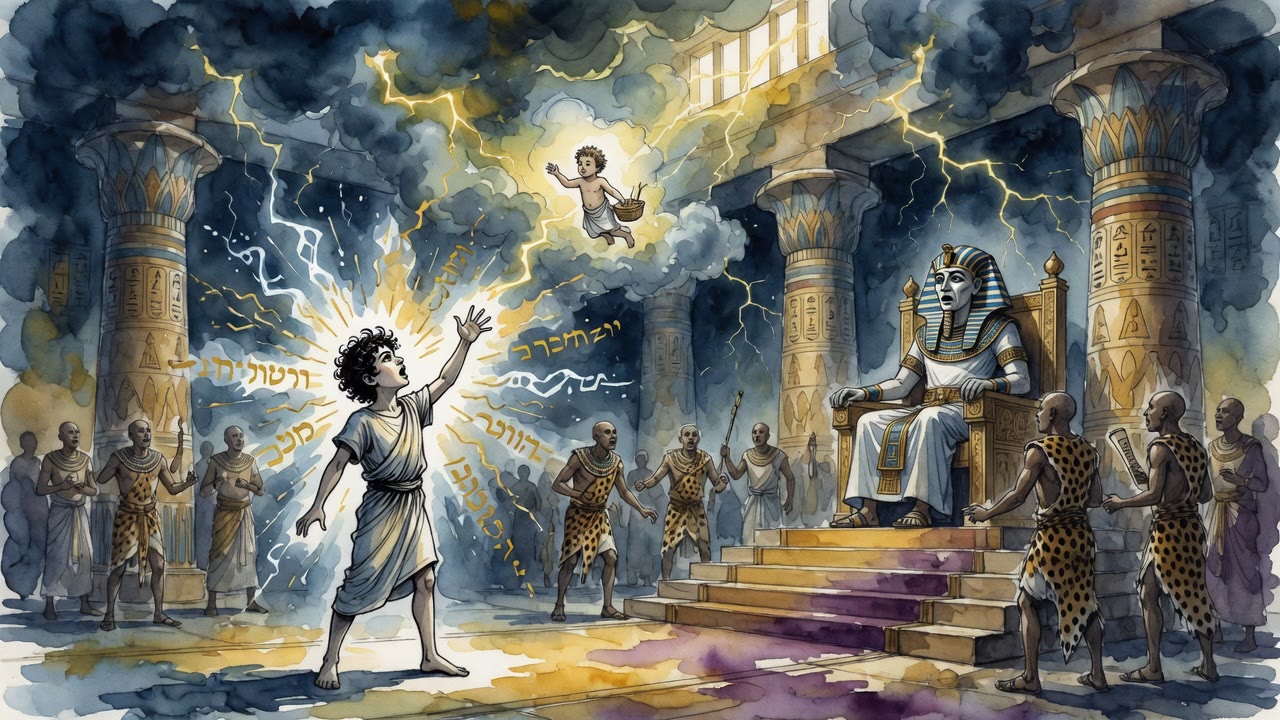
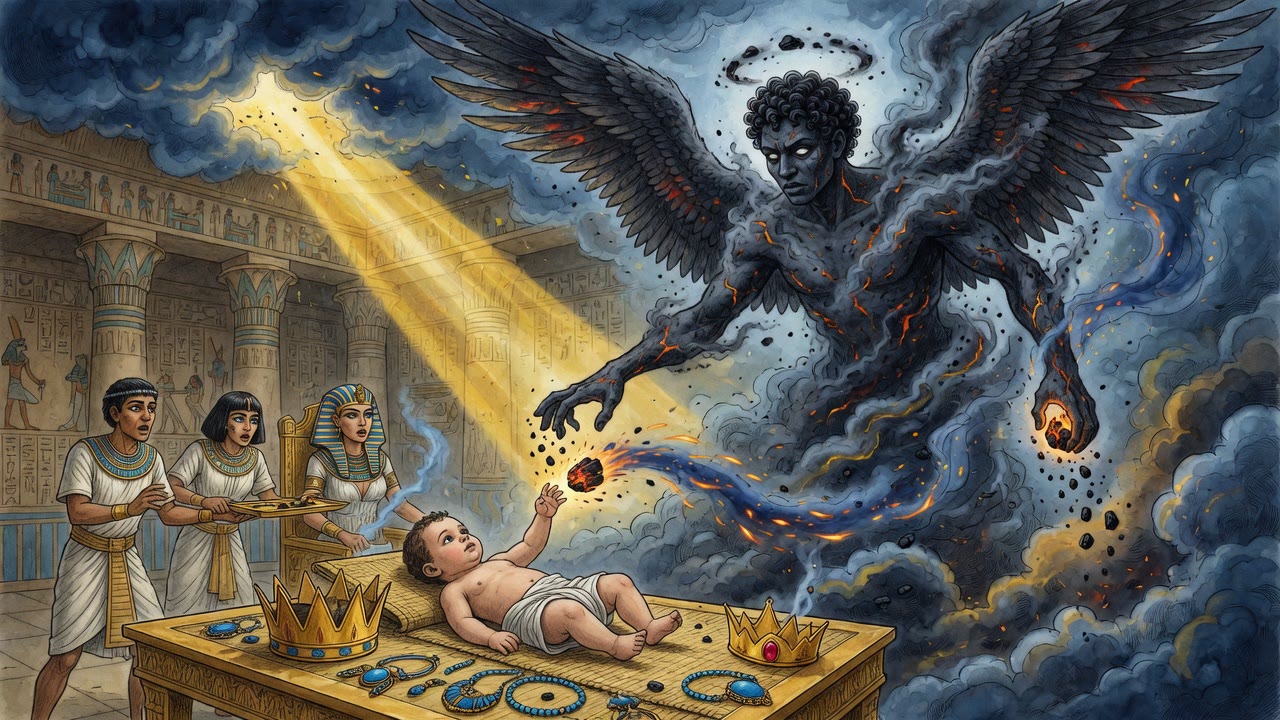
The crown left Pharaoh's head before anyone in the hall could breathe. A small hand had reached up from a woman's lap, closed around the gold band, and lifted it free. Now the toddler sat with the crown sliding down over his ears, blinking at the room, while the most powerful man in Egypt felt the cold air on his bare scalp and went rigid.
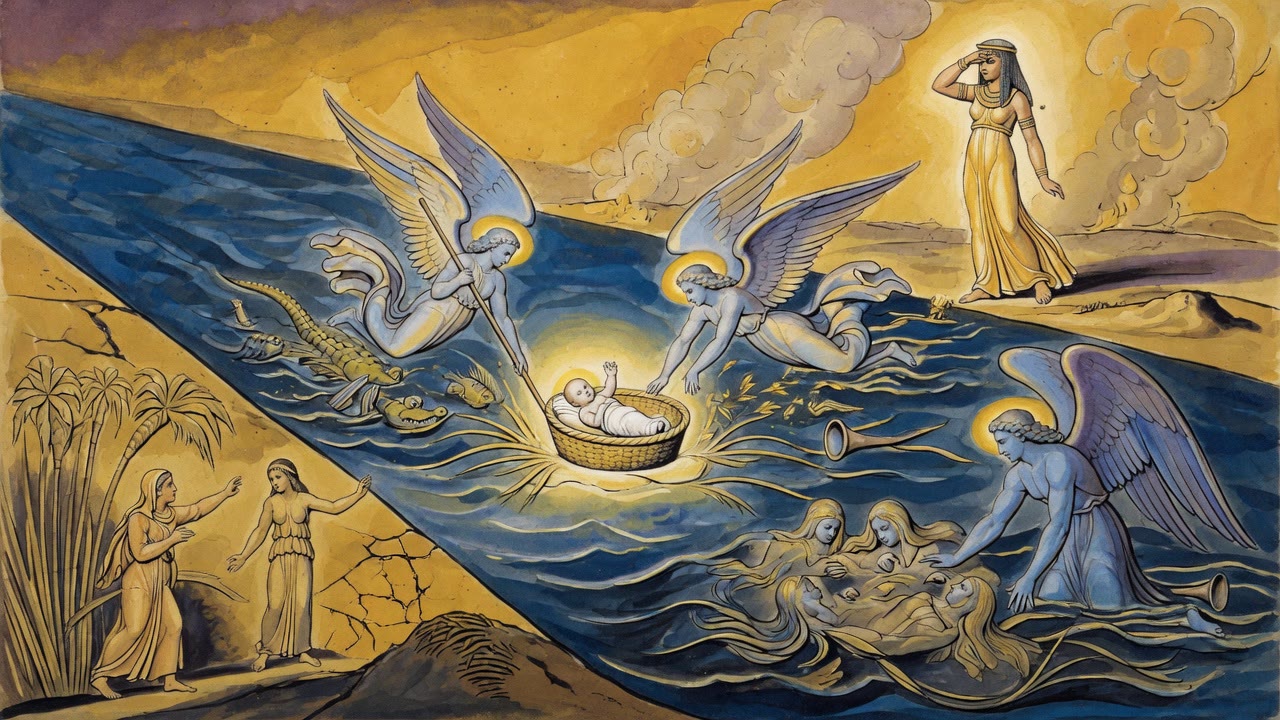
The boy was three years old. His name was Moses, and he had been raised in the palace since the day Pharaoh's daughter pulled him out of the river. He did not understand that he had just done a thing for which grown men were strangled. He only liked the way the gold caught the light.
Pharaoh sat at the head of his court with his queen, Alfar'anit, at his right hand. At his left sat his daughter Bithiah, and on her knee was the child, restless the way small children are at long banquets. He had squirmed, reached, and grabbed. Then he had set the crown on his own small head as if it were made for him.
The princes around the table stopped chewing. A servant froze mid-pour. The king himself did not move, and his stillness was worse than shouting, because everyone in the hall knew that a king who has been silently insulted is a king deciding how someone will die.
Balaam Asked for Blood
Whispers ran along the table like a draft under a door. Into that frightened murmur a single voice rose, smooth and certain. The voice belonged to Balaam, son of Beor, who sat among Pharaoh's counselors and had a gift for turning fear into policy.
He did not raise his hands or weep. He simply reminded the king of a dream from years before, a dream the interpreters had read as a warning. A Hebrew child would rise and pull Egypt down around the throne.
"This is that child," Balaam said. "Look at what he has done. A baby does not reach for a crown by accident. The spirit of his God is in him, and he is testing his hand on your gold while he is still small enough to be stopped." He spread the argument wide. He spoke of the Hebrews as a people of clever thieves, of Abraham who outmaneuvered kings, of Isaac and Jacob who took what was not theirs by birth, of Joseph who saved Egypt only to bind every Egyptian into service. "They take," Balaam said, "and they call it providence."
"Spill his blood now," he urged, "while he is too young to fight back." The counselors nodded. The case was clean. The child should be killed, and the dream would die with him.
A Counselor No One Knew
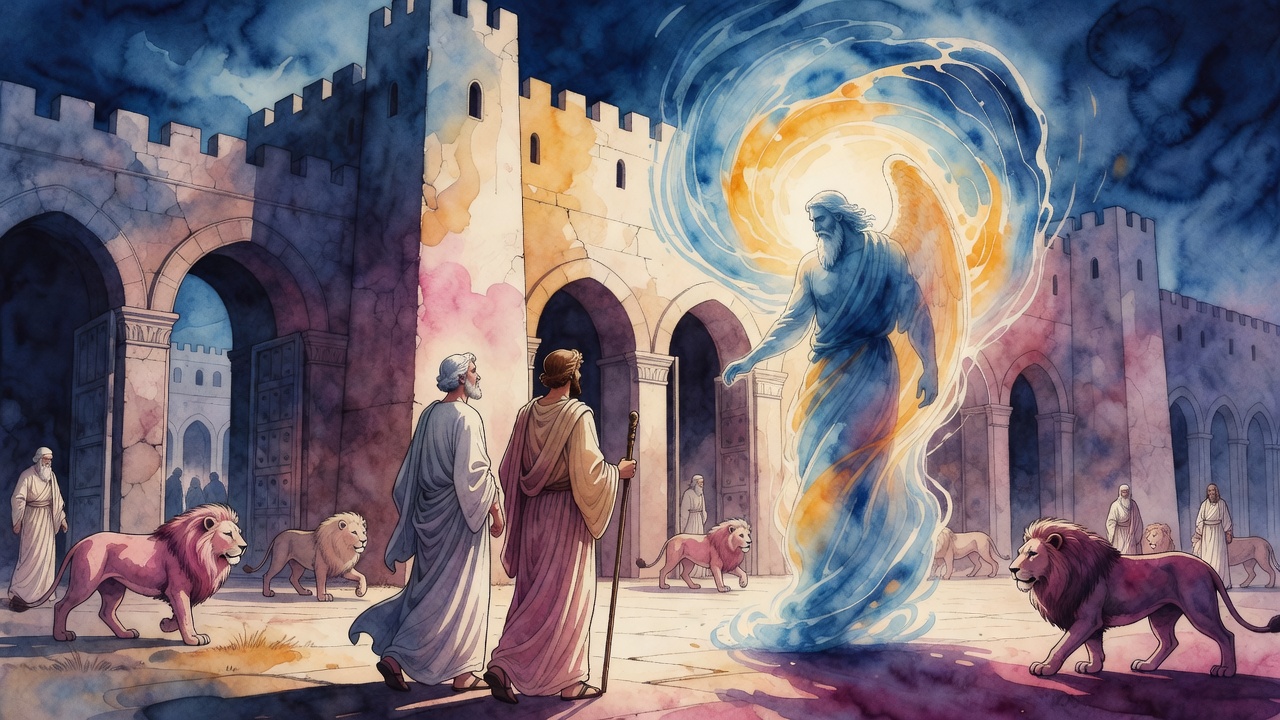
One counselor had not spoken. He sat among the wise men in the robes of a wise man, and the others assumed they knew him, because that is how disguise works. He was Gabriel, and he had taken a man's shape and a man's seat at the table for exactly this moment. He let Balaam finish. Then he offered a quieter idea, and quieter ideas are the ones frightened rooms reach for.
"Do not kill on a guess," he said. "A baby cannot plot. He grabbed the brightest thing in reach, the way any child grabs at light. Test him. Set two bowls before the boy. In one, a jewel that flashes like the crown. In the other, a live coal pulled from the fire. If the child has the cunning Balaam describes, he will choose the jewel, and you will have your proof and your justice. If he is only a child, he will choose by hunger and not by scheme."
It sounded like mercy dressed as caution, and it satisfied everyone. Balaam expected the jewel. Pharaoh wanted certainty. The counselor in the borrowed robe wanted neither. He wanted the boy to live, and he knew which way a small hand would move once he had decided to move it.
The Hand Turned to the Coal
They brought the two bowls and set them on the floor before Bithiah's knee. The jewel sat cold and brilliant on the left. On the right, the coal glowed orange under a thin gray skin of ash, and the heat of it rose in a wavering line that anyone could see.
Bithiah set the child down. Moses leaned forward on his hands. His eyes went to the jewel first, the way every eye in the room had gone to the crown, and Balaam's mouth began to curve. The boy's hand drifted left toward the bright stone.
Then his fingers were pushed. Not by anyone the court could see. A pressure he did not understand turned his small hand from the jewel to the coal, and he closed his fist around the burning ember. He felt the pain a heartbeat late, and like every child who has ever held something hot, he carried it straight to his mouth.
The coal touched his tongue and his lips. He screamed. Bithiah snatched him up, the ember fell, and the boy wailed against her shoulder while a blister rose where the fire had kissed him. The room exhaled. He chose the coal. He is only a child. The case for his blood collapsed in a single burnt cry.
The Mark He Carried Out the Door
Pharaoh waved his hand. "Let the brat live." Balaam's clean argument lay in ruins on the floor beside a cooling coal. The counselor in the wise man's robe said nothing more, and no one ever asked his name, and at some point he was simply not at the table anymore.
The burn healed. The boy grew. But the tongue that had been pressed to live fire never moved quite right again, and years later, standing before a bush that burned without turning to ash, a grown Moses would tell God that he was slow of speech and slow of tongue (Exodus 4:10). The thickness in his mouth was the price of a morning he could not remember, the morning a hand he never saw bent his fingers away from the jewel and saved his life with a wound.
Balaam would later counsel Pharaoh again, this time on the growing Hebrew people. Reuel of Midian pleaded for mercy and was rewarded in his line. Job stayed silent and paid for the silence. Balaam asked for destruction, and in the end he died by the sword. The coal in the banquet hall was only his first attempt to spill that particular blood. The angel who had sat in a borrowed robe had already spent the cheaper wound to buy the boy time.
Moses walked out of the hall with a blister on his mouth and a crown he no longer held. The gold stayed with Pharaoh. The scar stayed with the child.
← All myths