Parshat Bo5 min read

Aaron Stood Level with Moses Outside Egypt

Outside a city thick with idols, God spoke to Moses and Aaron as equals, and the quieter brother learned prophecy would not leave him in shadow.

Curated by Arthur · Told by Maggid ·
Table of Contents
  1. Outside the Idol Walls
  2. A Law of Geography
  3. The Sentence That Crowned the Brother
  4. Inheritance Without Conditions
  5. Went and Did, Heart First
Aaron Stood Level with Moses Outside Egypt Click for full size

Outside the Idol Walls

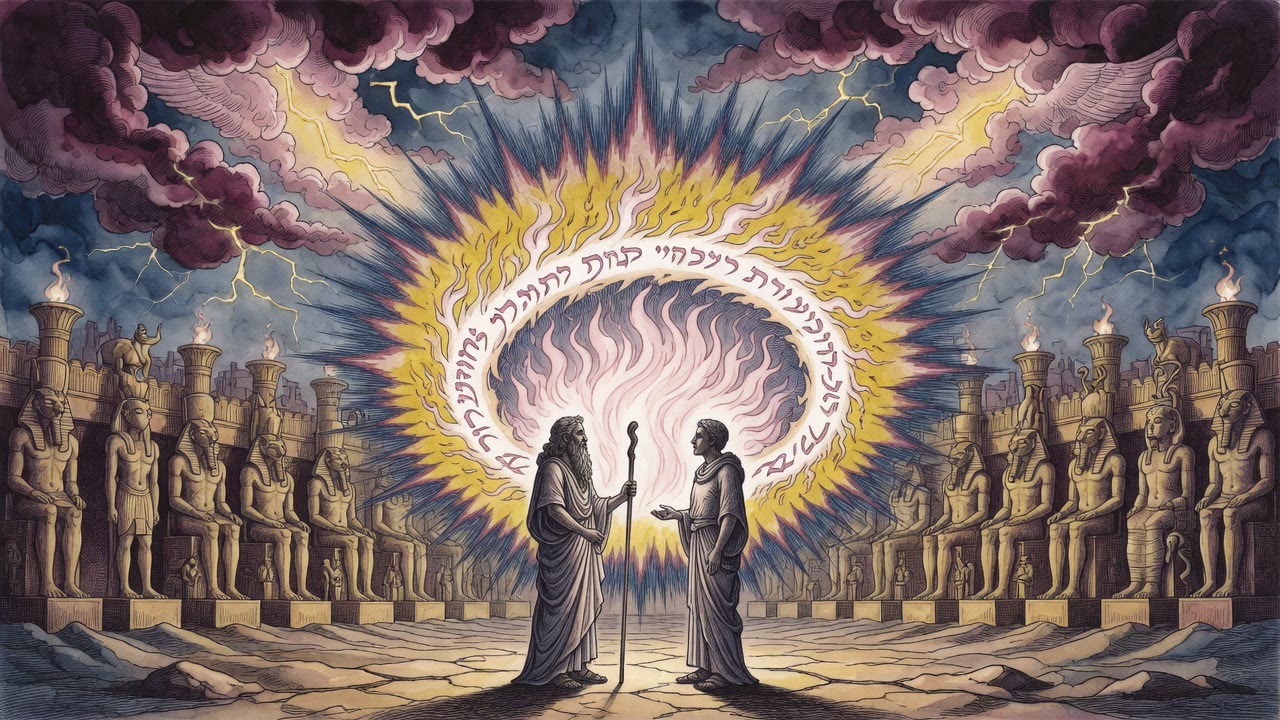
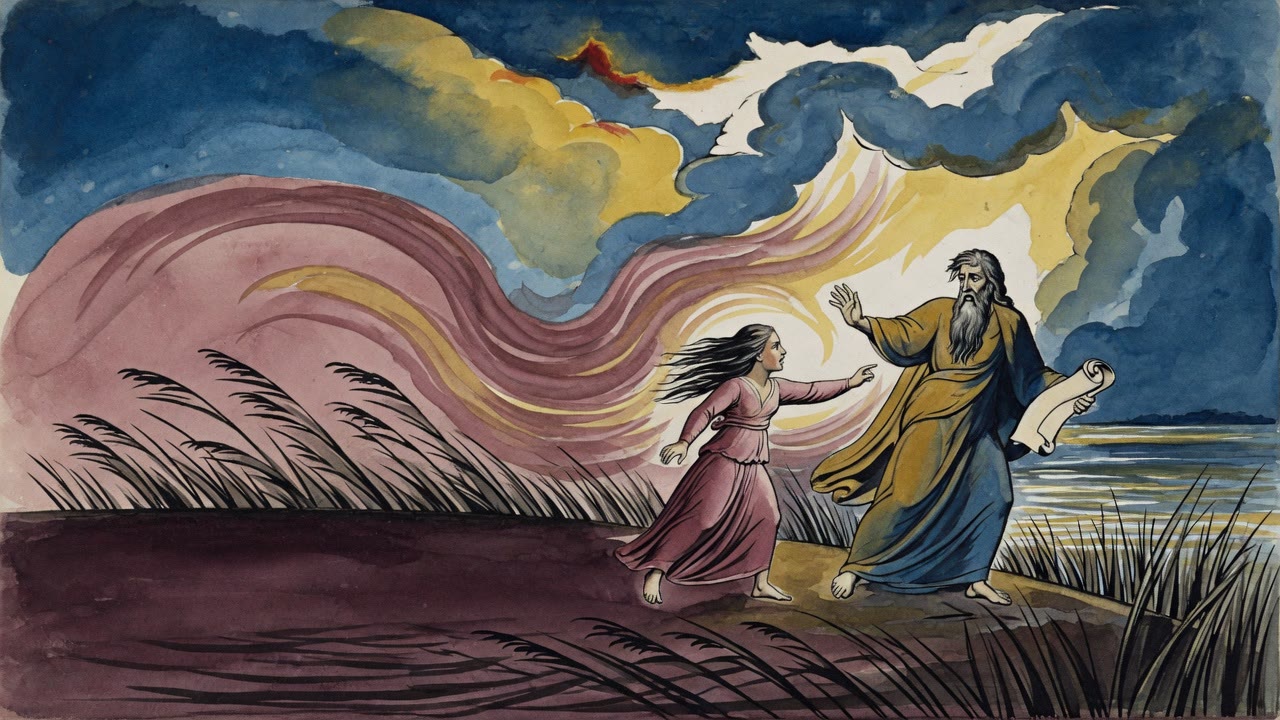
Moses would not pray inside the city. He told Pharaoh so with a courtesy that still cut: when I leave these walls, then I will cry out. The streets were crowded with gods that did not sweat and did not hear. Revelation refused that air. So Moses and Aaron walked past the last gate, past the last painted stone, into open ground where the word of God could land without sharing space with a carved rival.

Aaron felt the difference in his lungs before he felt it in his rank. Outside, the wind was only wind. Inside, every corner claimed a power.

A Law of Geography

The verse that named them both, Moses and Aaron, in the land of Egypt, carried a quiet map. Before the Land of Israel was made holy, the word could fall anywhere clean enough to receive it. Once the Land was sanctified, prophecy outside it would come mainly over water: Ezekiel by the river Chebar, Daniel beside the Tigris, Jonah on the open sea. Egypt still held an older permission, but even Egypt had a limit. Outside the city. Not among the idols.

If a simple prayer waited for the road beyond the walls, how much more the weight of command. Aaron stood in that outer strip of ground and understood that location was part of the covenant's manners.

The Sentence That Crowned the Brother

Then Scripture did something Aaron had not expected. It named him with Moses as if the two mouths shared one height. The sages read the pairing as a lifting. Whatever was true of Moses in that speech became true of Aaron: both received the word outside the city, both would stand before Pharaoh without shrinking, both would carry the work of heifer and lamp and oil and incense when the service took shape.

Aaron had spent years as the fluent one, the one who could speak when Moses' mouth felt heavy. Now the verse did not call him translator only. It called him partner. The quieter brother felt the crown settle without a public ceremony. No trumpet. Only a sentence that refused to leave him in a shadow.

Inheritance Without Conditions

Later the same tradition would guard two gifts as unconditional: the Torah as the eternal inheritance of Jacob's congregation, and the priesthood of Aaron as a covenant of salt that does not decay. An inheritance is not a loan with a behavior clause. A salt covenant is built to last. Aaron did not yet wear the full vestments of that forever, but outside Egypt's idols he already stood inside the first draft of permanence.

Moses carried the staff. Aaron carried the voice. The verse made both of them bearers of the same word.

Went and Did, Heart First

When the people "went and did," the sages heard reward for the going and the doing, and they heard that Moses and Aaron themselves kept the rite they taught. "So they did" covered the leaders as well as the camp. Desire ran ahead of full instruction; the heart leaned toward obedience before the last detail arrived.

Aaron remembered that lean later, in rooms where he might have been only second. Outside the idol city, equality had already been spoken once. He would need that memory when jealousy rose, when the people looked past him, when the work of the altar asked for a steadiness that fame cannot buy.

They turned back toward Pharaoh's doors. The idols still stood. The word did not. It waited for them in the open air, where two brothers could hear it at the same height.

Pharaoh's messengers found them still outside and tried to herd the conversation back toward the palace shade. Moses shook his head. The word had a preferred weather, and the weather was not incense smoke from other gods. Aaron spoke the demand for release in a voice that no longer sounded like a borrowed instrument. Pharaoh's man flinched at the twin authority, as if one staff and one mouth had quietly become two of each.

On the walk home Aaron asked Moses whether equality would survive the next humiliation. Moses said the verse had already spent its coin; what remained was to live as if the coin were still in the pocket. They passed a workshop where craftsmen painted eyes on wooden faces. Aaron looked away. He had just stood where eyes of wood could not follow, and he intended to remember the difference every time fear suggested he was only a helper.

That evening Miriam saw something new in both brothers, a matched tiredness that belonged to people who have heard the same sentence from the same source. She did not name it. She set bread down and let them eat like men who would need strength for doors thicker than the city gate they had just refused.


← All myths
From the tradition

Sources

3 sources

The texts behind this telling. Some cards carry a translation of the source; others are our own retelling of it, and each card says which. Every card links out to the original.

Mekhilta DeRabbi Shimon Ben Yochai 12:1Mekhilta DeRabbi Shimon Ben Yochai

Translation of the source text.Mechilta de-Rabbi Simon b. Jochai, ed. D. Hoffmann, Frankfurt 1905 · Public Domain

"And the LORD said to Moses and to Aaron in the land of Egypt" (Exodus 12:1). This teaches that all lands were fit for divine speech until the Land of Israel was sanctified; but once the Land of Israel was sanctified, there was no speech to the prophets in any place except over water, as it is said, "The word of the LORD surely came to Ezekiel son of Buzi the priest in the land of the Chaldeans by the river Chebar" (Ezekiel 1:3). And it says, "And I was at the Ulai canal" (Daniel 8:2); "And I was by the side of the great river, which is the Tigris" (Daniel 10:4). So too Jonah: He spoke with him only over water. Rabbi Yehudah says: Even at first He spoke with the prophets only over water, as it is said, "surely came" [a doubled verb]. Rabbi Nehemiah says: At first He spoke with the prophets in every place; what then does "the word of the LORD surely came to Ezekiel" teach? That the holy spirit was not constant upon him.

"In the land of Egypt": Might one think within the city? Scripture says "in the land"; in a field He spoke with him. Not in the field [proper] did He speak with him, but outside the city. And so Moses says to Pharaoh, "When I go out of the city" (Exodus 9:29): if a light matter such as prayer he did not pray within the city, a weighty matter all the more so. And why did He not speak with him within the city? Because it is full of idols. And still I might say He spoke with Moses outside the city, but when Moses spoke with Aaron he did not speak with him outside the city; Scripture says, "And the LORD said to Moses and to Aaron in the land of Egypt," comparing the speech of Aaron to the speech of Moses: just as Moses [received it] outside the city, so too Aaron outside the city. Just as Moses said, "Thus says," so too Aaron said, "Thus says." Just as Moses was a god to Pharaoh, speaking and not fearing, so too Aaron was a god to Pharaoh, speaking and not fearing. Just as Moses was mentioned regarding the heifer, the lamp, the anointing oil, and the incense of spices, so too Aaron was mentioned regarding the heifer, the lamp, the anointing oil, and the incense of spices. Scripture says, "And the LORD said to Moses and to Aaron," comparing the greatness of Aaron to the greatness of Moses.

"Saying": Rabbi Eliezer says: From where do we know that just as the order of the divine words was in the wilderness, so it was in the land of Egypt? There is no need; it is a logical inference. It says here "spoke" and it says "spoke" in the wilderness (Leviticus 11:1): just as the speech said in the wilderness, Aaron heard first and repeated first, so too the speech said here, Aaron heard first and repeated first. What of the case where Aaron preceded the sons in the wilderness because he was anointed with the anointing oil? Let Aaron precede the sons here, where he was not yet anointed with the anointing oil. Scripture says, "And the LORD said to Moses and to Aaron in the land of Egypt, saying," teaching that Aaron preceded the sons. And from where do we know that the sons precede the elders? There is no need; it is a logical inference. It says here "spoke" and it says there "spoke" in the wilderness: just as the speech said in the wilderness, the sons preceded the elders, so too the speech said here, the sons preceded the elders. What of the case where the sons preceded the elders in the wilderness because they went up the mountain first? Let the sons precede the elders here, where they did not go up the mountain first. Scripture says, "And to his sons He spoke," teaching that the sons precede the elders. And from where do we know that the elders precede Israel? There is no need; it is a logical inference. It says here "spoke" and it says "spoke" in the wilderness: just as the speech said in the wilderness, the elders preceded Israel, so too the speech said here, the elders preceded Israel. What of the case where the elders preceded Israel in the wilderness because they were sanctified with the holy spirit? Let the elders precede Israel here, where they were not yet sanctified with the holy spirit. Scripture says, "And Moses called to all the elders of Israel" (Exodus 12:21), teaching that the elders precede Israel.

Full source
Mekhilta DeRabbi Shimon Ben Yochai 12:28Mekhilta DeRabbi Shimon Ben Yochai

Translation of the source text.Mechilta de-Rabbi Simon b. Jochai, ed. D. Hoffmann, Frankfurt 1905 · Public Domain

"And the children of Israel went and did" (Exodus 12:28), to give them reward for the going as well as reward for the doing.

"as the LORD commanded Moses" (Exodus 12:28). Since we find that the first passage the Omnipresent spoke to Moses, and the second Moses spoke to Israel, whence do we know that both of them too he heard from the mouth of the Holy One, and went back and repeated them to Israel? Scripture teaches, "as the LORD commanded Moses." I have only Moses, on whom the passage depends; whence do we know that Aaron too was with him? Scripture teaches, "as the LORD commanded Moses and Aaron." One might think that Moses and Aaron, who were occupied with the commandment, had no Passover offering of their own; therefore Scripture teaches, "so they did." And whence do we know that even though it had not yet been said to them, they were ready and prepared, eager and made eager? Scripture teaches, "so they did", so they did, and so it was in their heart to do.

Full source
Mekhilta Tractate Amalek 4:32Mekhilta DeRabbi Yishmael

Retold in our words. Read the original at the link below.Mechilta, translated by Rabbi Shraga Silverstein · CC-BY

The Mekhilta extends its analysis of conditional versus unconditional covenants to two more foundational gifts: the Torah scroll and the priesthood of Aaron.

Whence is it derived that the Torah scroll was given unconditionally? From the verse (Deuteronomy 33:4): "The Torah which Moses commanded us is the eternal inheritance of the congregation of Jacob." The key word is "inheritance." An inheritance does not come with conditions attached. A father does not tell his son, "You may keep your inheritance if you behave well, but if you misbehave I will take it back." An inheritance, once given, belongs to the recipient permanently. By calling the Torah an inheritance of the congregation of Jacob, Scripture established that it belongs to the Jewish people forever, not as a loan, not as a conditional grant, but as an irrevocable possession.

The same unconditional permanence applies to the covenant with Aaron's priestly line. God declared (Numbers 18:19): "It is a covenant of salt forever." Salt preserves. Salt does not decay. A covenant of salt is one designed to last without deterioration. And the Torah reinforces this with a second verse (Numbers 25:13): "And it shall be unto him and to his seed after him a covenant of eternal priesthood."

Two gifts, both unconditional. The Torah belongs to all of Israel without conditions, and the priesthood belongs to Aaron's descendants without conditions. Neither can be revoked, neither can expire, and neither depends on the worthiness of the recipients.

Full source