Parshat Shemot6 min read

Miriam Tells Amram His Decree Is Worse Than Pharaoh's

A six-year-old girl told her father his decree was worse than Pharaoh's. Then Miriam prophesied the child who would save Israel.

Curated by Arthur · Told by Maggid ·
Table of Contents
  1. Amram Counts the Dead and Sends His Wife Away
  2. A Small Daughter Stands in Front of Him
  3. The Father Yields and the Wife Comes Home
  4. Miriam Walks the Riverbank
  5. The Girl Who Walked at the Head of the Nation

The water of the Nile had not stopped moving since the decree, and neither, it seemed, had the weeping of the women of Goshen. Throw every newborn Hebrew boy into the river. That was the order, and the river obeyed, swallowing what was given to it and carrying the rest downstream toward the sea.
In the house of Amram, the most respected man among the Israelites, a little girl watched her father do arithmetic with his hands. He counted the boys that had been born. He counted the boys that had been taken. The numbers did not balance, and his face went gray with what he had decided.

Amram Counts the Dead and Sends His Wife Away

Amram was no coward. The whole community measured itself against him, and what he weighed in his hands that night was not his own safety but the future. If a son was born, the son would be drowned. So why father sons at all? Why hand the Nile more boys to swallow? Better, he reasoned, to stop the births than to bury the children.

He went to Jochebed, his wife, and he divorced her. Not in anger. In grief. He believed he was sparing her the agony of carrying a child only to lose it to the water. And because Amram did it, the rest of Goshen did it too. Across the settlement, husbands turned from their wives. Beds emptied. The doors that had once opened for newborns stayed shut. Pharaoh had ordered the boys killed. Amram, without meaning to, had ordered the whole Hebrew future cancelled, quietly, from the inside, and no Egyptian soldier had to lift a hand to do it.

A Small Daughter Stands in Front of Him

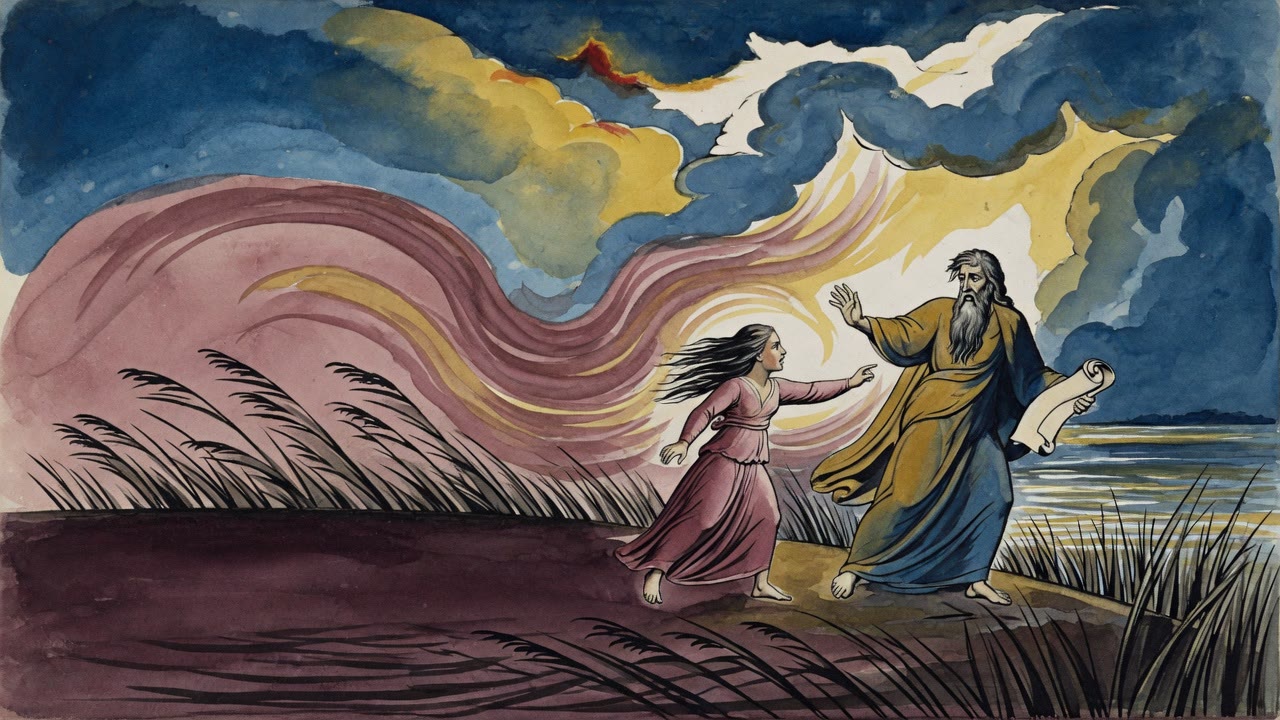
His daughter was perhaps five or six years old. She came and stood in front of him, this child barely tall enough to reach his belt, and she did not lower her eyes the way a daughter was supposed to.

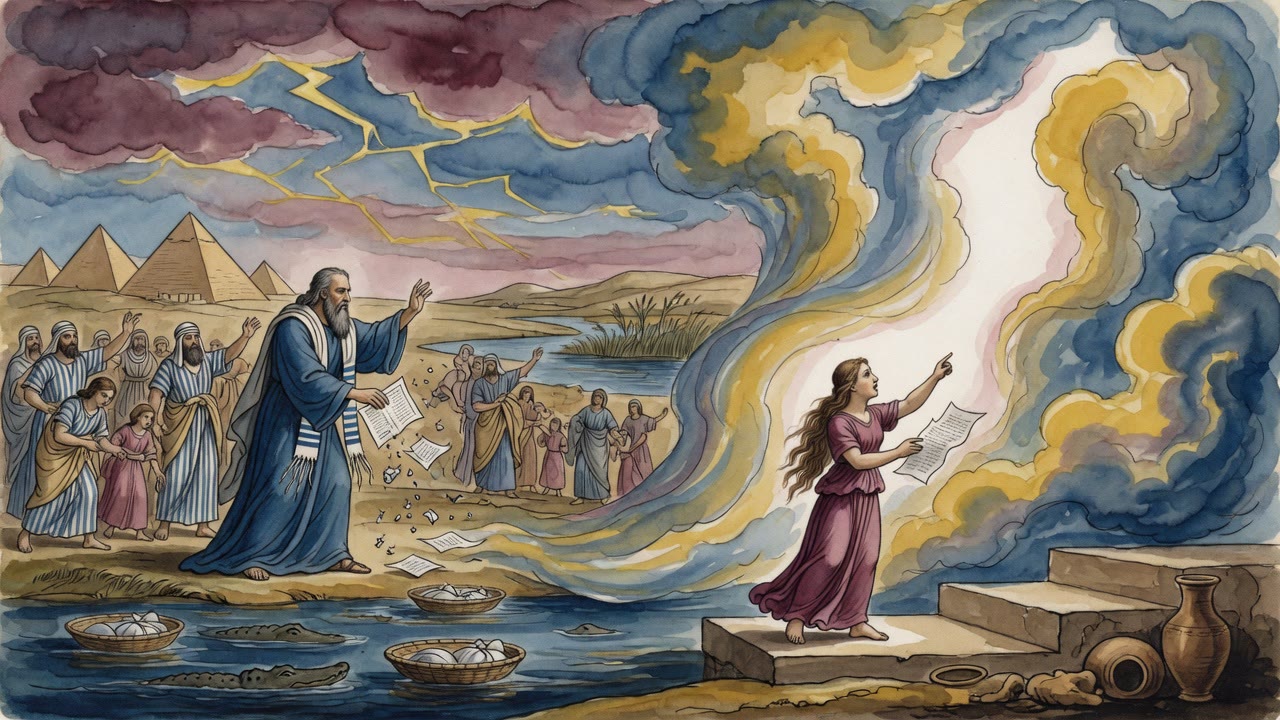
"Father," Miriam said, "your decree is worse than Pharaoh's."

The room went still. A man who had silenced grown elders now had a small girl telling him he had done a worse thing than the king who emptied cradles into the river.

She did not stop. Pharaoh, she said, only struck at the boys. Amram struck at the boys and the girls both, every child who would now never be born. Pharaoh was cruel only in this world, taking only the days a child would have lived under the sun. Amram was cutting his children off from the world to come, from every day that was ever meant to follow. Pharaoh's decree might fail. A boy might be hidden, might be saved. Amram's decree could not fail, because a child never conceived could never be rescued.

The Father Yields and the Wife Comes Home

Amram heard it. He was a man great enough to know wisdom when it came out of a mouth too young to have earned it, and the words landed in him like a verdict. He brought the matter before the elders who judged such things. They ruled that since Amram had begun the separation, Amram would have to be the one to end it, and so the man who had divorced his wife now married her again. Across Goshen the doors opened. Husbands returned to wives. The future that had gone silent began, in the dark, to gather itself back together.

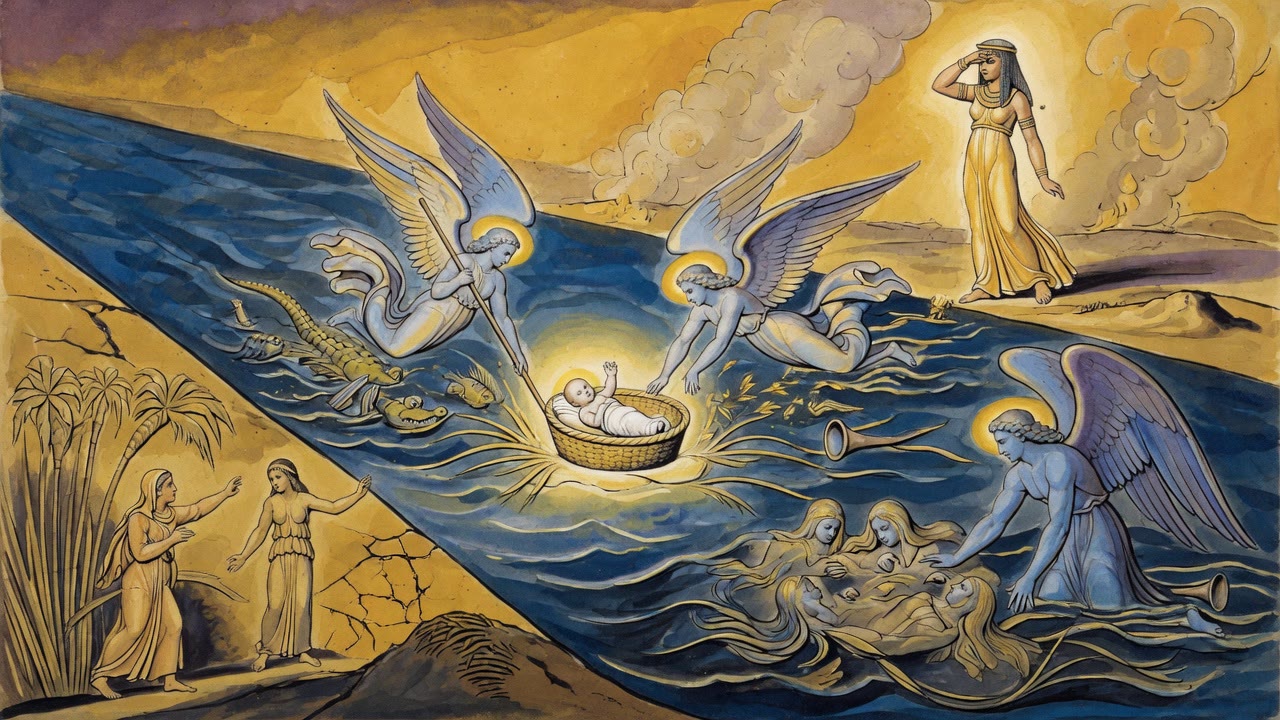
Jochebed conceived. When the months came round she bore a son, and the house filled with a light it had not held in a long time. The girl who had argued her father back to his wife now watched her mother hide the boy from the soldiers, three months of holding a baby's breath, until the day the basket was sealed with pitch and set among the reeds at the river's edge (Exodus 2:3).

Miriam Walks the Riverbank

Miriam did not go home. She stood at a distance along the bank to see what would be done to the child, a small figure among the tall reeds watching a basket ride the same water that had swallowed so many others (Exodus 2:4).

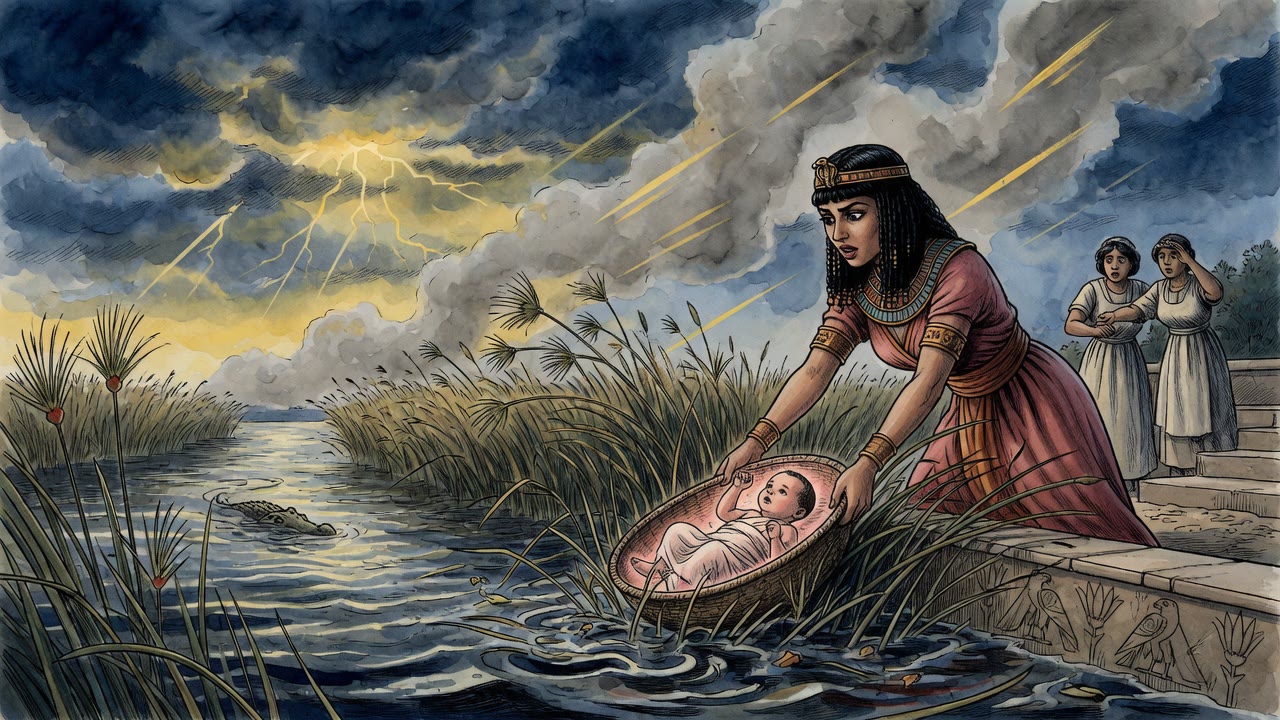
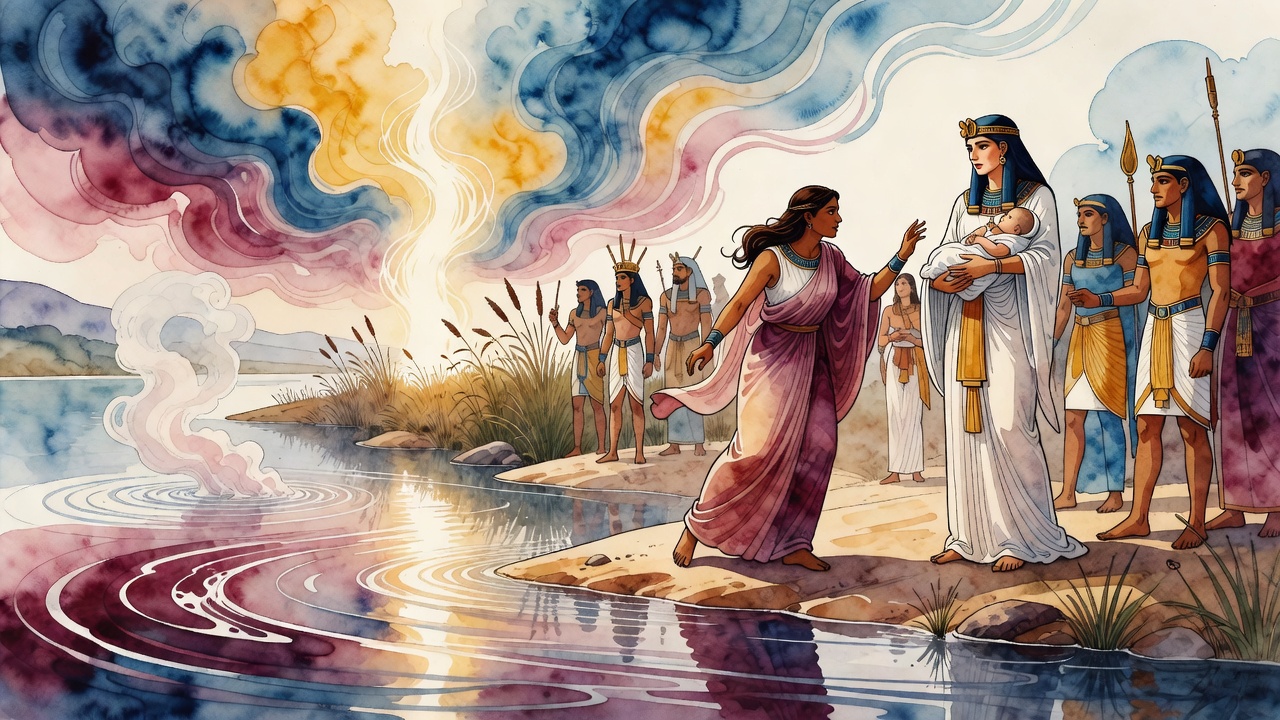
Down to the river came the daughter of Pharaoh. She saw the basket. She drew it out, opened it, and looked at the crying child, and her hard heart turned over. She named him Moses, drawn from the water, for she had drawn him out of it. The baby would not nurse. Egyptian woman after Egyptian woman was brought, and he turned his face from every one of them, hungry and refusing.

That was when Miriam stepped out of the reeds, walking up as though she had only happened to pass by and stopped to admire the child. A Hebrew nurse, she suggested, ever so lightly, might have better luck. Perhaps the baby would take milk from a woman of his own people. The princess, desperate, told her to fetch one. And Miriam ran home on winged feet and brought back the one woman in all of Egypt the child would feed from. She brought back Jochebed. The boy's own mother was paid Egyptian wages to nurse her own son.

The Girl Who Walked at the Head of the Nation

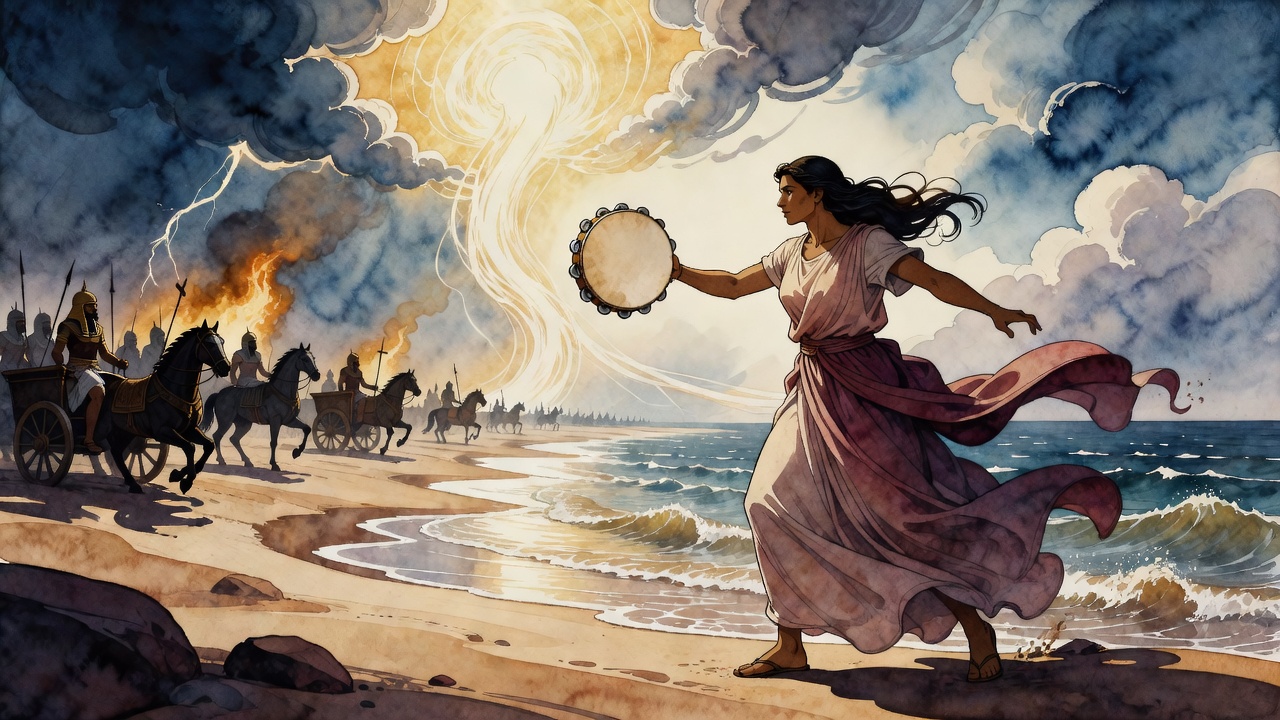
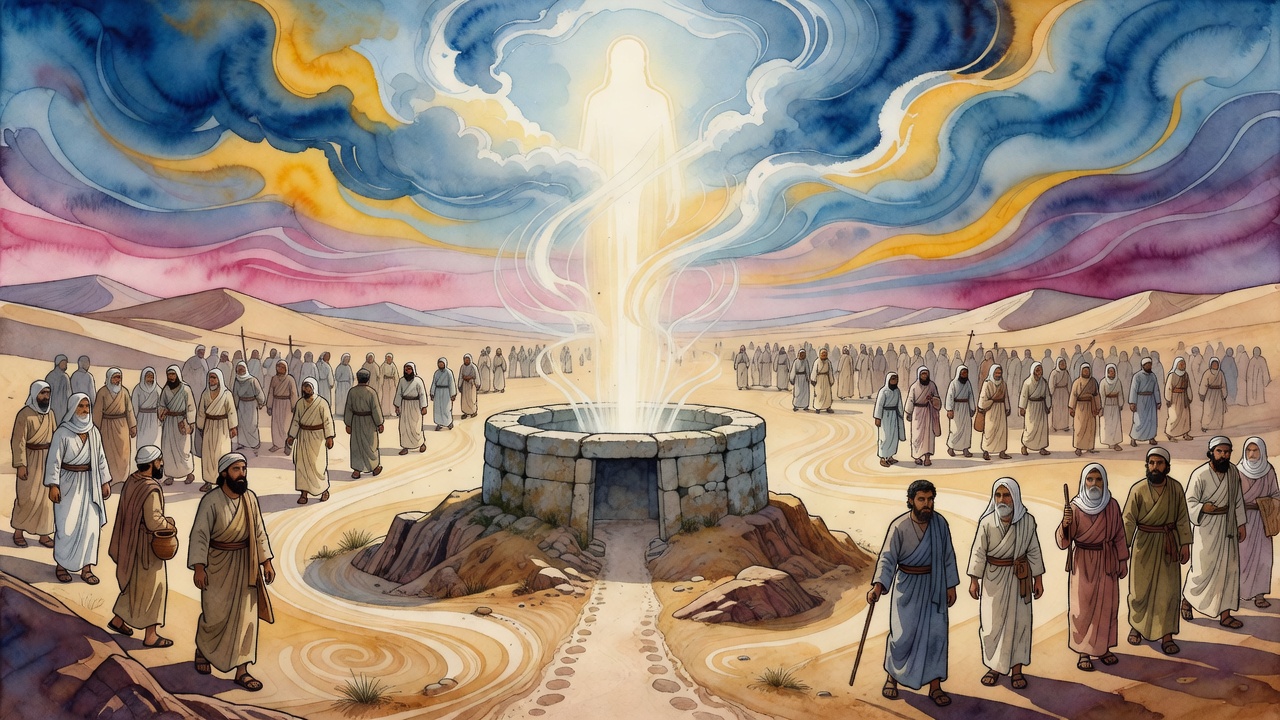
Everything that followed ran out from that small refusal in Amram's house. Moses grew. Israel walked out of Egypt. And the same Miriam who had argued for the unborn now walked at the head of the people in the wilderness, a prophetess leading the tribes forward under their raised banners. When she walked, the nation moved. A well of water followed her through the desert, sweet and miraculous, and it sustained them as long as she lived.

When she died, the well vanished with her. For six hours Moses sat weeping for his sister and did not know the water was gone. The people came to him with cracking lips and panic in their voices, and he had to rise from his grief to go and look at the dry stones where her well had been. The prophet would later set her beside her brothers, all three given to lead one people out (Micah 6:4).


← All myths
From the tradition

Sources

7 sources

The texts this telling draws on, in full. Open a card to read inline, or expand it for a wider, quieter read.

Legends of the Jews, IV. Moses In Egypt, Miriam Rebukes Her Father and Moses Is BornLegends of the Jews

The story of Moses' birth is a powerful evidence of that kind of bravery, laced with faith and a touch of the miraculous.

It all begins with a decree from Pharaoh, ordering the death of all newborn Hebrew boys. A truly horrific situation. Amram, a prominent Israelite, decides to separate from his wife, Jochebed, thinking it's better to prevent births than to have his sons murdered. This decision, though understandable, causes a ripple effect throughout the community. Everyone follows suit, and hope seems to dwindle.

It's Amram’s daughter, Miriam, who steps up with a profound and insightful argument. “Father," she says, "your decree is worse than Pharaoh's!" According to Ginzberg's retelling in Legends of the Jews, she points out that Pharaoh only targets the boys, while Amram's decree prevents all future life, girls included. It's a powerful and persuasive critique, highlighting the long-term consequences of despair.

Amram, recognizing the wisdom in her words, brings the matter before the Sanhedrin, the Jewish high court. They agree that he was the one who initiated the separation, so he should be the one to reverse it. And so, in a public display of renewed hope, Amram remarries Jochebed under a wedding canopy. Aaron and Miriam dance, and according to tradition, the angels themselves proclaim, "Let the mother of children be joyful!"

This remarriage isn't just a personal decision; it’s a spark that ignites a wave of hope throughout the Israelite community. Others follow Amram's example, returning to their wives and rekindling the possibility of a future. The text even suggests that Jochebed, despite her age, is rejuvenated, her youth returning as a sign of divine favor.

But pregnancy brings new anxieties. Amram turns to God in prayer, begging for deliverance from the suffering of his people. And in a dream, God reassures him. He promises that the child Jochebed carries will be the very one who will deliver the Hebrews from Egyptian oppression. This child, the dream reveals, will be hidden from those who seek to destroy him, and his memory will be celebrated for generations, even among strangers. His brother will establish a priestly lineage.

Miriam, too, has a prophetic dream. She sees a man in fine linen who tells her that the child born to her parents will be cast into the water, but through him, the waters will become dry, and he will lead Israel to salvation. These dreams, layered one upon another, build an atmosphere of anticipation and divine purpose.

Jochebed's pregnancy is unlike any other. She feels no pain, and at the moment of birth, the house is filled with a radiant light, brighter than the sun and moon. As we find in Midrash Rabbah, pious women were not included in the curse pronounced upon Eve, decreeing sorrow in conception and in childbearing. Even more remarkably, the infant, not yet a day old, begins to walk and speak, refusing his mother's milk as if he were already an adult.

Jochebed conceives Moses six months after conception instead of nine. For three months, they manage to hide the baby, despite the constant watch of Egyptian bailiffs. Imagine the fear, the tension, the constant vigilance! But eventually, Amram, fearing discovery and death for both himself and his son, makes the agonizing decision to place the child's fate in God's hands. He trusts that Divine Providence will protect the boy and fulfill the promise he received in his dream.

And so, the stage is set for one of the most iconic moments in Jewish history: the placing of baby Moses in a basket and setting him adrift on the Nile. But that, as they say, is a story for another time.

What strikes me most about this part of the Moses narrative is the interplay of human action and divine intervention. Amram and Jochebed make difficult choices, driven by fear and hope. Miriam speaks truth to power. And God responds, not by magically solving everything, but by offering guidance, reassurance, and a promise of a brighter future. It reminds us that even in the darkest of times, faith, courage, and a willingness to act can pave the way for miracles.

Full source
Legends of the Jews 4:59Legends of the Jews

It wasn't just a lucky break; it was a carefully orchestrated act of bravery and quick thinking by his sister, Miriam.

The scene: Pharaoh's daughter, Thermutis (some traditions even call her Bithiah), has just rescued a baby from the Nile. She names him Moses, meaning "drawn from the water." But the baby, naturally, needs a wet nurse. And he refuses to take milk from any of the Egyptian women brought to him.

What's a princess to do?

That's where Miriam steps in. As we find in Legends of the Jews, Miriam casually strolls up to Thermutis, as if she just happened to be passing by and admiring the child. She suggests, ever so subtly, that perhaps a Hebrew woman would have better luck. After all, the baby might just prefer someone from his own nation.

It's a brilliant move. Thermutis, desperate to care for the child, agrees. She tells Miriam to fetch a Hebrew woman.

And here's where Miriam's true genius shines. She doesn't just grab any random woman. She races home, "with winged steps, speeding like a vigorous youth," the verse says. She brings back her own mother – Moses's own mother, Jochebed. But, crucially, no one in the palace knows that this Hebrew woman is actually the baby's mother!

The plan works perfectly. The baby, without hesitation, latches onto Jochebed’s breast and holds on tight. Thermutis, delighted, entrusts the child to Jochebed's care.

And here's the truly amazing part: Thermutis, without even realizing it, utters a prophecy. She tells Jochebed, "Here is what is thine." As Legends of the Jews points out, it's an unconscious divination. She then says, "Nurse the boy henceforth, and I will give thee two silver pieces as thy wages."

So, Jochebed gets to raise her own son, to instill in him the values and traditions of their people, and she gets paid for it!

It's a beautiful story about courage, family, and the power of a well-placed suggestion. Miriam's quick thinking not only saved her brother's life but also ensured that he would be raised knowing his true heritage, setting the stage for his future role as the leader who would deliver the Israelites from slavery. What a evidence of the strength and wisdom of women in our tradition!

Full source
Sifrei Devarim 276:1Sifrei Devarim

Sifrei Devarim turns to Miriam, Moses and the Dreamer.

Sifrei Devarim, a collection of legal interpretations on the Book of Deuteronomy, offers a fascinating insight. It tells us that the entire forward momentum of the Israelites after leaving Egypt was, in a way, thanks to her. It says, “when you left Egypt”: the time of your redemption, and all was stopped because of her…” What does that mean, “stopped because of her?”

The text goes on to explain that during all that time in the wilderness, when the tribes marched with their banners held high, they only moved forward when Miriam led the way.

It’s a powerful image, isn’t it? A woman, a prophetess, at the very head of the entire nation, guiding them towards freedom. As the prophet Micah (6:4) reminds us, "And I sent before you Moses, Aaron, and Miriam." All three were crucial.

It makes you think about leadership, doesn’t it? And about the often-overlooked contributions of women throughout history.

Now, let’s shift gears a little and explore a different kind of law, one that speaks to our everyday interactions. (Deuteronomy 24:10) states, "When your neighbor is indebted to you, any kind of debt, do not enter his house to claim his pledge."

What does this verse really mean? It seems straightforward, but the Rabbis always taught us to dig deeper.

Sifrei Devarim asks a crucial question: does this law apply only to loans? What about other kinds of debts? What about a worker who is owed their wages? What about someone who bought goods on credit at the local store?

The text answers that the phrase "any kind of debt" expands the law’s reach. It’s not just about money lent and borrowed. It encompasses all forms of obligation. The principle remains the same: treat your neighbor with respect, even when they owe you something. Don't barge into their home and demand collateral.

It’s a beautiful example of how Jewish law strives for fairness and compassion, even in the most mundane of situations. These laws remind us that ethical behavior isn't just about grand gestures, but about the small, everyday choices we make in our dealings with others.

So, what do these two seemingly unrelated passages from Sifrei Devarim have in common?

Perhaps it's that they both remind us of the importance of looking beyond the surface. To recognize the often-unseen contributions of individuals like Miriam. And to apply ethical principles to every aspect of our lives, from grand historical narratives to the simple act of collecting a debt. It's a reminder that even the smallest details can reveal profound truths about ourselves and the world we inhabit.

Full source
Legends of the Jews 5:53Legends of the Jews

Legends of the Jews turns to Moses Mourns Miriam and the Well Disappears for Hours.

The grief was immense. That Miriam's death plunged everyone into mourning. Moses and Aaron wept in their private spaces, while the people mourned in the streets. But something else happened – something deeply unsettling. According to Legends of the Jews, for six hours, Moses remained unaware that Miriam's well, a miraculous source of water that had sustained them in the desert, vanished with her passing.

Can you imagine the Israelites' panic? They approached Moses, their patience wearing thin. "How long will you sit here and weep?" they asked, their voices laced with desperation. Moses, understandably, responded, "Shall I not weep for my sister, who has died?" But their reply revealed a deeper crisis: "While you are weeping for one soul, weep at the same time for us all.” They were without water.

Moses, still reeling from grief, went to investigate. He found the well completely dry. A wave of frustration washed over him, and he lashed out. "Have I not told you, 'I am not able to bear you myself alone'?" he demanded, reminding them of the structure he’d put in place: "You have rulers of thousands, rulers of hundreds, rulers of fifties, and rulers of tens, princes, chiefs, elders, and magnates, let these attend to your needs!"

But the people weren't having it. As we find in Ginzberg's retelling in Legends of the Jews, they insisted that the responsibility rested solely with Moses. "All rests with thee," they argued, "for it is thou who didst lead us out of Egypt and brought us unto this evil place; it is no place of seed or of figs, or of vines, or of pomegranates; neither is there any water to drink. If thou wilt give us water, it is well, if not, we shall stone thee."

Stoning. The ultimate rejection of leadership.

Overwhelmed and perhaps terrified, Moses fled to the Mishkan, the Tabernacle – that portable sanctuary that served as the dwelling place of God. He cried out, "O Lord of the world! Thy children want to stone me, and had I not escaped, they would have stoned me by now."

God's response is fascinating. "Moses, how much longer wilt thou continue to calumniate My children?" God asks, reminding him of a previous incident at Horeb. "Is it not enough that at Horeb thou didst say, 'They be ready to stone me,' whereupon I answered thee, 'Go up before them and I will see whether they stone thee or not!'" God then instructs him: "Take the rod and assemble the congregation, thou and Aaron thy brother, and speak ye unto the rock before their eyes, that it give forth its water."

What does this all mean? It's easy to focus on the miraculous elements – the well, the water from the rock. But perhaps the true miracle lies in the enduring, albeit strained, relationship between Moses and his people. It's a reminder that leadership is often a thankless task, fraught with challenges and misunderstandings. It shows us that even the greatest of leaders, like Moses, can falter, can feel overwhelmed, and can even despair. And yet, despite the accusations, despite the threat of violence, Moses remains committed to his people, and God remains committed to both. The story highlights the delicate balance between divine intervention, human agency, and the enduring need for faith, even in the face of profound loss and uncertainty. How often do we forget that even our leaders are human beings, and that we are all in this together?

Full source
Legends of the Jews 4:37Legends of the Jews

The familiar version gives us the big picture: slavery, plagues, the parting of the Red Sea. But what about the individual choices, the moral dilemmas, the moments of despair and resilience that shaped those times?

Let’s rewind, back to the moment Pharaoh issued his horrifying decree: every newborn Hebrew boy was to be thrown into the Nile. Imagine the terror, the grief. According to Legends of the Jews, this is when Amram, a leader of the Sanhedrin (the supreme rabbinic court) – that’s the Jewish high court – made a radical, heartbreaking decision. He believed the situation was so dire, so hopeless, that the best course of action was for husbands and wives to separate completely.

Can you Ceasing to bring children into such a world?

Amram, as a respected leader, set the example. He divorced his wife. And because of his standing, the men of Israel followed suit.

Now, why Amram? Why did his decision carry so much weight? Well, he wasn’t just any leader. He was a Levite, a member of the tribe of Levi. Legends of the Jews highlights that the tribe of Levi remained remarkably faithful to God even in the face of Egyptian oppression. While other tribes faltered, even abandoning the sign of the covenant – brit milah, circumcision – and seeking favor with the Egyptians, the Levites held firm.

The text goes on to tell us that this wavering faith of the other tribes had consequences. According to this account, God turned the Egyptians' former fondness for the Hebrews into a burning hatred, fueling their desire for the Hebrews' destruction. It’s a stark reminder of the connection between faith and fate as seen through this lens.

Initially, Pharaoh resisted the Egyptians' malicious plans. Remember, it was Joseph, a Hebrew, who had saved Egypt from famine. Pharaoh argued, "We owe everything to these Hebrews! Are you crazy?" But the Egyptians were relentless. They actually deposed Pharaoh, imprisoning him for three months until he relented and agreed to carry out their genocidal plan.

Talk about a fall from grace! A ruler forced to turn against the very people who had brought prosperity to his kingdom. According to Legends of the Jews, Pharaoh then sought to bring about the ruin of the children of Israel by every conceivable means. This was the "retribution they had drawn down upon themselves by their own acts".

It makes you wonder, doesn't it? About the weight of our choices, both individually and collectively. About the consequences of losing faith, and the enduring power of those who hold steadfast. These early chapters in the story of Exodus, as recounted in Legends of the Jews based on earlier sources, are a powerful reminder that even in the darkest of times, hope and resilience can still flicker.

Full source
Legends of the Jews 4:35Legends of the Jews

Legends of the Jews turns to Pharaoh Decreed Death for All Newborn Israelite Males.

Imagine: you've been enslaved, forced to build cities for a king who sees you as nothing more than cheap labor. Then comes the decree, a chilling echo of a nightmare made real. Pharaoh, haunted by dreams and the ominous pronouncements of his astrologers, orders the death of all newborn Israelite males.

The Egyptians, seeing the miraculous events unfold, went to their fields, yoking their oxen and plowing the earth, mimicking the act of planting seeds. But according to Legends of the Jews, even in this bizarre act of imitation, they couldn't harm the Israelite infants who had been swallowed up by the earth (Ginzberg). It's a strange image, isn't it? The earth, normally a symbol of life and growth, becoming a hiding place, a refuge from Pharaoh's wrath.

Despite the brutality, the Israelites continued to grow in number, “increased and waxed exceedingly.” It’s a evidence of their resilience, their unwavering faith in the face of unimaginable adversity. But Pharaoh, ever vigilant, ever paranoid, doubled down on his cruelty.

He commanded his officers to scour the land of Goshen, the area where the Israelites primarily resided, and to snatch away any newborn male infants they found. Can you imagine the horror? The desperation of mothers, clinging to their babies, as they were ripped from their arms and thrown into the Nile?

The verse reads, "no one is so valiant as to be able to foil God's purposes, though he contrive ten thousand subtle devices unto that end.” Despite Pharaoh's elaborate schemes, his cruel decrees, he couldn't ultimately thwart the divine plan.

Because the child, the one foretold in Pharaoh’s dreams and by his astrologers, the one destined to challenge his power, was already being protected, hidden away from the king's spies. The story of how this came to pass? That's a tale for another time. But remember this: even in the darkest of times, hope can bloom in the most unexpected places.

Full source
Midrash Aggadah, Exodus 2:4Midrash Aggadah

"And his sister stood at a distance" (Exodus 2:4). We hold that this entire verse is said with respect to prophecy. "And she stood (va-tittatzav)", as it is said, "And the LORD came and stood" (Exodus 3:10). "His sister (achoto)", as it is said, "Say to wisdom, you are my sister" (Proverbs 7:4). "At a distance (me-rachok)", as it is said, "From afar the LORD appeared to me" (Jeremiah 31:2). "To know (le-de'ah)", as it is said, "For a God of knowledge (de'ot) is the LORD" (1 Samuel 2:3). "What (mah)", as it is said, "What does the LORD your God ask of you" (Deuteronomy 10:12). "Will be done (ye'aseh)", as it is said, "The LORD will make (ya'aseh) for my lord a sure house" (1 Samuel 25:28). "To him (lo)", as it is said, "And he called it (lo) 'The LORD is peace'" (Judges 6:24).

Another interpretation: "And she stood", according to its plain sense, for the verse does not depart from its plain meaning. And in the merit that she waited one hour for Moses, to know what would be the end of the offspring, she merited that six hundred thousand foot soldiers waited for her, as it is written, "And the people did not journey on until Miriam was gathered in" (Numbers 12:15), to teach you that the Holy One, blessed be He, does not withhold the reward of any creature.

"What would be done to him", what would be the end of her prophecy, for she was prophesying and saying: my mother is destined to bear a son who will save Israel.

We learn in Sotah: Rabbi Chanina bar Pappa said: that day on which they cast him into the Nile was the twenty-first of Nisan. The angels said before the Holy One, blessed be He: Master of the universe, shall the one who is destined to recite a song on this day be cast into the sea? Rabbi Acha bar Chanina said: that day was the sixth of Sivan. The angels said: Master of the universe, shall the one who is destined to receive the Torah on this day, and to make the upper and lower worlds tremble, be stricken on this day? It is well according to the one who says it was the sixth of Sivan, thus you find three months, for on the seventh of Adar Moses was born, and you find that the sixth of Sivan was that day. But according to the one who says it was the twenty-first of Nisan, how do you find it? It was taught: that year was a leap year, the greater part of the first and the greater part of the last, and the middle one complete. And once they cast him into the Nile, they arose and annulled their decrees. And this is what Moses said to Israel, "six hundred thousand foot soldiers" (Numbers 11:21), for on my account you were saved.

Full source