Parshat Shemot5 min read

Moses Named God to Pharaoh and Pharaoh Checked His Book of Angels

A prince walked out of the palace and saw what the brick pits were doing to men. Years later he came back with a Name, and the throne looked it up.

Curated by Arthur · Told by Maggid ·
Table of Contents
  1. He Went Out to His Brothers
  2. The Height of the Glory
  3. Give Me Something to Say When They Ask
  4. Release My People for a Festival
  5. The Book Had No Entry
Moses Named God to Pharaoh and Pharaoh Checked His Book of Angels Click for full size

He Went Out to His Brothers

The kilns were downwind of the palace, which is why nobody in the palace ever had to smell them.
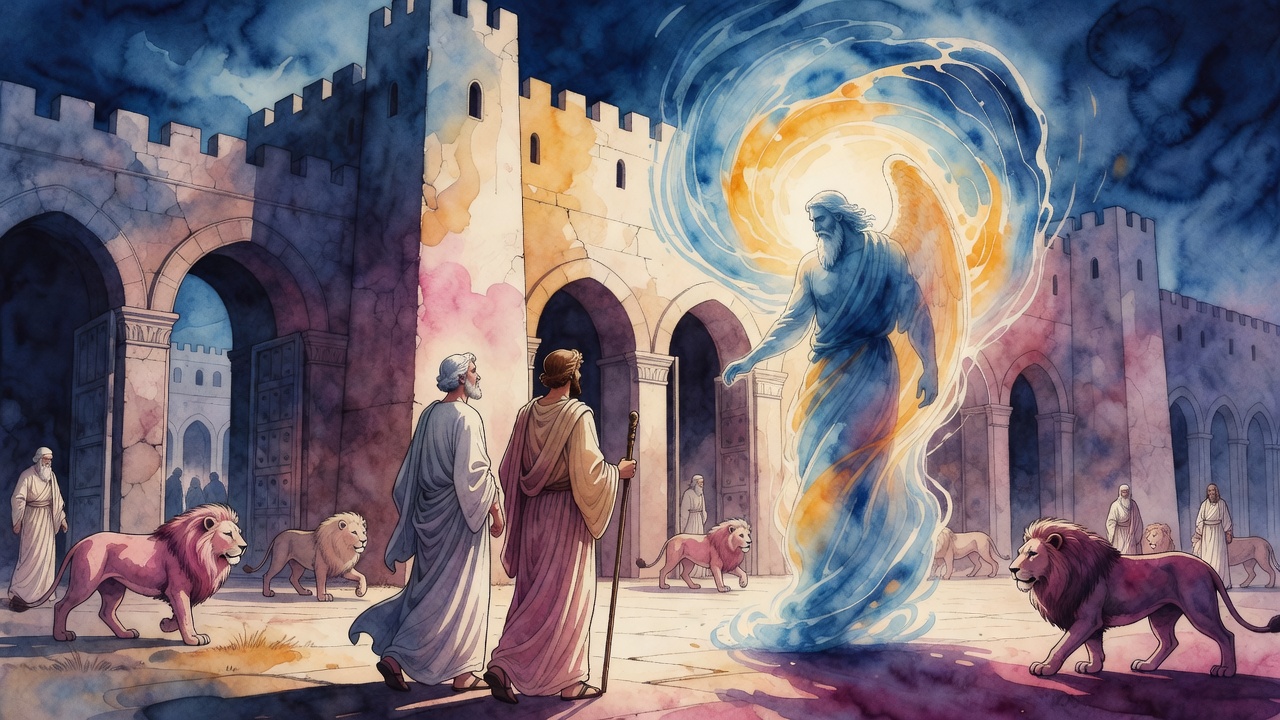
Moses was grown when he finally walked down there. He had the Egyptian speech and the Egyptian posture and a household that had raised him on soft floors, and he went out to his brethren and looked at them properly, and what he saw was not a labor problem. He saw the anguish of their souls and the greatness of their toil. The bodies were being used up, which any overseer could have told him. Something underneath the bodies was being used up too.

Then a Mizraite man began beating a Jewish man, one of his brothers, and the beating did not look like discipline. It looked like a killing that had already started.

Moses had no title down in the pits. He did not need one to know whose side his blood was on. He had eyes that had been out of the soft rooms long enough to see, and once a man has seen that, it does not go back in.

The Height of the Glory

Midian gave him sheep and quiet and a long time to stop thinking about it.

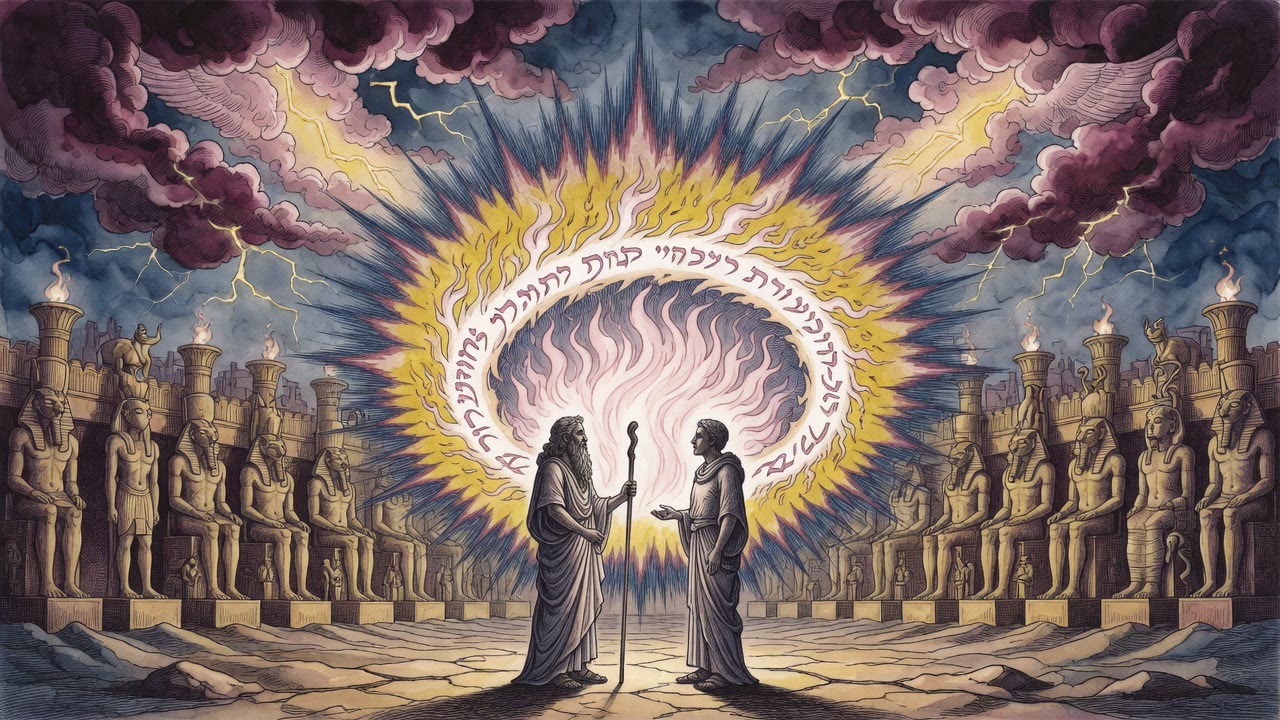
Then a bush on the mountain burned and did not turn to ash, and a Voice out of it named itself. I am the God of your father. The God of Abraham, the God of Isaac, the God of Jacob.

Moses put his hands over his face.

He was afraid to look at the height of the glory of the Shekhinah (shechinah, the divine presence) of the LORD. Not the light. The height of it. The man who had made himself look at what the brick pits were doing to people could not hold his eyes open in front of this, and he stood on a hillside with his face covered like someone waiting out a sandstorm.

Give Me Something to Say When They Ask

What he said next, from behind his hands, was not theology. It was logistics.

"Look. I will go to the sons of Israel and say to them, the LORD God of your fathers has sent me to you. And they will say to me, what is His Name? What shall I say to them?"

He knew that room. He had stood in it. Men who have been worked past the edge of their strength collect rumors of rescue the way dry ground collects rumors of rain, and they have learned to check the credentials of anyone who arrives with good news, because in Egypt every power that mattered had a name attached to it and a house and a priesthood and a list. A messenger who could not answer the question would be a story that died at the next shift change.

What came back to him was a Name to be remembered in every generation, tied to the fathers, older than the country he was about to walk into. He went down carrying it, along with a staff, a brother, and a mouth he did not trust.

The slaves asked. He answered. They believed him. That was the easy court.

Release My People for a Festival

Moses and Aaron went in to Pharaoh together, and the room smelled of incense, and they used the herald formula that every later prophet in Israel would use after them.

"Thus says the LORD, the God of Israel. Release My people, that they may make Me a festival in the wilderness."

It was a small ask, deliberately. Not freedom. Not the end of the brickwork. A holiday. Three days out in the sand to hold a feast for their God and come back. Two men in travel dust standing in front of a throne and speaking to it as though one sovereign were addressing another, and behind them, implied in every word, a people who belonged to a different King and kept a different calendar.

The Book Had No Entry

Pharaoh did not shout. He searched.

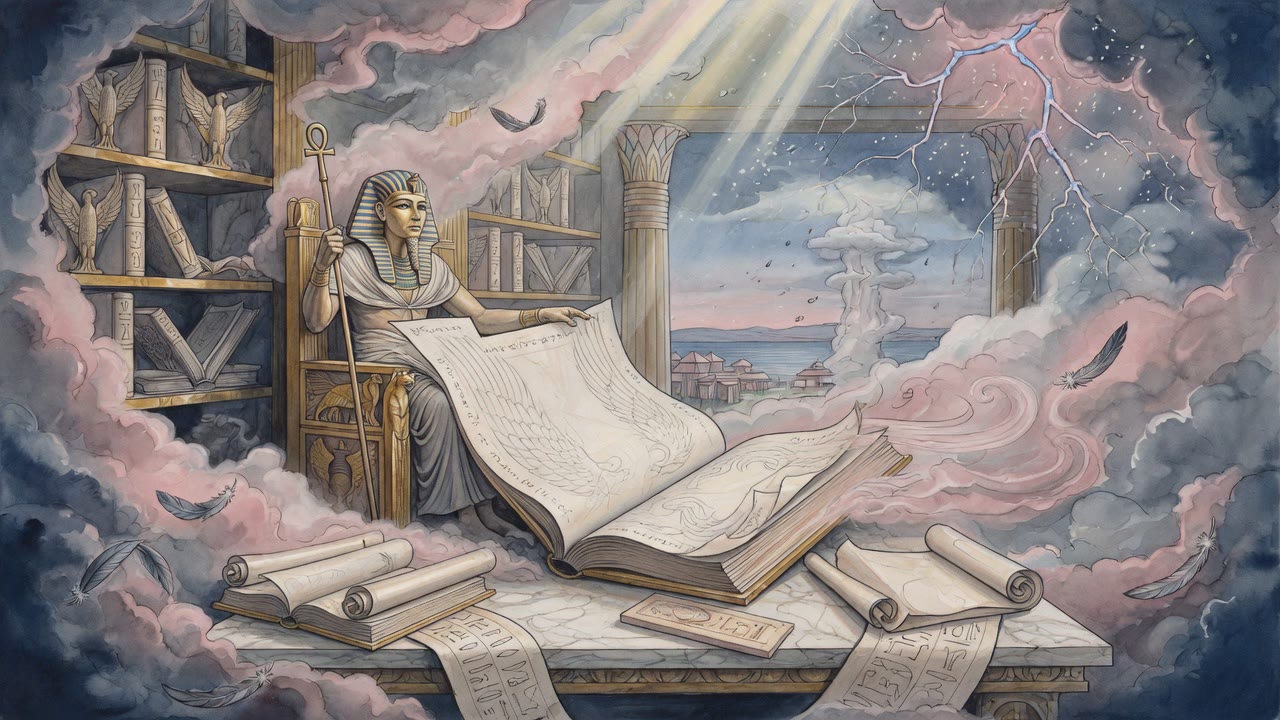
Egypt kept a Book of the Angels, a register of the divine powers the throne recognized by name, and Pharaoh had it and had read it. He came back with an answer that sounded, in that room, entirely reasonable.

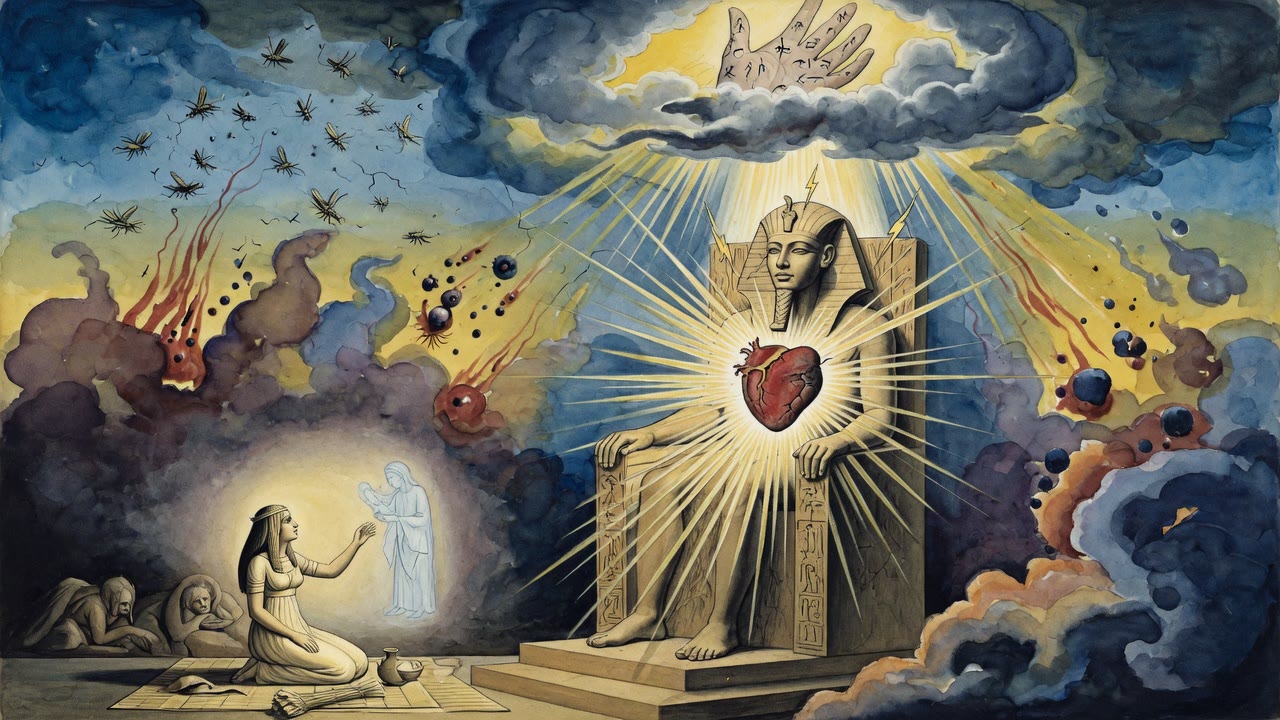
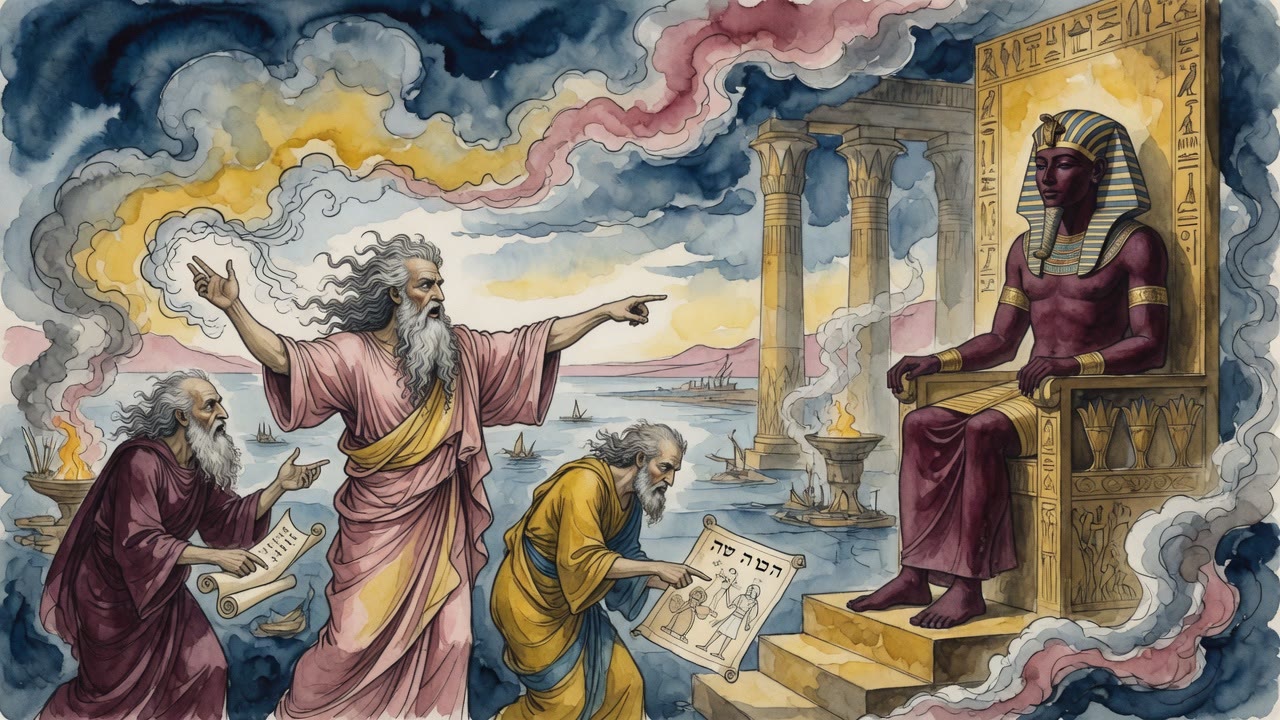
"The name of the LORD is not made known to me, that I should receive His word and release Israel. I have not found the name of the LORD written in the Book of the Angels. Of Him I am not afraid, and I will not release Israel."

He had looked. That is the part worth sitting with. He had done the research, run his finger down the list of everything in heaven that could hurt him, and found nothing where Moses was pointing, and the blank made him brave.

One man on that hillside had covered his face rather than measure the glory. One man in this room had measured it, found no entry, and closed the book.

Moses and Aaron walked back out past the incense and the guards, and the Name that was missing from Egypt's register went with them, and in a few days it would begin writing itself across the country in water and blood without asking the librarians for a shelf.


← All myths

From the tradition

Sources

5 sources

The texts behind this telling. Some cards carry a translation of the source; others are our own retelling of it, and each card says which. Every card links out to the original.

Targum Pseudo-Jonathan on Exodus 2:11Targum Pseudo-Jonathan on Exodus

Retold in our words. Read the original at the link below.The Targum of Jonathan ben Uzziel, trans. J. W. Etheridge, London, 1862 · Public Domain

He had grown up in silk. Now he stepped out into the brick kilns.

"And in those days when Mosheh was grown up, he went forth to his brethren, and saw the anguish of their souls, and the greatness of their toil. And he saw a Mizraite man strike a Jewish man of his brethren."

The Targum Pseudo-Jonathan on Exodus (2:11) does something the Hebrew only whispers. It says Moses saw the anguish of their souls. Not just their bodies. Not just the quotas of bricks. The souls.

Young Moses could have checked a ledger. He could have observed the labor quotas and walked home. Instead, the Targum tells us he perceived the inner cost. This is the first flash of the prophetic faculty in him, the ability to see past the visible grind into the invisible spiritual wound.

Rabbinic tradition preserved in our Midrash Aggadah collection (6,276 texts) elaborates: Moses did not merely watch the slaves. He picked up loads and carried them on his own royal shoulders. He placed the heavier burdens on the strong and the lighter burdens on the weak. He organized the first known ergonomic intervention in the ancient world, and he did it as a prince.

And then, the moment. An Egyptian overseer is striking a Hebrew. It is not a beating for discipline. It is a killing-in-progress. Moses has walked out of the palace into a moment that will demand action. The future liberator of Israel is about to discover what his own hand can do.

Beloved, the first step of every redeemer is refusing to look away.

Full source
Targum Pseudo-Jonathan on Exodus 3:6Targum Pseudo-Jonathan on Exodus

Retold in our words. Read the original at the link below.The Targum of Jonathan ben Uzziel, trans. J. W. Etheridge, London, 1862 · Public Domain

"And He said, I am the God of thy father, the God of Abraham, the God of Izhak, and the God of Jakob. And Mosheh covered his face; for he was afraid to look upon the height of the glory of the Shekhinah of the Lord."

The Targum Pseudo-Jonathan on Exodus (3:6) introduces a word that will shape the next two thousand years of Jewish mysticism. Shekhinah, the indwelling presence of God, feminine in grammatical gender, luminous, near. The Aramaic carefully distinguishes between the Holy One in His transcendence and the Shekhinah in her immanence. Moses cannot look at the height of the glory, the radiance that fills the place.

Notice the sequence. God first identifies Himself as the God of thy father, personal, intimate, the God Amram prayed to. Then He expands outward: the God of the three patriarchs. A concentric theology. Start with what you know, your own father's God. And then be lifted into the lineage.

Moses covers his face. The sages praised him for this. And also noted its cost. Because he covered his face at this first encounter, the Midrash Rabbah teaches (Shemot Rabbah 3:1, compiled c. 1100 CE), he was later granted, uniquely among prophets, to "speak to God face to face, as a man speaks to his friend" (Exodus 33:11). The humility of the first hiding earned the intimacy of the later seeing.

But there is a sterner reading: because he covered his face here, he did not ask at this moment for the privilege he would beg for later and be denied, to see the full glory. The opportunity he hid from in fear could not be fully recovered.

Beloved, humility is sacred. But sometimes holy boldness is the price of the vision.

Full source
Targum Pseudo-Jonathan on Exodus 3:13Targum Pseudo-Jonathan on Exodus

Retold in our words. Read the original at the link below.The Targum of Jonathan ben Uzziel, trans. J. W. Etheridge, London, 1862 · Public Domain

"And Moses said before the Lord, Behold, I will go to the sons of Israel, and say to them, The Lord God of your fathers hath sent me to you: and they will say to me, What is His Name? What shall I say to them?"

The Targum Pseudo-Jonathan on Exodus (3:13) captures the anxious precision of Moses's question. He is not asking a theological abstraction. He is asking a tactical one. The people will ask for a name. Give me something to say.

Why would the Israelites ask for a name? The sages explained: in Mizraim, every god had a name. Isis. Osiris. Ra. Thoth. A god without a name was no god at all. If Moses arrived in the slave quarters and said "I have been sent by the God of your fathers", the Israelites, four hundred years removed from Jacob's deathbed, would ask: which God? What is He called? How do we address Him?

Moses is anticipating this. He is a new prophet, and he is asking his Sender for the proper business card.

The Targum's Aramaic preserves the piercing directness of the request: What shall I say? Moses is not yet the confident figure of later Torah. He is a shepherd who grew up in a palace and now has to walk into a labor camp. He wants specifics.

This is one of the most human moments in the whole Sinai episode. The prophet, receiving the mission of his life, is worried about what to say in the opening sentence. God will answer him in the next verse with one of the most enigmatic names in Scripture.

Beloved, the bravest prophets are often the ones most unsure of their opening lines. Courage is not the absence of that question. Courage is asking it anyway.

Full source
Targum Pseudo-Jonathan on Exodus 5:1Targum Pseudo-Jonathan on Exodus

Retold in our words. Read the original at the link below.The Targum of Jonathan ben Uzziel, trans. J. W. Etheridge, London, 1862 · Public Domain

The confrontation finally arrives. Targum Pseudo-Jonathan preserves the opening line with ceremonial weight: Thus saith the Lord, the God of Israel: Release My people, that they may make unto Me a festival in the wilderness.

Notice the formula. This is the prophetic herald pattern, thus saith the Lord, that will echo through every later prophet from Isaiah to Malachi. Moses and Aaron are not making a personal request of Pharaoh. They are delivering a diplomatic message from one sovereign to another.

The Ask Is Not Full Freedom

The demand is striking for its modesty. Not let my people go forever. Not release them from slavery. Just: let them make a festival in the wilderness. A religious pilgrimage. A brief liturgical absence.

The sages of the Targumic tradition read this with sharpness. God is not genuinely asking for a three-day furlough. He is testing Pharaoh's willingness to concede anything at all. If Pharaoh refuses even a festival, he has revealed that his rule is incompatible with any form of Israel's worship. And the escalation that follows is on his hands, not God's.

The Aramaic word for festival, chaga, evokes the three pilgrimage feasts: Passover, Shavuot, Sukkot. What Moses asks for in miniature (three days in the wilderness) the slaves will receive in full (forty years).

The takeaway: every great deliverance begins with a small request that the oppressor refuses. The Jewish imagination tracks tyranny by watching how rulers respond to modest religious demands. Pharaoh fails the first test. The plagues are what happens when a ruler will not grant his slaves even a pilgrimage.

Full source
Targum Pseudo-Jonathan on Exodus 5:2Targum Pseudo-Jonathan on Exodus

Retold in our words. Read the original at the link below.The Targum of Jonathan ben Uzziel, trans. J. W. Etheridge, London, 1862 · Public Domain

Pharaoh's reply is one of the most arrogant utterances in the entire Torah. Targum Pseudo-Jonathan makes explicit what the Hebrew only implies: The name of the Lord is not made known to me, that I should receive His word to release Israel. I have not found written in the Book of the Angels the name of the Lord. Of Him I am not afraid, neither will I release Israel.

The Targum adds an extraordinary detail: Pharaoh keeps a Book of the Angels. In ancient Egyptian religion, divine beings were catalogued by name in priestly registers. Pharaoh, claiming the prerogatives of a god-king, owns such a book. He has consulted it. The Name of the Lord, the YHVH, does not appear there.

The Limits of Pharaonic Theology

The sages of the Targumic tradition are savage in their irony here. Pharaoh's theology runs on catalogues. If a god is not in the registry, that god does not exist. The God of Israel, whose Name cannot be catalogued because He is the source of all names, is therefore absent from Pharaoh's universe.

Then the three-part rejection: the Name is not made known; Pharaoh is not afraid; he will not release Israel. Each refusal is a step deeper into the obstinacy that the Holy One had already predicted.

The Targum is not softening Pharaoh, it is exposing him. His arrogance is not personal; it is structural. He cannot recognize a God who refuses to fit in an Egyptian book.

The takeaway: the Exodus is the story of a God who breaks out of every catalogue. When Pharaoh says I have not found Him in my book, the Holy One answers with ten plagues and a splitting sea. The Jewish imagination insists that the God of Israel is precisely the God who cannot be filed.

Full source