6 min read

Kindness and Truth Kissed at the Mountain of God

Aaron walks into the wilderness to meet Moses. At Horeb they kiss, and the meeting is named kindness and truth, peace and righteousness joined.

Curated by Arthur · Told by Maggid ·
Table of Contents
  1. The Kiss That Was Not Ordinary
  2. Kindness Met Truth on the Slope
  3. The Road Back Toward Egypt
  4. What the People Could Not See

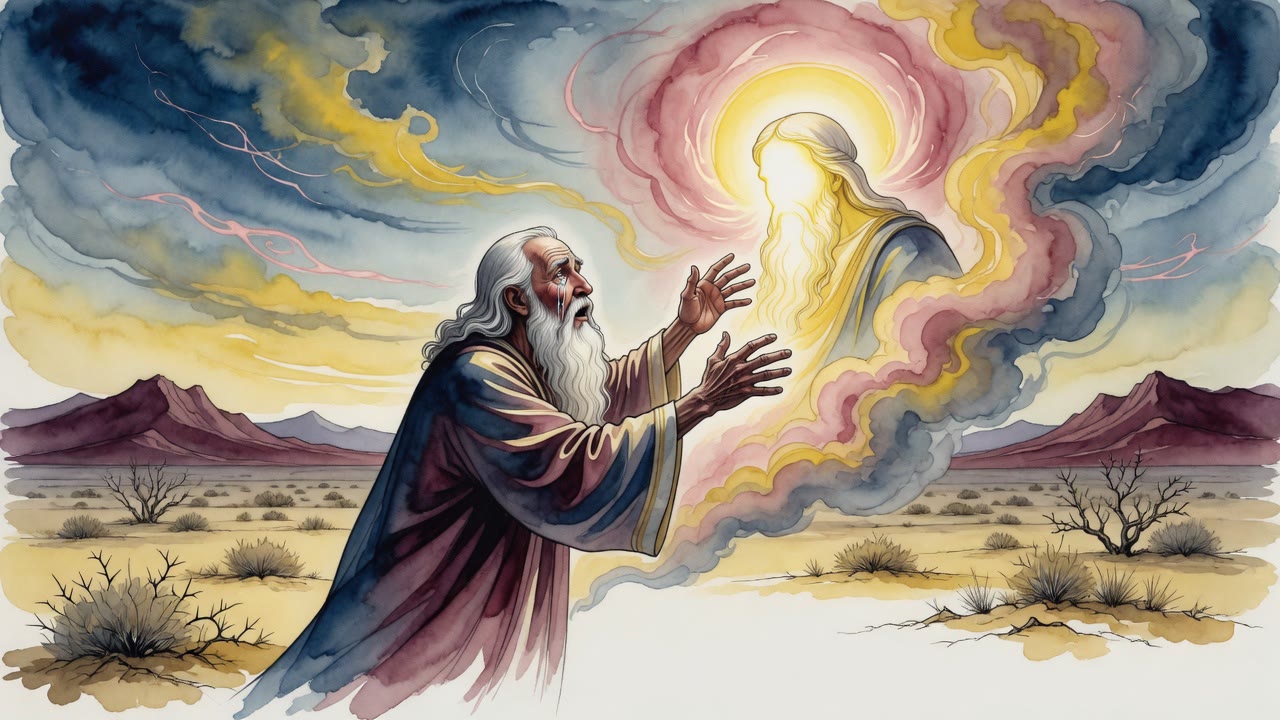
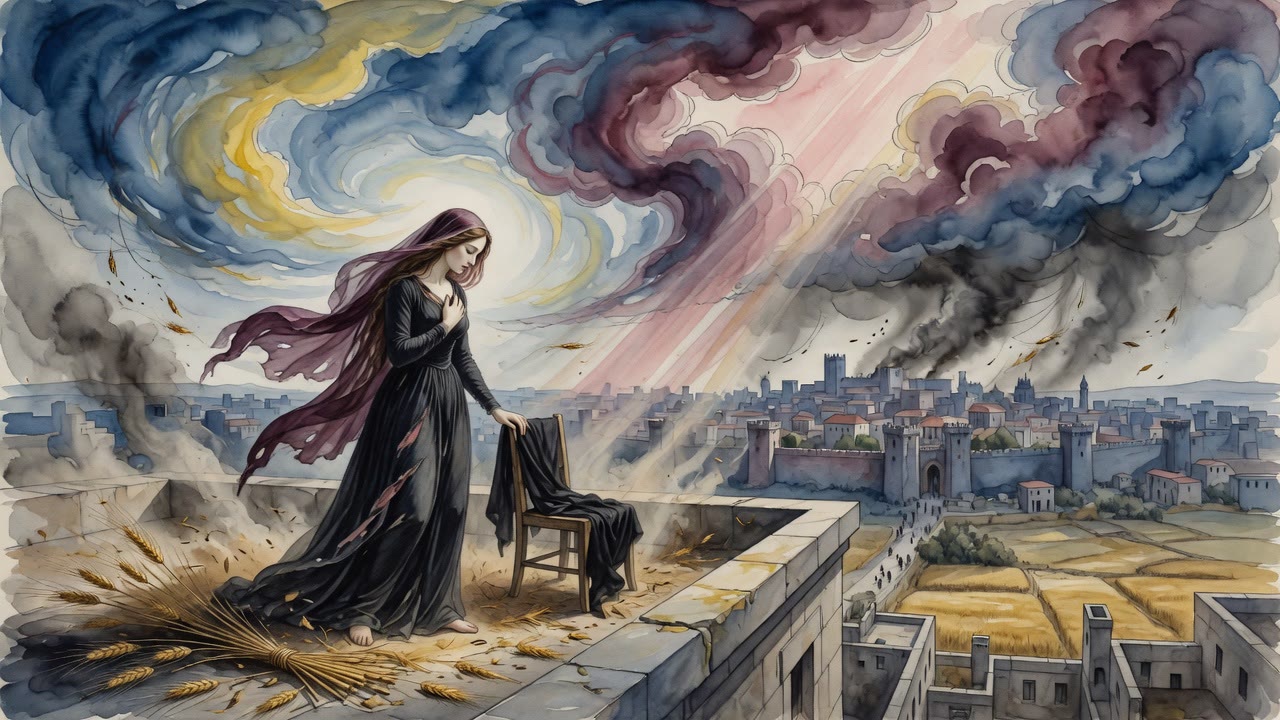
Aaron left Egypt with dust already on his sandals and the road still forming under them. God had sent him into the wilderness to meet a brother he had not seen for decades, a brother who had fled after killing an overseer and buried himself among Midianite sheep. Aaron did not know the face that waited for him. He knew only the mountain named for God, and that the man who herded Jethro's flock had been ordered home to crack an empire.
Kindness and Truth Kissed at the Mountain of God Click for full size

He walked until the air thinned and the rock of Horeb rose. Flocks moved on the slopes. A staff struck stone. Moses turned, and the years between them collapsed into a single breath. Goats scattered. Heat shimmered off the basalt. Aaron's throat closed, then opened, and he ran. A stone rolled under his heel and he did not slow. The man ahead was thinner than the prince who had fled Egypt, thicker in the shoulders from years of livestock, and still unmistakably the brother whose basket Aaron had once watched on the Nile.

The Kiss That Was Not Ordinary

They did not clasp like strangers testing a treaty. Aaron covered the last stretch and put his mouth to his brother's face. Moses answered the same way. The Torah records the kiss without apology (Exodus 4:27). No scribe softens it into a nod or a hand on a shoulder.

Most kisses, the sages say, are indecent. Three exceptions stand. This was one of them. Not hunger. Not politics. Not a greeting that hid a knife. Aaron was glad for Moses's elevation. Moses was glad for Aaron's. Each celebrated the other's rise while his own future still burned with risk. Egypt waited with brick and whip. Pharaoh waited with a sealed heart. Between those threats the brothers chose joy for one another first.

Aaron's arms still held the younger man who would speak for God. Moses's hands still smelled of sheep and smoke from a bush that had refused to turn to ash. A desert wind pushed at their robes and neither let go until the wind lost interest.

Kindness Met Truth on the Slope

Psalm 85 speaks of a meeting no human eye expected: "Kindness and truth met, righteousness and peace kissed" (Psalm 85:11). On this slope those four words put on flesh.

Kindness is Aaron. Of Levi it is said, "Your Tummim and your Urim for the man of your piety" (Deuteronomy 33:8). The oracles of the high priest sit in that piety. Peace is Aaron again. "He walked with Me in peace and uprightness" (Malachi 2:6). Truth is Moses. "My servant Moses is not so; in all My house he is trusted" (Numbers 12:7). Righteousness is Moses too. "He executed the righteousness of the Lord" (Deuteronomy 33:21).

On the mountain, kindness did not lecture truth, and truth did not shame kindness. They met. They kissed. Peace and righteousness did not compete for a single crown. The redemption of Israel would need both mouths, both staves, both ways of standing before a throne that ate rivals for breakfast.

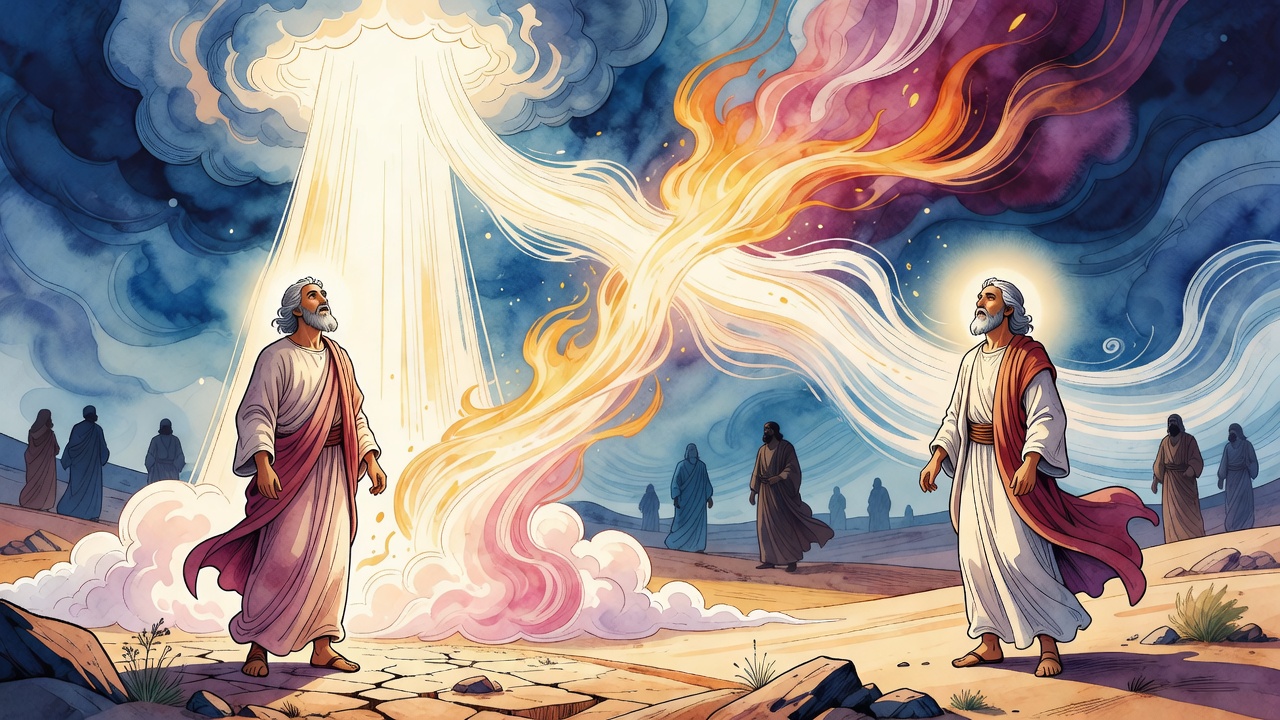
Aaron would soon strike the Nile. Moses would soon lift a hand toward heaven. Fire would run inside hail until a man sitting burned and a man standing burned. Blood would rise in wells. For now, before any plague, the first miracle was two men refusing jealousy on a rock that remembered a bush still green in the fire.

The Road Back Toward Egypt

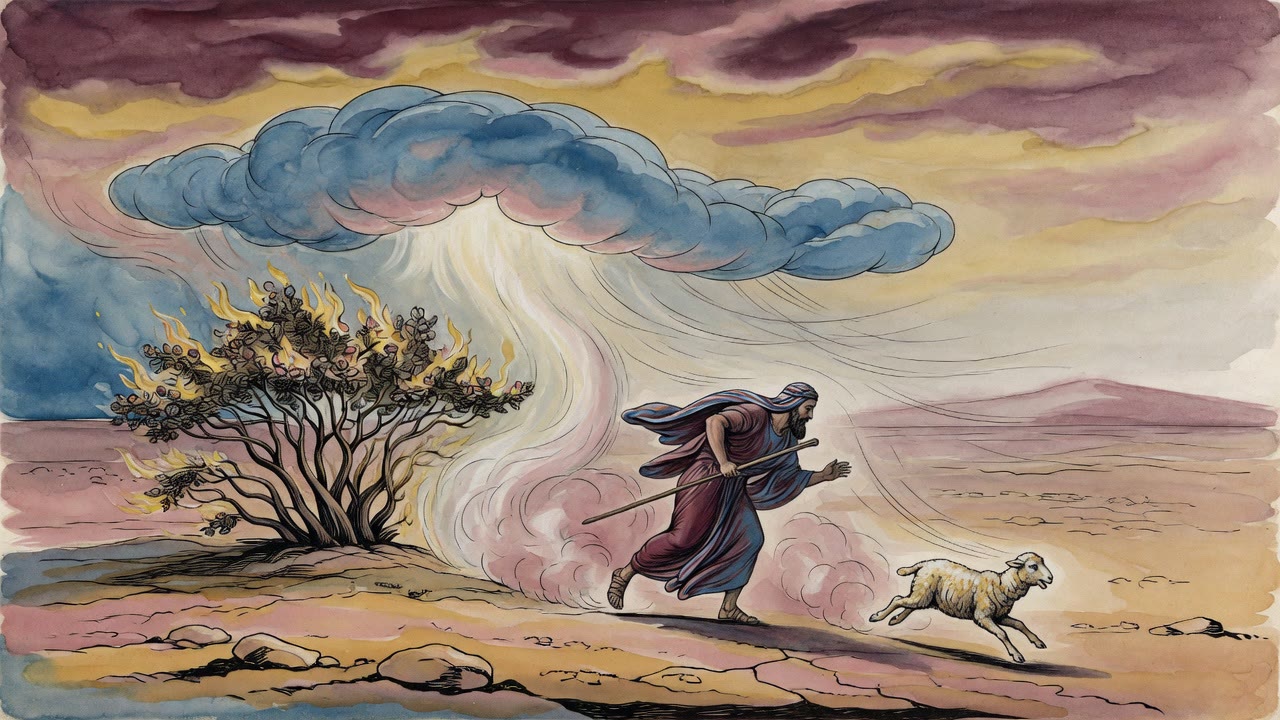
They turned their faces down the slope together. Moses carried the staff that would become a serpent in a palace. Aaron carried the years he had spent under Pharaoh while Moses herded sheep. Neither pretended the road would be short. The herding had trained Moses to notice the weak animal and the lagging lamb. He had led the flock into the wilderness until the mountain of God stopped him. The nation would train him harder. God would show him ways of mercy and deeds done so Israel could tell what was done to Egypt.

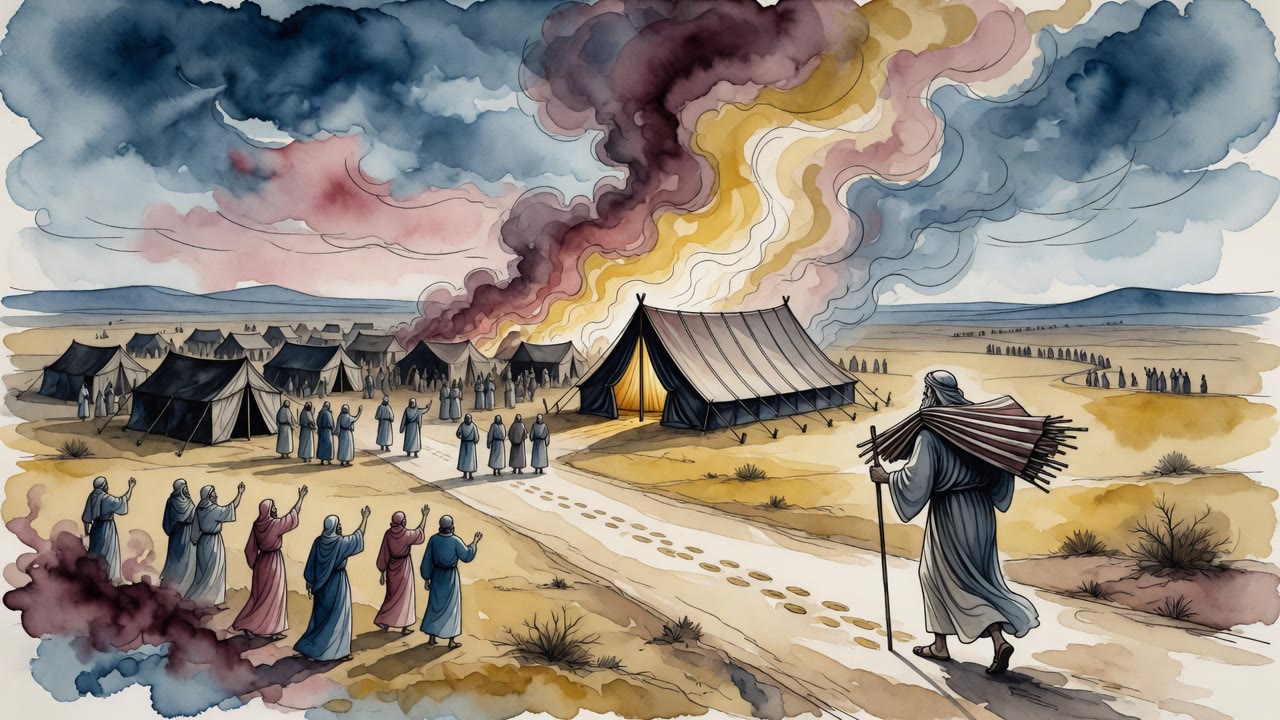
Aaron did not ask whether Moses still stammered. Moses did not ask whether Aaron still feared the palace corridors. They walked. Sand took their weight. The mountain fell behind. Somewhere ahead, Israel counted bricks without knowing two brothers had already sealed a partnership on a summit named for God.

When they reached the elders, Aaron would speak the words Moses could not push cleanly through his mouth. When they reached Pharaoh, both would stand until the river answered and the sky answered and the firstborn of Egypt answered. The kiss on Horeb was the contract before the plagues, signed without ink.

At a dry wadi they shared water from one skin. Moses poured first for Aaron. Aaron held the skin until Moses drank. Small order. Large practice. The partnership was already learning its manners.

What the People Could Not See

Israel in Goshen still woke to the same overseers. Nothing in the brick pits announced that kindness and truth had kissed in the wilderness. Redemption often begins offstage, on a mountain, in a private gladness that refuses to curdle into rivalry.

Later ages would watch brothers kill brothers for a birthright, a coat, a throne. Here the opposite happened. The man destined for the priesthood rejoiced that the prophet had been chosen. The man destined for the tablets rejoiced that the priest would walk beside him. The kiss held because neither needed the other to be smaller.

When the plagues finally fell, the work divided. Aaron owned the blows that rose from earth: blood, frogs, lice. Moses owned the blows that fell from air: hail, locusts, darkness. God owned the worst: swarms, pestilence, the firstborn. One night all three shared a single agony of boils, ash thrown toward heaven from one pair of hands that had been two handfuls a moment before. The partnership that began with a kiss at Horeb stayed visible in every staff raised and every word spoken before a throne.

At Horeb the first act was not a staff or a speech. It was Aaron's face against Moses's face, and Moses answering, while the mountain kept the secret of two men glad for each other's greatness before Egypt ever learned their names as a pair.


← All myths
From the tradition

Sources

3 sources

The texts behind this telling. Some cards carry a translation of the source; others are our own retelling of it, and each card says which. Every card links out to the original.

Shemot Rabbah 5:10Shemot Rabbah

Retold in our words. Read the original at the link below.The Sefaria Midrash Rabbah, 2022 · CC-BY

The ancient Jewish texts explore this very idea, and one particular passage in Shemot Rabbah, a collection of rabbinic interpretations on the Book of Exodus, offers a powerful insight into the meeting between Moses and Aaron.

The verse Now, The first reading, it's a simple reunion. But the Rabbis, in their wisdom, saw something much deeper. They connected this meeting to the verse in (Psalm 85:11): "Kindness and truth met, righteousness and peace kissed."

So, who are these figures of Kindness, Truth, Righteousness, and Peace? According to Shemot Rabbah, "Kindness (ḥesed)" is Aaron. The text references (Deuteronomy 33:8), "Of Levi he said: Your Tummim and your Urim for the man of your piety [ḥasidekha]." The Tummim and Urim were oracular devices used by the High Priest, and this verse associates Aaron, of the tribe of Levi, with piety and therefore kindness. "And truth" – well, that's Moses, as (Numbers 12:7) states, "My servant Moses is not so, [in all My house he is trusted]." His unwavering commitment to God makes him the embodiment of truth.

It doesn't stop there. "Righteousness," the Midrash (rabbinic interpretive commentary) tells us, is also Moses, citing (Deuteronomy 33:21): "He executed the righteousness of the Lord." And "peace" – that's Aaron again. (Malachi 2:6) says of him, "He walked with Me in peace and uprightness."

Now, about that kiss. The text acknowledges that not all kisses are created equal. Our Rabbis even say that, generally speaking, most kisses are indecent, with only three exceptions! So what made this kiss between Moses and Aaron so special? Shemot Rabbah offers a beautiful explanation: "This one was glad for the prominence of that one, and that one was glad for the prominence of this one." It was a mutual celebration of each other's strengths and roles.

Alternatively, the Midrash offers a different interpretation of "vayishak" (he kissed him), linking it to the Hebrew word meshek, meaning "transaction." They exchanged roles, each taking on aspects of the other’s responsibilities. Aaron took on some of Moses' leadership, and Moses recognized Aaron's priestly role.

Rabbi Shmuel bar Naḥman uses a compelling analogy. He compares the kiss between Moses and Aaron to solid gold, contrasting it with the deceptive kiss of Esau to Jacob, which he likens to "an earthen vessel plated with silver dross" (Proverbs 26:23). Esau's kiss was insincere, masking a wicked heart. But the kiss of Aaron and Moses? It was a "kiss of truth."

The text then presents a slight variation on these roles. Rabbi Yehuda ben Rabbi Simon says Aaron is kindness and Moses is truth, while Rabbi Azarya flips it, saying Moses is kindness (for his actions with Joseph) and Aaron is truth, as "The law of truth was in his mouth" (Malachi 2:6).

Finally, the Midrash poses a fascinating question: To whom did God show deference in this meeting? Was it to Aaron, who had been in Egypt, prophesying to the Israelites? Or was it to Moses, the one who would ultimately lead them to freedom? Some say it was to Aaron, so that when Moses arrived, the people would believe him, knowing Aaron's prophecies had come true. Others say it was to Moses, so that the people would trust his leadership.

What does all this tell us? Perhaps it's about the power of genuine connection, of recognizing and celebrating the strengths of others. Maybe it's about the importance of truth and kindness in leadership. Or perhaps it's simply a reminder that true relationships are built on mutual respect and admiration, like the golden kiss between Moses and Aaron.

Full source
Shemot Rabbah 12:4Shemot Rabbah

Retold in our words. Read the original at the link below.The Sefaria Midrash Rabbah, 2022 · CC-BY

The Book of Exodus tells us, "Moses extended his staff toward the heavens and the Lord sent thunder and hail, and fire ran down to the ground, and the Lord rained hail upon the land of Egypt" (Exodus 9:23). Okay, but how did it all work?

Well, Shemot Rabbah, a classic collection of rabbinic interpretations on the Book of Exodus, breaks it down for us in a fascinating way. It suggests a kind of divine division of labor. According to this Midrash (rabbinic interpretive commentary), some plagues were brought about by Aaron, some by Moses, some by God Himself – the Holy One blessed be He – and one, rather unusually, by all of them together.

Specifically, the plagues that originated from the earth – blood, frogs, and lice – were brought about by Aaron. Hail, locusts, and darkness? Those were Moses’s domain, says the Midrash, because they were in the air. As the text puts it, Moses "had control over the earth and the heavens." Swarms, pestilence, and the devastating plague of the firstborn were directly from the Holy One blessed be He. And the agonizing boils? Those, apparently, were a group effort. (See Shemot Rabbah 11:5).

It gets even more interesting when we look closer at the plague of hail. The verse says, "And the Lord [vaY-H-V-H] sent thunder and hail." Shemot Rabbah points out that every time we see the name vaY-H-V-H used, it indicates that God acted with His heavenly court. It's like when it says "And the Lord [vaY-H-V-H] remembered Sarah" (Genesis 21:1) – it wasn't just Him, but also "He and His advisory council."

And what about that “fire running down to the ground"? The Midrash interprets this as a judgment, a taste of Gehenna – the hellish place of punishment – for the wicked Egyptians. Ouch. If they were sitting, they were burned by the hail; if they were standing, they were burned by the fire (referring to (Exodus 9:2)4).

The Torah tells us, "There was hail, and fire flaming within the hail, very severe, that there had not been in Egypt since it became a nation" (Exodus 9:24). "Hail, and fire flaming within the hail" – a miracle within a miracle! Rabbi Yehuda and Rabbi Neḥemya offer vivid descriptions. One says it was like a pomegranate seed, where you can see the pit from the outside. The other compares it to a lantern where water and oil are mixed, yet the fire still burns brightly within.

The Midrash offers an analogy: Think of two warring legions. When the king needed them for his own war, he made peace between them, and they worked together to accomplish his mission. Fire and hail are natural enemies, but when it came to punishing Egypt, the Holy One blessed be He brought them together to strike the land. The Hebrew word used here, mitlakaḥat, is particularly striking. It means "to take the dead [met lakaḥat]." According to this interpretation, the hail would strike a person, and then the fire would consume them.

The devastation was widespread. “The hail struck throughout the land of Egypt, everything that was in the fields, both man and animal; and the hail struck all the vegetation in the fields, and broke every tree of the fields” (Exodus 9:25). The hail even trapped the Egyptians’ livestock, so they couldn't escape. And if an Egyptian tried to slaughter an animal for food, a bird would swoop down and eat it! This is based on the verse in (Psalms 78:48): “He consigned [vayasger] their cattle to the hail, and their livestock to fiery bolts [lareshafim].” The Midrash interprets lareshafim as birds, referencing (Job 5:7): “As the sparks [uvnei reshef] fly upward.”

The trees weren't spared either. (Psalm 78:47) says, "He killed their vines with hail, and their sycamore trees with frost [baḥanamal]." Rabbi Yehuda bar Rabbi Shalom explains baḥanamal as "it came [ba], rested [ḥana], cut [mal]." Rabbi Pinḥas adds that it descended like an axe, hewing the trees.

But amidst all this destruction, there was one place untouched: “Only in the land of Goshen, where the children of Israel were, there was no hail” (Exodus 9:26). Why was Goshen spared? The Midrash tells us it was because its patron protected it. The very presence of the Israelites was enough.

So, what does this all mean? It shows us a God who works through many means – sometimes directly, sometimes through intermediaries, and sometimes by harnessing even the most unlikely of forces.

Full source
Shemot Rabbah 2:1Shemot Rabbah

Retold in our words. Read the original at the link below.The Sefaria Midrash Rabbah, 2022 · CC-BY

Our story begins, as so many do, in the book of Exodus.

"Moses was herding the flock of his father-in-law Yitro, the priest of Midyan, and he led the flock into the wilderness, and he arrived at the mountain of God, to Ḥorev" (Exodus 3:1).

The Shemot Rabbah, a classic collection of rabbinic interpretations on the Book of Exodus, sees something deeper in this seemingly simple verse. It draws a connection to (Psalm 103:7): "He makes known to Moses His ways, His deeds [alilotav] to the children of Israel."

Why this connection?

The Midrash (rabbinic interpretive commentary) contrasts human actions with those of HaShem, the Holy One, blessed be He. Human actions, it says, can be distorted, even malicious. Think of the verse in (Deuteronomy 22:14), "He pressed false charges against her." Ouch.

But HaShem’s actions? They are rooted in mercy. "The Lord is compassionate and gracious" (Psalms 103:8). This isn't just a nice sentiment; it's the foundation upon which Moses' entire mission rests.

The Midrash goes on to say that HaShem revealed these attributes to Moses precisely when Moses pleaded, "Please make known to me Your ways" (Exodus 33:13). Remember HaShem's response? "I will be gracious to whom I will be gracious" (Exodus 33:19). That, the Midrash tells us, is "the Lord is compassionate and gracious."

So, what "ways" did HaShem reveal? According to the Shemot Rabbah, it was "the path to the culmination [the redemption]" of the Egyptian exile. Moses learned how HaShem would ultimately free the Israelites.

And what about HaShem's "deeds," the alilotav? These, the Midrash says, were performed in Egypt "so that Israel would relate the deeds that the Holy One blessed be He did to Egypt." This ties into (Exodus 10:2): "So that you relate in the ears of your sons […what I wrought [hitallalti] upon Egypt]." It wasn't just about liberation; it was about creating a story, a legacy of divine intervention to be passed down through generations.

The Midrash beautifully breaks down the qualities described in (Psalm 103:8). "Compassionate" – meaning HaShem had compassion on Israel, ensuring the plagues didn't affect them. "And gracious" – meaning the Israelites "found grace in the eyes of Egypt." Even in the midst of suffering, there were glimmers of divine favor.

And finally, "Forbearing" (Psalms 103:8) – HaShem showed patience, "as He tilts the scales in favor of kindness, and He looked to the good and not to the evil that they were destined to perform." Even knowing the Israelites would stumble, HaShem chose to focus on their potential for good.

So, what do we take away from all this? It seems Moses wasn't just a random shepherd. He was chosen because he was open to understanding HaShem’s ways – ways defined by compassion, grace, and forbearance. He understood that even when things looked bleak, redemption was possible, and that even flawed people were worthy of divine love and liberation. And maybe, just maybe, that’s a message we can all use today.

Full source