5 min read

Moses Prayed Forty Days and Five Short Words

Rabbi Eliezer refused to scold either the long pray-er or the short one, because Moses had already set both measures on the mountain and at the camp.

Curated by Arthur · Told by Maggid ·
Table of Contents
  1. The Restless Congregation
  2. The Word That Named the Wound
  3. What the Inward Match Demands
  4. Whispers After the Formal Words
  5. Two Measures, One Mountain

Two men finished the Amidah (the standing prayer at the heart of every service) in front of Rabbi Eliezer, and both of them looked wrong to everyone watching.
Moses Prayed Forty Days and Five Short Words Click for full size

The Restless Congregation

The first swayed and added private petitions until the room grew tight with waiting. Necks stiffened. Someone shifted a foot. The second raced through the words so fast his lips seemed to trip over themselves, done almost before he had begun. Students cornered their master afterward. Too long, they said. Too short, they said. Both seemed a failure of measure, a public awkwardness that needed a ruling.

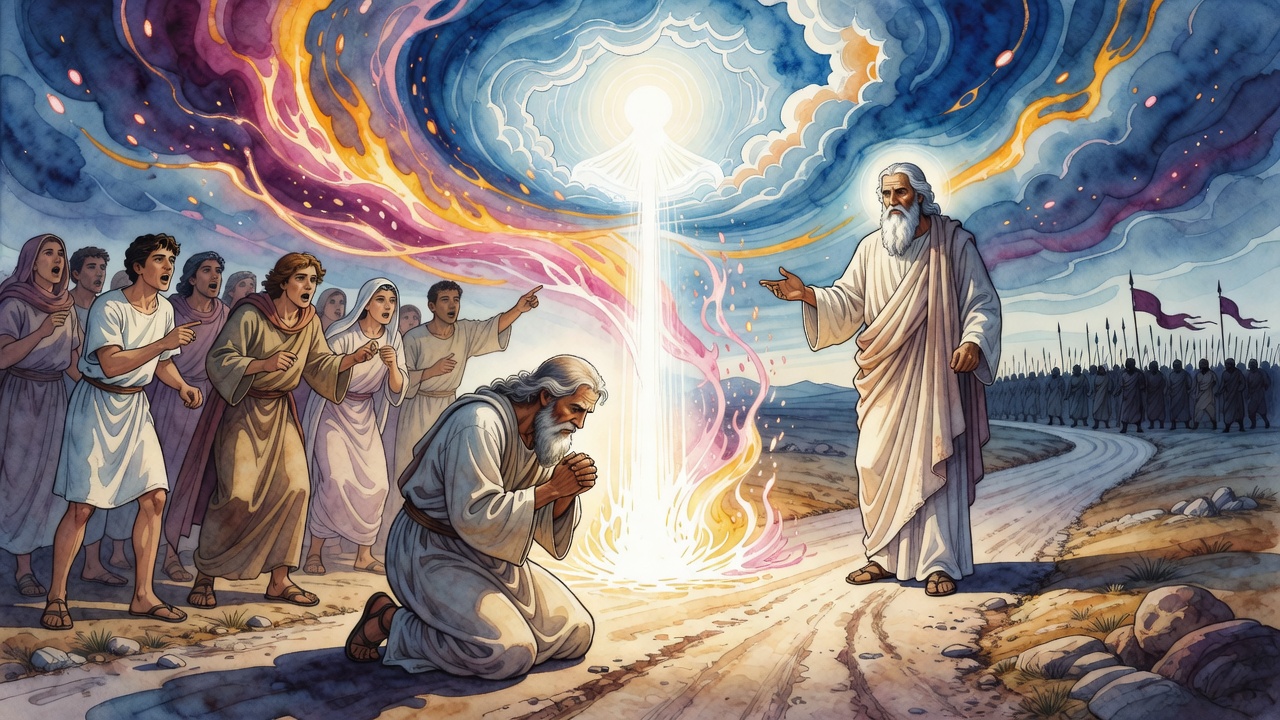
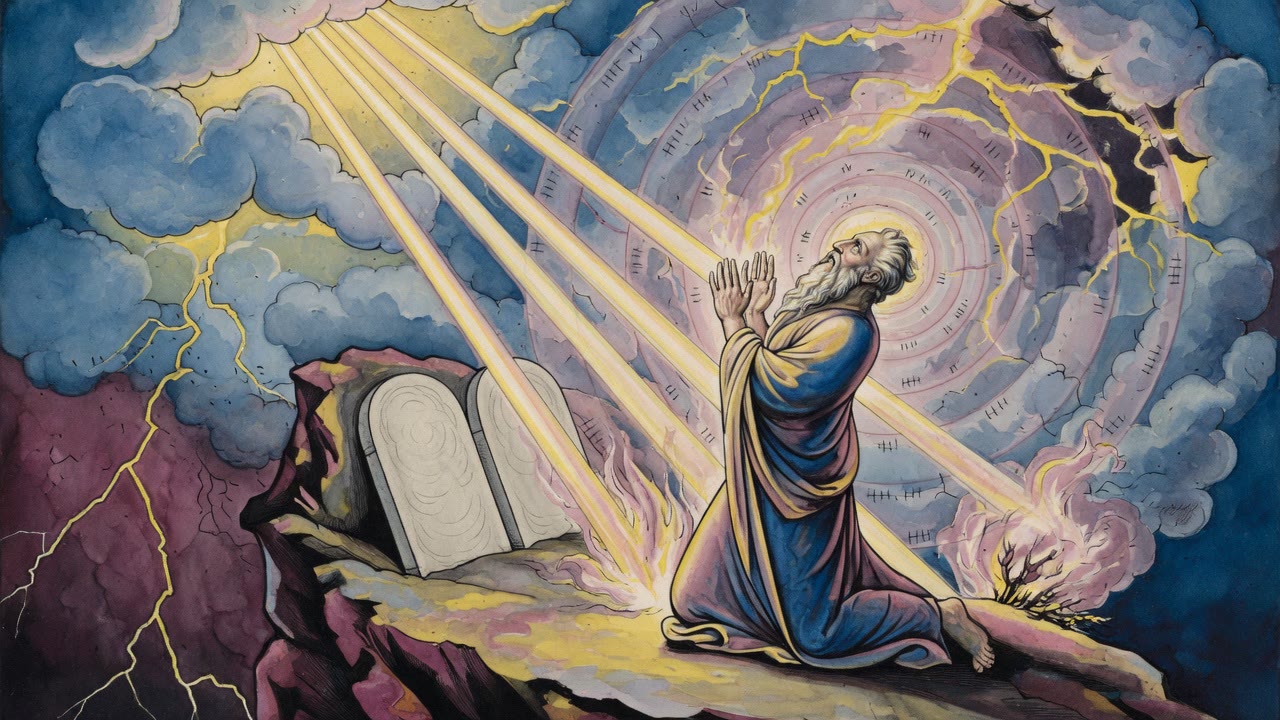
Rabbi Eliezer answered quietly. The long one had not outlasted Moses, who stood forty days and forty nights on the mountain pleading for Israel after the calf (Exodus 34:28). Who scolds a man for a few extra minutes when a prophet once burned whole weeks into prayer and refused to come down until mercy rewrote the decree?

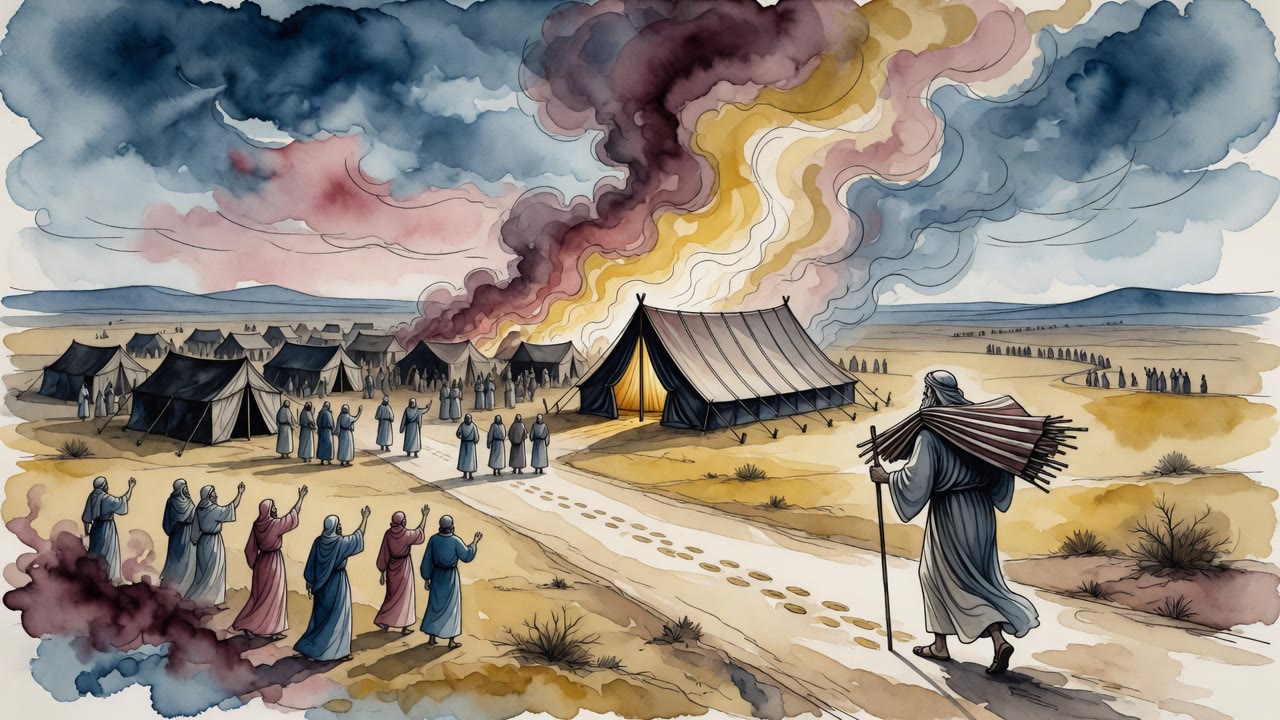
The short one had not undercut Moses either. When Miriam was struck with leprosy at the edge of the camp, Moses cried five Hebrew words: El na refa na lah, "Please, God, heal her please" (Numbers 12:13). A breath. Heaven took it. No poem. No delay. A sister's skin turning, and a brother's mouth cutting straight to the ask.

The Word That Named the Wound

The long prayer sat on the far side of a sin the people had pointed at with a small word. With "this" they sinned, aiming at the calf and saying "this Moses, the man," as if the leader could be reduced to a missing body and replaced with gold. With "this" their heart later grew faint in Lamentations. With "this" they will one day be comforted, naming the LORD they waited for.

The same pointing finger that built an idol also pointed toward a teacher, a Torah, a God, and a people. The midrash builds one sentence from scattered verses. Let this one come, Moses, and receive this, the Torah, from this One, for this people. The pointing word is not discarded. It is redeemed by better aims.

Prayer after that kind of fracture cannot be timed by a clock alone. Sometimes the soul needs forty days to refuse to leave the mountain. Sometimes a sister's body is breaking and there is no room for extra music in the mouth.

What the Inward Match Demands

Rabbi Eliezer's ruling dissolves a false fight. Length is not virtue. Brevity is not virtue. Match is virtue. A long prayer that stays because the relationship will not let go. A short prayer that cuts because the emergency will not wait.

The students wanted a rule they could police from the back row, a way to grade strangers by duration. Their master gave them a prophet's two precedents and sent them home without a stopwatch. The congregation's restlessness was not the measure. The heart's fit to the hour was the measure.

A person who prays long out of vanity is not Moses on the mountain. A person who prays short out of boredom is not Moses at the camp edge. The teaching protects both real stances and refuses to confuse them with performance errors.

Whispers After the Formal Words

Later sages kept private prayers after the fixed ones, confessions that sound like the short end of Moses' scale stretched by a few lines. Rava would say he was worthless before he was created and dust in life, more so in death, a vessel of shame before God. That confession later echoed in Yom Kippur's mouth. Mar bar Ravina asked that his tongue be guarded from evil and his lips from deceit, that his soul stay silent toward those who curse him. Rabbi Alexandri begged to be stationed in a lighted corner, not a dark one, eyes not dimmed toward the sleep of death.

Another prayer named the block without flattery. Our will is to perform Your will. What prevents us? The yeast in the dough, the yetzer hara (the impulse toward evil inside every person), and subjugation to foreign kingdoms. Sin is not always a clean choice. Sometimes the obstacle is baked into the human condition and the political air.

These are not performances for a congregation's patience. They are emergency speech and honest dust-speech. They keep the five-word spirit alive inside longer liturgy.

Two Measures, One Mountain

On the mountain Moses refused to come down until mercy rewrote the decree after the calf. At the camp edge he refused to speechify while Miriam waited. Both stances are loyalty. Both are love under different pressures. Forty days is not better than five words. Five words are not holier than forty days. Each is the right tool for a different fire.

Rabbi Eliezer, hearing restless students grade two strangers, would not let the bet midrash turn into etiquette. He put Moses back in the room. Forty days on one side of the aisle, five words on the other, and a congregation learning that heaven answers both when the heart is the right length for the hour.

The long pray-er kept swaying. The short one had already gone home. The teaching stayed, harder than either of their reputations.


← All myths
From the tradition

Sources

3 sources

The texts behind this telling. Some cards carry a translation of the source; others are our own retelling of it, and each card says which. Every card links out to the original.

Gaster, Exempla no. 185; cf. Berakhot 34aThe Exempla of the Rabbis (1924)

Retold in our words. Read the original at the link below.The Exempla of the Rabbis, Moses Gaster (1924) · PD-US-pre-1929

Two men once prayed at length before Rabbi Eliezer. The first stretched his Amidah far beyond the usual length, swaying and adding private petitions until the congregation grew restless. The second raced through his words so quickly that he finished almost before he started.

Rabbi Eliezer's students came to him afterward, troubled. "Master, the first man was praying too long. And the second was praying too briefly. Both seemed wrong."

Rabbi Eliezer answered them quietly.

"The one who prayed long," he said, "was not praying longer than Moses, who once stood before God for forty days and forty nights on the mountain, pleading for Israel after the sin of the calf (Exodus 34:28). If Moses prayed for forty days, who are we to criticize a man for praying a few extra minutes?

"And the one who prayed short was not praying shorter than Moses either, who, when his sister Miriam was struck with leprosy at the edge of the camp, cried out only five Hebrew words, El na refa na lah, 'Please, God, heal her please' (Numbers 12:13). That prayer was the length of a breath, and God accepted it."

The Exempla preserves Rabbi Eliezer's teaching because it dissolves a false argument. The right length of a prayer is not fixed. What matters is the inward match: a long prayer that refuses to leave God's side, or a short prayer in a moment so urgent there is no room for extra words. Both have a prophet's precedent.

(From The Exempla of the Rabbis, Moses Gaster, 1924, no. 185, based on Berakhot 34a.)

Full source
Yalkut Shimoni on Torah 391:8Yalkut Shimoni on Torah

Translation of the source text.Torat Emet (Yalkut Shimoni) · CC-BY-NC

"For this Moses, the man." They sinned with "this," they were stricken with "this," and they are comforted with "this." They sinned with "this": "for this Moses, the man." They were stricken with "this": "for this our heart is faint" (Lamentations 5:17). And they are comforted with "this": "this is the LORD, we have waited for Him" (Isaiah 25:9). Let this one come and receive this from this One for this people. Let this one come, this is Moses, as it says, "for this Moses." And receive this, this is the Torah, as it says, "and this is the Torah that Moses set." From this One, this is the Holy One, blessed be He, as it says, "this is my God and I will glorify Him" (Exodus 15:2). For this people, these are Israel, "this people You acquired."

"And they removed" (this is written at sign 867). "These are your gods, Israel." Rabbi Yehudah said in the name of Rav: an Israelite who set up a brick to bow down to it, and a gentile came and bowed down to it, has rendered it forbidden. This is like the beginning of the Land of Israel, of which the Merciful One said, "and their sacred trees you shall burn with fire" (Deuteronomy 12:3). Now since it is an inheritance to them from their fathers, and a person cannot forbid a thing that is not his, and if it were because of those original idols, mere nullification would suffice for them. Rather, since Israel worshipped the calf, they revealed their intent that idol worship is acceptable to them, and when gentiles come they act as their agents. Here too, an Israelite who set up a brick revealed his intent that idol worship is acceptable to him, and when a gentile comes he acts as his agent. And perhaps it was only with the calf that it was acceptable to them, but with another matter not? The verse states, "these are your gods, Israel," teaching that they craved many deities. Then say that whatever was involved with the calf should be forbidden, but from here onward it should be permitted. Who can prove it?

Full source
Berakhot 17aTalmud Bavli, Berakhot

Translation of the source text.William Davidson Edition - Vocalized Aramaic + William Davidson Edition - English · CC-BY-NC

in the heavenly entourage [pamalia] of angels each of whom ministers to a specific nation (see Daniel 10), and whose infighting causes war on earth; and in the earthly entourage, the Sages, and among the disciples engaged in the study of Your Torah, whether they engage in its study for its own sake or not for its own sake. And all those engaged in Torah study not for its own sake, may it be Your will that they will come to engage in its study for its own sake.

After his prayer, Rabbi Alexandri said the following: May it be Your will, Lord our God, that You station us in a lighted corner and not in a darkened corner, and do not let our hearts become faint nor our eyes dim. Some say that this was the prayer that Rav Hamnuna would recite, and that after Rabbi Alexandri prayed, he would say the following: Master of the Universe, it is revealed and known before You that our will is to perform Your will, and what prevents us?

On the one hand, the yeast in the dough, the evil inclination that is within every person; and the subjugation to the kingdoms on the other. May it be Your will that You will deliver us from their hands, of both the evil inclination and the foreign kingdoms, so that we may return to perform the edicts of Your will with a perfect heart. After his prayer, Rava said the following: My God, before I was created I was worthless, and now that I have been created it is as if I had not been created, I am no more significant.

I am dust in life, all the more so in my death. I am before You as a vessel filled with shame and humiliation. Therefore, may it be Your will, Lord my God, that I will sin no more, and that those transgressions that I have committed, cleanse in Your abundant mercy; but may this cleansing not be by means of suffering and serious illness, but rather in a manner I will be able to easily endure. And this is the confession of Rav Hamnuna Zuti on Yom Kippur.

When Mar, son of Ravina, would conclude his prayer, he said the following: My God, guard my tongue from evil and my lips from speaking deceit. To those who curse me let my soul be silent and may my soul be like dust to all. Open my heart to Your Torah, and may my soul pursue your mitzvot. And save me from a bad mishap, from the evil inclination, from a bad woman, and from all evils that suddenly come upon the world.

And all who plan evil against me, swiftly thwart their counsel, and frustrate their plans. May the words of my mouth and the meditation of my heart find favor before You, Lord, my Rock and my Redeemer. The Gemara recounts that when Rav Sheshet would sit in observance of a fast, after he prayed he said as follows: Master of the Universe, it is revealed before You that when the Temple is standing, one sins and offers a sacrifice.

And although only its fat and blood were offered from that sacrifice on the altar, his transgression is atoned for him. And now, I sat in observance of a fast and my fat and blood diminished. May it be Your will that my fat and blood that diminished be considered as if I offered a sacrifice before You on the altar, and may I find favor in Your eyes.Having cited statements that various Sages would recite after their prayers, the Gemara cites additional passages recited by the Sages on different occasions.

When Rabbi Yoḥanan would conclude study of the book of Job, he said the following: A person will ultimately die and an animal will ultimately be slaughtered, and all are destined for death. Therefore, death itself is not a cause for great anguish. Rather, happy is he who grew up in Torah, whose labor is in Torah, who gives pleasure to his Creator, who grew up with a good name and who took leave of the world with a good name.

Such a person lived his life fully, and about him, Solomon said: “A good name is better than fine oil, and the day of death than the day of one’s birth” (Ecclesiastes 7:1); one who was faultless in life reaches the day of his death on a higher level than he was at the outset. Rabbi Meir was wont to say the following idiom: Study with all your heart and with all your soul to know My ways and to be diligent at the doors of My Torah.

Keep My Torah in your heart, and fear of Me should be before your eyes. Guard your mouth from all transgression, and purify and sanctify yourself from all fault and iniquity. And if you do so, I, God, will be with you everywhere. The Sages in Yavne were wont to say: I who learn Torah am God’s creature and my counterpart who engages in other labor is God’s creature.

My work is in the city and his work is in the field. I rise early for my work and he rises early for his work. And just as he does not presume to perform my work, so I do not presume to perform his work. Lest you say: I engage in Torah study a lot, while he only engages in Torah study a little, so I am better than he, it has already been taught: One who brings a substantial sacrifice and one who brings a meager sacrifice have equal merit, as long as he directs his heart towards Heaven (Rav Hai Gaon, Arukh).

Abaye was wont to say: One must always be shrewd and utilize every strategy in order to achieve fear of Heaven and performance of mitzvot. One must fulfill the verse: “A soft answer turns away wrath” (Proverbs 15:1) and take steps to increase peace with one’s brethren and with one’s relatives, and with all people, even with a non-Jew in the marketplace, despite the fact that he is of no importance to him and does not know him at all (Me’iri), so that he will be loved above in God’s eyes, pleasant below in the eyes of the people, and acceptable to all of God’s creatures.

Tangentially, the Gemara mentions that they said about Rabban Yoḥanan ben Zakkai that no one ever preceded him in issuing a greeting, not even a non-Jew in the marketplace, as Rabban Yoḥanan would always greet him first. Rava was wont to say: The objective of Torah wisdom is to achieve repentance and good deeds; that one should not read the Torah and study mishna and become arrogant and spurn his father and his mother and his teacher and one who is greater than he in wisdom or in the number of students who study before him, as it is stated: “The beginning of wisdom is fear of the Lord, a good understanding have all who fulfill them” (Psalms 111:10).

It is not stated simply: All who fulfill, but rather: All who fulfill them, those who perform these actions as they ought to be performed, meaning those who do such deeds for their own sake, for the sake of the deeds themselves, not those who do them not for their own sake. Rava continued: One who does them not for their own sake, it would have been preferable for him had he not been created. Rav was wont to say: The World-to-Come is not like this world.

In the World-to-Come there is no eating, no drinking, no procreation, no business negotiations, no jealousy, no hatred, and no competition. Rather, the righteous sit with their crowns upon their heads, enjoying the splendor of the Divine Presence, as it is stated: “And they beheld God, and they ate and drank” (Exodus 24:11), meaning that beholding God’s countenance is tantamount to eating and drinking.

The Gemara states: Greater is the promise for the future made by the Holy One, Blessed be He, to women than to men, as it is stated: “Rise up, women at ease; hear My voice, confident daughters, listen to what I say” (Isaiah 32:9). This promise of ease and confidence is not given to men. Rav said to Rabbi Ḥiyya: By what virtue do women merit to receive this reward? Rabbi Ḥiyya answered: They merit this reward for bringing their children to read the Torah in the synagogue, and for sending their husbands to study mishna in the study hall, and for waiting for their husbands until they return from the study hall.

When the Sages who had been studying there took leave of the study hall of Rabbi Ami, and some say it was the study hall of Rabbi Ḥanina, they would say to him the following blessing: May you see your world, may you benefit from all of the good in the world, in your lifetime, and may your end be to life in the World-to-Come, and may your hope be sustained for many generations. May your heart meditate understanding, your mouth speak wisdom, and your tongue whisper with praise.

May your eyelids look directly before you, your eyes shine in the light of Torah, and your face radiate like the brightness of the firmament. May your lips express knowledge, your kidneys rejoice in the upright, and your feet run to hear the words of the Ancient of Days, God (see Daniel 7). When the Sages took leave of the study hall of Rav Ḥisda, and some say it was the study hall of Rabbi Shmuel bar Naḥmani, they would say to him the following, in accordance with the verse: “Our leaders are laden, there is no breach and no going forth and no outcry in our open places” (Psalms 144:14).

Our leaders are laden. Rav and Shmuel, and some say Rabbi Yoḥanan and Rabbi Elazar, disputed the proper understanding of this verse. One said: Our leaders in Torah are laden with mitzvot. And one said: Our leaders in Torah and mitzvot are laden with suffering.

Full source