5 min read

Noah Drank in His House and Ham Found the Shame

Shem and Japheth walked backward into the tent with a cloak stretched between them so they would not have to see what their brother had seen.

Curated by Arthur · Told by Maggid ·
Table of Contents
  1. The First Vineyard After the Water
  2. Ham Went Outside and Told
  3. The Cloak They Carried Backward
  4. Noah Woke and Knew
  5. A Son's Name Set Down Too Early
Noah Drank in His House and Ham Found the Shame Click for full size

The First Vineyard After the Water

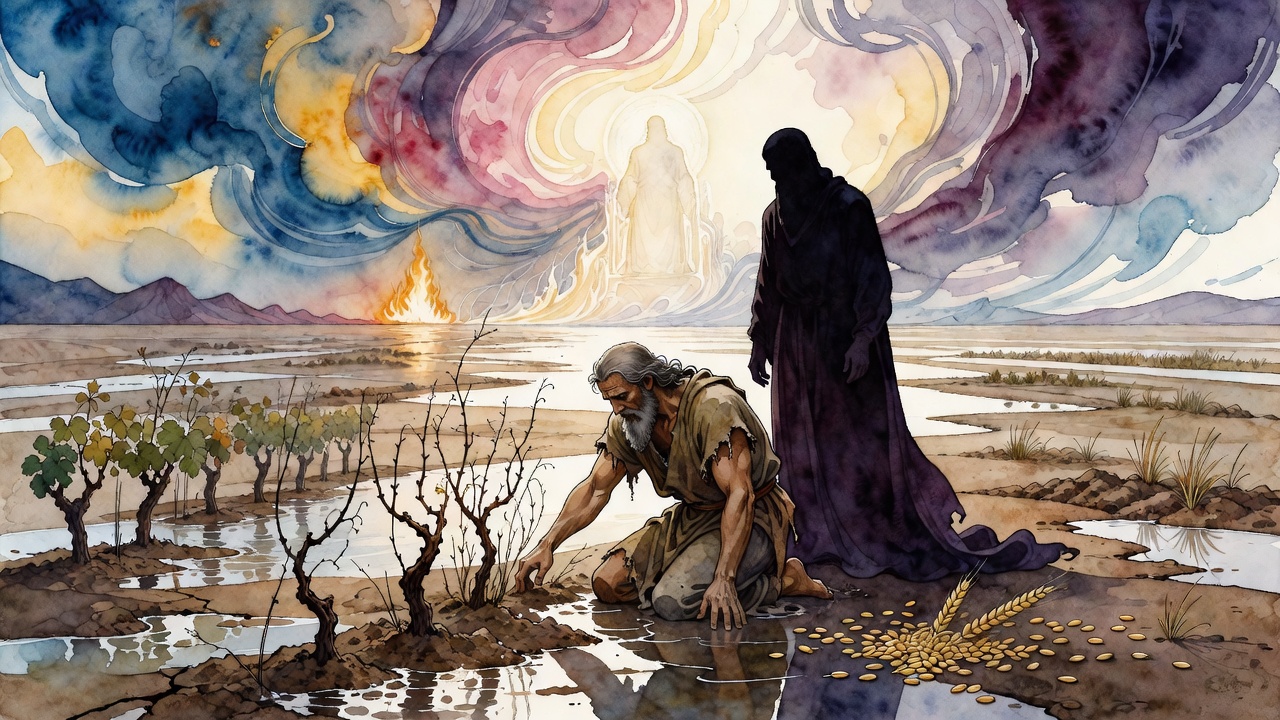
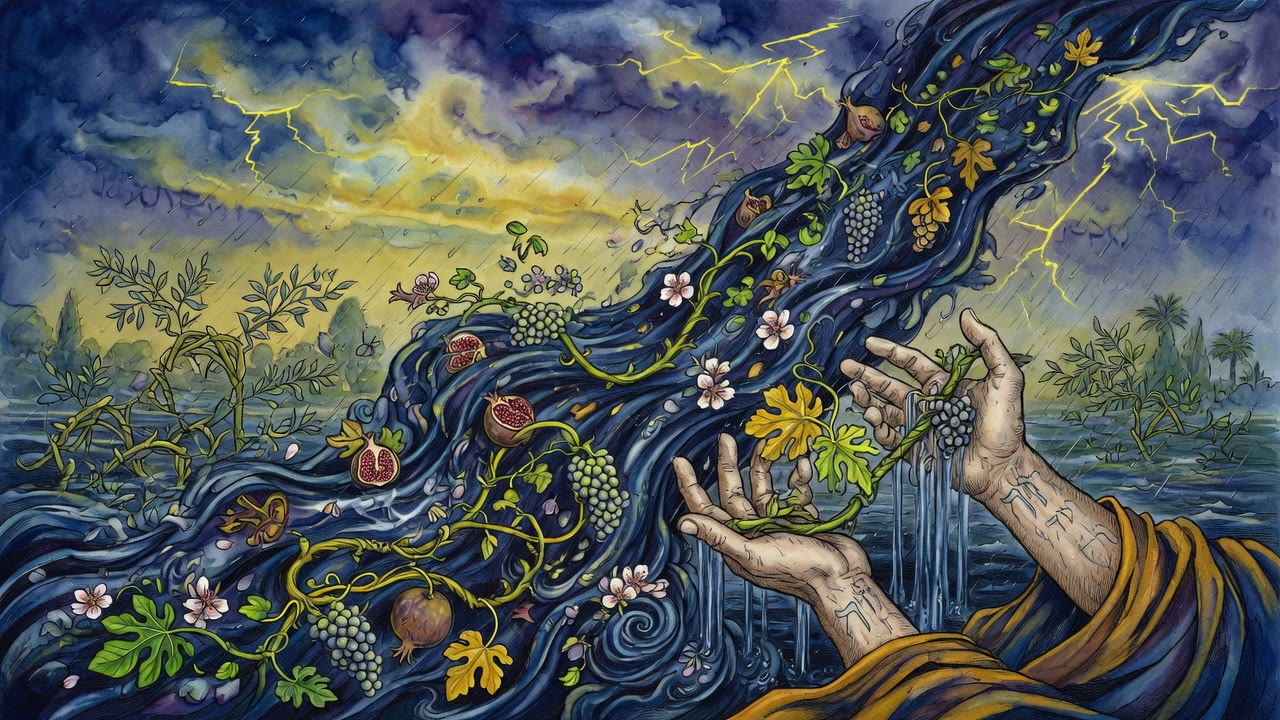
Noah pushed cuttings into ground that had been at the bottom of a sea. Nothing had grown in it for a year. Everyone who might have argued with him about where to put the rows was gone, so he set them where he liked and worked them alone.
The vines took. He pressed the grapes, poured the new wine into jars, and one evening he filled a cup inside his own four walls and drank it, and filled it again.

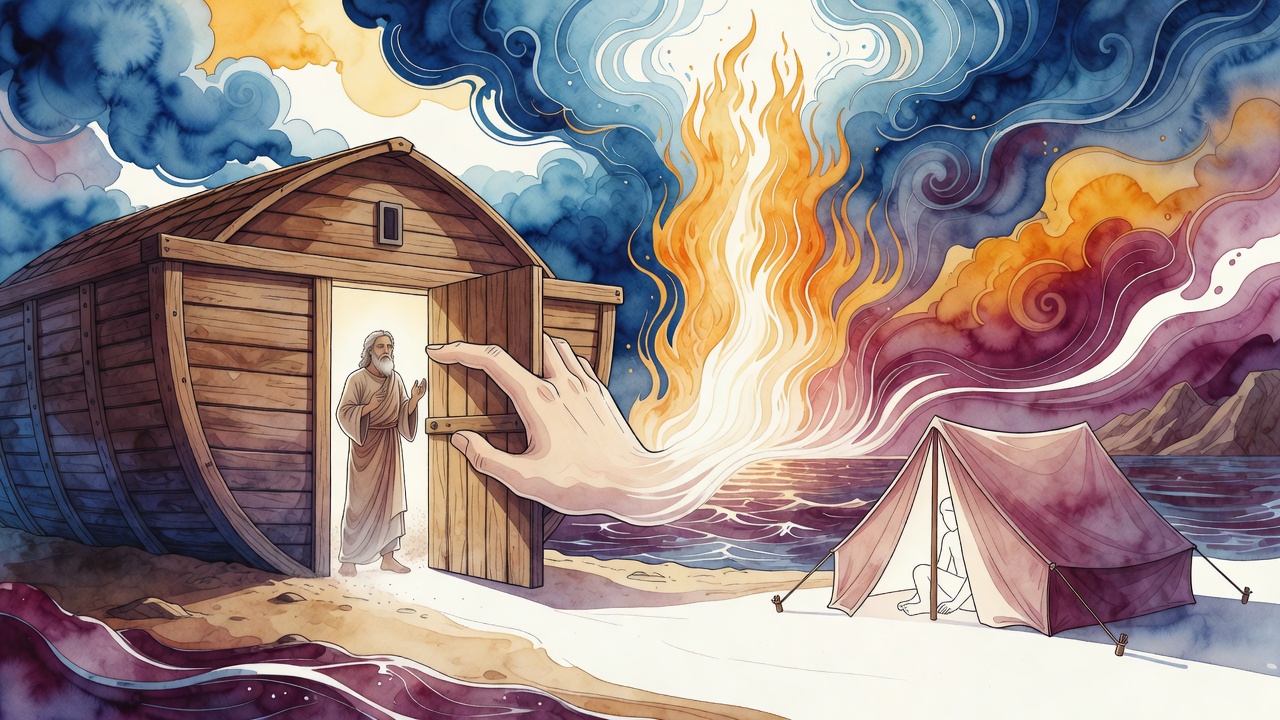
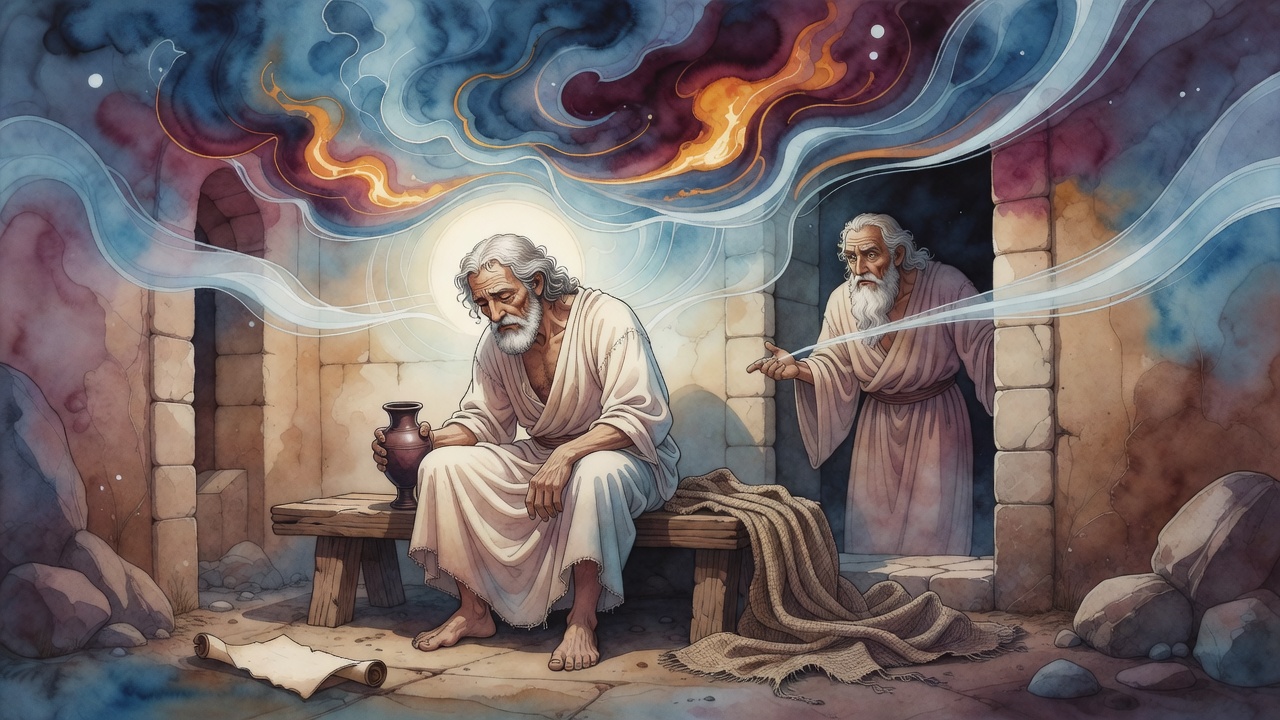
He drank of the wine and he was drunken. The man who had counted the animals in two by two, who had held a boat together over a drowned world for a year and come out the other side, went down on the floor of his tent with his clothes off him. No angel came. No voice came out of anywhere. The roof and the walls closed over him, which is what a house is built to do.

Stone and timber will cover a body. They cover nothing else. The other garment, the one a man puts on every morning and wears the way honest people wear their honesty, had come off with his tunic, and he had not decided to take it off. A righteous man goes down the way the drunk and the out-of-their-minds go down, meaning none of it, and afterward he has to be dressed again by hands.

Ham Went Outside and Told

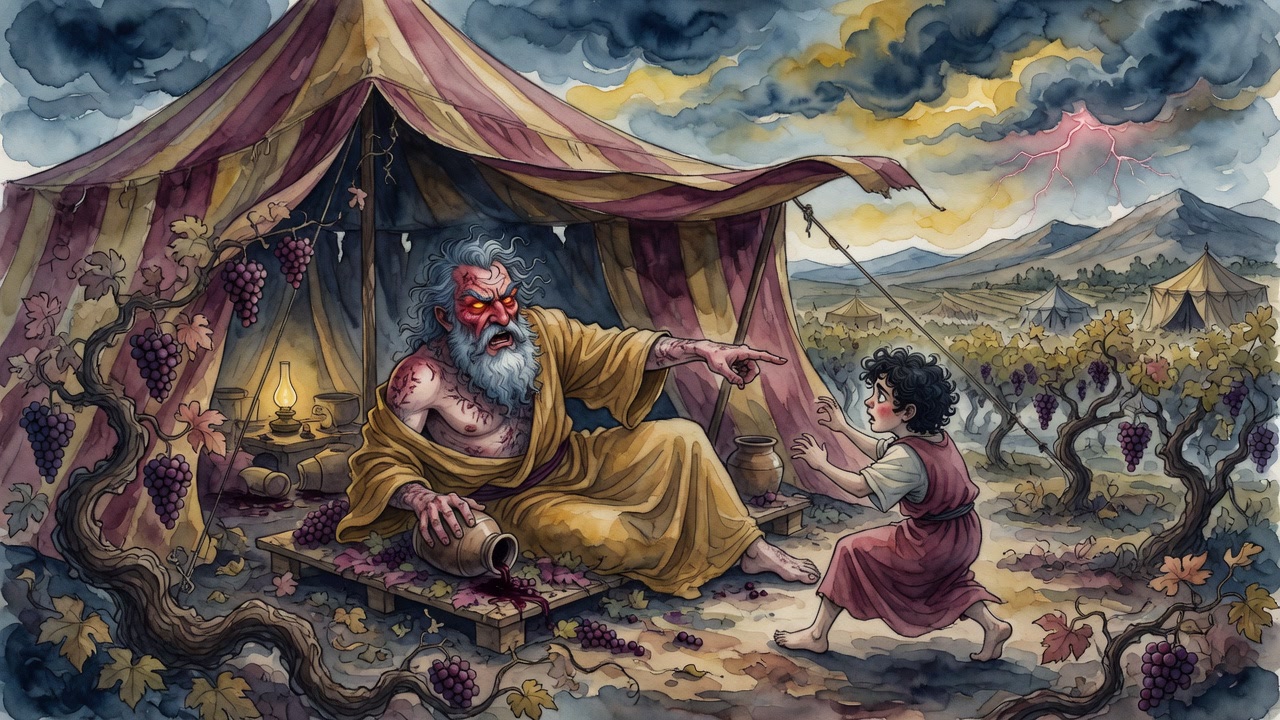
Ham found him there on the floor of the tent. He did not put out a hand. He did not turn around. He looked at his father, and then he walked out through the door to where his two brothers were standing and told them what was lying inside.

The telling took a few seconds. It is the whole of what he did, and it was enough. Inside the tent a man was uncovered under his own roof and the walls were doing their work. Out in the open air the shame went where the walls could not follow it, and after that no cloth in the world could get in front of it.

The Cloak They Carried Backward

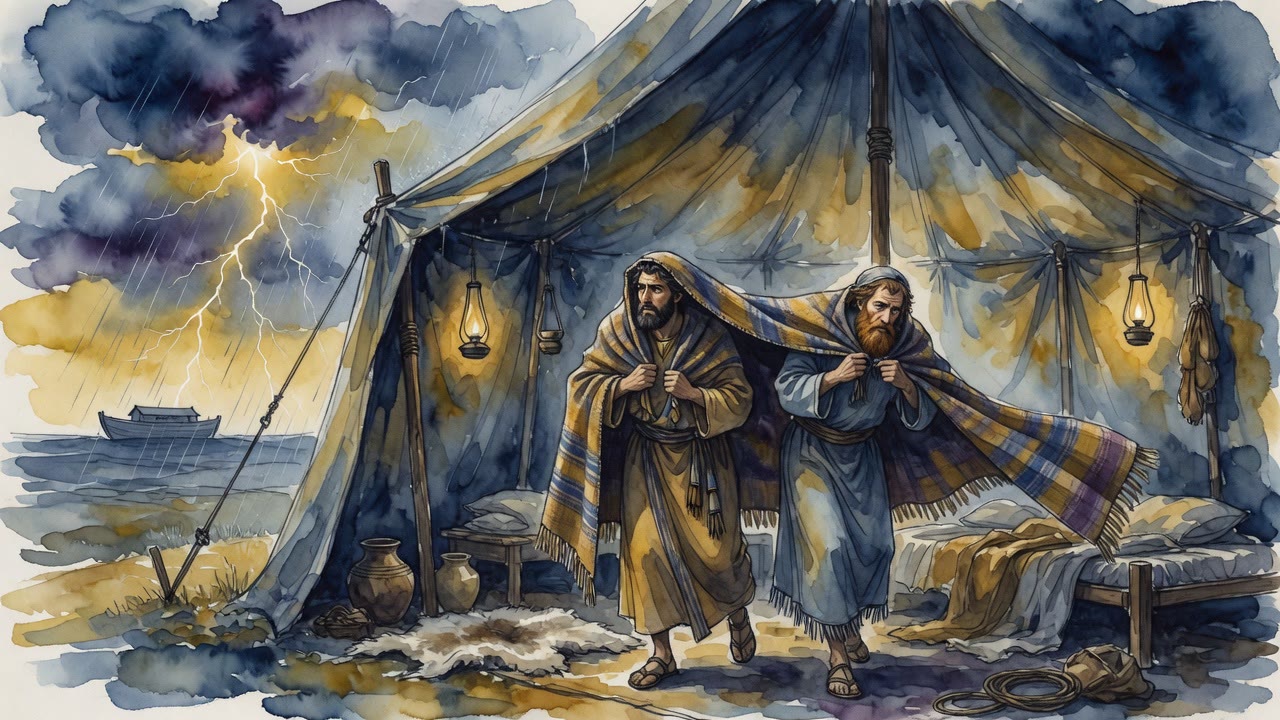
Shem and Japheth took a garment and laid it across both their shoulders, one end on each man. Then they walked into the tent backward.

Their faces stayed turned the other way the whole time. They could not see the floor, so they went by the sound of their own heels and by the pull of the cloth between them, and when they judged they had come far enough they let it down and kept walking backward until they were out in the daylight again.

Two grown men shuffling in reverse into a dim tent with a blanket stretched between them. It took a great deal longer than looking would have taken. That was the entire difference between them and their brother.

Noah Woke and Knew

He came up out of the wine under a garment he had not pulled over himself, and he knew what his youngest son had done to him. Nobody told him. The cloth on top of him said one thing and the quiet outside the tent said the rest.

Then he opened his mouth, and the first words spoken out of the first vineyard were not about Ham at all.

"Cursed be Canaan. A servant of servants shall he be to his brothers."

He blessed the God of Shem, and said Canaan would be Shem's servant. He said God would make room for Japheth, and that Japheth would live in the tents of Shem, and that Canaan would serve him too. Three times the sentence came down. Three times it landed one generation past the man who had earned it.

A Son's Name Set Down Too Early

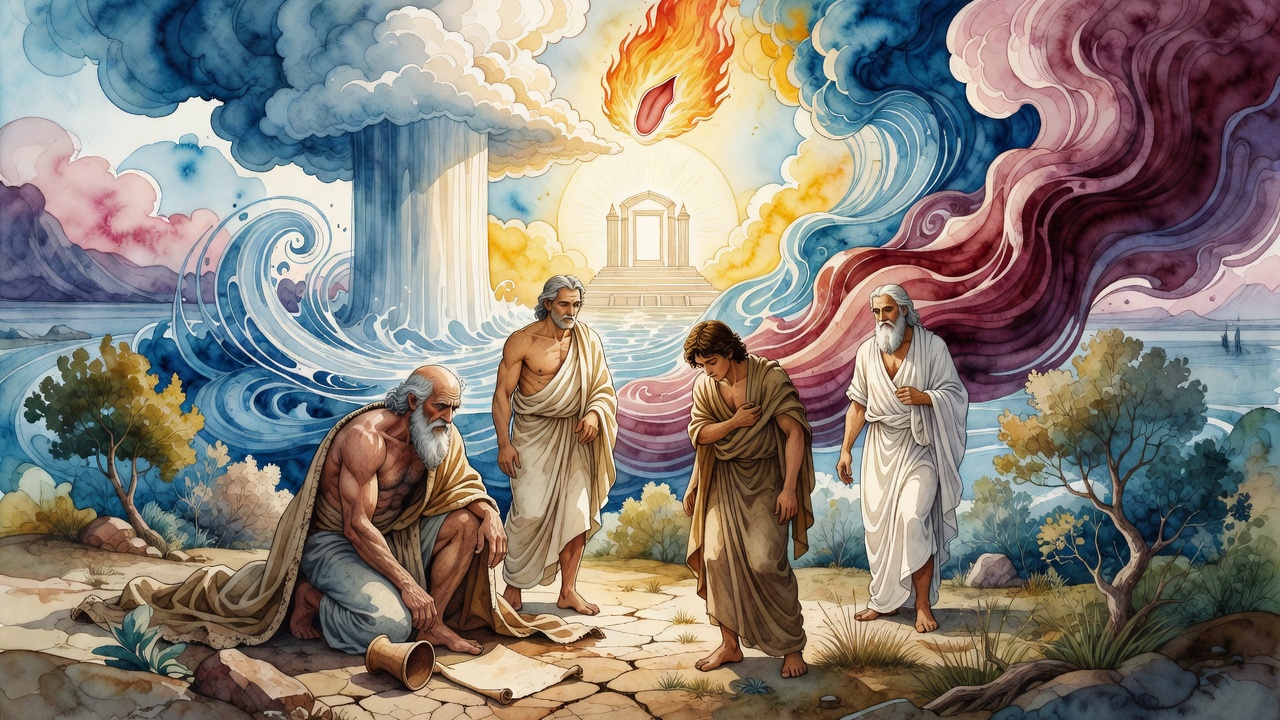
The three of them had come off the boat together and been named together, Shem and Ham and Japheth. Only one of them had a child's name fastened to him at that moment, before the ground had dried, before the cuttings went in, before there was any wine in the world to be drunk. Ham, the father of Canaan.

Shem is given nobody there. Japheth is given nobody there. The middle son walks out of the boat already carrying a son who has done nothing yet, and years later, in a tent that smells of new wine, an old man sits up under a borrowed cloak and says that name out loud.

Noah lived three hundred and fifty years after the flood. Canaan's name went in front of him into every one of them.


← All myths

From the tradition

Sources

3 sources

The texts behind this telling. Some cards carry a translation of the source; others are our own retelling of it, and each card says which. Every card links out to the original.

The Midrash of Philo 21:1The Midrash of Philo

Retold in our words. Read the original at the link below.The Works of Philo Judaeus, trans. C. D. Yonge, London, H. G. Bohn, 1854-1890 · Public Domain

The Midrash of Philo preserves this as a question on Scripture, not a finished ruling:

What is the meaning of the statement, "He drank of the wine and was drunken?" (Genesis 9:21).

The entry records the question Philo poses. It does not supply an answer the source does not give.

Source: The Midrash of Philo 21:1.

Full source
The Midrash of Philo 21:5The Midrash of Philo

Retold in our words. Read the original at the link below.The Works of Philo Judaeus, trans. C. D. Yonge, London, H. G. Bohn, 1854-1890 · Public Domain

It offers a reading that's surprisingly insightful, telling us it’s actually a praise of the wise person. Yes, you read that right: praise!

How can nakedness be praiseworthy? Philo suggests we need to understand it on two levels: the literal and the hidden. The fact that this nakedness occurred "not out of doors but in his house" is key. The house, made of stone and wood, conceals the physical body. It provides a boundary. But, Philo argues, the soul needs its own kind of covering: "the discipline of wisdom."

That's where it gets interesting. According to The Midrash of Philo, there are two kinds of spiritual nakedness. The first is accidental, a stumble, an "involuntary offence," almost like being drunk or insane. We all mess up. We lose our way. It’s as if a righteous person, wearing honesty like a garment, trips and exposes themselves. But the important thing is to then reclothe oneself "with the discipline and study of honesty."

The second kind of spiritual nakedness? That’s something else entirely. This nakedness comes from "perfect virtue." It’s about shedding the "carnal weight of the body," escaping from the tomb of physical desires and earthly anxieties. Think of it like finally being free from all the things that weigh us down – pleasures, passions, misfortunes, all the "evil effects of these different circumstances."

The person who can navigate those dangers, escape those injuries, and free themselves from those evils? That person, says Philo, has achieved true happiness. They've earned a destiny "without any stain or disgrace." And in fact, Philo goes so far as to call this state of being "the ornament and badge of beauty" for those worthy of living "in an incorporeal manner."

This notion that true wisdom isn't just about knowledge, but about shedding the things that bind us to the material world, about striving for a state of spiritual purity. So, maybe the next time you stumble across a seemingly strange or awkward passage in the Bible, remember Philo's lesson: there might be a hidden depth, a profound truth waiting to be uncovered. Maybe, just maybe, it's an invitation to examine our own "nakedness" and strive for a more virtuous, fulfilling existence.

Full source
The Midrash of Philo 18:1The Midrash of Philo

Retold in our words. Read the original at the link below.The Works of Philo Judaeus, trans. C. D. Yonge, London, H. G. Bohn, 1854-1890 · Public Domain

It's like when you're telling a story, and you suddenly realize one particular character is way more important to the plot than you initially thought.

Take Noah, for example. We know he had three sons: Shem, Ham, and Japhet. But then, in (Genesis 9:18), we get this curious little aside: "And Ham was the father of Canaan," followed by a reminder, almost as an afterthought, "These are the three sons of Noah." Why the focus on Ham and his son Canaan? Why not just list all three sons equally?

This little textual wrinkle caught the attention of the ancient sages. And when the sages notice something… well, you know

The Midrash of Philo, a collection of interpretations and expansions on the Torah, asks this very question. Why, after naming Shem, Ham, and Japhet, does the text only elaborate on the generations of Ham? Is there something special – or perhaps, something problematic – about Ham's line?

The Midrash (rabbinic interpretive commentary) doesn't explicitly answer with a single, definitive explanation here. But the very act of posing the question opens up a world of possibilities. It suggests that the Torah isn't just a straightforward historical account but a carefully crafted narrative where even the smallest details can hold profound meaning. It invites us, the readers, to dig deeper, to explore the relationships between these brothers and the implications of their actions for the future of humanity. What does it mean that Ham is singled out in this way? What role will his descendants play in the unfolding story?

These are the kinds of questions that keep us turning the pages, poring over the text, and wrestling with the wisdom of our ancestors. And it all starts with a seemingly simple question about Noah's sons. A question that, perhaps, holds more answers than we initially suspect.

Full source