Parshat Noach6 min read

The Vine the Flood Carried from Eden to Noah's Hands

The flood that drowned the world tore a vine loose from the garden of Eden and carried it downstream, straight into Noah's waiting hands.

Curated by Arthur · Told by Maggid ·
Table of Contents
  1. The Man Who Was Substituted
  2. What the River Left on the Bank
  3. A Cutting from the Garden
  4. The Wine That Came from Upstream
  5. Naked in the Tent

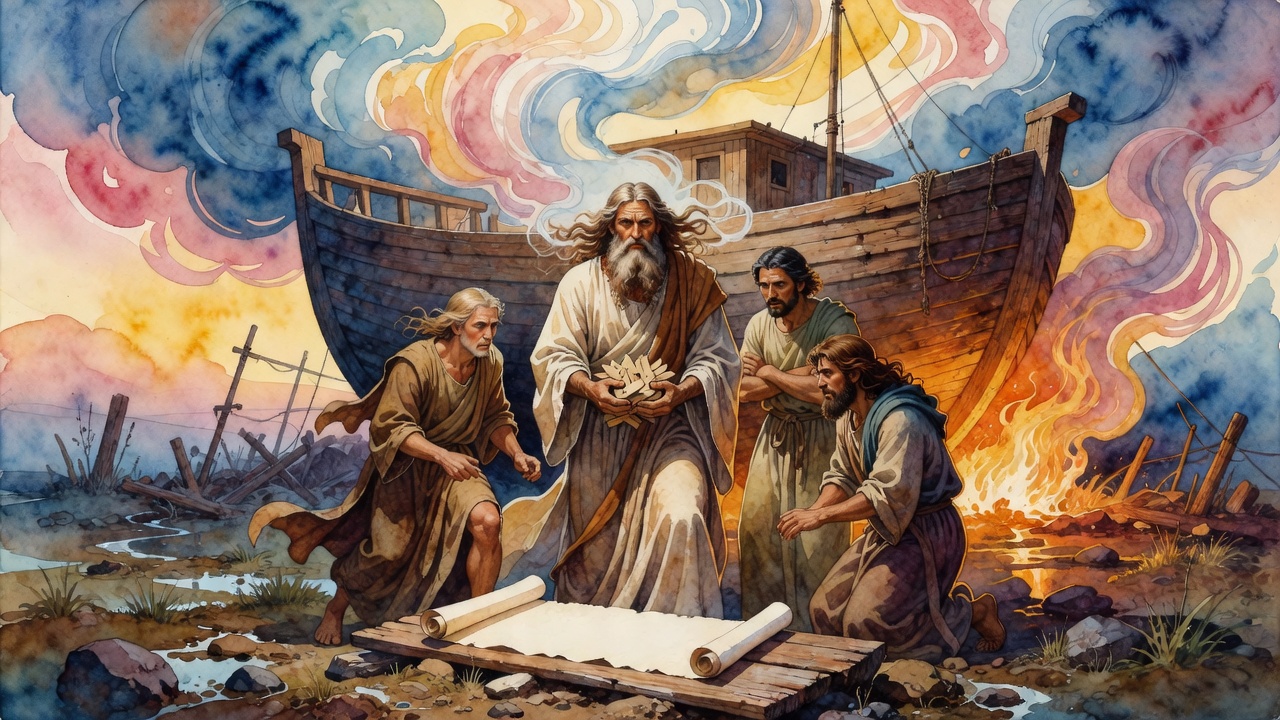
The water went down the way it had risen, without hurry. Noah stood at the door of the ark and looked out at a world scraped to the bone. Mud lay over everything, gray and glistening, and the silence was total. No birdsong, no lowing, no human voice from the valleys where cities had been. The smell of drowned earth climbed the mountainside, and he was the oldest man alive and the youngest at once, because everything would have to begin with him.
The Man Who Was Substituted

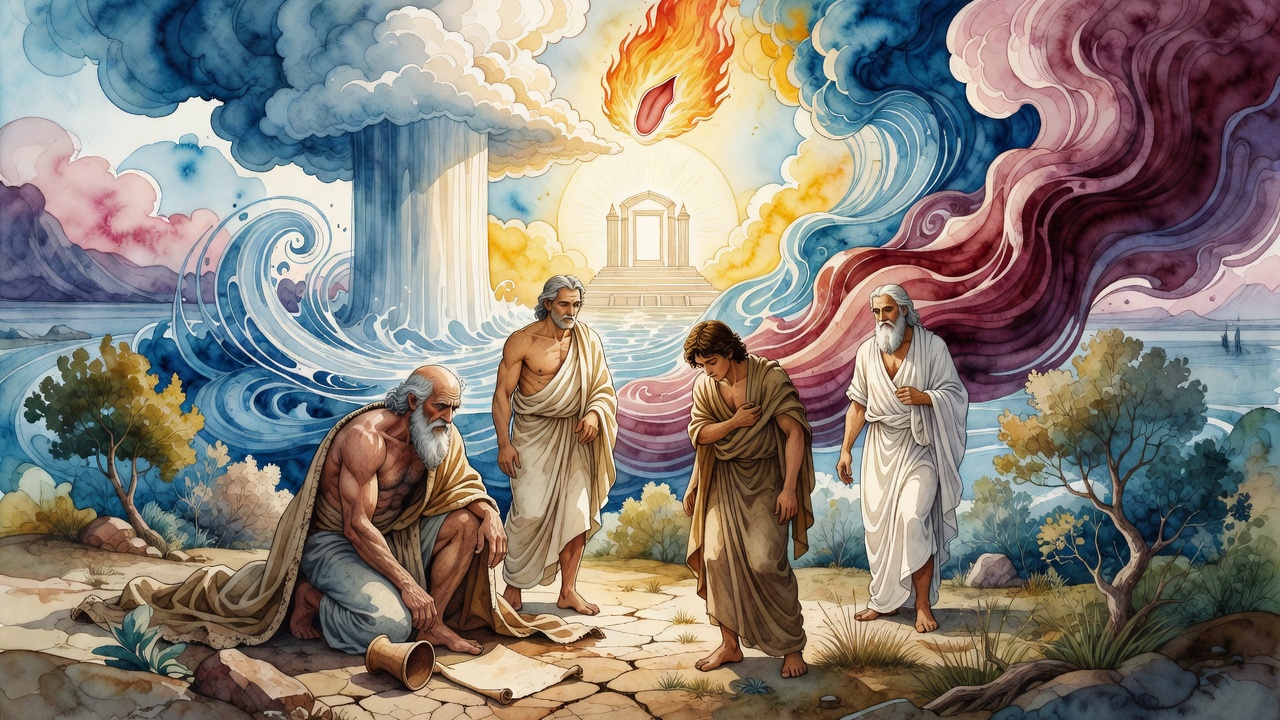
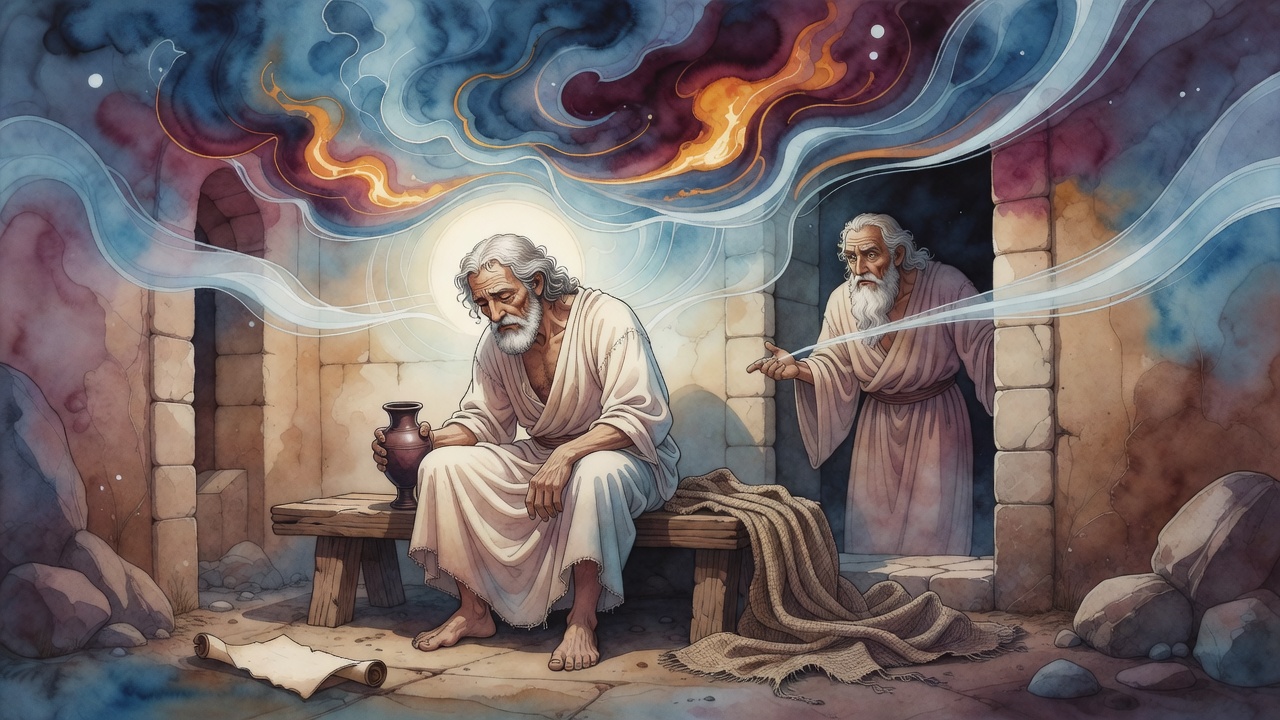
He knew why he stood there while no one else did. Before the rain, the whole earth had gone rotten. All flesh had corrupted its way upon the earth (Genesis 6:12), every order of creation bent out of its place, even the angels sent down to the world tangled in the ruin, and the violence rose until God resolved to wipe man and beast from the face of the ground. But one man was found pure in that generation, righteous and whole (Genesis 6:9), and at the hour of destruction that one man was put in the place of all the rest. For his sake a remnant remained. In his covenant the flood ceased, and the bow in the cloud (Genesis 9:13) still hung in his memory.

So he came down with his sons and their wives and the animals, built an altar, and went to work. Noah became a man of the soil. He hauled stones, buried carcasses, and coaxed the washed land back toward bearing. The labor was endless, and it kept the silence at a distance.

What the River Left on the Bank

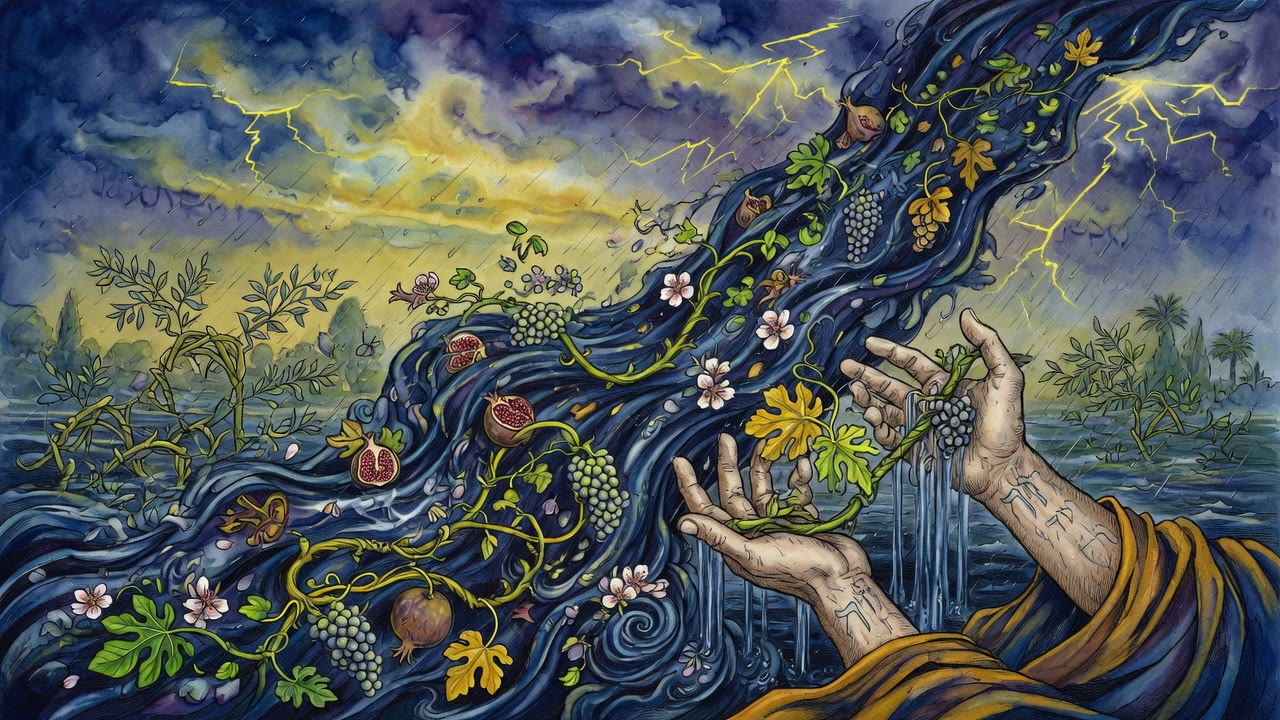
He was walking the riverbank when he saw it. Green, in all that gray. He stopped, because nothing green had any right to be there. A vine lay in the shallows where the falling water had abandoned it, torn up whole, its roots trailing like wet hair, its leaves bruised but living. The mabbul, the deluge, had covered the highest mountains. It had drowned every growing thing under heaven. But this plant had ridden the same water that killed the world, and it had come through alive.

Noah waded in and pulled it from the mud. He turned it over in his hands, felt the toughness of the stem, the stubborn grip of life in it. It had come from upstream. And upstream lay the river that went out to water the garden in the east (Genesis 2:10), the garden no man had entered since the first man was driven out of it.

The flood had broken into Eden. The water that erased the world had torn this vine loose from the garden itself and carried it downstream, through the death of everything, to lay it at his feet.

A Cutting from the Garden

He did not plant a vineyard from seed that day. He planted what he found (Genesis 9:20). He dug a trench in the new soft earth, set the Eden vine into it, and pressed the mud closed around the roots with both hands. His first act of building after the unbuilding of the world was to put a piece of paradise back into the ground.

The gates of that garden were barred, the way guarded by cherubim and a sword of turning flame (Genesis 3:24). No man could go back to Eden. But Eden, it turned out, could come to a man. Noah watered the vine and watched it take hold. He was tending the only living thing besides his own household to pass through the flood outside the ark.

The Wine That Came from Upstream

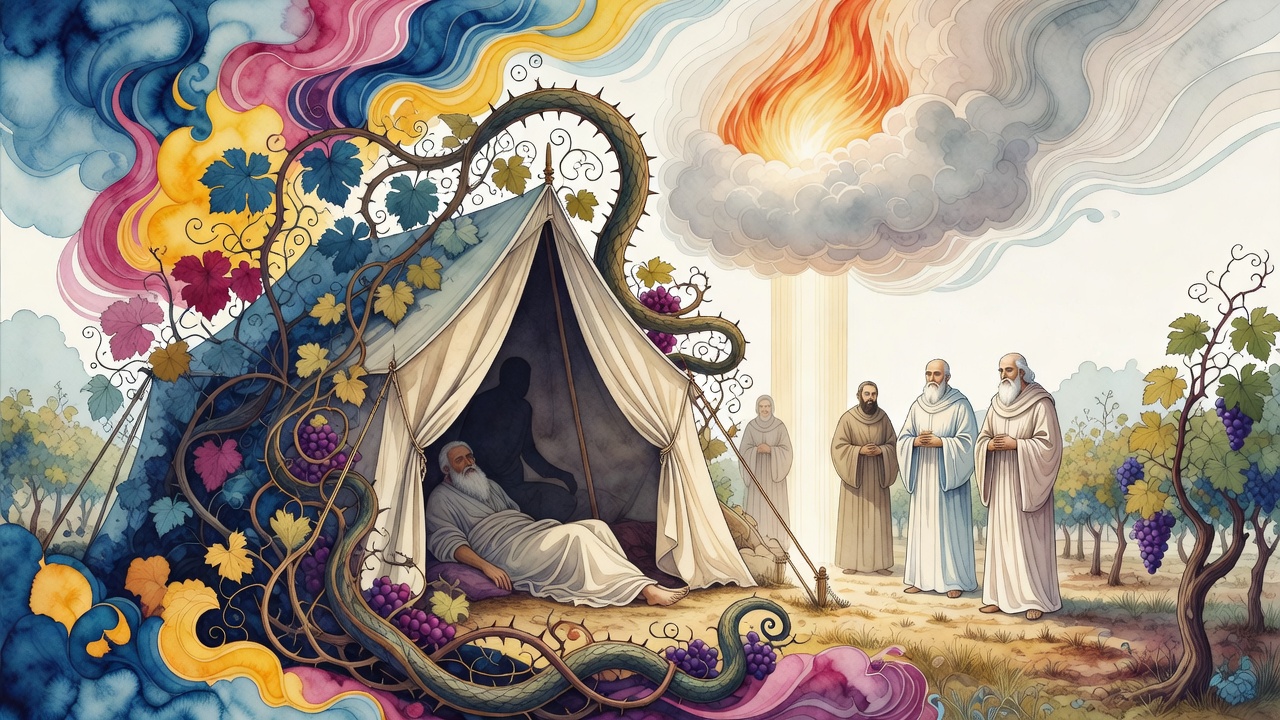
The vine took to the washed earth as if it remembered older soil. It climbed, it spread, it hung heavy with fruit, and when the grapes darkened Noah pressed them and set the juice aside until it turned. Then the survivor of the flood, the righteous one, the man for whose sake the remnant of all flesh existed, sat down in his tent and drank.

He drank of the wine and was drunk, and he lay uncovered inside his tent (Genesis 9:21). The fruit of Eden undid him. A man and a woman had once stood in that same garden, looked at fruit that was a delight to the eyes, and reached for it, and their eyes were opened and they knew that they were naked (Genesis 3:7). Now the garden's fruit had crossed the floodwaters and found another righteous hand reaching for it, and again it ended in nakedness and shame.

Naked in the Tent

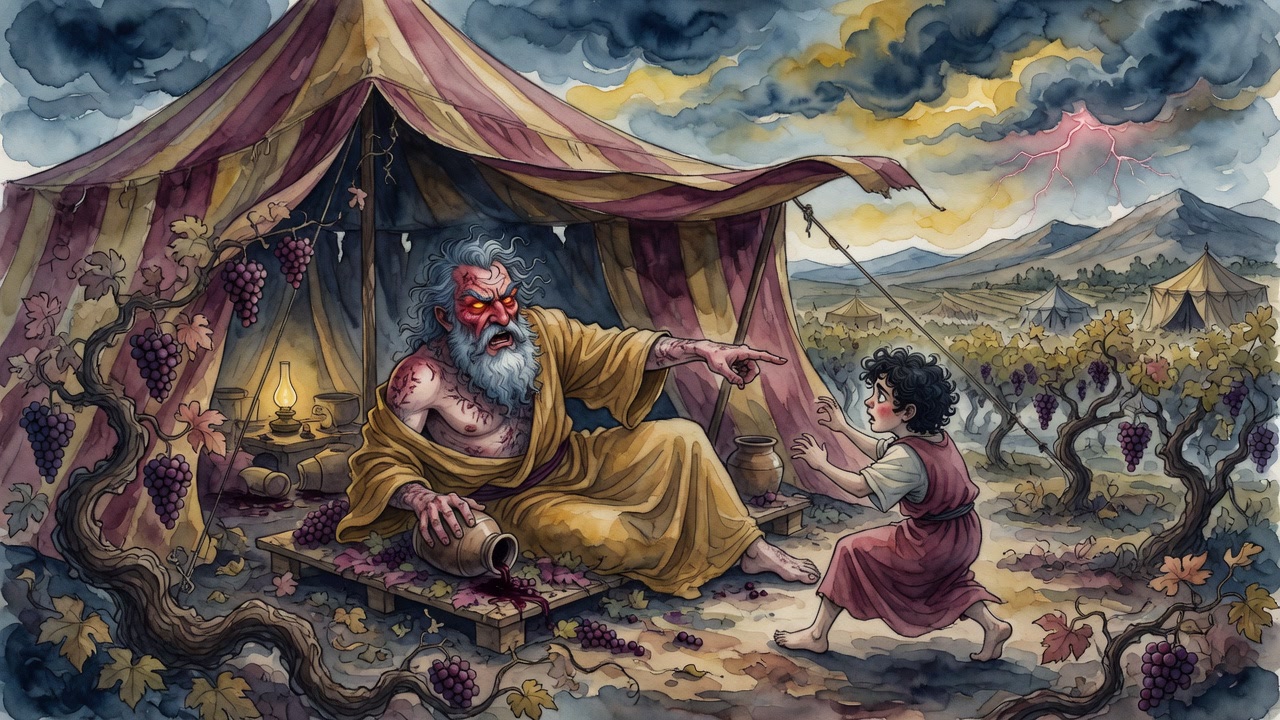
Ham walked in, saw his father sprawled and exposed, and went outside to tell his brothers. Shem and Japheth would not look. They laid a garment across both their shoulders, walked backward into the tent, and covered their father with their faces turned away (Genesis 9:23). Nakedness, shame, a covering brought by another's mercy. The oldest pattern in the world repeated itself in a goat-hair tent on a mountainside, just as it had played out once before under the trees of the garden this vine had grown in.

Noah woke from his wine and knew what his youngest son had done to him, and the first words spoken over the new world after the blessing were a curse. Outside the tent the vine went on growing, green and indifferent, fed by rain that no longer threatened anyone. It was a gift carried out of paradise and a trap carried out of paradise, and it was the same plant. The flood had taken everything from the old world except one man, his family, and this. Noah had survived the water. What the water carried out of Eden was another matter.


← All myths
From the tradition

Sources

6 sources

The texts this telling draws on, in full. Open a card to read inline, or expand it for a wider, quieter read.

Targum Jonathan on Genesis 9Targum Jonathan

The Hebrew Bible says Noah planted a vineyard (Genesis 9:20). The Targum Jonathan says he "found a vine which the river had brought away from the garden of Eden." This single addition transforms Noah from a farmer into a man who accidentally recovered a relic of paradise. The grapevine was not just any plant. It was Edenic, carried downstream by the Flood from the original garden. Noah's drunkenness becomes something stranger and sadder, he was undone by a fruit of Eden itself.

The chapter opens with dietary law, and the Targum sharpens every rule. The Hebrew forbids eating flesh "with the life-blood still in it" (Genesis 9:4). The Targum specifies two cases: flesh "torn of the living beast, what time the life is in it" and flesh "torn from a slaughtered animal before all the breath has gone forth." This is not translation. This is early halakhah (Jewish religious law) embedded in narrative, the Targum is legislating the Noahide laws with the precision of a legal code.

The murder law gets the same treatment. The Hebrew says "whoever sheds the blood of man, by man shall his blood be shed" (Genesis 9:6). The Targum splits this into two legal scenarios. If there are witnesses, "the judges shall condemn him unto death." If there are no witnesses, "the Lord of the world will bring punishment on him in the day of the great judgment." The translators built an entire judicial system into a single verse, complete with an eschatological fallback for unprovable crimes.

The rainbow covenant is filtered through the Memra as always, "between My Word and the earth". But the real surprise comes with Ham. The Hebrew says Noah "knew what his youngest son had done to him." The Targum says Noah learned this "by the relation of a dream." And Ham was cursed not just for seeing his father's nakedness, but because he was "inferior in worth, on the account that he had not begotten a fourth son." The curse falls on Canaan, Ham's fourth son, because Ham's failure to produce a fourth worthy heir somehow demanded it.

The blessing of Japheth is equally transformed. The Hebrew says God will "enlarge Japheth" (Genesis 9:27). The Targum says Japheth's sons "shall be proselyted and dwell in the schools of Shem." The translators turned a territorial blessing into a prophecy about conversion to Judaism and Torah study.

Full source
Book of Jubilees 5:10Book of Jubilees

Take the Book of Jubilees, for instance. It paints a stark picture of a world gone wrong, a world that’s deeply, fundamentally…corrupt.

The verse reads, "And God looked upon the earth, and behold it was corrupt, and all flesh had corrupted its orders, and all that were upon the earth had wrought all manner of evil before His eyes." "All flesh had corrupted its orders." It’s not just a little bit of bad behavior here and there. It’s a complete breakdown of the natural order, a perversion of what was intended. Everything, according to Jubilees, has gone sideways.

God’s reaction? It’s "I shall destroy man and all flesh upon the face of the earth which I have created." A clean slate. A cosmic reset button. It's a powerful statement about the severity of the situation.

The story doesn't stop there. It also points a finger at the malakhim, the angels, who were sent to Earth. These weren't innocent bystanders. According to Jubilees, they played a role in this corruption.

"And against the angels whom He had sent upon the earth, He was exceedingly wroth…"

These angels, it seems, didn't exactly follow instructions. Maybe they got too involved, maybe they overstepped their bounds. Whatever the reason, their actions had consequences. Severe ones.

The text continues, "…and He gave commandment to root them out of all their dominion, and He bade us to bind them in the depths of the earth, and behold they are bound in the midst of them, and are (kept) separate."

Imagine that: these celestial beings, stripped of their power and imprisoned. It speaks to the idea that even those in positions of authority, even those closest to the divine, are not immune to the consequences of their actions. They are held accountable.

So, what do we take away from this? Is it just a gloomy story about a world gone bad? I don’t think so. It’s also a story about accountability, about the importance of maintaining order, and about the potential for even the most divine beings to fall from grace. It's a warning, perhaps, but also a reminder that even when things seem utterly corrupt, there's always the possibility of a new beginning. A chance to rebuild, to restore, to create a better world from the depths of despair. What will we do with that chance? That's the question Jubilees leaves us with.

Full source
Ben Sira 44:19Ben Sira

Ben Sira, in his wisdom, offers a clue: "Their wisdom the community will repeat, and their praises the assembly will recount." It's through the act of remembering, of telling and retelling, that their legacies live on.

Who are these figures worthy of such remembrance? Ben Sira gives us a glimpse, starting with Ḥanokh (Enoch).

Ḥanokh, What does it mean to "walk with God"? It suggests a life lived in profound connection, a constant striving for righteousness. And his being "taken" – well, that's a mystery that has fueled countless interpretations. Was it a reward? An escape? A transformation? Whatever it was, it served as "a sign of knowledge," a reminder that such a life is possible.

Then comes Noaḥ (Noah). Righteous Noaḥ, who "was found pure, at a time of destruction he was substituted.": "substituted." He became the vessel, the ark, through which life could continue. The text continues, "for his sake there was a remnant, and in his covenant the Flood ceased."

The weight of the world rested on his shoulders. And what an image: the rainbow, "through an eternal sign the covenant was made with him, and without it all flesh would have been wiped out." A promise. A sign of hope amidst utter devastation. We needed that covenant. We still need that covenant.

Finally, Ben Sira introduces us to Avraham (Abraham), "a father of many [av hamon] nations, given no blemish in his glory." Av hamon – the father of a multitude. This is a crucial point. Abraham wasn't just the father of one nation, but of many. His legacy extends far beyond his immediate descendants. And despite his flaws, his moments of doubt and fear, he was "given no blemish in his glory." Why? Perhaps because his faith, his willingness to follow God's call, outweighed everything else.

What’s fascinating is how these figures are presented. Not as flawless paragons, but as humans who, despite their imperfections, embodied something extraordinary. They walked with God, they saved humanity, they became fathers of nations.

These figures, Ḥanokh, Noaḥ, and Avraham, they weren't just names in a book. They were living examples, reminders that even in the face of immense challenges, we have the capacity for greatness, for righteousness, for making a difference. And it's through remembering their stories, as Ben Sira tells us, that their wisdom continues to guide us. What stories will we tell, and what legacies will we leave behind?

Full source
Legends of the Jews 4:66Legends of the Jews

Think about Noah for a second. The flood survivor, the righteous man who saved humanity and all the animals. In many ways, he was considered pious, a paragon of virtue. But according to some accounts, things changed when he turned his attention to... grapes.

The story goes that Noah discovered the very vine that Adam had carried out of Paradise after the expulsion. A direct connection to the Garden of Eden. He tasted the grapes, liked what he tasted, and decided to cultivate it. He became a "man of the ground," as some texts put it. (Ginzberg, Legends of the Jews).

The Midrash (rabbinic interpretive commentary) actually suggests that the entire process, from planting to inebriation, happened in a single day! Incredible. He planted the vine, it bore fruit immediately, he pressed the grapes, drank the juice, and. well, he got drunk and dishonored himself.

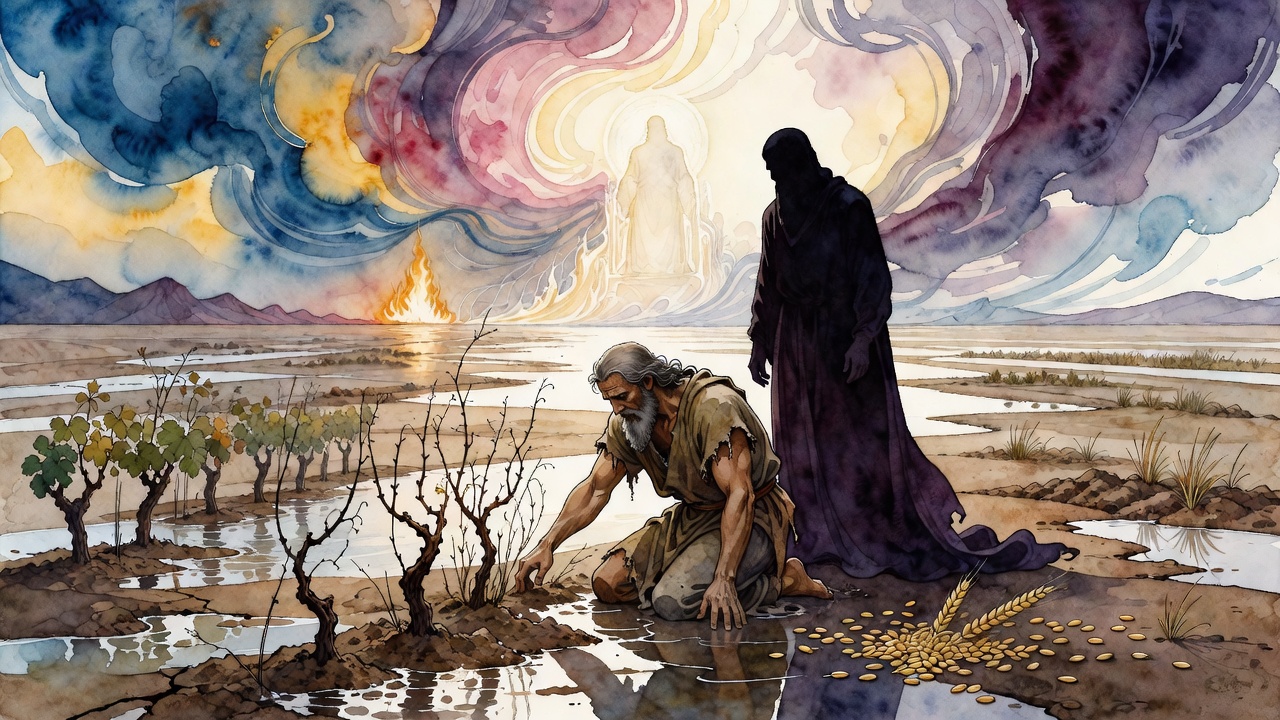
There's another player in this drama. A shadowy figure who seems to pop up whenever things are about to go sideways: Satan.

The story in Legends of the Jews tells us that Satan just happened to be passing by as Noah was planting the vine. He asked Noah, "What is it thou art planting here?"

This seemingly innocent question is loaded. What does Satan know about the vine, and what does he intend to do with this knowledge? The text suggests that his presence, at that precise moment, was no accident.

This is where the tale pivots, hinting at the darker consequences of Noah’s discovery. His actions, though perhaps unintentional, paved the way for excess, curses, and even the introduction of slavery. Quite a heavy burden for one vineyard, wouldn’t you say?

What does it all mean? Perhaps it’s a cautionary tale about the potential for even the most righteous individuals to stumble. Maybe it’s a reflection on the duality of nature, how something as beautiful and seemingly benign as a grapevine can lead to both joy and ruin. Or maybe it's simply a reminder that even after surviving a global catastrophe, humanity is still, well, human. Flawed, complex, and full of surprises.

Full source
Book of Jubilees 7:1Book of Jubilees

Book of Jubilees turns to What Noah Did After Leaving the Ark.

The Book of Jubilees, sometimes called Lesser Genesis, is a fascinating ancient Jewish text that expands on the stories in Genesis. It's considered apocryphal by some, canonical by others (like the Ethiopian Orthodox Church), and it offers a unique perspective on early biblical history.

So, what does Jubilees tell us?

Well, chapter 7 opens with Noah getting his hands dirty. It says, "And in the seventh week in the first year thereof, in this jubilee, Noah planted vines on the mountain on which the ark had rested, named Lûbâr, one of the Ararat Mountains."

Okay, let's unpack that a little. A “jubilee” refers to a specific period of time – in this case, a 49-year cycle (seven weeks of years). So, very specifically, in the first year of the first jubilee after the flood, Noah begins to cultivate the land.

And where does he do this? On Mount Lûbâr, one of the mountains in the Ararat range, where the ark finally came to rest. Imagine the scene: the waters have receded, the earth is beginning to heal, and Noah, the patriarch, is planting vines.

Why vines, though? What’s the significance?

Well, vineyards are a symbol of civilization, of settling down, of taking the raw materials of the earth and cultivating them into something…more. It's a powerful image of renewal and a fresh start for humanity. Noah isn’t just surviving; he’s actively rebuilding and shaping the world anew.

This simple line from Jubilees speaks volumes about Noah's role not just as a survivor, but as a founder, a pioneer. He’s not just waiting for instructions; he’s taking initiative. He’s taking the first steps, literally planting the seeds of a new world.

Full source
Book of Jubilees 7:9Book of Jubilees

Book of Jubilees turns to Noah Plants a Vineyard - A Scandalous Scene in Jubilees.

It's considered apocryphal by some, meaning it's not included in the canonical Hebrew Bible, but it's a treasure trove of tradition and insight into how ancient Jews understood their own history.

In this particular passage from Jubilees, Chapter 7, The waters have receded, the Ark has landed, and it’s time to give thanks. Big time.

What does Noah do? He doesn't just offer a quick prayer. No, no. He builds an altar. And what does he sacrifice? The text is very specific: "the ox and the ram and the sheep." The best of the best. He lays all their flesh upon the altar, mixes their offerings with oil, and then,

Can you picture it? The smoke rising, the aroma of roasted meat mingled with the scent of incense, a "sweet savour" ascending to God. It’s a powerful image. Then, Noah and his children rejoice. They drink of the wine. This isn't a somber, restrained affair. This is a celebration!

And here’s where the story takes a turn that's both very human and, well, a little awkward. "And it was evening, and he went into his tent, and being drunken he lay down and slept, and was uncovered in his tent as he slept."

Whoa.

Talk about a buzzkill. After this incredible act of devotion, after this joyful celebration, Noah gets drunk and exposes himself in his tent. It's a stark reminder that even the most righteous among us are flawed.

What are we supposed to make of this? Is Jubilees trying to diminish Noah's greatness? Maybe. Or perhaps it's offering a more nuanced portrait. Noah is a hero, yes, but he's also a man. He's fallible. He's capable of making mistakes, even after surviving the apocalypse.

This little snippet from Jubilees offers a powerful reminder that the stories we tell about our heroes are rarely simple. They're complex, messy, and full of unexpected turns. And maybe, just maybe, that's what makes them so compelling.

Full source