5 min read

Noah Wanted One More Son After the Floodwaters

Pitch under his nails, hay dust in his throat, Noah kept the animals fed for a year. He wanted one boy small enough to crawl where an old man cannot bend.

Curated by Arthur · Told by Maggid ·
Table of Contents
  1. The Ark He Had to Build With His Own Hands
  2. The Year of Feeding
  3. The Vineyard and the Tent
  4. The Shape of the Curse

For five hundred years Noah refused to have children.
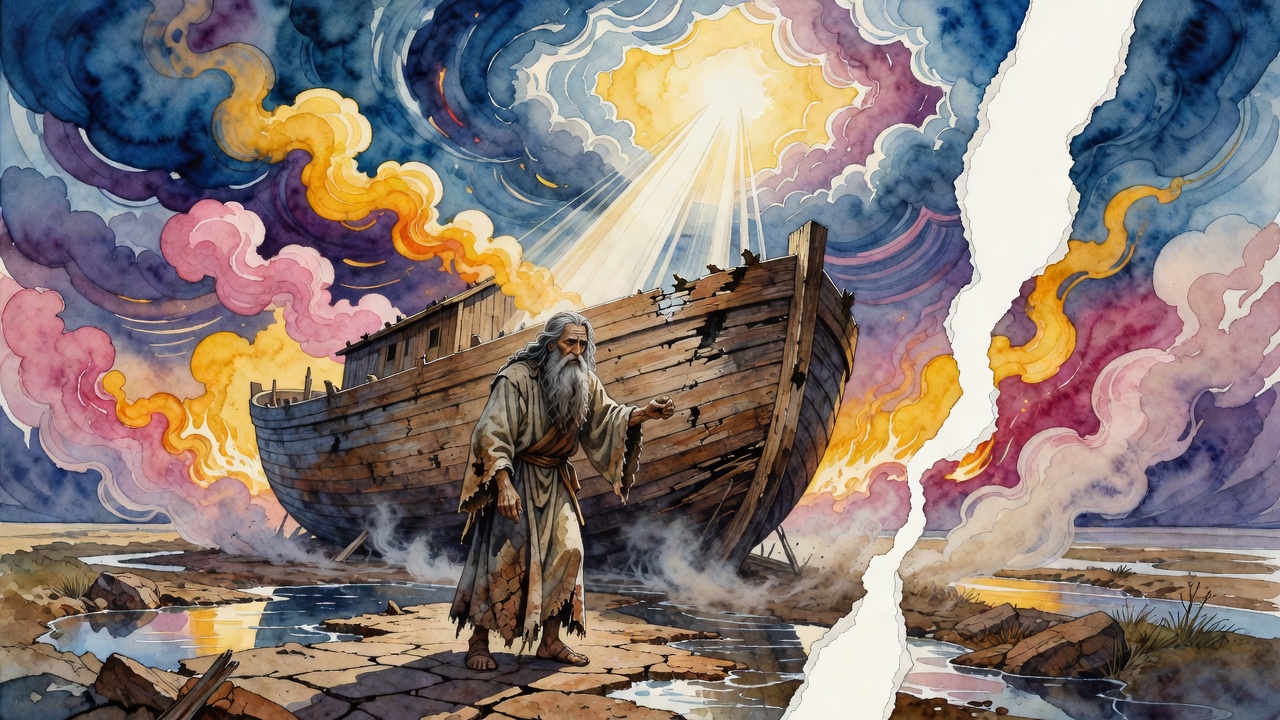
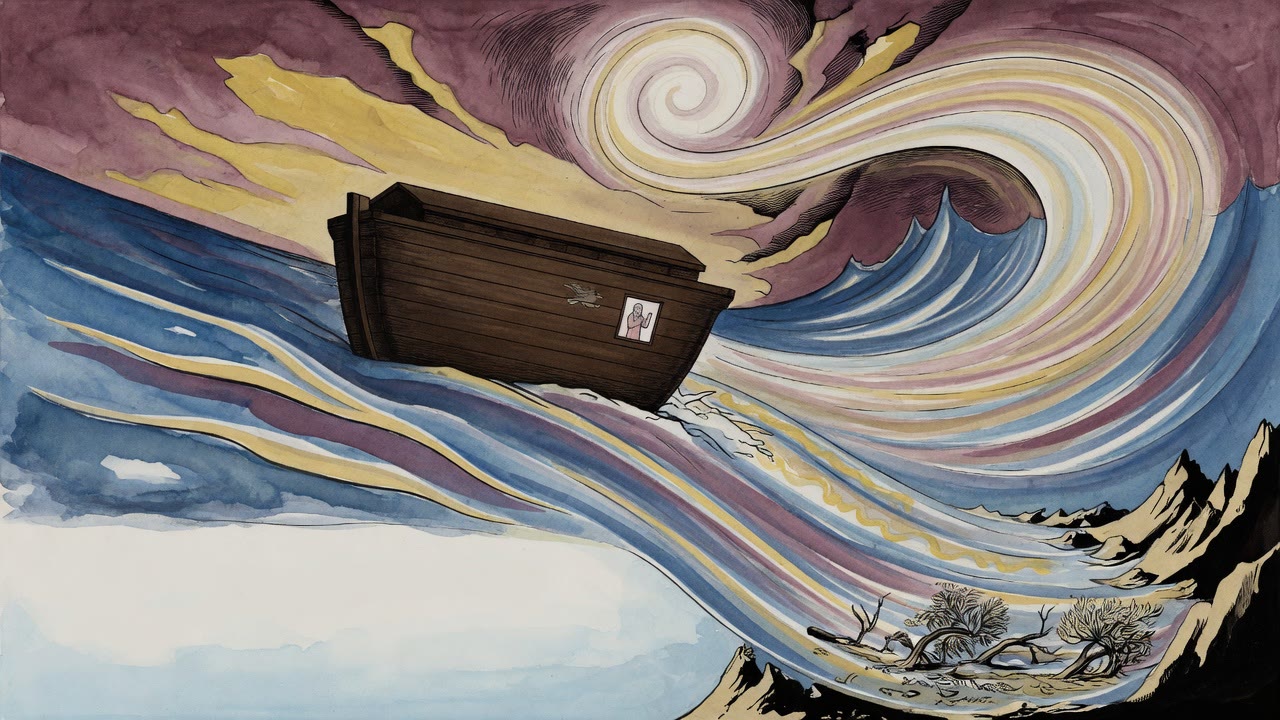
Noah Wanted One More Son After the Floodwaters Click for full size

He had watched the people around him provoking their Maker daily and in the open, so he did the arithmetic any careful man would do. A world with a term on it does not need more sons in it, and there had already been famine in his father Lamech's day, up out of the ground the Lord had cursed. "Let that man die childless," Noah said about himself, in the third person, the way people talk when they have given something up and do not want to hear their own name in it.

Then God said, be fruitful and multiply. Noah put down the argument he had been holding for five centuries and went and raised a family.

The Ark He Had to Build With His Own Hands

Shem, Ham and Japheth were grown men with wives of their own by the time the second instruction came, and it was worded to leave him no way out of the labor. Make yourself an ark. Not send for one, not have one raised by a crew. The wood was named and the measurements were given and the work was his, so an old man went and cut gopher timber and boiled pitch and set the boards himself.

Then the rain started and the door shut, and the water took everything he had ever walked past.

The Year of Feeding

Inside, he was the only man on board whose knees still had to go all the way down to the boards.

His sons had wives and their own stations on the decks, but a grown son is not a small son. A small son fits where a full-grown man does not. He can be sent, and he comes back, and he makes the third trip in the middle of the night without being asked twice. Noah went down through the animal decks himself in the dark, every night, for a year, with the feed and the water, and somewhere in that year he made himself a promise. When the ground comes back I will have one more boy, and he will be mine to raise, and he will serve me when I am past all this.

That was the whole of it. Not a dynasty and not a blessing. One child small enough to be useful before the old man's hands gave out.

The Vineyard and the Tent

The water went down. The ground dried, and Noah planted a vineyard, because a man who has spent a year keeping other creatures alive will eventually want something growing that is his. The wine came in. He drank it and it took him, and he lay down uncovered inside his tent.

What Ham did to his father in there is not written down. Something was done to his body while he slept, and his son did it, and the household knew before Noah did.

He woke up covered. Somebody had laid a garment over him, which meant somebody had come in, seen him, and been decent about it, which meant somebody else had come in first and had not been. Noah worked that out in the first few seconds of an old man's waking, before he had even sat up, and then he followed it forward to the promise he had made himself in the dark on the animal decks and understood that it was finished. There would be no small son now.

The Shape of the Curse

"You kept me from raising a son to serve me," he said to Ham. "So that man will be a servant to his brothers."

It was cut to the exact size of what had been taken. Ham had removed the one who would have served Noah, so Ham's line would serve Shem and Japheth, and those two were themselves called servants of God. One kind of service had been denied, so another kind was imposed, and the chain ran upward out of the lowest man in it all the way to Heaven.

Noah lived on for years after the vineyard. He had gone through the water with every living kind aboard and come out onto rinsed ground with three grown men, their wives, and a curse he had spoken himself. At night, when the knees went, there was nobody small in the house to send.


← All myths
From the tradition

Sources

3 sources

The texts behind this telling. Some cards carry a translation of the source; others are our own retelling of it, and each card says which. Every card links out to the original.

Yalkut Shimoni on Torah 61:13Yalkut Shimoni on Torah

Translation of the source text.Torat Emet (Yalkut Shimoni) · CC-BY-NC

Another interpretation: Noah suffered much distress in the ark, for he had no young son to serve him. He said, "When I go out, I will raise up for myself a young son to serve me." Once Ham did that deed to him, he said to him, "You prevented me from raising up a son to serve me; therefore that man shall be a slave to his brothers, who are servants to Me."

Full source
Yalkut Shimoni on Torah 43:1Yalkut Shimoni on Torah

Translation of the source text.Torat Emet (Yalkut Shimoni) · CC-BY-NC

"From the ground which the LORD has cursed." Ten kinds of famine came into the world. One in the days of the first Adam, (Genesis 3:17) "Cursed is the ground because of you." One in the days of Lamech, "from the ground which the LORD has cursed." One in the days of Abraham, (Genesis 12:10) "And there was a famine in the land." One in the days of Isaac, "And there was a famine in the land, besides the first famine." One in the days of Jacob, (Genesis 45:6) "For these two years the famine." One in the days when the judges judged, (Ruth 1:1) "And there was a famine in the land." One in the days of David, (2 Samuel 21:1) "And there was a famine in the days of David three years." One in the days of Elijah, "If there shall be these years dew or rain." One in the days of Elisha, (2 Kings 6:25) "And there was a great famine in Samaria." One that comes rolling in by stages. And one in the time to come, "Not a famine for bread nor a thirst for water, but to hear the words of the LORD."

Rabbi Shmuel bar Rav Yitzchak said: its main onset should have been in the days of Saul and not David, but because Saul was a sprig of the sycamore (and some say: a small sapling) and could not withstand it, the Holy One, blessed be He, shifted it and brought it in the days of David. The proverb says: Shila sins and Yochana is punished. Therefore [the famines] did not come in the days of weak men but in the days of mighty men who could withstand them. A parable of a glassblower who held a basket full of cups and fine glassware: when he wishes to hang up his basket, he brings a peg and drives it in and hangs himself upon it first, and only afterward hangs his basket. Rabbi Berechyah would read concerning them, "He gives strength to the weary."

(Genesis 5:32) Noah perceived that they were provoking the Holy One, blessed be He. He said: Why should I trouble myself with being fruitful and multiplying? Therefore he did not beget until five hundred years; and afterward he said, Let that man die without children. But the Holy One, blessed be He, said (Genesis 1:28), "Be fruitful and multiply"; immediately he engaged in being fruitful and multiplying.

Full source
Yalkut Shimoni on Torah 52:1Yalkut Shimoni on Torah

Translation of the source text.Torat Emet (Yalkut Shimoni) · CC-BY-NC

"Make yourself an ark of gopher wood" (Genesis 6:14). In four places this expression is stated; in three it was explained, in one it was not explained. "Make yourself an ark of gopher wood" - wood of the kardus tree. "Make yourself swords of flint" (Joshua 5:2) - blades of rock. "Make yourself two trumpets of silver" (Numbers 10:2) - explained. "Make yourself a fiery serpent" (Numbers 21:8) - not explained. "The wise man will hear and increase learning" (Proverbs 1:5) - this is Moses. He said: If I make it of gold, this word does not match that word [nachash, serpent, does not echo zahav, gold]; and likewise of silver. Rather, I will make it of copper, because this word matches that word [nechoshet echoes nachash]. "And Moses made a serpent of copper" (Numbers 21:9). From here we learn that the Torah was given in the holy tongue, and just as it was given in the holy tongue, so the world was created in the holy tongue.

Have you ever in your days heard one say gini, ginya, anthropi, anthropta, gever, gevarta? Rather, "man" [ish] and "woman" [ishah, which share a root] - from here that it was created in the holy tongue. "Make compartments for the ark" (Genesis 6:14) - just as the nest [ken] purifies the leper, so your ark [tevah] purifies you.

Full source