5 min read

Noah's Household Kept Apart While the World Drowned

Inside the ark Noah's sons slept apart from their wives while the earth died, then walked out paired again to begin the second human sowing.

Curated by Arthur · Told by Maggid ·
Table of Contents
  1. First After the End of the First
  2. Abstinence While the Cities Sank
  3. The Door Opens on Paired Feet
  4. The Second Beginning on Bare Earth

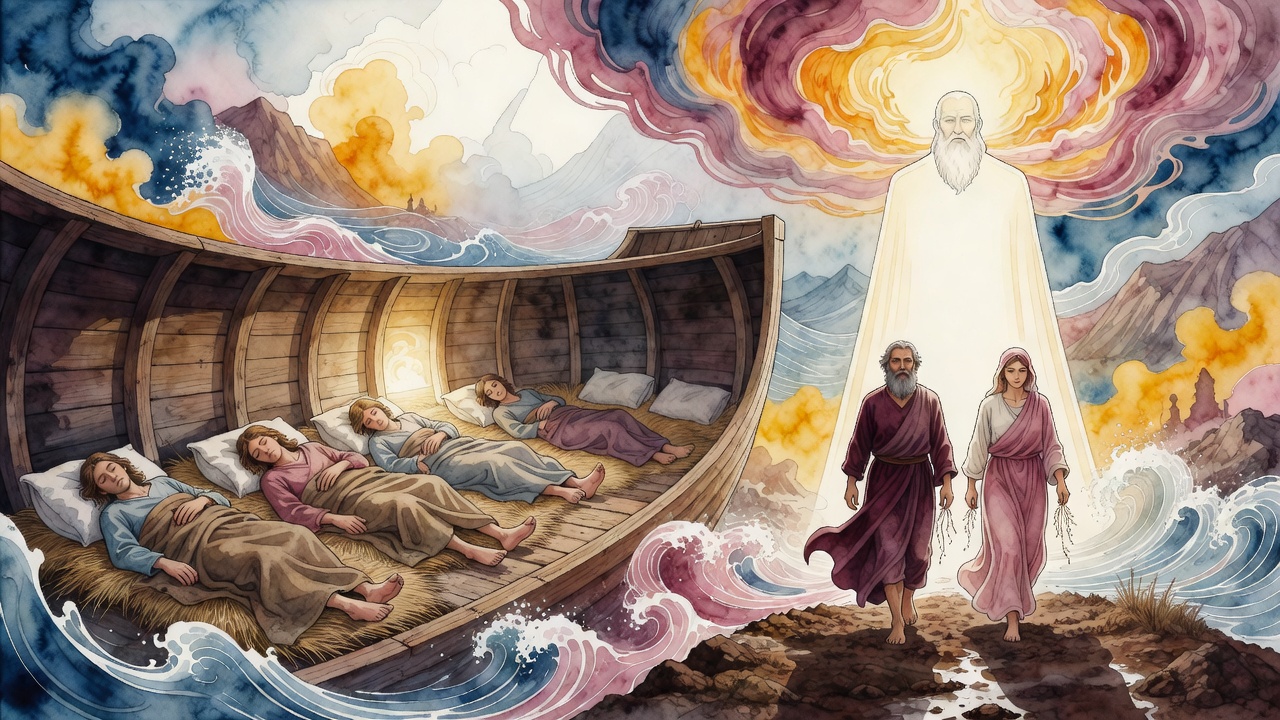
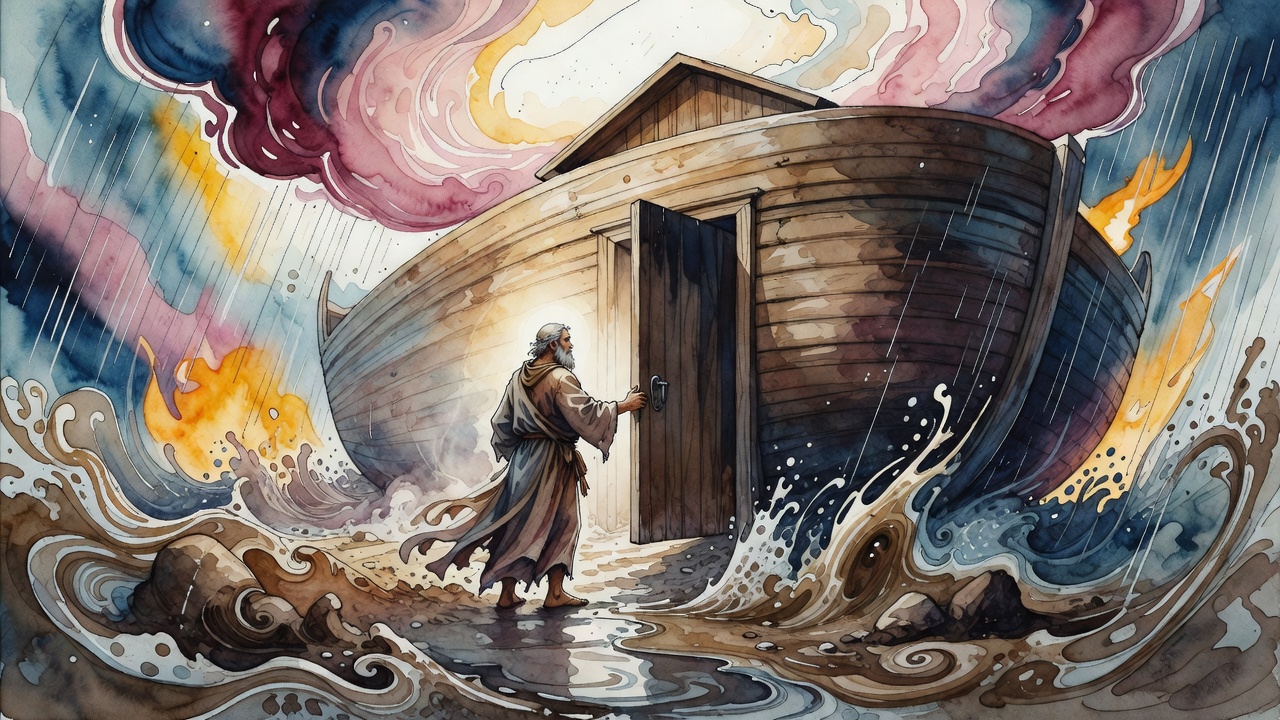
The door of the ark shut on a household already split by command. Noah entered with his sons. The women entered with his wife. Husbands did not walk beside wives. The pairs that would one day rebuild the world climbed the ramp as two columns, male and female kept apart, because the age outside was dying and pleasure had no place beside that death.

Noah's Household Kept Apart While the World Drowned Click for full size

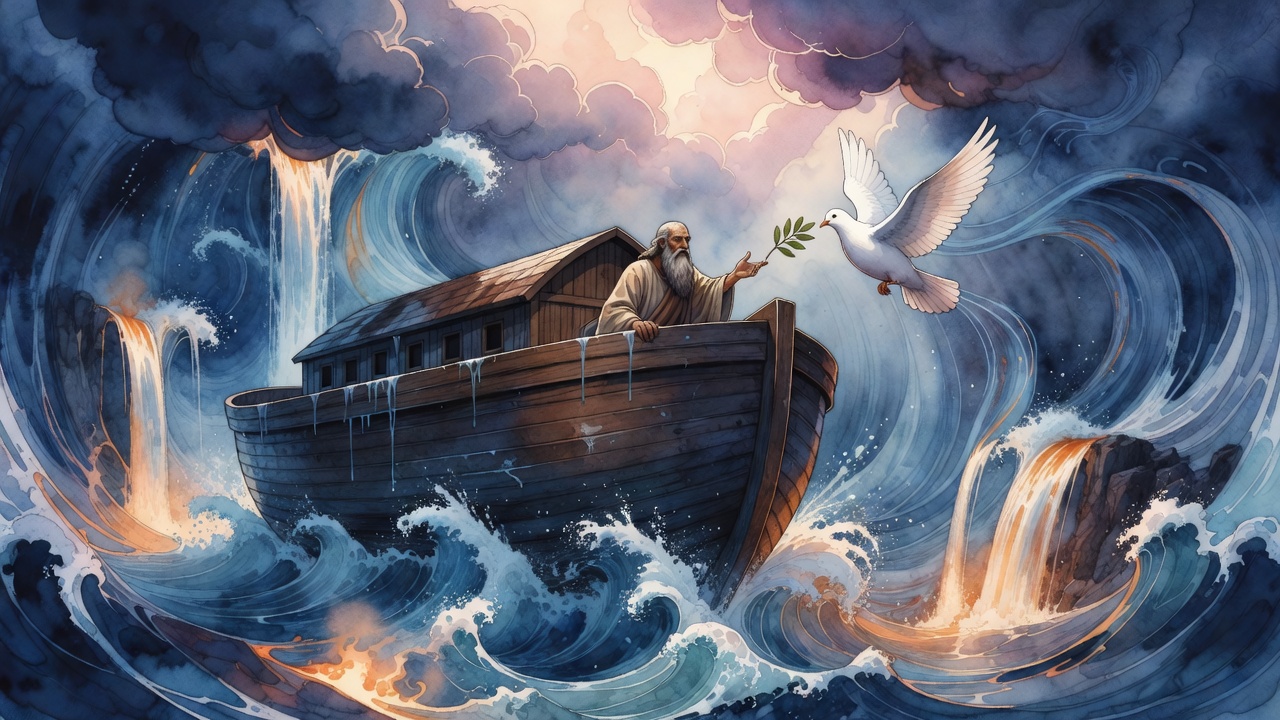
Rain started like a thrown net. Screams reached the hull and then thinned. Noah stood in the narrow corridor between stalls and listened until there was nothing left to hear but animals breathing and wood complaining. He did not touch his wife. The sons did not seek their wives in the dark. The flood was not a bridal chamber.

First After the End of the First

Adam had been first when the ground was new. Now the ground was ending while Adam's later generations still clung to life, and a different firstness gathered in one man. Noah was not first by birthday. He was first by order of virtue, captain of a ship that held the only human seed left, prince of a state reduced to eight bodies and a zoo of survivors.

He wanted a clean life and a clear line from God. The world outside had wanted speed toward ruin. When the waters rose, that race ended. Destruction clung to the number six in the long grind of his six hundredth year. Safety began to return as the count tilted toward one, toward unity, toward a single household tasked with starting again.

He felt the weight of being first without wanting the crown. First meant every choice after the flood would set the pattern for tribes not yet born. First meant there was no neighbor left to blame.

Abstinence While the Cities Sank

The command was simple and hard. Do not indulge while the earth is destroyed. Do not celebrate life while life is being erased. Noah told his sons in a low voice that the ark was a house of mourning. Bedding stayed separate. Hands stayed busy with feed and bilge. When a son looked toward the women's side, Noah shook his head once, and that was enough.

Nights stretched. The lamp smoked. Someone wept without naming a drowned friend. The separation was not cruelty. It was the only decency left when the deep had swallowed every street. To beget children into a world still being unmade would have been a kind of mockery. The household held its breath with the rest of creation.

Outside, the fountains still spoke. Inside, reason had to keep distance from appetite. The men held the work of mind and order. The women held their own grief in their own half of the dark. Battle against chaos required clear lines until the water lost its claim.

The Door Opens on Paired Feet

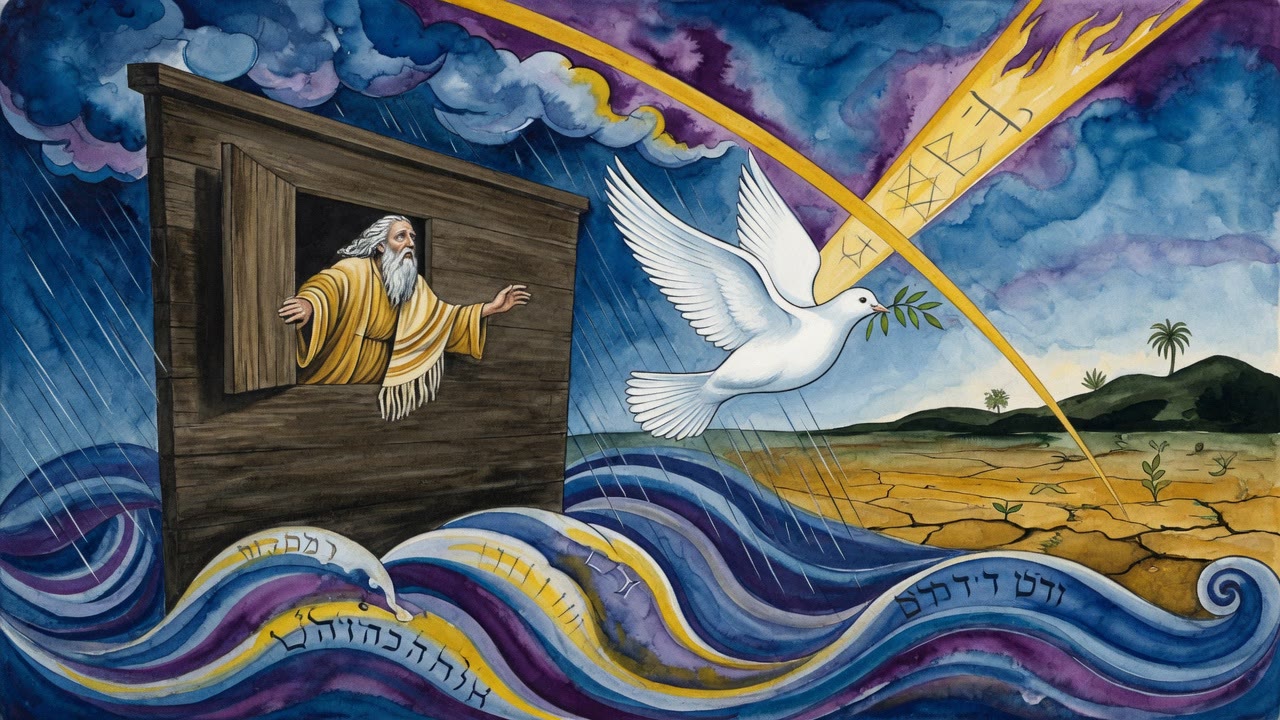
When the mountain finally took the hull and the ground dried enough for weight, the order changed. God did not send them out as two columns. Husbands and wives stepped into the light together. The pairing was a sentence written in footsteps: offspring is to be begotten according to nature. The world needed bodies again. The second sowing required the bond that had been sealed shut for compassion's sake.

Noah walked with his wife. She smelled of pitch and stored grain. His sons took their wives' hands without looking back at the empty stalls. Behind them the ark stood open like a mouth that had finished speaking. Ahead, mud waited for seed and for children.

He stopped at the threshold and looked once more into the interior. Separate berths. Separate paths. The year of abstinence lay behind him like a shroud folded away. What waited was not luxury. It was duty with warmth returned to it.

The Second Beginning on Bare Earth

They built, planted, and slept under a sky that still looked too wide. Noah watched his sons become fathers of nations in prospect and tried not to flinch at how thin the line of righteousness had been. The flood had ended in the six hundred and first year of his life. Evil had run its course in six. Safety leaned toward one household, one covenant, one chance.

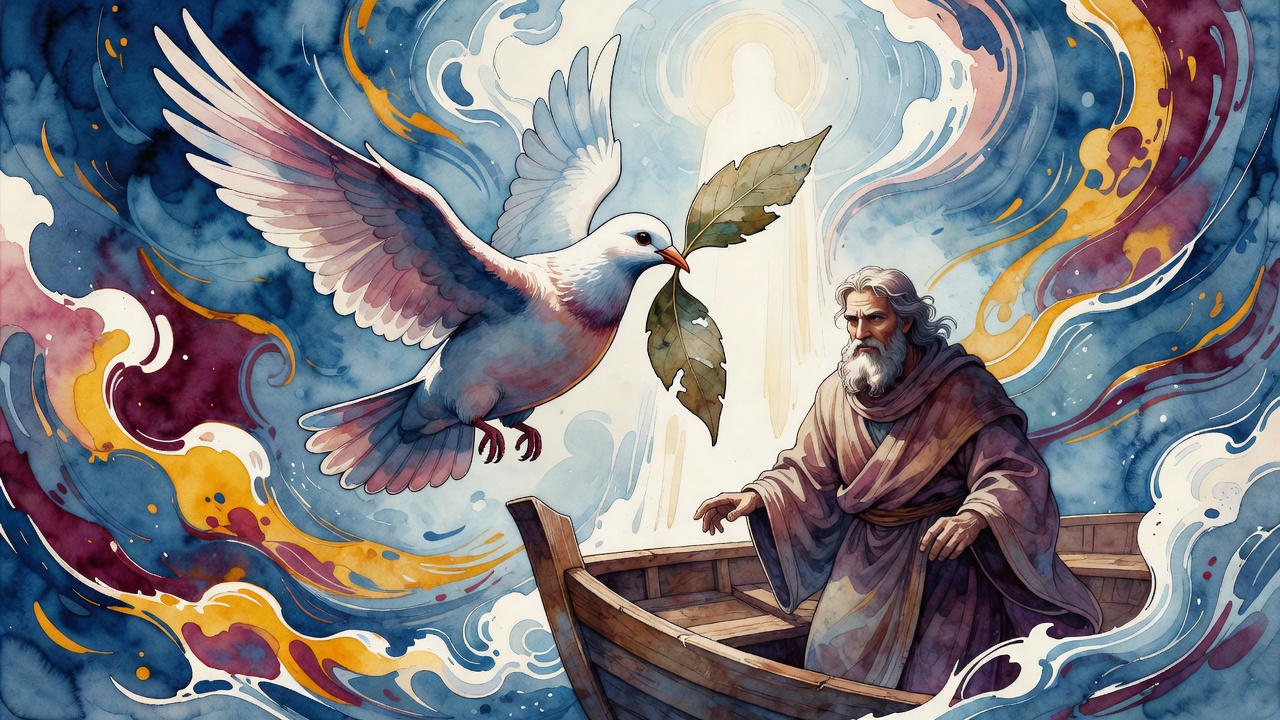
He remained first without parade. First man of the second earth. First to decide whether the new villages would remember why the old ones drowned. When he lay down at night beside his wife again, the boards of memory still creaked with the sound of rain, and he held the knowledge that the pairing itself was a command as strict as the earlier silence.

The ark had taught him how to keep a household apart for the sake of the dead. The exit taught him how to put it back together for the sake of the living. Between those two orders the world turned from corpse to seedbed, and he walked it as the man heaven had set at the front of the line.


← All myths

From the tradition

Sources

2 sources

The texts behind this telling. Some cards carry a translation of the source; others are our own retelling of it, and each card says which. Every card links out to the original.

The Midrash of Philo 13:2The Midrash of Philo

Retold in our words. Read the original at the link below.The Works of Philo Judaeus, trans. C. D. Yonge, London, H. G. Bohn, 1854-1890 · Public Domain

Philo, in his Midrash (rabbinic interpretive commentary), dives headfirst into this question when talking about Noah and the flood. It's a fascinating exploration of time, virtue, and what it truly means to be "first."

Philo wrestles with the idea that "first" can refer to both the first month and the first man, Noah. Both interpretations, he argues, have valid points. If But, Philo points out, the Torah also talks about the seventh month – specifically the second equinox – as being both the first and the seventh. Confusing. But stick with me. He suggests that it's "first" in terms of nature and virtue, but seventh in terms of the calendar. We find this concept echoed elsewhere; for instance, (Exodus 12:2) states, "This month shall be unto you the beginning of months: it shall be the first month of the year to you."

What if "first" refers to Noah himself? Well, Philo argues, then it takes on an even deeper meaning. Noah, the righteous man, was truly the first. Like a captain of a ship or a prince of a state, Noah was first not just in virtue, but in order. He was the beginning of the second sowing of humanity. Ginzberg, in Legends of the Jews, elaborates on Noah's unique position after the flood, highlighting his role as the sole righteous individual tasked with repopulating the world.

Think about this: the flood happened during the lifetime of Adam, the original first man. When the waters receded, things returned to a semblance of their former state. Noah, along with his family, were alone on the earth until the regeneration of humankind began. Philo sees significance in this. Noah yearned for a life of virtue, while the rest of the world rushed towards death through wickedness.

And then there's the timing. The evil ceased in the six hundred and first year of Noah's life. Philo sees significance in the numbers. Destruction, he says, is associated with the number six, while safety is restored with unity – with one. Unity, he believes, is generative and life-giving. He even connects this to the waning of the sea at the new moon! The units are preferred, he says, when God saves the earth.

Now, Philo points out that "Noah" in Hebrew translates to "the just one," while the Greeks call him Dikaios, also meaning "just." But, even the just are not exempt from the laws of the body. Noah, despite his righteousness, was still mortal. This is why the number six (from the six hundredth year) is connected to unity, symbolizing corporeality and inequality. That is why we read "in the six hundred and first year."

But how was Noah righteous? Philo says he was just in his generation, not just in comparison to the corruption around him. He was chosen by God, deemed worthy of life, and became both the end and the beginning of an age. The end of the corruptible and the beginning of what was to follow.

Philo concludes with a beautiful image: praising the man who, with his whole being, looked up in friendship with God.

So, what does it all mean? Perhaps "first" isn't just about chronology. Maybe it's about being a pioneer of virtue, a beacon of hope in a world drowning in wickedness. And maybe, just maybe, it's about that enduring friendship with the Divine that allows us to weather any storm.

Full source
The Midrash of Philo 18:2The Midrash of Philo

Retold in our words. Read the original at the link below.The Works of Philo Judaeus, trans. C. D. Yonge, London, H. G. Bohn, 1854-1890 · Public Domain

Ancient interpreters saw layers of meaning in every detail, even the order in which people entered and exited the ark. Philo, a Jewish philosopher from Alexandria, writing in the 1st century CE, was one of these interpreters. He saw profound symbolism in the pairings as Noah and his family left the ark after the flood.

Philo dives deep into what might seem like a minor detail: the order in which Noah and his family entered and exited the ark. He highlights a deliberate shift. Entering, the sons are grouped with the father, the daughters-in-law with the mother-in-law. But upon exiting, husbands and wives are paired together. Why this change?

Philo suggests it's about more than just logistics. He believes the Torah, in its precise wording, is offering a subtle lesson. Before the flood, God commanded them to abstain from marital relations while in the ark. Philo argues this wasn't just a practical matter of limited space or resources. Instead, it was a call to compassion and mourning for the destruction around them. "After a destruction of all things on earth..do not indulge in pleasures, for that is not decorous," Philo imagines God saying. It was a time for somber reflection, not celebration of life's joys.

When the floodwaters receded, the time for abstinence was over. The paired exits signaled a renewed mandate: "offspring is to be begotten in accordance with nature." The world needed to be repopulated. The Zohar, much later, echoes this sentiment, emphasizing the importance of rebuilding and continuing the chain of existence after catastrophe.

But Philo doesn't stop at the literal level. He then explores the inner meaning, the allegorical interpretation. He sees the ark as a symbol of the mind, and the flood as a period of cleansing from sin and ignorance. During this inner purification, the "male" – representing intellect and reason – must be separated from the "female" – representing the senses and passions. This separation allows the mind to focus and overcome its weaknesses. It’s a "time of battle," as Philo puts it, where clarity and order are essential.

Once the purification is complete, the intellect and the senses can reunite. The "female race," the senses, can then "clothe themselves with the vigour of the male," meaning they can be guided by reason and wisdom. This union allows the soul to produce virtue, justice, and courage. This idea, of integrating the senses with intellect rather than suppressing them entirely, is a powerful concept that resonates even today.

Philo beautifully illustrates how chaos and confusion can prevent us from creating anything good. "When once a confusion, in the similitude of a deluge, has overwhelmed the intellect..it is utterly impossible that any one should be able, either to sow, or to conceive, or to generate any good thing." Only when we calm the storms within, when we quiet the "lawless counsels" of our passions, can we cultivate virtue and bring forth good works.

It's not just a tale of survival, but a profound allegory about purification, integration, and the potential for renewal within ourselves.

Full source