Parshat Noach5 min read

Noah Will Not Open the Ark Without God's Word

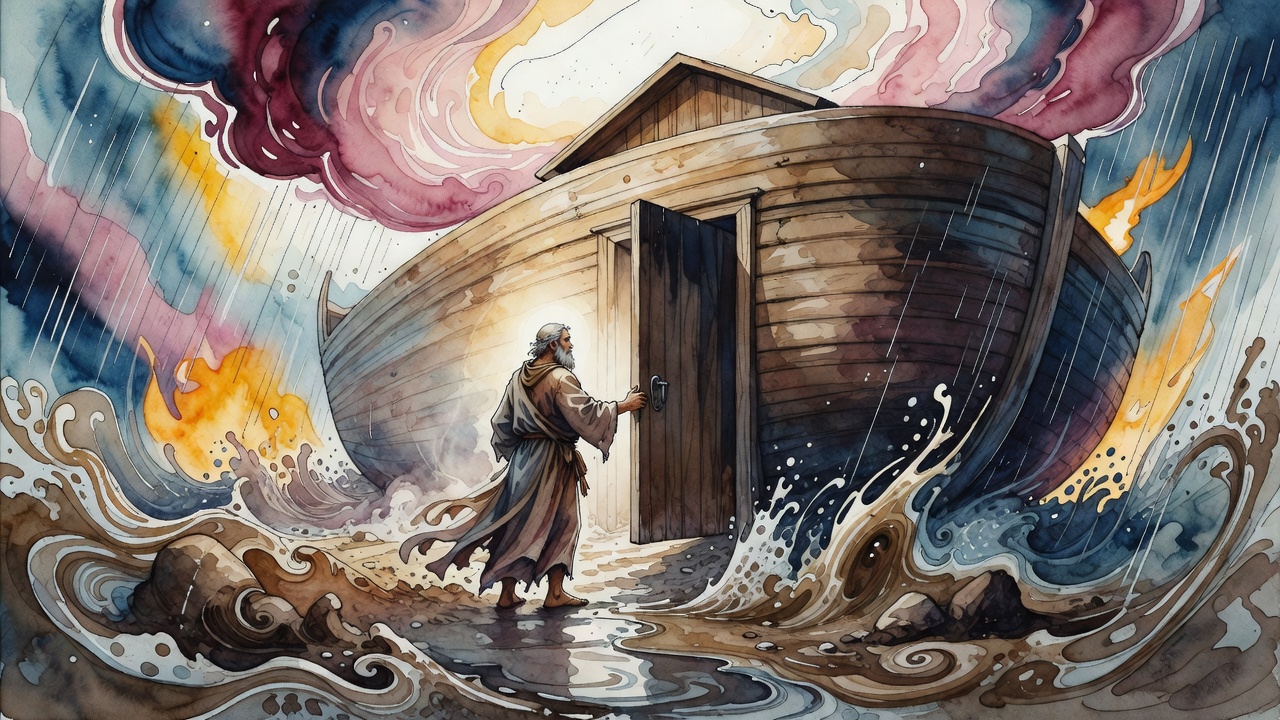
Waters fall and the world is mud. Noah keeps his hand off the door until the same voice that sealed him speaks exit.

Curated by Arthur · Told by Maggid ·
Table of Contents
  1. The Boards Remember the Rain
  2. Justice Begins as Reverence
  3. Seven Clean, Two Unclean
  4. The Soul Learns the Same Door
  5. First Step on Soft Ground
Noah Will Not Open the Ark Without God's Word Click for full size

The Boards Remember the Rain

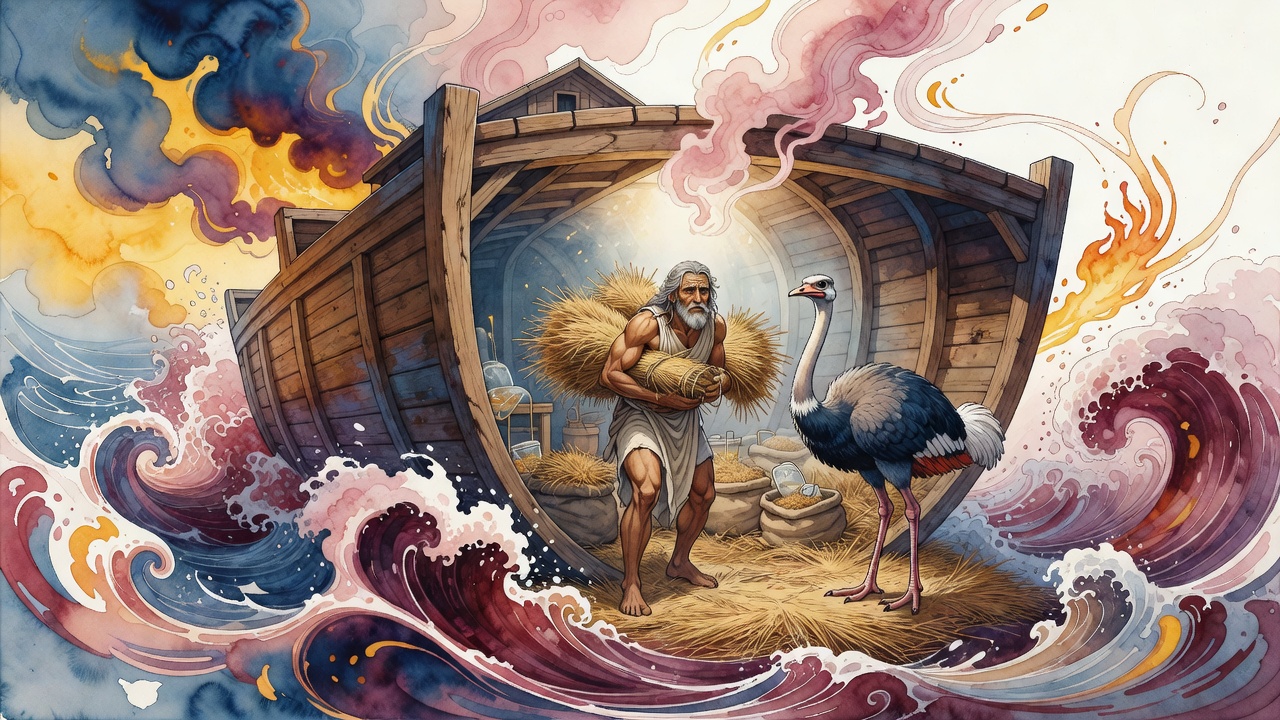
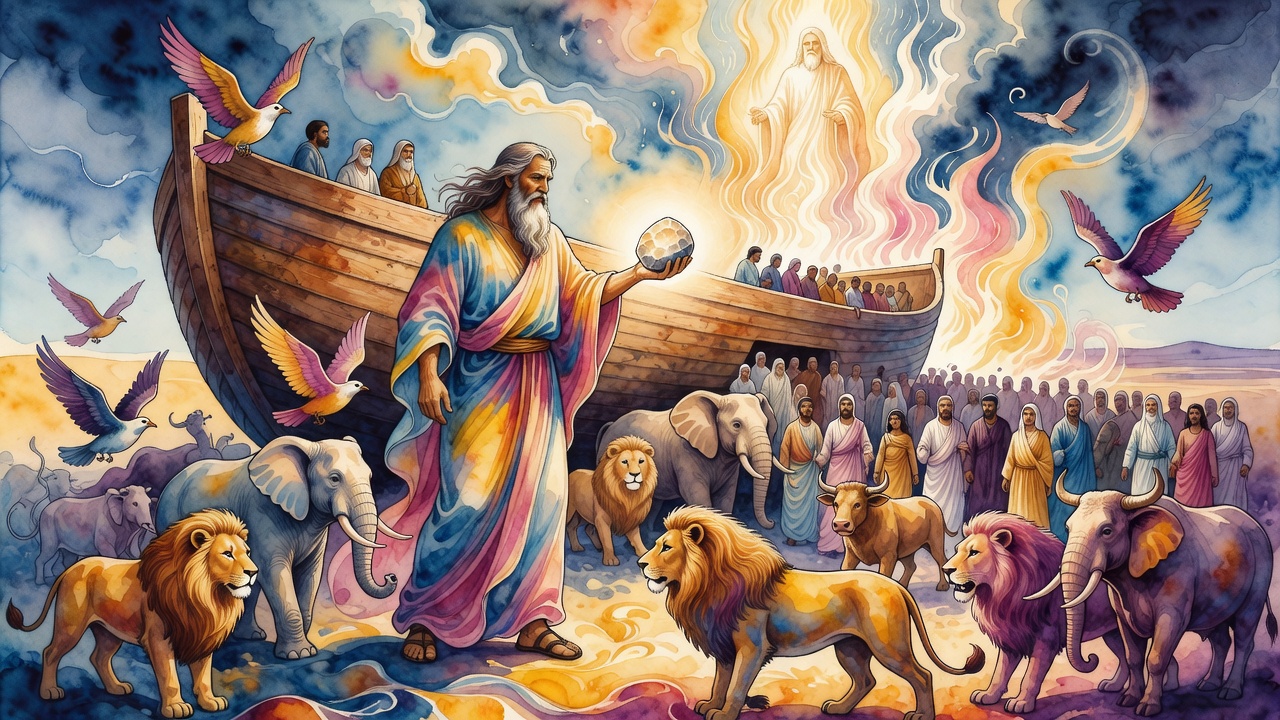
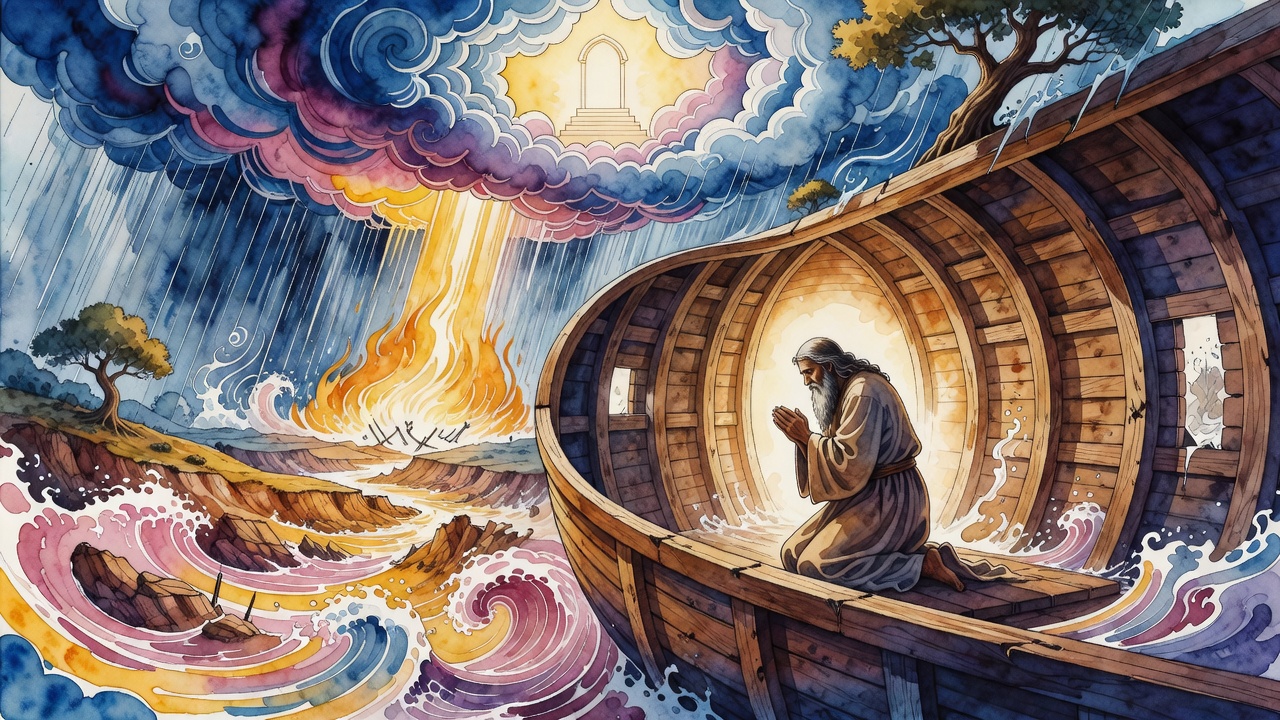
Noah pressed his palm to wood that had heard the world end. Outside, the new ground steamed. Inside, animals shifted and stank and lived. The door was a simple thing of beam and seal. He did not treat it as simple.

He had entered when God said enter. He would leave when God said leave. The man who had seen the earth become one sea did not trust his own hunger for open air, green smell, or the end of rocking.

Family watched him. Sons waited. The silence after rain can feel like permission. Noah treated it as weather, not as a verdict.

Justice Begins as Reverence

Philo's reading puts a spine under that pause. Justice is born from yirah, reverence, not from swagger. Injustice is recklessness that thinks it can manage the world alone once the crisis seems over.

Noah had watched unimaginable water. Of course he lived afterward with the knowledge that catastrophe can return. Fear alone would have made him a prisoner of the hold. Reverence made him a servant who waits for instruction even when the deck is dry.

"Let no one believe that he can ever do anything perfectly unless God himself guides him by his preventing precepts." Exit without a word would be a small rebellion dressed as common sense. The same ear that built by cubit must open by command.

Justice, in this frame, is not first a court. It is a man refusing to promote his own timing over the voice that timed the rain.

Seven Clean, Two Unclean

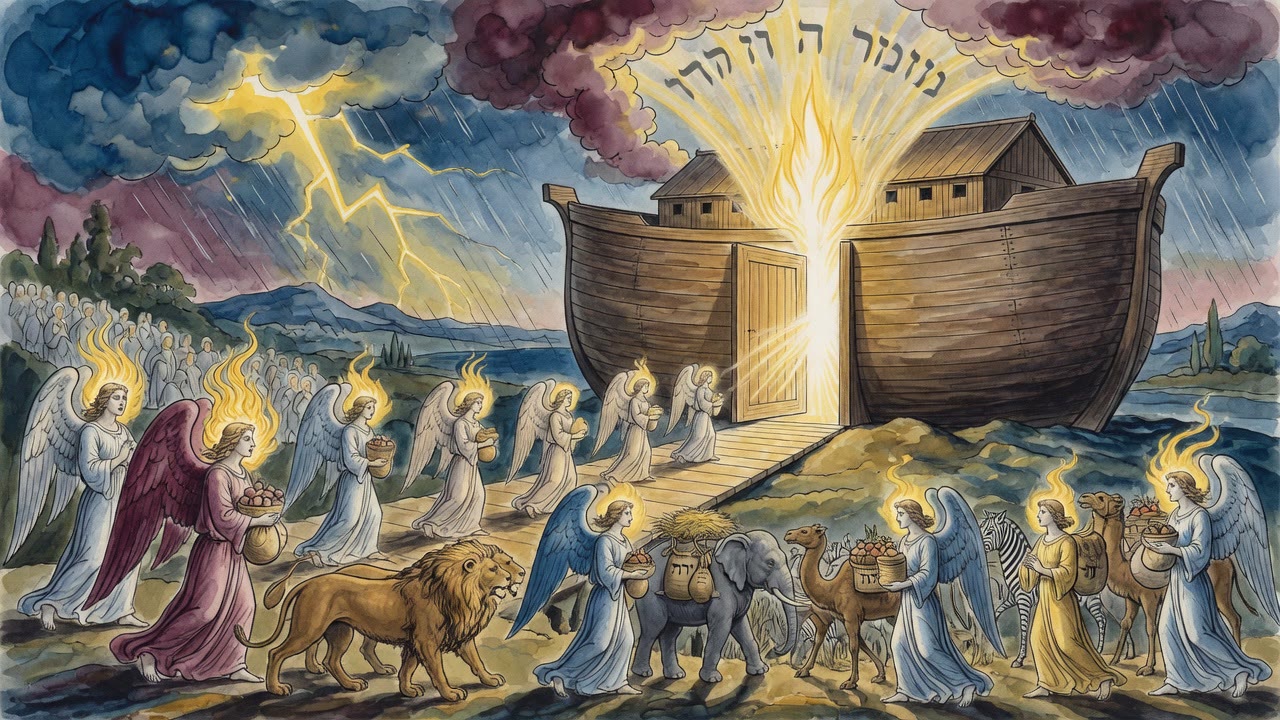
Before the rain, the command had already sorted the living cargo. Seven pairs of clean animals, two of the unclean (Genesis 7:2). Noah did not redesign the manifest to match his preferences or his guesses about post-flood farming.

Clean beasts enough for offering and for future herds. Unclean enough for survival of their kinds. The arithmetic was God's. Noah's work was obedience measured in stalls, feed, and the patience of predators caged beside prey under one roof.

A man that careful with counts does not kick the door open because the sun looks friendly on a new mudflat. The same discipline that loaded the ark now locked it from the inside of his will.

When offerings would later need clean blood, the extra pairs would matter. Noah could not see the altar yet. He could keep the inventory intact until the inventory was needed.

The Soul Learns the Same Door

Philo also hears the ark as a figure of the soul's passage: sealed against a flood of appetite, kept alive by command, released only when the upper word permits a new walk on a washed earth.

Noah's body did the literal version. He sat in the dark of pitch and timber until the sentence changed. Birds tested windows. He still waited. The flood had trained him that timing is not a human hobby and that survival is not the same as graduation.

The soul that leaves early falls back into the water it thought it had escaped. The man who leaves early claims a world God has not yet handed over. Noah refused both mistakes with the same still hand on the beam.

First Step on Soft Ground

When the word finally came, exit was not triumph. It was the second half of the same listening that had built the boat. He stepped out into a world without neighbors. Wind. Bird cry. The odd peace of total loss.

Altar smoke would come soon. Vineyards and mistakes would come later. The first act was still the same act as boarding: move when told. Animals poured after him in their kinds, clean and unclean still counted by the old command.

Somewhere in that open, justice meant keeping the habit of reverence now that the water could not enforce it. No walls of rain. Only a man and a voice and a door behind him that had taught him how to wait.

Noah did not congratulate himself for patience. He walked out under a command, the only roof he trusted when every other roof on earth had failed.

One of his sons may have muttered about rotten air. Noah let the muttering die against the sealed wood. He had argued once for the world and been answered with a boat. He would not now argue for a doorway. Argument had finished. Listening remained.

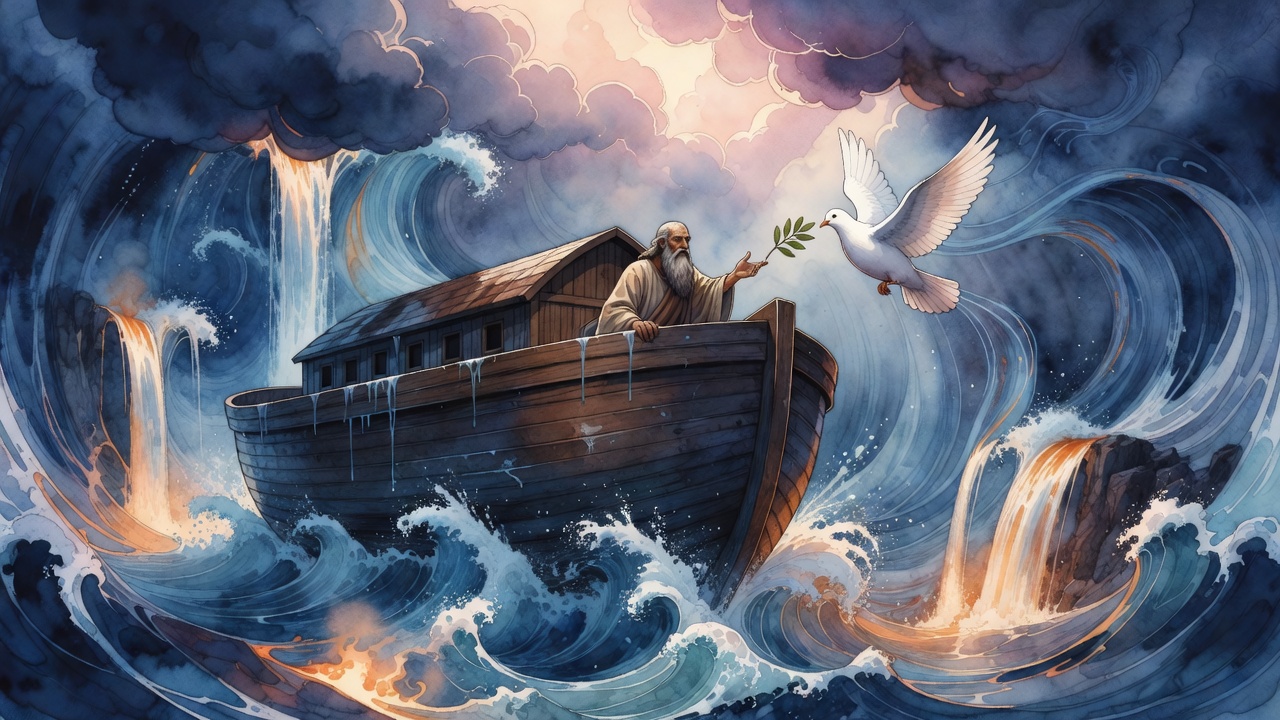
When green showed and the dove's stories improved, hope became a pressure under the ribs. He still waited. Hope is not a key. Command is a key. The difference kept him righteous when the whole earth was a temptation to improvise.

Years later, wine would loosen what water had taught. That failure does not erase the door discipline. It only shows how hard reverence is once dry land returns and a man thinks he owns the timing again.


← All myths
From the tradition

Sources

3 sources

The texts behind this telling. Some cards carry a translation of the source; others are our own retelling of it, and each card says which. Every card links out to the original.

The Midrash of Philo 15:2The Midrash of Philo

Retold in our words. Read the original at the link below.The Works of Philo Judaeus, trans. C. D. Yonge, London, H. G. Bohn, 1854-1890 · Public Domain

Philo, a Jewish philosopher living in Alexandria in the first century CE, delved deep into the Torah, seeking wisdom and hidden meanings. And in one particular midrash – a kind of interpretive story or commentary – he gives us a powerful insight into the nature of justice, fear, and faith.

Philo suggests that justice is often born out of a sense of yirah, awe or fear – perhaps more accurately, reverence. Injustice, on the other hand, is characterized by recklessness and overconfidence. But what does it truly mean to fear God, or to have yirat Shamayim, fear of Heaven?

Philo explains it's about recognizing our limitations. It means not prioritizing our own understanding over God's wisdom. It's about knowing when to surrender our own reasoning and trust in a higher power.

He uses Noah as an example, a man who witnessed unimaginable devastation. According to Philo, it's only natural that Noah would live with the awareness that such a catastrophe could happen again. The trauma would shape him.

But there's more to it than just fear of disaster. Philo emphasizes that Noah's obedience was key. Just as Noah entered the ark at God's command, he understood that he should only leave it when God instructed him to do so. He couldn’t just decide he’d waited long enough!

This is the crucial point: we can never truly achieve anything perfectly unless God guides us. We need divine instruction. Philo phrases it beautifully: "...let no one believe that he can ever do anything perfectly unless God himself guides him by his preventing precepts." "preventing precepts" idea for a second. It's not just about following instructions after the fact, but about God's guidance shaping our very path, preventing us from straying down the wrong road.

Perhaps it's a reminder to balance our own intellect and judgment with humility and faith. To recognize that true justice isn't just about following rules, but about aligning ourselves with a higher purpose. To cultivate yirah, not as paralyzing fear, but as a deep respect for the mysteries of the universe and the power that guides it.

Maybe, just maybe, surrendering to that guidance is the key to navigating our own turbulent seas.

Full source
The Midrash of Philo 2:1The Midrash of Philo

Retold in our words. Read the original at the link below.The Works of Philo Judaeus, trans. C. D. Yonge, London, H. G. Bohn, 1854-1890 · Public Domain

(Genesis 7:2) lays it out: seven pairs of every clean animal, but only one pair of unclean animals. Seems straightforward, but. why?

That’s a question that’s been puzzling interpreters for centuries. Philo, the 1st-century Jewish philosopher from Alexandria, grappled with this very issue. What was the reason behind this seemingly arbitrary distinction?

Why seven pairs of the clean, and only two of the unclean?

Philo’s midrash, a method of interpreting scripture, attempts to examine the deeper meaning behind these numbers. It wasn't just about saving the animals, it was about something more profound. The text hints at a purpose "to preserve seed upon all the earth."

It's clear that preservation is key. But why the different quantities?

One perspective is that the "clean" animals, those deemed fit for sacrifice according to Jewish law, needed a larger representation. After the flood, Noah would offer sacrifices to God (Genesis 8:20), and these "clean" animals would be needed. Having only two wouldn’t allow for both sacrifice and continued propagation.: If Noah only had one pair of sheep, and he sacrificed one… well, that’s the end of the sheep!

So, the seven pairs ensure survival and allow for offering a pleasing sacrifice to God. That's the practical reading.

But Midrash often delves deeper. Perhaps the number seven itself holds significance. Seven is a number often associated with completion and perfection in Jewish thought. Think of the seven days of creation, for instance. By bringing seven pairs of clean animals, Noah was, in a way, ensuring the complete and perfect re-establishment of life on Earth after the devastation of the flood.

As for the unclean animals? Two were enough. Their primary purpose wasn’t sacrifice, but simply to ensure the continuation of their species. Just the bare minimum was required for them to fulfill their role in the new world.

So, the next time you read the story of Noah's Ark, take a moment to appreciate the detail and depth embedded within seemingly simple instructions. It wasn't just about filling the ark; it was about the future of life, sacrifice, and the very fabric of existence. And that, my friend, is a story worth pondering.

Full source
The Midrash of Philo 1:2The Midrash of Philo

Retold in our words. Read the original at the link below.The Works of Philo Judaeus, trans. C. D. Yonge, London, H. G. Bohn, 1854-1890 · Public Domain

Philo, the great Jewish philosopher of Alexandria, grappled with these questions centuries ago. And his interpretations, preserved in what we call The Midrash of Philo, offer a fascinating perspective. Philo dives deep into the creation narrative, exploring not just what happened, but why. He asks: What does it mean that God gave humans dominion over the animals? Was Noah, after the flood, granted the same honor as Adam?

Philo points out that the scripture says, "And God made man; in the image of God created he him; male and female created he them. And God blessed them, and said, Be fruitful, and multiply, and replenish the earth; and be ye lords over it…” (Genesis 1:27-28). God bestows this power upon humanity right from the start. And this echoes in the story of Noah, who, after the deluge, receives a similar mandate. Philo sees a profound connection here, suggesting that Noah, in a way, represents a "second creation" of humanity.

Philo distinguishes between two versions of man's creation. He argues that the first Adam, the one created "in the image of God," is different from the Adam fashioned from clay. He sees the first Adam as an "incorporeal entity," a being of pure spirit, created on the sixth day, a number considered perfect. The second Adam, formed from the earth, comes later, on the seventh day, after the world is complete.

Why this distinction? Philo suggests that it's about more than just physical creation. It's about the potential for humans to cultivate wisdom and virtue. He interprets the dominion over animals allegorically. It's not just about physical control, but about the soul's ability to master its own base instincts. What does it mean to "rule over" beasts? Philo argues it means subduing wickedness, which he sees as untamed and savage. "Flying fowls," with their lightness and pride, represent arrogance and mischief. And the "creeping things?" Those are the destructive vices that slither through the soul: concupiscence (strong sexual desire), sadness, cowardice. Even the "fishes," pursuing a life of fleeting pleasure, represent a lack of wisdom and sobriety.

So, according to Philo, God wants the souls of wise people to cultivate beauty and virtue, filling their minds like the earth is filled, leaving no room for folly. And this inner transformation is what truly allows us to fulfill our role as stewards of creation.

Philo's interpretation might seem a bit different from what you might have heard before. But it invites us to consider: What does it truly mean to be created in God’s image? Is it simply a matter of physical form? Or does it involve cultivating inner qualities of wisdom, virtue, and self-mastery? Perhaps, according to Philo, it’s both.

Full source