Parshat Chukat7 min read

Og Mocked Baby Isaac at the Weaning Feast and Sealed His Doom

At Isaac's weaning feast the giant Og sneers he could crush the laughing heir with one finger, and Heaven dooms him to fall by that child's seed.

Curated by Arthur · Told by Maggid ·
Table of Contents
  1. The Giant Who Came to See the Heir
  2. One Finger on the Gift of God
  3. The Long Walk Toward the Appointment
  4. The Heir's Seed Comes to Bashan

The cradle had not been rocked in any house before this one. Now it rocked in the tent of Abraham, and the child inside it laughed, and the whole world had come to watch him do it.
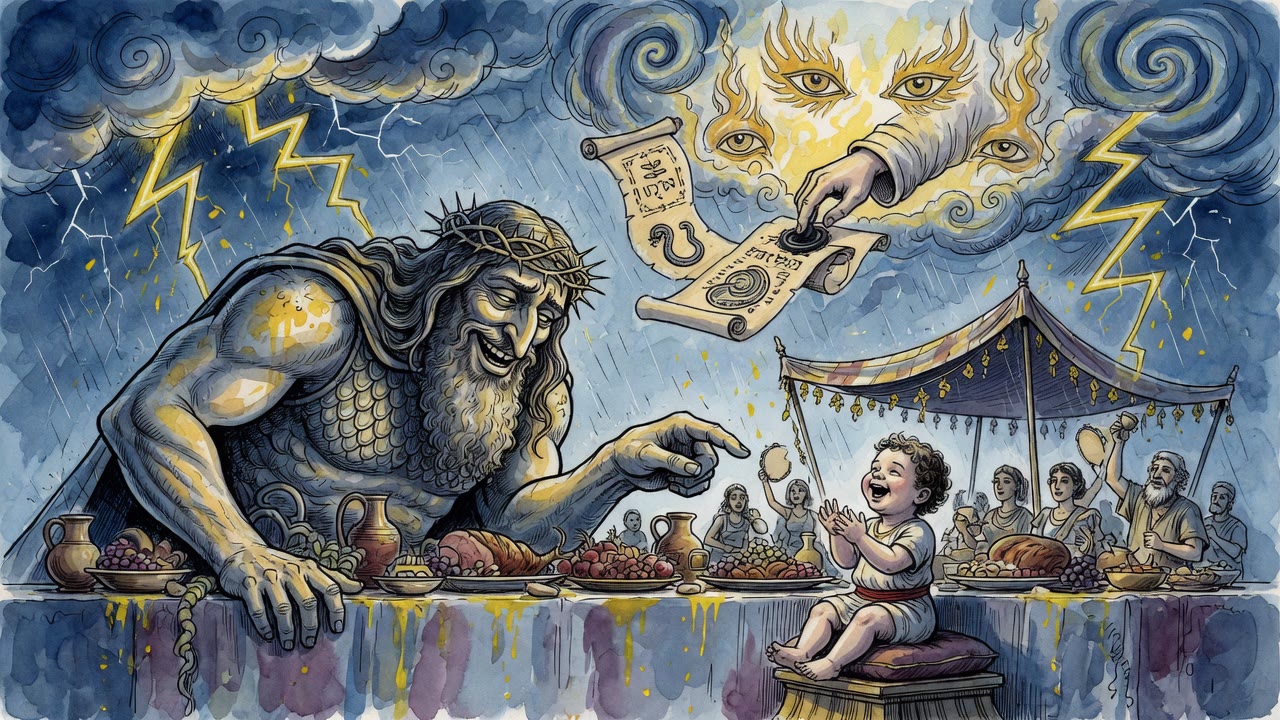
They had come because the feast was great. The day Isaac was weaned, Abraham set out the long tables, and the great ones of every kingdom took their places along them. Thirty-one kings reclined among the guests, and the thirty-second, the king of Jericho with his deputy beside him, made the count come out strange when anyone tried to total it later. Joshua would one day kill every one of these men. For now they ate Abraham's bread and drank Abraham's wine and leaned in to see the heir who had been promised to a man old enough to be dust.

The Giant Who Came to See the Heir

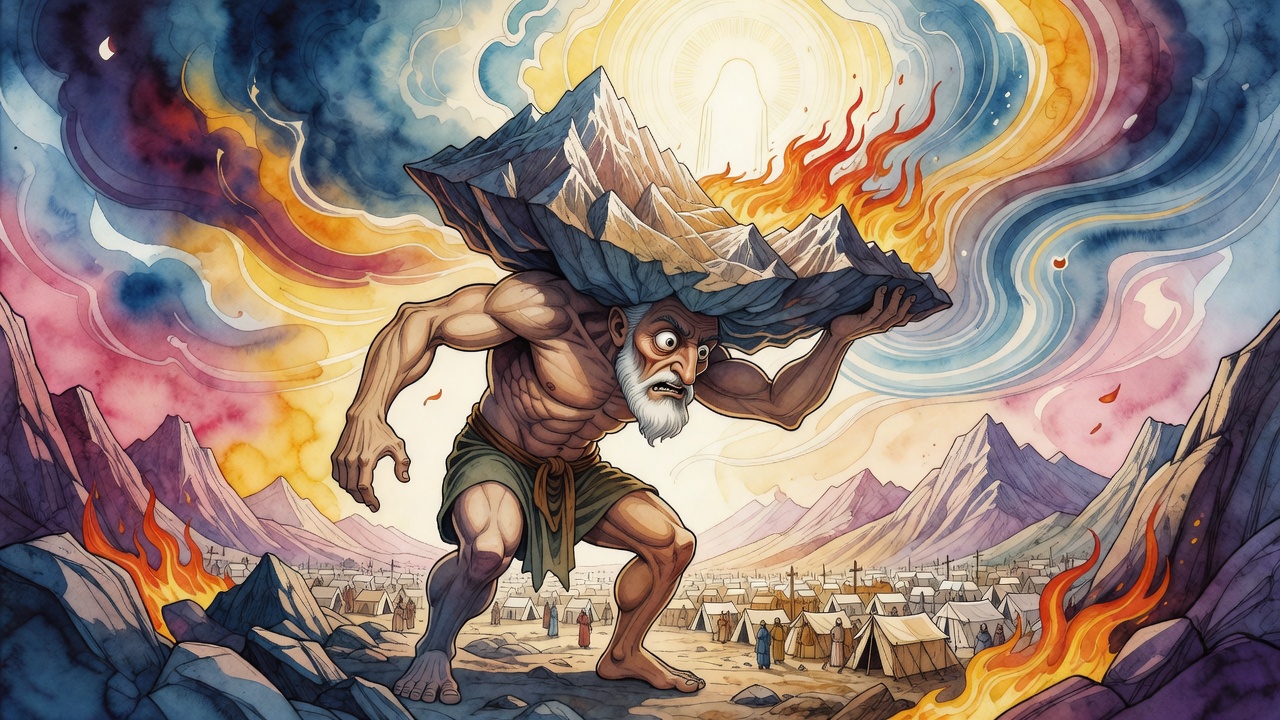
Among them sat a creature the tables had to be rebuilt to hold. Og stood nine cubits when he stood, nine by the measure of his own forearm, so that a man laid head to foot beside him would not reach his knee. His bed was iron because no wood would bear him. He had seen more years than any guest at the feast, more years than the feast could imagine, because Og had walked out of a slaughter that erased his entire kind.

Once the Rephaim had filled the earth, a race of giants, the last shadow of the age before the Flood. Then Amraphel and the kings with him fell on them at Ashteroth-karnaim and cut them down to nothing. One escaped. Scripture would not even call him by his name there. It called him only "the one who escaped," the way a farmer speaks of the olives that drop early and never ripen, the runt fruit, the leftover. That escapee had run to Abraham's door once before, years ago, breathless, to tell him his nephew Lot had been taken. The same Og. The least of the giants, mightiest now only because everyone taller than him was dead.

One Finger on the Gift of God

The great ones turned to Og at the table, half teasing, the way powerful men test each other. "Were you not the one always saying it," they said. "That Abraham was a barren mule. That he would never father a child."

Og looked down the length of the tables to the cradle, to the small thing wrapped and laughing in it, the whole inheritance of a covenant balanced inside a basket.

"And now," he said. "What is this gift of his. A feeble little thing. If I set one finger on it, I would crush it."

The laughter at the tables did not get the chance to finish.

The Great One of the worlds was present at that feast. He had been at the table all along, unseen among the kings, and Og's words went up to Him like smoke off the meat. The answer came down on the giant where he sat.

"You mock My gift," the voice said. "By your own life, you will see thousands of thousands and tens of thousands of tens of thousands come out of this child's children. And the end of you, of you, will be to fall by their hand and no other."

Og had a finger he could have crushed an infant with. The sentence handed back to him was that the infant's seed would crush him, and that nothing else in all the centuries between now and then would be allowed to do it first.

The Long Walk Toward the Appointment

So Og went on living. He lived the way a man lives who has been told the date of his death is fixed and far. Kingdoms rose around him in Bashan and he took their crowns. He grew into the giant the wars would whisper about, the one whose iron bed they kept in Rabbath of the children of Ammon, because even God had ringed that city with a command that Israel must not provoke it, and so the bed of the last giant rested in the one place no Israelite hand would reach to disturb it.

Men measured themselves against the memory of him for generations. When Goliath came down into the valley to curse Israel, six cubits and a span, the armies called him the in-between man, the champion who stood between two heights. Two cubits and a span taller than any ordinary soldier. Two cubits and a span short of a true giant. Short, that is, of Og. The Philistine who froze a whole army was a middling thing measured against the creature who had once promised to flick an infant out of the world.

The Heir's Seed Comes to Bashan

The infant grew. Isaac fathered Jacob, and Jacob fathered the tribes, and the tribes became the thousands of thousands the voice had counted out at the feast, until they stood at last at the edge of Bashan with Og's kingdom in front of them and a man named Moses at their head.

Moses looked up at Og and was afraid, because memory has weight, and this was the oldest enemy on the earth. But the word came as it had come once before over a cradle. "Do not fear him. I have given him into your hand." The promise made at the weaning feast was being paid out, syllable for syllable, to the seed it had named.

And then the strangest mercy. When Og fell, his whole land fell with him, every city, without another sword's stroke. God had drawn all of Og's warriors out to stand with their king on that one field, so that when the king went down the cities behind him held only women and children and no army at all. Israel could never have taken Bashan stronghold by stronghold. The Amorite cities were too many and too strong, and the conquest would have ground on past the lifetimes of the men marching. Instead it ended in an afternoon, because the appointment had been kept.

The runt of the giants, the leftover olive, the one who had outlasted his entire vanished race, lay dead at the feet of a man descended from the baby he had offered to crush with a finger. The cradle had been rocked. The laughing child had won.


← All myths
From the tradition

Sources

3 sources

The texts this telling draws on, in full. Open a card to read inline, or expand it for a wider, quieter read.

Yalkut Shimoni on Torah 94:2Yalkut Shimoni on Torah

"And Abraham made a great feast" (Genesis 21:8). The Great One of the worlds was there. "And the king made a great feast" (Esther 1:3): the Great One of the worlds was there. This is what is written: "For the LORD will again rejoice over you for good" (Deuteronomy 30:9), in the days of Mordecai and Esther; "as He rejoiced over your fathers," in the days of Abraham. Another interpretation: the great ones were there. Og and all the great ones of the kingdom were with him. They said to Og: Were you not saying that Abraham was a barren mule who does not beget? He said to them: And now, what is his gift? Is it not a feeble thing? If I put my finger on it, I would crush it. The Holy One, blessed be He, said to him: You mock My gift. By your life, you shall see a thousand thousands and myriads of myriads come forth from his children's children, and that man's end will be to fall only by their hand, as it is said: "And the LORD said to Moses: Do not fear him, for I have given him into your hand" (Numbers 21:34). Rabbi Levi said: No cradle was ever rocked first except in the house of Abraham our father. Rabbi Yehoshua ben Menachem said: Those thirty-two kings whom Joshua killed were all at the feast in the house of Abraham our father. But were they not thirty-one? It is as Rabbi Berekhiah, Rabbi Chelbo, and Rabbi Parnach said in the name of Rabbi Yochanan: "the king of Jericho, one" (Joshua 12:9). Scripture did not need to say "one" except to mean him and his deputy.

"And Sarah saw the son of Hagar the Egyptian" (Genesis 21:9). Rabbi Shimon said: Rabbi Akiva used to say something about this verse to Ishmael's discredit, and I say something to his credit. Rabbi Akiva expounded: "mocking" means only sexual transgression, as you say, "the Hebrew slave came to me ... to mock me" (Genesis 39:17). This teaches that Sarah our mother saw Ishmael seizing gardens, hunting married women, and abusing them. Rabbi Ishmael taught: "mocking" is only language of idolatry, as it is said, "and they rose up to play" (Exodus 32:6). This teaches that Sarah our mother saw Ishmael building altars, catching grasshoppers, and offering incense upon them. Rabbi Eliezer son of Rabbi Yose HaGelili says: this language means only bloodshed, as you say, "let the young men arise and play before us" (II Samuel 2:14). Ishmael would say to Isaac: Let us go and see our portions in the field. Then Ishmael would take a bow and arrows and shoot toward Isaac, while making himself appear as though he were only playing. This is what is written: "Like a madman who casts firebrands, arrows, and death, so is a man who deceives his neighbor and says, Am I not joking?" (Proverbs 26:18-19).

But I say this language means only inheritance. When Isaac was born, everyone was rejoicing. Ishmael said to them: You are fools. I am the firstborn, and I take a double portion. From the answer Sarah gave Abraham, you learn this: "For the son of this maidservant shall not inherit with my son, with Isaac" (Genesis 21:10). "With my son" - even if he were not Isaac; "with Isaac" - even if he were not my son; all the more so with my son, who is Isaac. "And the matter was very bad in Abraham's eyes" (Genesis 21:11). This is what is written: "and shuts his eyes from seeing evil" (Isaiah 33:15).

Full source
Midrash Aggadah, Deuteronomy 3:11Midrash Aggadah

"For only Og king of Bashan" (Deuteronomy 3:11). Every place where "only" is stated, it indicates a diminution, because Og was lesser and inferior to all the Rephaim who lived in his days, and he remained from the remnant of the Rephaim, from those whom Amraphel and his companions had killed, as it is stated, "and they smote the Rephaim in Ashteroth-karnaim" (Genesis 14:5); and concerning him it is stated, "And there came one that had escaped, and told Abram the Hebrew" (Genesis 14:13), and this was Og. And why did he call him "one that had escaped" (palit)? Because he was not reckoned like the rest of the Rephaim. As in the baraita that we learned: "escaped olives" (peletei zeitim) which are not ripened.

"Behold, his bedstead was a bedstead of iron." He recounted the greatness and might of the Holy One, blessed be He, that a mighty one such as this He delivered into their hand. "Is it not in Rabbath of the children of Ammon?" Because he knew that the Holy One, blessed be He, had commanded concerning the children of Ammon that they should not provoke them, therefore He placed his bedstead there.

"Nine cubits." From here we learn that a giant ('anak) is nine hundred high [i.e., nine cubits], and the rest of the people are four cubits, each one according to his own cubit. "After the cubit of a man", by the cubit of Og. And therefore Goliath was called "ish ha-benayim," "the champion" (the in-between man) (1 Samuel 17:4), because a giant is greater than nine cubits, and he was middling, for he was only six cubits and a span (ibid.); by two cubits and a span he was greater than another man, and by two cubits and a span he was less than a giant.

Full source
Legends of the Jews 5:105Legends of the Jews

Legends of the Jews turns to Og's Miracle.

This giant, known as Og, wasn't just the last one chronologically. He was also, according to the tradition, the least significant. Can you imagine? Surrounded by legendary figures, this one, despite his immense size and strength, is considered. insignificant.

That's how it goes sometimes, doesn't it?

The text in Legends of the Jews tells us that with Og's death, all his lands fell to the Israelites. Just like that. No further battles, no drawn-out sieges. It all came to them "without another sword's stroke." It was all part of God's plan.

And it's interesting to consider why. Why this sudden, almost anticlimactic end to the reign of giants?

According to the legend, God had arranged things so that all of Og's warriors were with him when he encountered Israel. After Israel defeated them, only women and children remained in the land.

Think about the implications of that. The narrative emphasizes the divine hand in shaping events. It wasn't just brute force or military strategy that won the Israelites their land. It was something more. It was a coordinated, almost orchestrated event.

Now, imagine if Israel had been forced to conquer each city individually. The text suggests they would never have finished! The number of cities and the strength of the Amorite armies were simply too great.

This gives us a sense of the scale of the challenge facing the Israelites. It wasn't just about overcoming physical obstacles; it was about overcoming seemingly insurmountable odds. The story emphasizes the magnitude of God's intervention.

So, what can we take away from this little snippet of legend? Perhaps it's a reminder that even the mightiest figures can fade into insignificance. Or perhaps it's a evidence of the power of divine providence, shaping events in ways that are beyond our comprehension. Whatever it is, it's a fascinating glimpse into the world of giants, Israelites, and the mysterious workings of destiny.

Full source