Og Carried a Mountain to Crush Israel Until It Dropped Around His Neck
Og measured the camp of Israel with one eye, tore a mountain loose, and balanced it on his head to bury a whole nation under a single stone.
Table of Contents
The valley below Bashan was full of tents, and the giant on the ridge began to count them.
 Click for full size
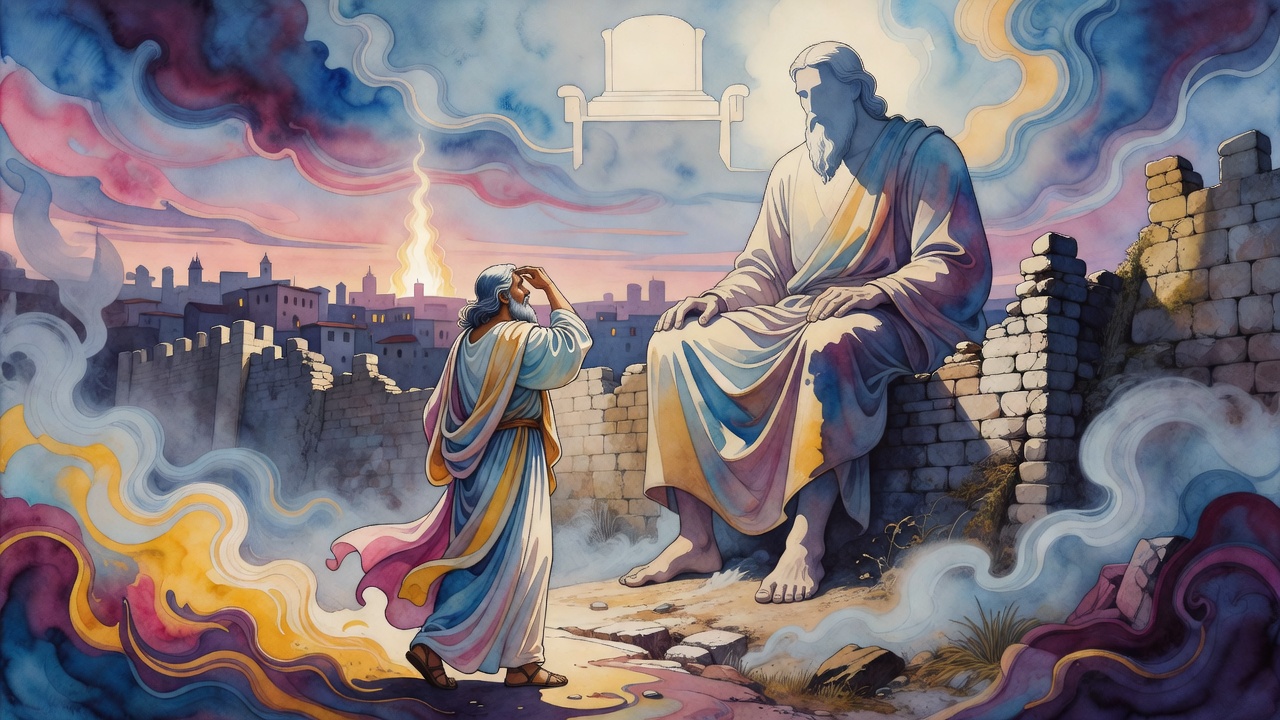
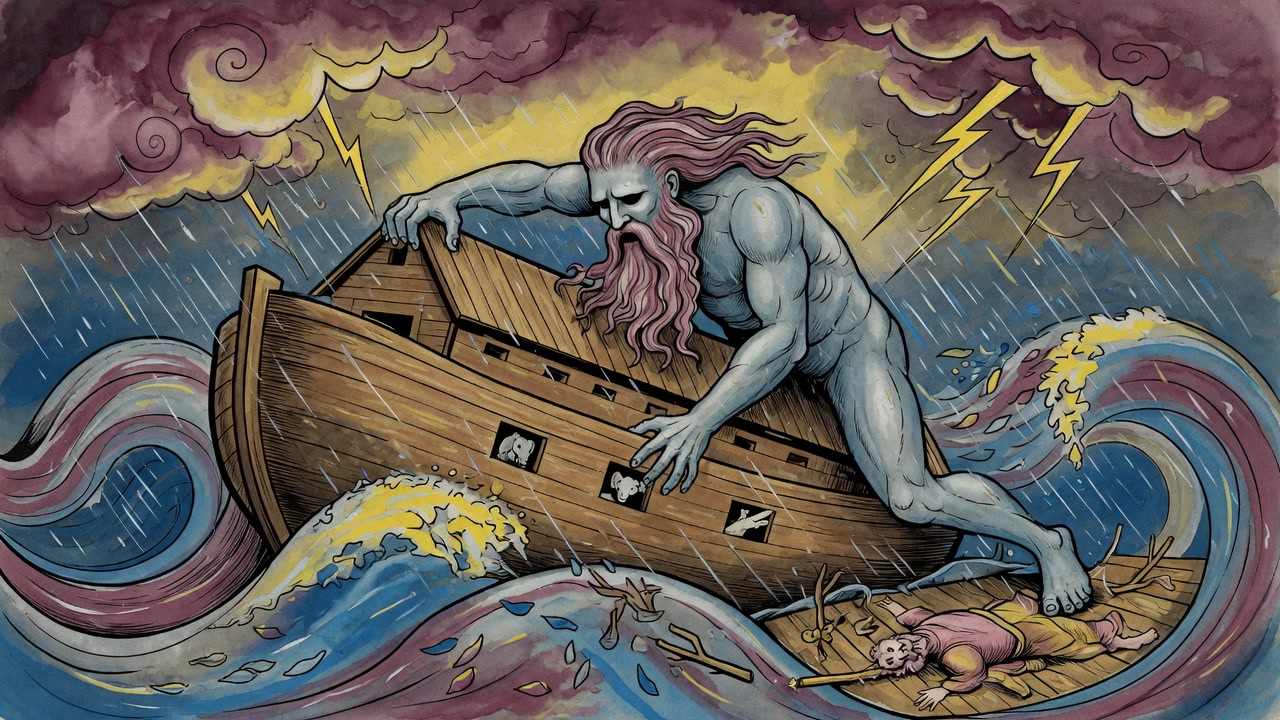
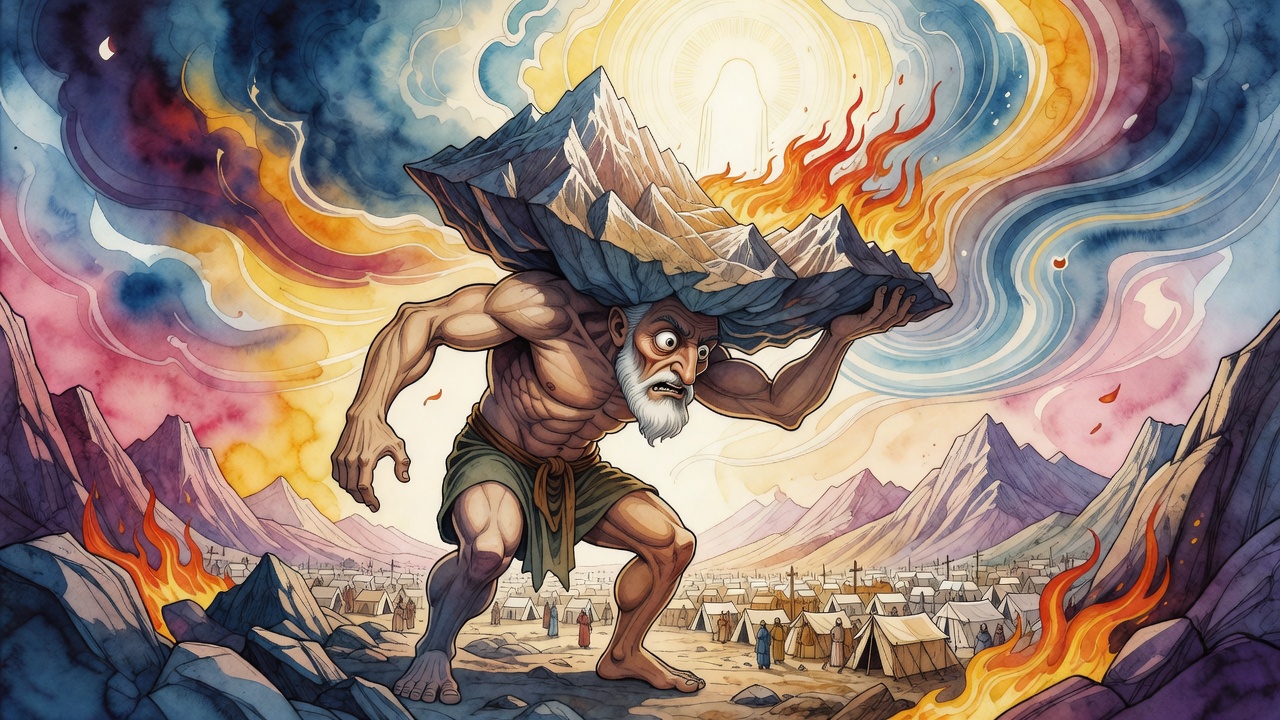
Og stood above the camp of Israel and narrowed one eye until the whole nation fit inside it. He let his gaze run from the first tent to the last, measuring, the way a builder measures a wall before he wrecks it. "Three parsangs across," he said to the wind. Three parsangs. He had outlived the Flood. He had ridden the roof of an ark while the world drowned beneath him, and he had buried more enemies than there were tents in that valley. He was not going to chase these people from rock to rock through the wilderness. He was going to end the whole Exodus in a single afternoon.
The Giant Walked Off to Find a Lid for the World
So Og turned his back on the camp and went looking for a stone the size of a nation. He found a mountain three parsangs wide, exactly the width he had measured with his eye, and he set his hands beneath its roots. He tore it loose. The ground let go with a sound like the world cracking its spine, and Og lifted the whole mass over his head and balanced it there, a roof for an entire people, a lid he meant to lower onto Israel until nothing moved underneath it again. Then he started back, slow and enormous, carrying a mountain the way a man carries a basket.
From the camp the tents looked small. From under the mountain, walking, Og could no longer see them at all.
God Sent the Smallest Things Against the Largest
The Holy One did not send fire. He did not send an angel with a sword the length of the sky. He sent ants. Some who tell it say a single raven, but most remember ants, a black river of them pouring up the slope of the stone on the giant's head. They went into the mountain and they bored. Grain by grain they hollowed it, tunneling through three parsangs of rock while Og walked on, and the peak above him began to soften and sag. Then the stone gave. It slipped, it sank, and it dropped down around Og's neck and settled there like a collar forged for a giant.
He reached up to shove it off.
His Own Teeth Locked the Mountain Shut
That was when his teeth betrayed him. As he strained against the rock, his teeth grew. They stretched out of his jaw, this way and that way, branching past his lips and curling over the lip of the stone, hooking the mountain fast against his own face. The harder he pulled, the deeper they caught. The giant who had measured a nation now could not measure the few inches between his teeth and freedom. He stood in the wilderness with a mountain around his neck and his own mouth holding it there, and he could not move.
The Rabbis heard this in a line of the Psalmist, "You have broken the teeth of the wicked." Do not read it broken, they said. Read it stretched out. The wicked are trapped by the very thing that grew from them.
Moses Leaped the Height of the Tabernacle
Moses came out to where the giant stood pinned. Moses was ten cubits tall, the full height of the Tabernacle he had raised in the wilderness. He took up an axe ten cubits long. And then, against a creature whose ankle stood above his head, Moses jumped. Ten cubits into the air, all of him and all of the axe, and at the top of that leap the blade came down on Og's ankle. The tendon went. The giant who had outlasted the Flood folded toward the ground he had tried to tear apart, and the mountain came down with him.
The Hands That Threw and the Mouth That Held
But the mountain Og had meant as a tomb for Israel never reached them. Moses spoke the Ineffable Name over the falling stone and held it in the air, three parsangs of rock hanging above the camp on the strength of a single word, so that not one tent was crushed. The people looked up at the mountain floating where their graves should have been, and they made a blessing and a curse in one breath. May the hands that lift a mountain to throw it be cut off. And may the mouth that holds a mountain up in the air be blessed.
The giant lay in the dust beside the stone he had carried so far. The ants were already gone.
← All myths