6 min read

The Old Man in Tatters Found His Grandson

A father cast his own father into rags. In a loft a boy cut a mantle in half, and the house learned what honor costs.

Curated by Arthur · Told by Maggid ·
Table of Contents
  1. The Loft and the Knife
  2. Honor Measured Like One's Own
  3. Hillel and the Wager at Dusk
  4. When Scholars Tried to Strip a Seat
  5. One Day Before Death

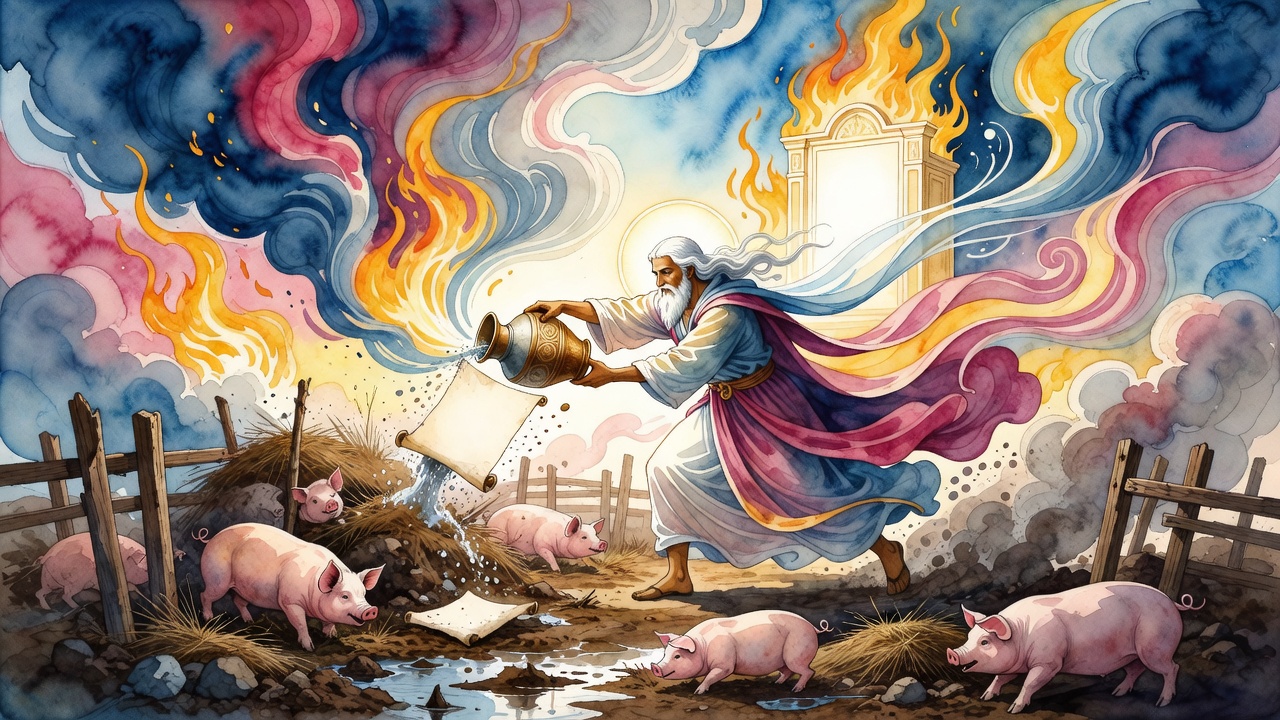
The old man stood in the street in tatters, cold enough that his bones argued with the wind. He had once owned fields and ledgers and a house that answered to his name. He had trusted his son with all of it while he still lived, and the son had answered trust with exile. Beggars recognized the old man before neighbors did.
The Old Man in Tatters Found His Grandson Click for full size

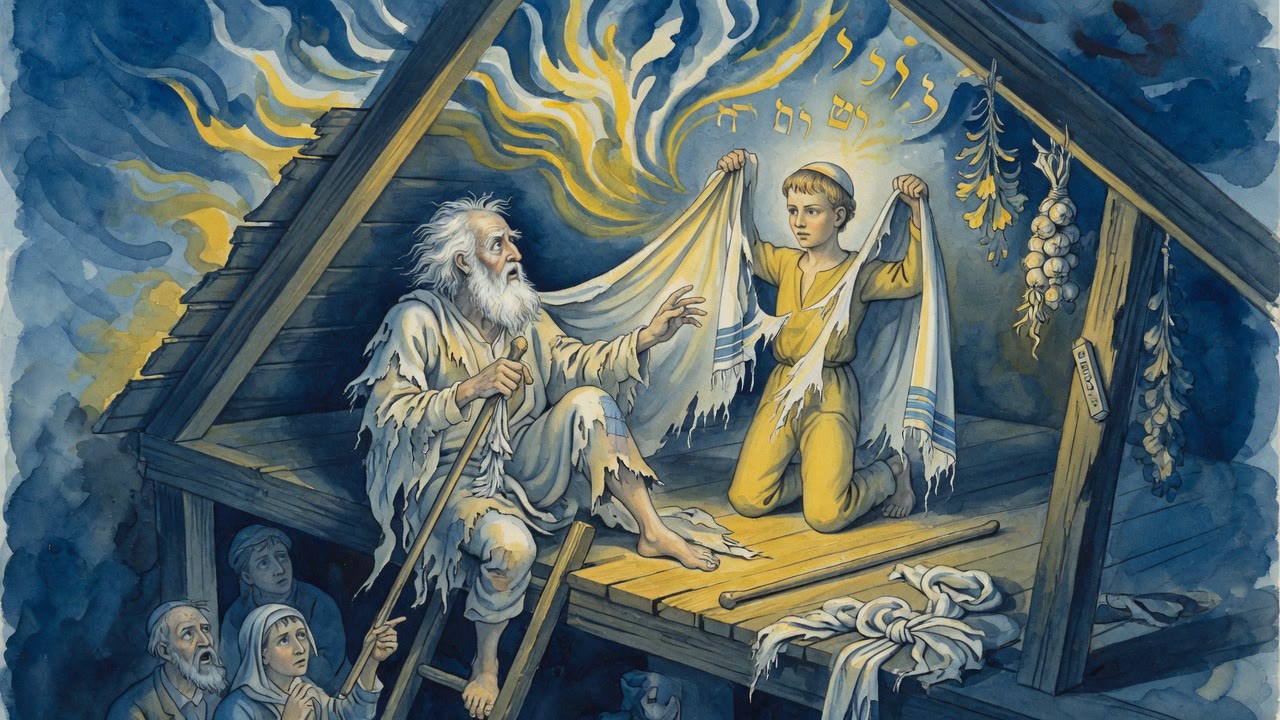
His grandson found him first. The boy stopped mid-step, stared at the rags, then at the face under them, and heard a request so small it should have shamed the household. A mantle. Only a mantle. Something thick enough to keep a grandfather from shaking through another night in the open.

The Loft and the Knife

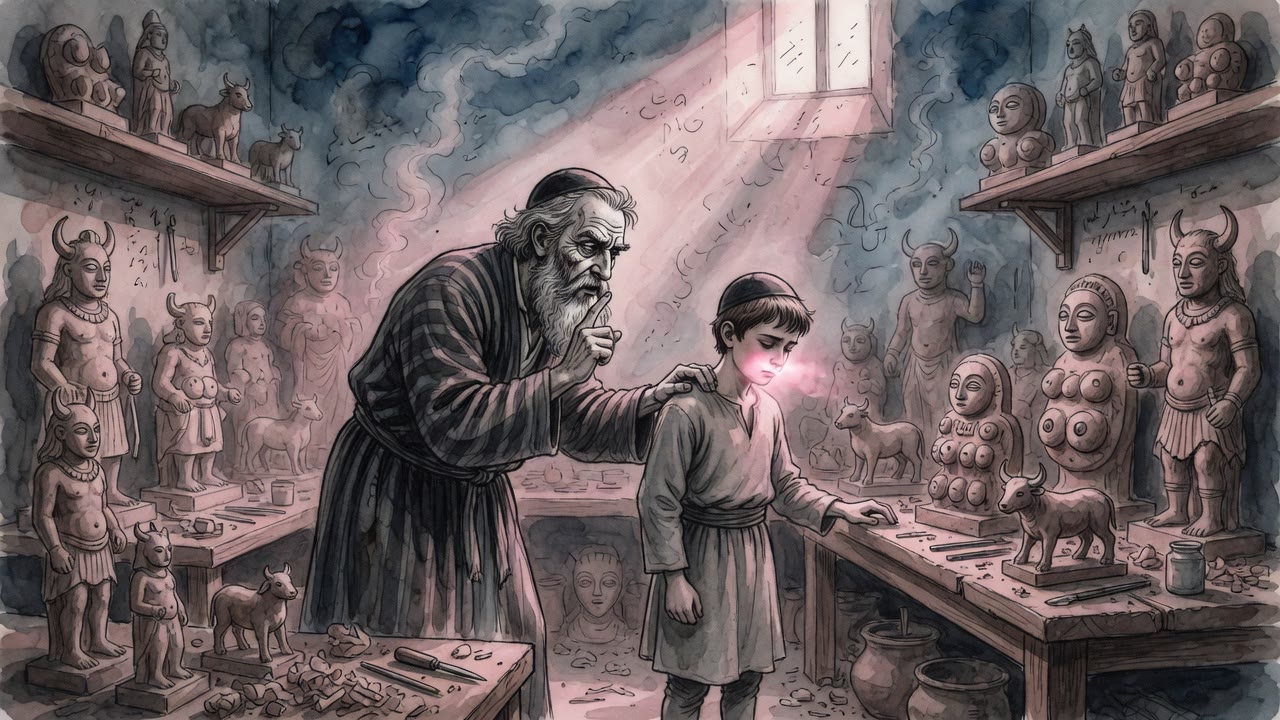
After much begging the father sent the boy upstairs. "A certain mantle hangs on a hook," he said, as if the loft could bury the shame under dust and storage. The boy climbed the ladder. He found the garment. He also found a knife used for rope and sacks.

He cut the mantle in half.

The father, impatient with the silence, went up after him. The boy held both pieces without flinching. "One half for my grandfather," he said. "The other half I keep for you, when you grow old and I decide what you are worth."

The room did not need a sermon. The father saw his own future wearing his own cruelty. The cold he had assigned to another body had already been measured for him. He brought the old man home that day and restored him to honor, not because mercy suddenly flooded him, but because a child had held up a mirror with fabric and steel.

Neighbors later said they saw the grandfather cross the threshold still holding half a mantle like a legal document. The other half stayed with the boy. No one in that house forgot which generation had done the accounting.

Honor Measured Like One's Own

Rabbi Eliezer taught three things that sit hard on a household like this. Let the honor of your fellow be dear to you as your own. Do not be easily moved to anger. Repent one day before your death. The first line is not decoration for a study hall wall. As a man guards his own name from a bad report, so he must guard his fellow's name when gossip starts to travel. And when a man once owned a million and now owns nothing, he must not let his self-respect fall even to the value of a perutah. Poverty is not a license for humiliation, and wealth is not a license to humiliate.

The father who shoved his own father among beggars had treated honor as a private coin he could spend or withhold. The grandson spent it differently. He made inheritance visible in a way ledgers never do: whatever you do to the generation above you will be done to you by the generation below, and the street will watch the transfer.

Honor, in this teaching, is not vanity. It is the public weight of a person. Strip it without cause and you teach the children of your house a craft they will practice on you.

Hillel and the Wager at Dusk

Anger is the other blade. Two men once wagered four hundred zuz that one of them could provoke Hillel the Elder on the eve of the Sabbath while Hillel washed his head. The man knocked and shouted, "Where is Hillel? Where is Hillel?" as if the Nasi of patience were a servant to be barked at. Hillel wrapped himself in his robe and came out. "My son, what do you require?"

The questions were mockeries dressed as curiosities. Why are the people of Palmyra bleary-eyed? Why do the Africans have flat feet? Hillel answered each with calm reasons, returned to his washing, and when the man came back again and again to break him, Hillel still called him "my son."

The wager failed. Four hundred zuz could not buy Hillel's rage. The father in tatters had the opposite economy: he bought ease with his parent's disgrace and paid for it in a loft with a knife. One man refused to spend anger. The other spent honor until a child forced a refund.

When Scholars Tried to Strip a Seat

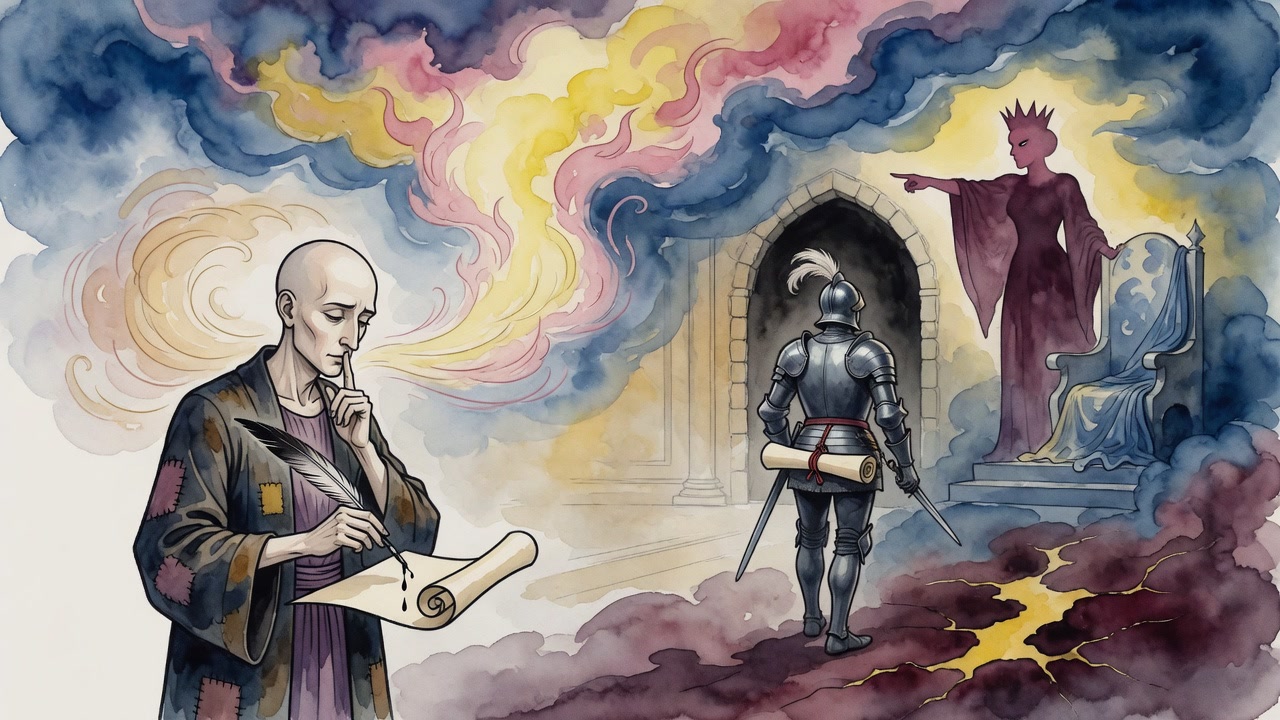
Honor also breaks academies. Rabban Shimon ben Gamliel, the Nasi, wanted the assembly to mark his office when he entered, not rise equally for him and for Rabbi Meir and Rabbi Natan. The two sages, offended at being leveled, planned to humble him with a difficult tractate he had not mastered, to force him from his seat in front of students and make the prince look empty.

A friend learned of the scheme and warned him in time. The Nasi prepared through the night, mastering the material while the plotters slept on their cleverness. When the challenge came in session, he answered with full command. Their design collapsed in public.

They were expelled, then later restored under a hard condition: their names would not ride rulings as principal authority. Teachings of theirs would be cited anonymously or under other names. The house of study kept their learning and still protected the office they had tried to strip.

In the street story and the academy story, the pressure is the same. Someone treats rank as a weapon, and the community answers with a consequence that leaves a mark no apology can polish away.

One Day Before Death

Rabbi Eliezer's third teaching lands like a knock at dusk. Repent one day before your death. No one knows which day that is, so the work of return cannot wait for a convenient calendar or a softer mood. The father who cut his parent off thought he had years to rearrange the house. The boy with the knife shortened the timetable to a single afternoon.

In the end the old man sat warm again. The mantle, even halved, covered more than a body. It covered a ledger of honor that had gone bankrupt and had to be rewritten in public, under a child's eyes,.


← All myths
From the tradition

Sources

3 sources

The texts behind this telling. Some cards carry a translation of the source; others are our own retelling of it, and each card says which. Every card links out to the original.

Exempla of the Rabbis, No. 437Exempla of the Rabbis (Gaster, 1924)

Retold in our words. Read the original at the link below.The Exempla of the Rabbis, Moses Gaster (1924) · Public Domain

A rich man, having confidence in his son gave him all his property in his lifetime. After a while the son commenced to neglect his father, ill-treating him and sending him away to be among the beggars. One day the old man, clad in tatters, met his grandson and asked him to beg of his father to let him have a mantle to cover himself, as it was so cold. After much begging the father sent his son up to the loft and told him to fetch a certain mantle which was hanging on a hook. Whilst on the loft the boy took a knife and cut the mantle in half. The father, wondering what the boy was doing all that time, went to find out. The son told him that he had been busy cutting the mantle in half and added that he would give his grandfather one half and keep the other half for his own father when he grew old. The man was greatly surprised at this reply and recognising the wickedness of his action, took his father back and treated him with all honour.

Full source
Avot DeRabbi Natan 15Avot DeRabbi Natan

Retold in our words. Read the original at the link below.The Minor Tractates of the Talmud, trans. A. Cohen, Soncino Press (1965) · CC-BY

THEY EACH SAID THREE THINGS. R. ELIEZER SAID: LET THE HONOUR OF YOUR FELLOW BE DEAR TO YOU AS YOUR OWN; BE NOT EASILY MOVED TO ANGER; REPENT ONE DAY BEFORE YOUR DEATH.LET THE HONOUR OF YOUR FELLOW BE DEAR TO YOU AS YOUR OWN. What does this mean? It teaches that as a man regards his own honour, so should he regard the honour of his fellow; and as a man would not wish to see an ill report spread about his own honour, so should he not wish to see an ill report spread about the honour of his fellow.Another interpretation of LET THE HONOUR OF YOUR FELLOW BE DEAR TO YOU AS YOUR OWN: Thus if a man once possessed a million and is now deprived of all his wealth, he should not lose his self-respect even to the slightest degree.1lit., ‘to the value of a peruṭah’. Though he is destitute his self-esteem should remain high; cf. Sanh. 92b (Sonc. ed., p. 621): ‘Even in times of danger one should not lay aside his insignia of office’. Honour is a precious possession.

BE NOT EASILY MOVED TO ANGER. What does this mean? It teaches that a man should be meek like Hillel the Elder and not impatient like Shammai the Elder.What was the meekness of Hillel the Elder? It is related2Cf. Shab. 31a (Sonc. ed., pp. 138ff) for variants of this passage. that two men once wagered with each other the sum of four hundred zuz, saying, ‘Whoever will succeed in provoking Hillel to anger will take the four hundred zuz’. One of them went [to call on Hillel]. The day was the eve of the Sabbath towards dusk, and Hillel was then washing his head. He came, knocked at the door, and called out, ‘Where is Hillel? Where is Hillel?’ Hillel wrapped himself in his robe and went to him, asking, ‘My son, what do you require?’ ‘I have a question to ask,’ he said. ‘Ask it,’ said Hillel. Thereupon he asked, ‘Why are the inhabitants of Palmyra bleary-eyed?’ He answered, ‘Because they live in sandy deserts, and the winds scatter the sand over their eyes; for that reason their eyes are bleary’. The man departed, waited a while, returned, again knocked at the door, and called out, ‘Where is Hillel? Where is Hillel?’ Hillel wrapped himself in his robe and went out to him, asking, ‘My son, what do you require?’ ‘I have a question3The Heb. halakah, the term for a legal decision, cannot have this meaning here. to ask,’ he said. ‘Ask it,’ said Hillel. Thereupon he asked, ‘Why have the Africans flat feet?’ He answered, ‘Because they live in marshy places and constantly walk in the water;4They therefore walk barefoot, and so their feet are broad because of not having been cramped by shoe or sandal. for that reason their feet are flat’. The man departed, waited a while, returned, again knocked at the door and called out, ‘Where is Hillel? Where is Hillel?’ He wrapped himself in his robe, and went out to him, asking, ‘What do you wish to ask?’ ‘I have a question to ask,’ he said. ‘Ask it,’ said Hillel. The man then wrapped himself in his cloak and sat down before him. ‘What do you wish to ask?’ said Hillel. The other rejoined, ‘Is that the manner in which a President5The Heb. is in the plural, referring to the Presidents of the Sanhedrin (the supreme rabbinic court). replies? May there not be many like you in Israel!’ ‘Heaven forfend!’ exclaimed Hillel, ‘r temper. What is it you require?’ He asked, ‘Why have the Babylonians long heads?’6An insulting remark since Babylon was Hillel’s birthplace. He answered, ‘My son, you have asked an important question. Because they lack skilful midwives there, as soon as a child is born it is placed in the arms7The Heb. is ’ebarim, ‘limbs’, a peculiar word in the context. A variant is ḥeḳ, ‘bosom’. of male and female slaves; for that reason their heads are long. Here [in the Holy Land] there are expert midwives, and as soon as a child is born it is placed in a cot and its head is massaged; for that reason their heads are round’. Then said the man to him, ‘Through you I have lost four hundred zuz’. Hillel retorted, ‘Hillel is worthy that you should lose [twice] four hundred zuz on his account, and Hillel should not lose his temper’.

What was the impatience of Shammai the Elder? It is related that a man8In Shab., loc. cit., he was ‘a Gentile’, but in the context a Jew is clearly intended. once came and stood before Shammai and said to him, ‘Master, how many Torahs have you?’ He answered, ‘Two, one written and one oral’. The man said, ‘I believe you regarding the written, but I do not believe you regarding the oral’. Shammai rebuked him and [24b] angrily drove him away. The man then came before Hillel and asked, ‘Master, how many Torahs were given [to Israel]’. He answered, ‘Two, one written and one oral’. He said, ‘I believe you regarding the written, but I do not believe you regarding the oral’. Hillel said to him, ‘My son, take a seat’. He then wrote the alphabet for him. Hillel asked him, ‘What is this letter?’9Pointing to an alef. ‘An alef,’ he replied. Hillel said, ‘It is not an alef but a beth’. He asked, ‘And what is this letter?’10Pointing to a beth. ‘A beth,’ he replied. Hillel said, ‘It is not a beth but a gimel’. ‘Moreover, how do you know that this letter is alef, that beth, and the other gimel?’ continued Hillel. He replied, ‘So it has been handed down to us by our forebears: this is alef, that beth, and the other gimel’. ‘Just as you have accepted this11The letters of the alphabet. on trust, so accept the other12The existence of two Torahs. on trust.’Once a gentile was passing behind a Synagogue when he heard a child reciting the verse, And these are the garments which they shall make: a breastplate, and an ephod, and a robe.13Ex. 28, 4. He came to Shammai and asked him, ‘Master, for whom is all that finery?’ He answered, ‘For the High Priest who stands and ministers at the altar’. The gentile said to him, ‘Make me a proselyte on condition that you appoint me High Priest’. Shammai retorted, ‘Is there no priest in Israel and have we no High Priests in Israel to serve in the High-priesthood, except this insignificant proselyte who comes with staff and scrip only and wishes to minister as High Priest?’ He rebuked him and angrily drove him away. The gentile then came to Hillel and said to him, ‘Master, make me a proselyte on condition that you appoint me High Priest, so that I may stand and minister at the altar’. Hillel said to him, ‘Take a seat, and I will tell you something. If a man wishes to have an audience of a human king, is it not proper for him to learn how to make his entrance and his exit?’ ‘Certainly,’ answered the gentile. Hillel continued, ‘As you are desirous to have an audience of the King of kings, the Holy One, blessed be He, is it not all the more incumbent upon you to learn how to enter the Holy of Holies, how to trim the lamps, how to approach the altar, how to order the table, how to arrange the altar-pile?’ ‘Do whatever seems good to you,’ said the gentile. Hillel then wrote the alphabet for him which he soon learnt, and then [he studied] the Book of Leviticus. So he continued until he reached the verse, And the common man that draweth nigh shall be put to death.14Num. 1, 51. Then the proselyte reasoned within himself thus, ‘If Israelites who are designated sons of the All-present,15Cf. Deut. 14, 1. of whom the Divine Presence declares, Ye shall be unto Me a kingdom of priests, and a holy nation,16Ex. 19, 6. are warned by Scripture, And the common man that draweth nigh shall be put to death, how much more so does it apply to me, an insignificant proselyte, who am come with nothing but my scrip!’ In this manner the proselyte was reconciled of his own accord. He came to Hillel the Elder and said to him, ‘May all the blessings of the Torah alight on your head! Had you been like Shammai the Elder, I would never have entered the assembly of Israel. The impatience of Shammai sought to destroy me out of this world and out of the world to come; your gentleness brought me to life in this world and in the world to come’. It is reported that that proselyte became the father of two sons; one he named Hillel and the other Gamaliel. They were called ‘Hillel’s proselytes’.

REPENT ONE DAY BEFORE YOUR DEATH. The disciples asked R. Eliezer.17Cf. Shab. 153a (Sonc. ed., p. 781). ‘Does, then, a man know on which day he will die that he should repent [the day before]?’ He replied, ‘All the more reason that he repent to-day lest he die tomorrow, or that he repent to-morrow lest he die the day after; as a consequence his whole life is spent in repentance’.R. Jose b. Judah said in the name of R. Judah b. R. Ilai, who said it in the name of his father R. Ilai, who reported it in the name of R. Eliezer the Great: REPENT ONE DAY BEFORE YOUR DEATH; WARM YOURSELF BEFORE THE FIRE OF THE SAGES, BUT BEWARE OF THEIR GLOWING COALS LEST YOU BE SCORCHED, FOR THEIR BITE IS THE BITE OF A FOX, AND THEIR STING IS THE STING OF A SCORPION; YEA ALL THEIR WORDS ARE LIKE COALS OF FIRE.18From Aboth 2:15 (Sonc. ed., II, 10, pp. 20f).

Full source
Exempla of the Rabbis, No. 88Exempla of the Rabbis (Gaster, 1924)

Retold in our words. Read the original at the link below.The Exempla of the Rabbis, Moses Gaster (1924) · Public Domain

This entry from Gaster's Exempla of the Rabbis preserves in summary form a famous Talmudic account of a clash within the academy. The figures are Rabban Shimon ben Gamliel, the Nasi or prince who presided over the Sanhedrin, and two of the leading scholars of the generation, Rabbi Meir and Rabbi Natan. The dispute concerns honor and rank. The Nasi wished to mark a visible distinction between his office and the standing of the other sages, since the custom had been for the assembly to rise equally before all three when they entered the study hall.

Offended at being leveled with the prince, Rabbi Meir and Rabbi Natan resolved to humble him. Their plan was to confront him in session with a difficult tractate he had not mastered, exposing him to the ridicule of the students and forcing him from his seat. But a friend learned of the scheme and warned him in time. The Nasi prepared himself through the night, mastered the material, and when the challenge came he answered with full command, defeating their design. The two scholars were then expelled from the academy.

The story does not end in simple victory. After a time the remaining sages pressed for the two to be reinstated, unwilling to lose teachers of such caliber. They were received back, but on a telling condition imposed as a penalty for the attempted humiliation: their names were not to be attached as the principal authority to any ruling. Teachings of theirs would be cited anonymously or in the name of others, so that the honor of the office they had assailed was preserved even as their learning was restored to the house of study.

Full source