6 min read

Dama Refused to Wake His Father for Gold

Buyers from Jerusalem offered a fortune for a breastplate stone under a sleeping father. Dama refused, and a red heifer answered from his herd.

Curated by Arthur · Told by Maggid ·
Table of Contents
  1. The Stone Under a Sleeping Father
  2. The Sale That Waited for Waking
  3. A Slap in the Marketplace
  4. Esau in His Finest Clothes
  5. The Family That Would Not Sell Its Smoke
  6. The Red Heifer's Receipt
Dama Refused to Wake His Father for Gold Click for full size

The Stone Under a Sleeping Father

The buyers came down to Ashkelon with Temple urgency in their eyes and gold already counted in their pouches. The choshen, the High Priest's breastplate, needed a stone to complete the twelve names it carried over the heart (Exodus 28:17-21), and word said a gentile merchant named Dama ben Netina held exactly that jewel in his warehouse.

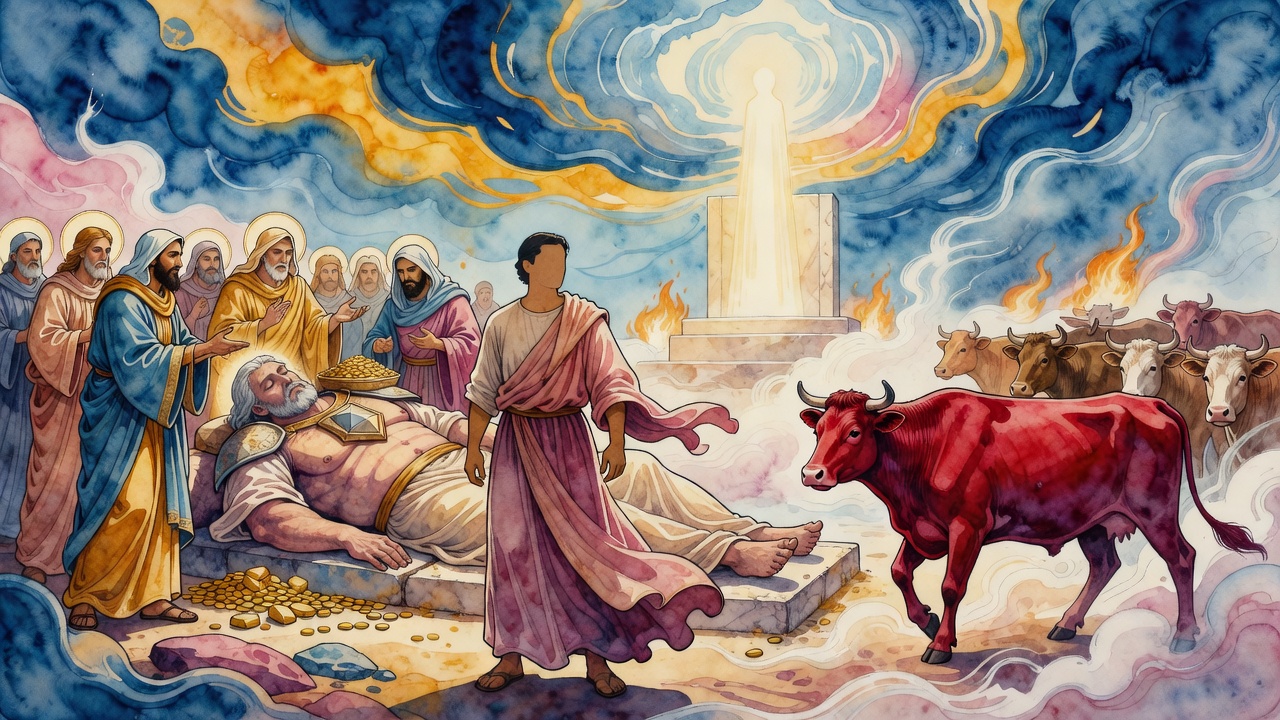
They found him polite, solvent, and immovable. The stone lay in a locked chest. The key lay in his father's pocket, and the old man slept stretched across the chest itself, one leg resting on the lid, breath slow, toes slack. Dama looked at the pair of them, gem and father, price and sleep, and shook his head. Come back later. I will not wake him.

The buyers heard a negotiation. They raised the offer. A thousand gold pieces became ten thousand. The sums climbed into territory that rewrites a merchant's life. Dama's face did not change. For one afternoon, the sleep of an old man outweighed the budget of the sanctuary.

The Sale That Waited for Waking

When his father finally stirred on his own, Dama opened the chest and brought out the stone. Then he did the stranger thing. He sold it at the first price, the modest sum offered before the bidding began. He would not gouge the Temple for the hours of refusal, and he would not pocket profit born from honoring his father. The waiting had never been leverage. The waiting had been the whole point.

The buyers carried the jewel up to Jerusalem half shamed and half amazed. In the courts of the House, the names of the tribes would shine over a heart, set with a stone released only after a gentile son finished guarding a nap.

A Slap in the Marketplace

His mother was harder to honor. Her mind had come loose, and in public she would strike him, hand free, voice sharp enough to turn strangers' heads. Dama did not perform patience for the crowd. "That is enough, mother." No counterblow. No speech. He steadied her only enough to keep her from falling, then let go.

The students of Rabbi Eliezer the Great later held this pagan of Ashkelon up as the measuring rod for a commandment Israel had carried since Sinai. Honoring father and mother is not a mood. It is a refusal to shame the people who gave you a name, even when they shame you first, and its reward reaches into this world and the World to Come.

Esau in His Finest Clothes

Rabban Shimon ben Gamliel measured himself against a harder mirror and admitted the loss. He had served his own father in work clothes, saving the fine garments for the marketplace. Esau did the reverse. When he attended Isaac, he dressed as if entering the chamber of a high officer, seams clean, belt straight, the game he had hunted presented with both hands (Genesis 25:28). Whatever else Esau was, at his father's side he was exact.

That exactness earned his descendants time. Israel on the road was told, "You have circled this mountain enough; turn yourselves to the north" (Deuteronomy 2:3), and the sages heard in the verse a debt of honor still being paid to Esau's line. Rabbi Yehoshua ben Levi remembered how six hundred thousand angels of destruction massed over Jerusalem and held back when the Divine Presence withdrew its right hand before the enemy (Lamentations 2:3). Patience with Esau's house is not approval. It is a long accounting that still remembers a bowl of game and a fine coat.

The Family That Would Not Sell Its Smoke

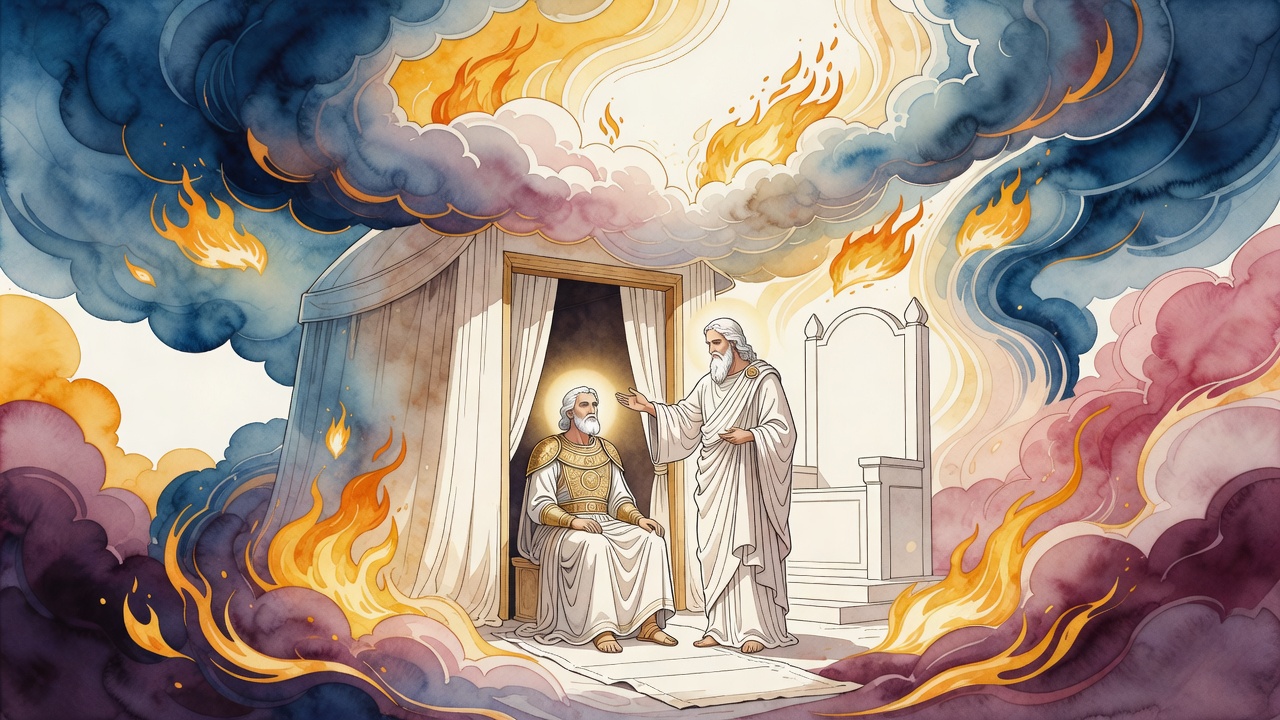
Refusal had a cousin inside the Temple itself. The house of Abtinas held the secret of the ketoret, the eleven-spice incense whose smoke rose from the golden altar in a straight column, bending neither left nor right. They would teach the craft to no one. Angry directors dismissed them and imported specialists from Alexandria, and the Alexandrian smoke wandered like ordinary perfume. The directors came back. The family returned at double the fee, mouths still closed.

Their reason was not greed. They feared handing the formula to someone unworthy, who would carry it to an idol's altar and make a pagan shrine smell like the House of God. And they kept one discipline sharper than any fee: no member of the family ever wore perfume, so that no one alive could say they had turned the sacred spices to their own skin. The guardians of Israel's fragrance walked through life smelling of nothing at all.

The Red Heifer's Receipt

Heaven keeps accounts that markets cannot see. Within the year, Dama's herd produced a parah adumah, a flawless red heifer, the rare animal whose ashes purify Israel (Numbers 19) and whose price makes ordinary livestock look like straw. Priests came south again, this time to buy from him. Dama named a figure equal to what he had given up by letting his father sleep, and they paid it. The mitzvah (a commandment) was repaid with interest, in the exact currency he had declined.

He checked on the old man again that evening, without an audience. His father asked what all the visitors had wanted. Nothing that could not wait, Dama said, and meant it.


← All myths

From the tradition

Sources

4 sources

The texts behind this telling. Some cards carry a translation of the source; others are our own retelling of it, and each card says which. Every card links out to the original.

Gaster, Exempla of the Rabbis No. 188 (1924); Kiddushin 31aThe Exempla of the Rabbis (1924)

Retold in our words. Read the original at the link below.The Exempla of the Rabbis, Moses Gaster (1924) · PD-US-pre-1929

The Talmud in Kiddushin 31a tells the story of Dama ben Netina, a gentile merchant of Ashkelon who became, in the rabbinic imagination, the standard for filial honor. The exempla collection edited by Moses Gaster in 1924 preserves the tale as number 188.

The priests of the Temple in Jerusalem came to Dama's warehouse one day in search of a particular precious stone to complete the choshen, the breastplate of the High Priest that bore the names of the twelve tribes (Exodus 28:17-21). The stone was in a locked chest, and the key was in his father's pocket, and his father was asleep on top of the chest.

Dama would not wake him. He stood before the priests and shook his head. Come back later, he told them. My father is resting, and I will not disturb him. The priests, assuming he was simply negotiating for more money, raised their offer. Then raised it again. The sums climbed into the many thousands of dinars. Dama still refused. The honor of his father was not for sale at any price.

Eventually his father woke on his own. Dama opened the chest, took out the stone, and sold it for the original, modest price the priests had first offered. He would not profit from the moments his father had slept.

The story does not end there. Heaven rewards acts like this with exacting precision. The next year Dama's herd produced a parah adumah, a flawless red heifer, the rarest and most valuable animal in the Jewish sacrificial economy, used for the purification ritual of Numbers 19. Jewish priests came to buy it. Dama named a price equal to the sum he had given up by refusing to wake his father, and they paid. The mitzvah of kibbud av, honoring one's father, was repaid with interest, in the exact currency he had declined. Heaven is a meticulous accountant of unnoticed kindnesses.

Full source
Yoma 38a (Harris, Hebraic Literature, 1901)Hebraic Literature (1901)

Retold in our words. Read the original at the link below.Project Gutenberg eBook #14368, Hebraic Literature · PD-US-pre-1929

In the Temple of Jerusalem, the most fragrant service of the day was the burning of the ketoret, the compound incense of eleven spices that rose in a thin column from the golden altar inside the Holy. The preparation of this incense was not a job for any priest. It was a hereditary craft, and one family, the house of Abtinas, held the secret.

The Mishnah in Yoma 3:11 records that this family refused to teach their art to anyone else. At one point the Temple directors, angered by the refusal, removed the Abtinas family from the service and imported specialists from Alexandria, in Egypt, to prepare the sweet perfume. The Alexandrian experts failed. Whatever they mixed did not rise the way the incense of Abtinas rose, a straight column that bent neither left nor right. The directors had to come back and ask the family to resume, and the family, knowing their worth, only agreed if their fee was doubled.

Why the secrecy? The Talmud records their own answer, preserved in Harris's 1901 Hebraic Literature. We feared that we might teach the formula to some unworthy person, who would then use the knowledge in idolatrous worship. The spices that made Israel's altar column ascend could, in the hands of an idolater, make a pagan altar smell just as sweet. The Abtinas family refused to let the fragrance of the Beit HaMikdash be counterfeited.

There is one more detail, almost ethical poetry. The members of this family were careful never to use perfume of any kind on their own persons, so that no one could ever say, They are putting the sacred ingredients to personal use. They lived unscented so that the incense of Israel could remain unrivaled. The guardians of the smoke walked through life smelling of nothing at all.

Full source
Devarim Rabbah 1:15Devarim Rabbah

Retold in our words. Read the original at the link below.The Sefaria Midrash Rabbah, 2022 · CC-BY

Our jumping-off point is the verse in (Deuteronomy 2:3), "You have circled this mountain enough; turn yourselves to the north.” But how does this relate to honoring parents? Well, in halakha, or Jewish law, this verse is used to illustrate the incredible reward for honoring one's father and mother. This mitzvah, this good deed, is one of those rare things that brings benefits in this world and ensures a place in the World to Come.

The text from Devarim Rabbah dives right in. It asks: what does honoring parents really entail? To answer, it brings us the story of Dama ben Netina, a non-Jew living in Ashkelon. Rabbi Abbahu tells us that the students of Rabbi Eliezer HaGadol used Dama as an example.

Dama's mother was, shall we say, eccentric. The text delicately puts it as "mentally disturbed." She would sometimes slap him, even in public! And his response? A gentle, "That is enough, mother." Can you

The story doesn't end there. On another occasion, some sages needed to purchase a precious gem, crucial for the priestly vestments used in the Temple. Dama had it, and they offered him a thousand gold pieces – a king's ransom! But Dama found his father asleep, with his leg resting on the chest containing the gem. He wouldn’t dare disturb his father's rest, even for such a huge sum. He let the sages leave empty-handed.

Thinking he was just trying to squeeze more money out of them, they upped the offer to ten thousand gold pieces! When his father finally woke up, Dama retrieved the gem. He refused to accept the inflated price, sticking to the original agreement of one thousand. He didn’t want to profit from the mitzvah of honoring his parents.

So, what was his reward? Our Rabbis tell us that during that very year, his cow gave birth to a red heifer, a rarity with immense ritual significance. He sold it for more than ten thousand gold pieces! A clear sign that the Holy One, blessed be He, repays those who honor their parents.

Now, Rabban Shimon ben Gamliel chimes in with a fascinating comparison. He admits that despite his best efforts, Esau, yes, that Esau, actually honored his father Isaac more than he did.

He explains that he would serve his father wearing work clothes, and only change into finer garments when going to the marketplace. Esau, however, always wore his best clothes when attending to his father. Rabban Shimon ben Gamliel realized that Esau's approach showed greater respect. As the Maharzu commentary says, Rabban Shimon ben Gamliel served his father in soiled garments in order to indicate his willingness to act even as a servant in serving his father. But Esau would put on his finest clothes, as though he were going to meet a government officer.

This leads to a deeper dive into the story of Jacob and Esau. Remember when Rebecca helps Jacob deceive Isaac to get the blessing? Jacob is worried. "Mother," he says, "Esau is hairy, and I am smooth! What if my father feels me? I’ll be cursed, not blessed!" (Genesis 27:11-12).

Rebecca's solution? "I’ll dress you in Esau's best clothes, the ones he wears to serve your father." And that's exactly what she does. When Jacob enters, Isaac says, "The voice is the voice of Jacob, but the hands are the hands of Esau" (Genesis 27:22).

The text highlights Esau's reaction when he realizes he's been tricked. He cries out, "Come and see what this simple man did to me!" (Genesis 27:36). The text emphasizes that Esau was meticulous in honoring his parents.

Finally, Rabbi Yudan adds a fascinating detail. When the Israelites were about to wage war against Edom, the descendants of Esau, God showed Moses the mountain where the patriarchs were buried. God tells Moses to tell the Israelites: "You cannot confront him. Even now, the reward for honoring those buried on this mountain is owed him." The implication is that even Esau's descendants benefit from the merit of honoring one's parents.

Honoring parents isn't just about grand gestures. It’s about the little things: patience, respect, and putting their needs before our own, even when it's difficult. It's about recognizing the inherent worth and dignity of our parents, regardless of their quirks or imperfections. And it's a mitzvah with rewards that ripple through generations. What small act of honor can we offer our parents today?

Full source
Devarim Rabbah 1:17Devarim Rabbah

Retold in our words. Read the original at the link below.The Sefaria Midrash Rabbah, 2022 · CC-BY

It begins with the phrase "you have circled enough," and then dives into what it really means to be patient, to trust, and to understand the long game of history.

The verse in question, "Be silent before the Lord, vehitḥolel for Him" (Psalms 37:7), is the key. What does vehitḥolel even mean? It’s a tricky word, but the rabbis unpack it beautifully. One interpretation suggests it means to place your hope in God, just like the Psalmist cries out, "Why, my soul, are you stooped over?…Have hope [hoḥili] in God" (Psalms 42:6). See the connection there? Vehitḥolel is about cultivating that deep, unwavering hope.

It gets even more profound. Rabbi Tahlifa of Caesarea offers another perspective: if suffering befalls you, accept it with behila – with fear, with awe, with a sense of something greater at play. It's not about passive acceptance, but about recognizing the divine hand, even in hardship.

The text takes a turn to address a difficult question: Why do the wicked prosper? "Do not contend with one who prospers" (Psalms 37:7), it says, referring to Esau. He's the archetype of the successful evildoer. The text even connects him to Rome, which, at the time of the writing, was seen as a deceitful empire. We're told the Roman judge would trick and confuse the accused, leading them to incriminate themselves. Not exactly a shining example of justice, is it?

Rabbi Yehoshua ben Levi brings in a truly powerful image. He describes the destruction of Jerusalem, with sixty myriads – that's six hundred thousand! – of angels of destruction ready to strike. But they held back because they saw the Divine Presence itself "withdrawing His right hand from being before the enemy" (Lamentations 2:3). God was silent. The angels followed suit. It's a stark reminder that sometimes, even divine power is restrained.

Rabbi Hanina interprets “circled the mountain [hahar]” as a reference to Esau circling his father, who needed him. Remember, "Isaac loved Esau because of the game in his mouth" (Genesis 25:28). Esau provided for his father, and for that, he earned a reward. Rabbi Shmuel ben Rabbi Gedalya says that God acknowledges this. When Jacob offered a gift to Esau, Esau famously said, "I have plenty [rav]" (Genesis 33:9). God says, "With this expression, he honored [Jacob], with this expression, I will say to [the Israelites]: Turn away from him, 'you have circled enough [rav].'"

So, what’s the takeaway? It's not about condoning injustice or ignoring suffering. It's about understanding that everything – even the prosperity of the wicked – has its place in the divine plan. It’s about trusting that even when we feel like we're going around in circles, there's a purpose to the journey. And sometimes, the most profound action is to be silent, to hope, and to trust in the ultimate unfolding. Maybe that’s what it truly means to stop circling the mountain and finally move forward.

Full source