Translation of the source text.Torat Emet (Yalkut Shimoni) · CC-BY-NC
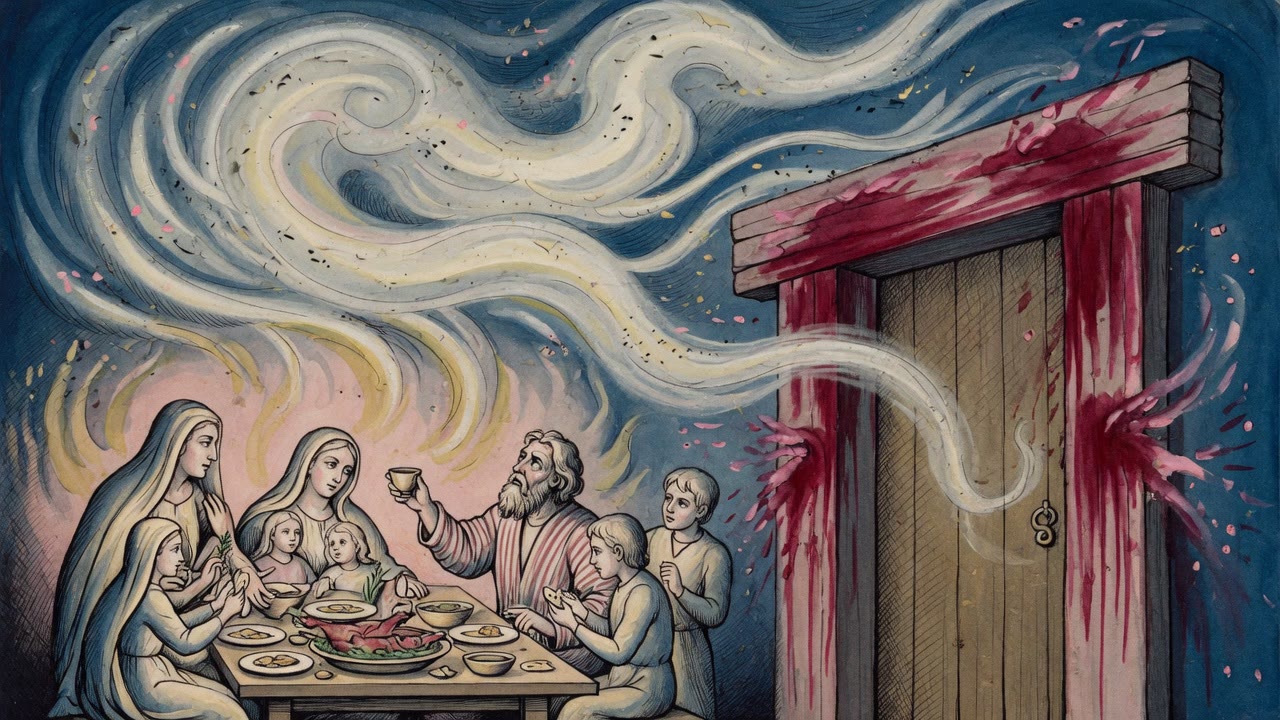
"In one house shall it be eaten" (Exodus 12:46). Scripture is speaking of one company. Or perhaps "in one house" means exactly what it says? When Scripture says, "upon the houses in which they shall eat it" (Exodus 12:7), we have learned that it may be eaten in many houses. What then does Scripture teach by "in one house shall it be eaten"? Scripture is speaking of one company. From here they said: the Passover offering may be eaten in two places, but the Passover offering may not be eaten in two companies. Rabbi Shimon ben Yochai says: How can it be eaten in two places? If they were inside the house and the beam split above them, they go out to the courtyard. If they were in the courtyard and rains came down upon them, they enter the house. They are therefore found eating it in two places. "You shall not carry forth any of the flesh abroad out of the house" (Exodus 12:46) means outside the company. Thus, if one carried it out, he transgressed the commandment. I might hear that it remains fit; but the legal reasoning teaches otherwise: since peace offerings are offerings of lighter sanctity, and the Passover offering is also of lighter sanctity, if you have learned concerning peace offerings that when one carries them outside he disqualifies them, then the Passover offering too, if he carries it outside, he disqualifies it. What then does Scripture teach by "You shall not carry out"? It teaches outside the company. "You shall not carry out from the house": Scripture is speaking of the flesh. You say it speaks of the flesh, or perhaps both flesh and bone are disqualified alike? Scripture therefore teaches, "You shall not carry out from the house any of the flesh" (Exodus 12:46). Scripture is speaking of the flesh. This is written in remez 641 and remez 443.
"And you shall not break a bone in it" (Exodus 12:46). Why is this said? Has it not already been said, "And they shall eat the flesh" (Exodus 12:8)? Does this mean the flesh outside the bone, or [only] the flesh inside the bone? And how do I uphold "and you shall not break a bone in it"? As referring to a bone that has no flesh, or perhaps a bone that has flesh. Scripture therefore teaches, "and a bone you shall not break": whether it has flesh or does not have flesh. "In it" means in the Passover offering, and not in all other consecrated offerings. For one might reason: if the lighter Passover offering carries a transgression of "you shall not break," then is it not logical that offerings of stricter sanctity would carry that transgression? What then does Scripture teach by "in it"? In it, and not in other consecrated offerings. One who breaks a bone in a ritually pure Passover offering receives the forty lashes, but one who leaves over flesh from a ritually pure offering, and one who breaks a bone in an impure offering, does not transgress. From where do we know this? Scripture says, "and you shall not break a bone in it": in it, when it is fit, and not when it is disqualified. From where do we know the rule for one who leaves over from a pure offering? As it was taught: "You shall let nothing of it remain until morning" (Exodus 12:10). Scripture came to place a positive commandment after a negative commandment, and so on. The rabbis taught: "and you shall not break a bone in it," whether a bone that has marrow in it or a bone that has no marrow in it. And how do I uphold "and they shall eat the flesh" (Exodus 12:8)? As flesh that is on top of the bone. Or perhaps it means only flesh inside the bone, and how do I uphold "and you shall not break a bone in it"? As referring to bones that have no marrow; but bones that have marrow, one may break and eat. Do not wonder at this, for a positive commandment may come and override a negative commandment. Rava said: A positive commandment does not override a negative commandment in matters of the Sanctuary. When Scripture says concerning the second Passover, "nor shall they break a bone of it" (Numbers 9:12), though there was no need for Scripture to say it, since it had already said, "according to all the statute of the Passover they shall do it" (Numbers 9:12), you must say: the rule applies equally to a bone that has marrow and a bone that has no marrow. "You shall not carry out from the house" (Exodus 12:46): I have only learned from house to house. From where do I learn from company to company? Scripture therefore teaches, "of the flesh abroad," meaning outside the place of its eating. Rav Ami said: One who carries Passover-offering flesh from one company to another is not liable until he sets it down, because "carrying out" is written concerning it as with Shabbat. It was taught: "upon the houses in which they shall eat it" (Exodus 12:7) teaches that the Passover offering may be eaten in two companies. Could this mean that the one who eats may eat in two places? Scripture therefore teaches, "in one house shall it be eaten" (Exodus 12:46). From here they said: if the attendant ate an olive-bulk [beside the oven], and the members of the company wanted to do him a kindness, they come and sit beside him. These are the words of Rabbi Yehuda. Rabbi Yishmael says: "houses in which they shall eat it" teaches that the one who eats it may eat in two places. Could it mean that it may be eaten in two companies? Scripture therefore teaches, "in one house shall it be eaten" (Exodus 12:46). One master holds that the reading tradition is decisive, and one master holds that the written tradition is decisive. Could the principal eating of the Passover offering be in two companies? Scripture therefore teaches, "in one house shall it be eaten."
"All the congregation of Israel shall keep it" (Exodus 12:47). Why is this said? Because Scripture says, "Draw out and take yourselves lambs" (Exodus 12:21). Just as the Passover of Egypt was fit only by families, so I might say the Passover of the generations is fit only by family. Scripture therefore teaches, "All the congregation of Israel shall keep it," telling that the Passover offering may be eaten in a mixed company. "And when a stranger shall sojourn with you and keep the Passover" (Exodus 12:48): I might hear that as soon as he converts he keeps the Passover immediately. Scripture therefore teaches, "and he shall be as one born in the land" (Exodus 12:48): just as the native-born keeps it on the fourteenth, so the convert keeps it on the fourteenth. Rabbi Shimon ben Elazar says: Suppose one converted between the two Passovers. I might hear that he keeps the second Passover. Scripture therefore teaches, "and he shall be as one born in the land": just as a native-born person who did not keep the first keeps the second, and so on. "Let all his males be circumcised, and then let him come near to keep it" (Exodus 12:48): this tells that the circumcision of his males prevents him from eating the Passover offering. I have only learned the circumcision of his males. From where do I learn the circumcision of his servants? You reason as follows: "then" is said here, and "then" is said there (Exodus 12:44). Just as there it concerns the circumcision of his servants, so here it concerns the circumcision of his servants; and just as there it concerns the circumcision of his males, so here it concerns the circumcision of his males. These are the words of Rabbi Yishmael. Rabbi Akiva says: The circumcision of his males does not prevent him from eating the Passover offering. What then does Scripture teach by "Let all his males be circumcised, and then let him come near to keep it"? Rather, if two commandments stood before him, the commandment of the Passover offering and the commandment of circumcision, I would not know which one he should do first. When Scripture says, "Let all his males be circumcised," it places the commandment of circumcision before the commandment of the Passover offering. Rabbi Nathan says: Scripture need not say "Let all his males be circumcised" except to include a slave who immersed before his master, who thereby goes out free. There was an incident with Bloria, some of whose maidservants immersed before her and some after her. The case came before the sages, and they said: those who immersed before her are freewomen, and those who immersed after her remain enslaved. Even so, they served her until the day of her death. The school of Elijah taught: Once I was passing from place to place, and a certain elder found me. He said to me: Do the nations of the world have a share in the days of the Messiah? I said to him: My son, every nation and every kingdom that oppressed Israel and pressed them hard will see Israel's good fortune, then return and go back to their dust, and they will never live again, as it is said, "The wicked shall see it, and be grieved," and so on (Psalms 112:10). But every nation and every kingdom that did not oppress Israel and did not press them hard will come into the days of the Messiah, as it is said, "And strangers shall stand" and so on, "but you shall be called the priests of the LORD" (Isaiah 61:5-6), and it says, "and to His servants He shall call another name" (Isaiah 65:15). These are the worthy ones among the nations. He said to me: My teacher, say that since they come into the days of the Messiah, and so on. "No uncircumcised person shall eat of it" (Exodus 12:48): could this mean that he disqualifies the members of the company who come with him? And there is legal reasoning for it: since impurity disqualifies and uncircumcision disqualifies, just as with impurity Scripture did not make partial impurity like total impurity, so with uncircumcision it should not make partial uncircumcision like total uncircumcision. Or go this way: since uncircumcision disqualifies and time disqualifies, just as with time Scripture made partial time like total time, so with uncircumcision it should make partial uncircumcision like total uncircumcision. Let us see what it resembles. We derive a matter that does not apply to all sacrifices, and so on. Or go this way: we derive a matter whose general rule was not permitted from a matter whose general rule was not permitted, and impurity cannot prove it, because its general rule was permitted. Scripture therefore teaches, "and every uncircumcised person": when there is complete uncircumcision, it is disqualified; partial uncircumcision is not disqualified. And if you say this is for sprinkling the blood, so that complete uncircumcision disqualifies but in sprinkling it does not, Rabbah holds that if one slaughtered it for circumcised persons with the intent that uncircumcised persons be atoned through it, it is fit, for disqualifying thought about uncircumcised eaters does not apply at the sprinkling. And if you say, what is lighter about sprinkling? It is that thought about the eaters does not apply at its sprinkling. But Rav Chisda says the opposite, to the other side: Scripture therefore teaches, "[and] every uncircumcised person," that if there is total uncircumcision it disqualifies, but partial uncircumcision does not disqualify. And if you say the same law should apply to sprinkling, Scripture therefore teaches, "This" (Exodus 12:43), with respect to slaughtering; but with respect to sprinkling, even partial uncircumcision also disqualifies. And if you say, what is the stringency? It is that piggul, an offering invalidated by wrong-time intent, is established only through sprinkling.

 Click for full size