6 min read

Inside Israel's Blood-Marked Passover Houses

At midnight Israel stayed inside with lamb blood and circumcision as their shield while Pharaoh ran through Egypt begging Moses to let them go.

Curated by Arthur · Told by Maggid ·
Table of Contents
  1. The Houses Were Marked Before the Cry
  2. Two Bloods Stood at the Door
  3. Midnight Kept Moses' Word
  4. Pharaoh Ran Through His Own Streets
  5. No One Left Like Thieves
  6. The Voice Made Freedom Public

At midnight, Israel did not run.

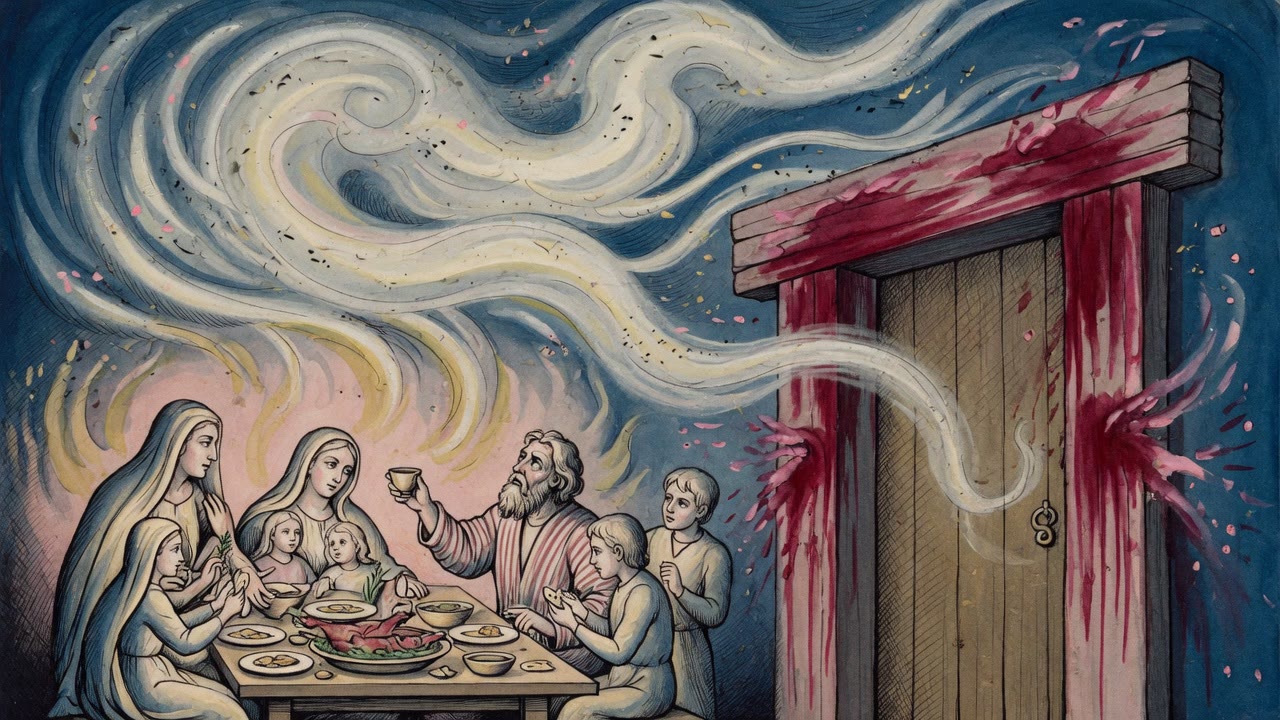
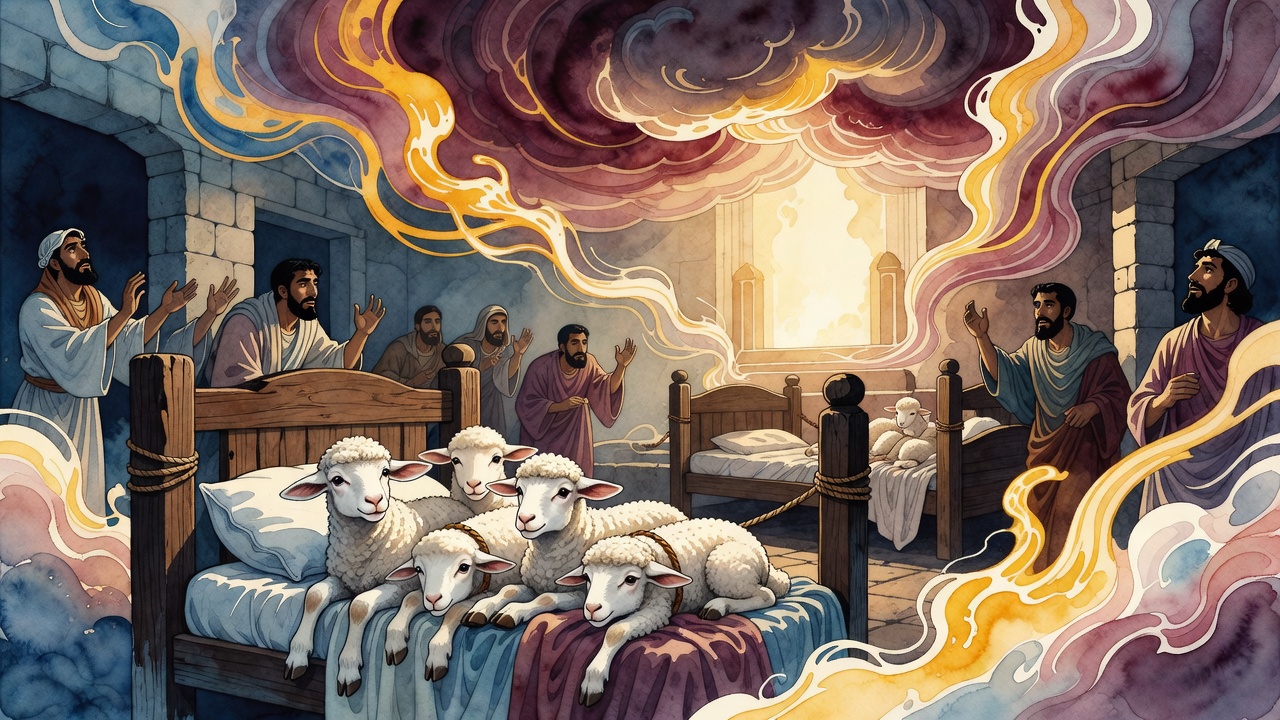
Inside the blood-marked houses, families waited with the doorways sealed and the night pressing against the lintels. Outside, Egypt began to cry from one end of the land to the other. Inside, the people who had been slaves stayed where God had placed them, not because the road was closed, but because the command had a boundary. No one left until morning.

The Houses Were Marked Before the Cry

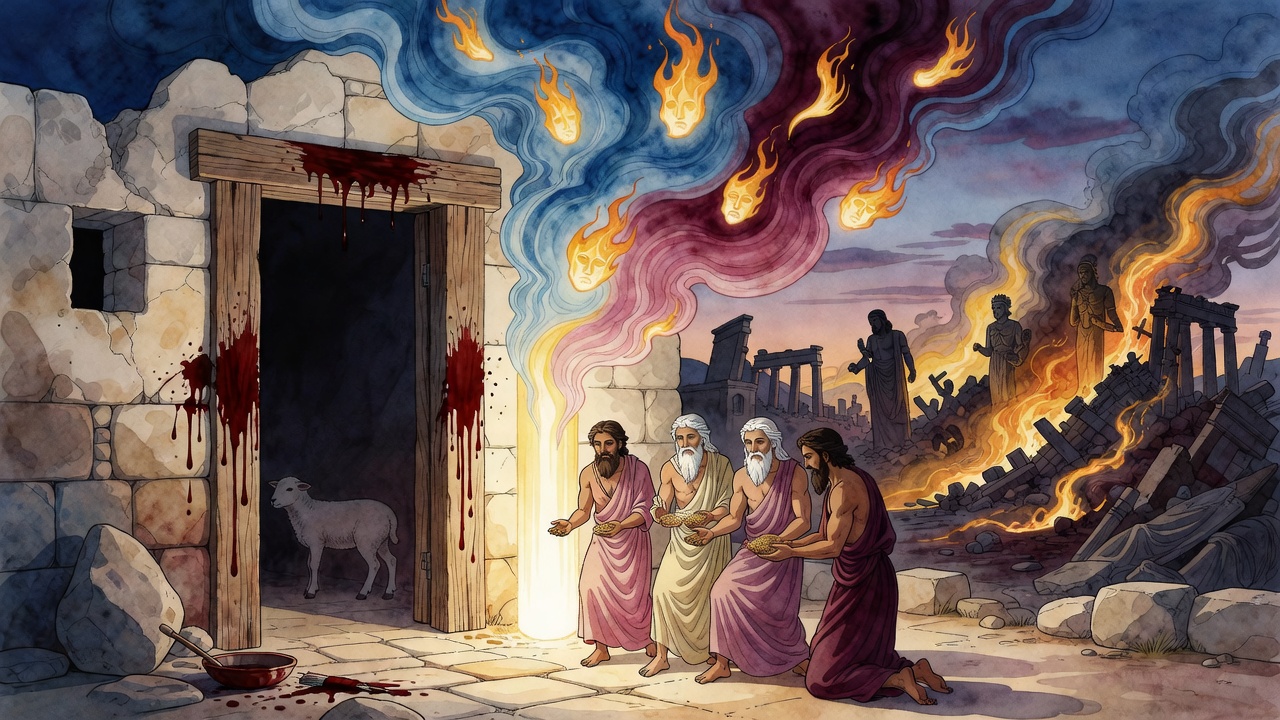
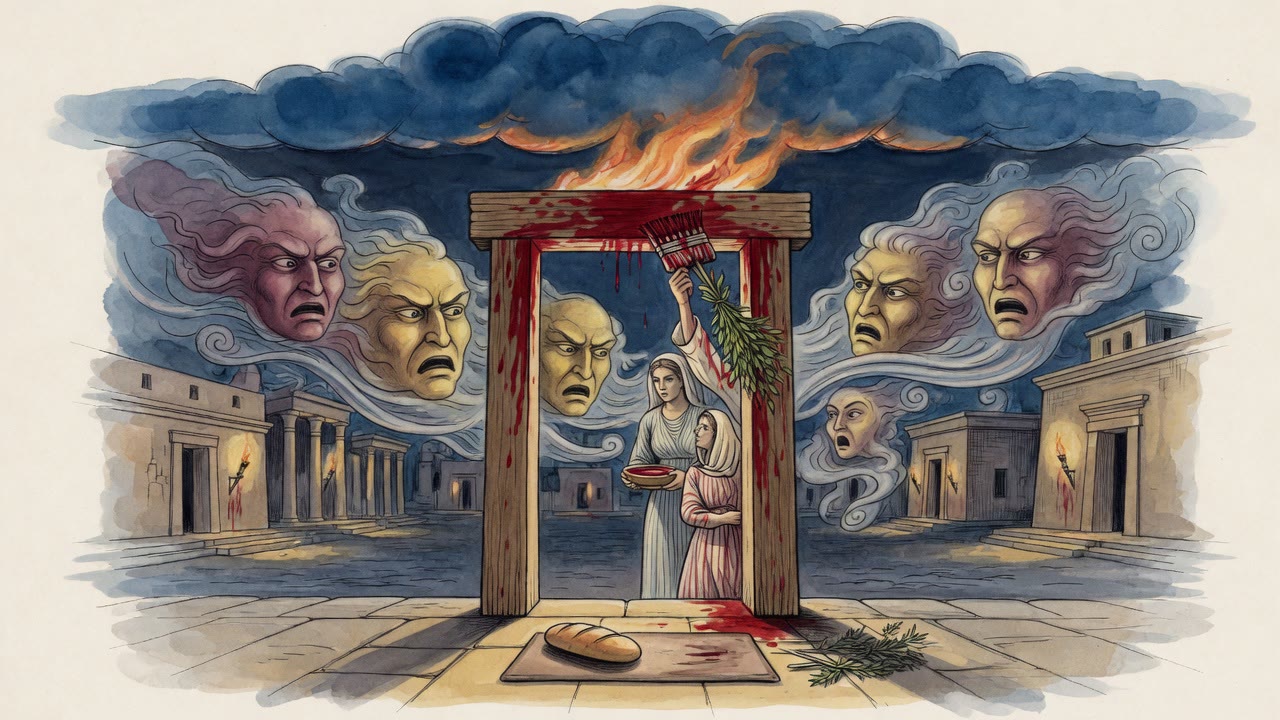
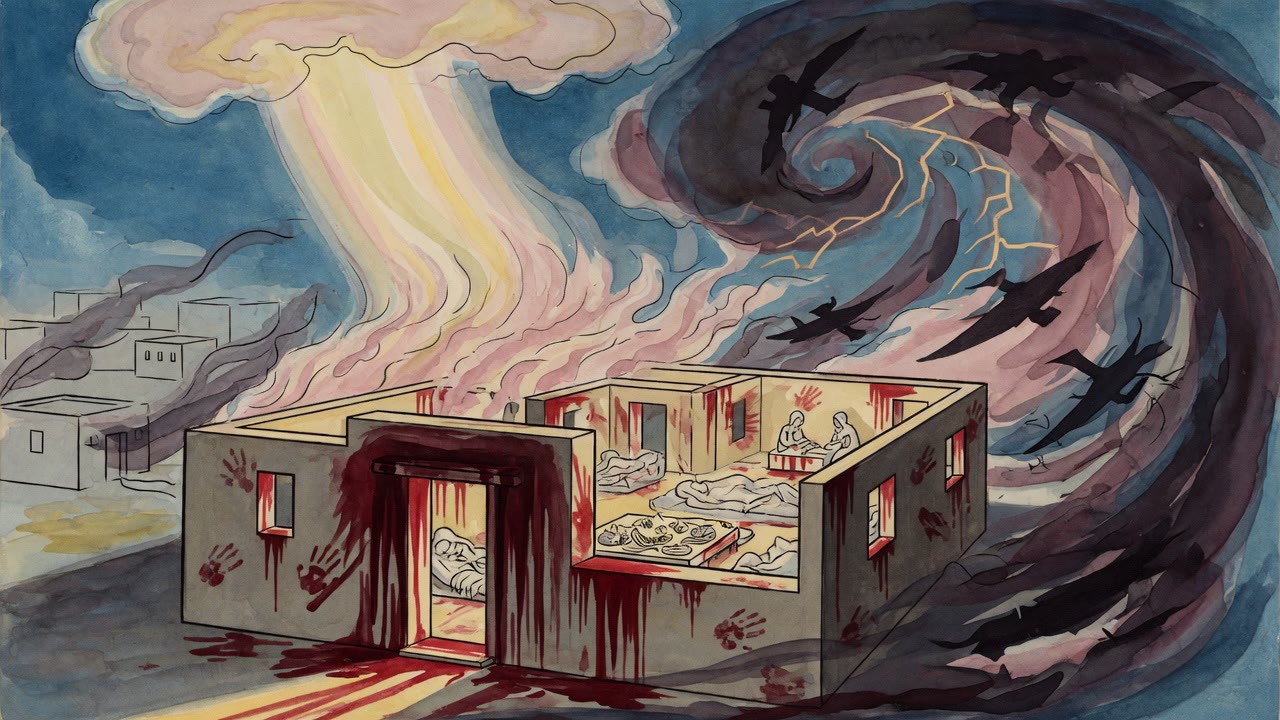
The blood on the doorposts was not decoration. It stood at the threshold like a witness. Every house had become a small court, and the doorway carried evidence that the people inside belonged to a different authority now.

The lamb had been taken, slaughtered, eaten in haste, and its blood placed where an entering force would have to see it. The meal itself tasted like departure. Belts tightened. Feet were ready. Staffs were near. But readiness did not mean panic. Freedom was being rehearsed in rooms that still sat inside Pharaoh's kingdom.

The night demanded a strange discipline. Be ready to leave, but do not leave. Dress like travelers, but remain behind the blood. Eat like free people, but wait for the hour to open.

Two Bloods Stood at the Door

The threshold carried more than the blood of the lamb. Another blood stood beside it, the blood of circumcision. Israel had to be marked in the covenant before the house could stand under protection. The door was not guarded by magic paint. It was guarded by belonging.

The destroyer had authority that night. Death was moving through Egypt by command, not by accident, and the marked houses needed a shield strong enough to answer that authority. The blood worked like bail, a legal pledge placed at the entrance. It did not argue that death was unreal. It said that this house had already been claimed.

So the families waited with two signs joined at the edge of the home: the blood of the offering and the blood of the covenant. One marked the night. One marked the body. Together they made the doorway speak.

Midnight Kept Moses' Word

Moses had spoken of midnight, and heaven made the hour exact.

The strike did not come early, when Egypt could call it confusion. It did not come late, when Pharaoh's servants could call it failure. It came at the center of the night, the hinge between one day and the next, when houses are most vulnerable and rulers are least theatrical. The empire that measured labor by quota and brick now had its own hour measured back to it.

At that hour, the firstborn fell. Palace and prison were caught in the same net. The plague did not flatter rank. It entered royal rooms and captive rooms, places of command and places of confinement, because Egypt as a world had been built on holding Israel down.

Pharaoh Ran Through His Own Streets

Then Pharaoh ran.

The king who had sat on a throne while others begged now moved through marketplaces in the dark, searching for Moses. His own streets had become a maze. His own people were awake. His own house had been struck. The man who had refused to hear command after command now shouted into the night for the slave he had tried to break.

Israel did not make the search easy. Voices called from one side and another, here, over here, until the king's desperation became public. The mockery mattered. A ruler who had hidden behind palace walls was dragged into the open by grief and fear. He had made slaves run at his word. Now he was the one running.

No One Left Like Thieves

When Pharaoh found Moses, he begged him to rise and go.

Moses refused the terms. Israel would not slip away at night like thieves. The command was clear: no one left his doorway until morning. Pharaoh could grant permission, but he could not rewrite the hour. The leaving would not be a frightened escape smuggled through darkness. It would happen in the open, under the command of the One who had struck Egypt at midnight.

That refusal changed the shape of freedom. Pharaoh wanted the plague to end. Moses required Egypt to admit what had ended. The difference was everything. A king in panic can push people out to save himself. A king made to speak can confess that the slaves are no longer his.

The Voice Made Freedom Public

Pharaoh said they were free. Moses made him say it again.

The words had to stand in the air twice because slavery had trained Egypt's mouth for ownership. Until now, Pharaoh said, they were slaves to me. From now on, they were servants of the Lord. The sentence cut the old chain at its root. Israel was not released into emptiness. They were transferred from bondage to service, from Pharaoh's labor to God's command.

Then the divine voice carried across the land, across forty days' journey, four hundred parsangs by four hundred. Egypt heard what the doorways had already known. The marked houses had been protected for a reason. Morning would not reveal fugitives. It would reveal a people waiting for permission from heaven, not from Pharaoh.

Inside the houses, the staffs were still in hand. Outside, Egypt pressed them to go. The doors stayed shut until the night had finished its work.


← All myths
From the tradition

Sources

4 sources

The texts this telling draws on, in full. Open a card to read inline, or expand it for a wider, quieter read.

Shemot Rabbah 18:1Shemot Rabbah

The familiar reading treats these epic stories in the Torah and just accept that things happened at the right moment. But what if there's a hidden layer of incredible detail beneath the surface, revealing just how meticulously God arranges events? to one example from Shemot Rabbah, specifically section 18, that blew my mind.

The verse in (Exodus 12:29) tells us, "It was at midnight, and the Lord smote all the firstborn in the land of Egypt…" Simple enough. But the rabbis in Shemot Rabbah don't let it rest there. They ask: Why midnight? What's so special about that particular hour?

The midrash (rabbinic interpretive commentary) connects this moment to (Isaiah 44:26): "Who fulfills the word of His servant and performs the counsel of His messengers." Rabbi Abahu identifies the "servant" in this verse as none other than Moses himself, citing (Numbers 12:7), "My servant Moses is not so, [he is trusted in all My house]." So how exactly did God fulfill Moses's word at midnight?

Think back to the plague of darkness. Pharaoh, desperate, tries to bargain with Moses, saying, "Go serve the Lord; only your flocks and your herds will remain…" ((Exodus 10:24)). But Moses stands firm: "By your life, 'no hoof will remain'" ((Exodus 10:26)). Now, the midrash digs into the meaning of "hoof." It wasn't just about what the Israelites owned. Even if an animal belonged to an Egyptian, if a single hoof of that animal belonged to an Israelite, Moses wouldn't leave it behind! That’s some serious commitment to principle. Moses continues, "As we will take from them… And we will not know with what we will serve the Lord" ((Exodus 10:26)). The midrash brilliantly interprets this as Moses saying, "You, Pharaoh, are just flesh and blood. People die if they disobey you. But we serve God! We don't know what He will ask of us. Maybe He'll demand sacrifices equivalent to the 210 years we were enslaved!"

Pharaoh, completely fed up, explodes: "Until when will you enter here? 'Go from me, beware, do not see my face anymore'" ((Exodus 10:28)). And Moses, with incredible resolve, replies: "You have spoken well; I will not see your face anymore" ((Exodus 10:29)).

Here's where things get truly fascinating. The midrash suggests that God, eager to keep Moses from being seen as a liar, actually rushed into Pharaoh’s palace to speak to Moses. How do we know? Well, previously Moses had refused to speak to God within the city, let alone the palace, because of all the idolatry. As (Exodus 9:29) says, "As I leave the city, I will spread my hands to the Lord." But now, God initiates the conversation, telling Moses, "One more plague I will bring upon Pharaoh…" ((Exodus 11:1)).

Moses, overjoyed, proclaims publicly, "So said the Lord: About midnight, [I will emerge in the midst of Egypt]" ((Exodus 11:4)). He essentially tells Pharaoh, "I won't come to you anymore. You will come to me. Your officials will beg me to leave!" He avoids explicitly demanding Pharaoh’s prostration, showing respect even in this moment of triumph.

And then, precisely at midnight, as Moses had declared, the final plague strikes. "It was at midnight, and the Lord smote all the firstborn…" Hence, the verse, "Who fulfills the word of His servant."

But the midrash doesn’t stop there! It adds, "And performs the counsel of His messengers," explaining that God had even consulted with Abraham about this plan! Remember when Abraham pursued the kings in Genesis 14? The midrash offers a mind-bending interpretation of "And he divided the night between them" ((Genesis 14:15)), suggesting that God and Abraham shared the night, setting the stage for the ultimate act of divine justice. Once midnight arrived on the night of the plague, the plan was complete.

So, what does all this mean? It means that the Exodus wasn't just a miraculous escape; it was a meticulously planned, divinely orchestrated event, down to the very minute. It shows us a God who keeps His promises, protects His messengers, and acts with incredible precision. It makes you wonder what other hidden depths lie beneath the surface of the stories we think we know so well.

Full source
Shemot Rabbah 18:10Shemot Rabbah

Shemot Rabbah, a classic midrashic (rabbinic interpretive commentary) collection, explores the details of the Exodus narrative, painting a vivid picture of that pivotal moment. One passage, Shemot Rabbah 18, focuses on the final plague – the slaying of the firstborn – and its immediate aftermath. It's a brutal event, no doubt. But the rabbis try to understand its nuances.

The passage reminds us that the Holy One, blessed be He, performed many miracles for Israel. But this one…it was different. It wasn't just about saving the Israelites; it was about judging those who actively opposed their freedom. The midrash uses a rather harsh analogy, comparing the Egyptians, specifically the firstborn, to animals, referencing (Ezekiel 23:20): “Whose flesh is the flesh of donkeys.” It’s a stark image, meant to emphasize the depth of their depravity in the eyes of the divine.

It doesn't stop there. The midrash expands the scope of the plague, noting that even the firstborn of captives were affected. Why? Because these captives, when offered freedom in exchange for Israel's release, refused. They preferred to remain in bondage rather than see Israel liberated. A chilling choice, isn't it? A choice that sealed their fate. "Therefore, He judged them with [the Egyptians]."

The passage then presents a powerful analogy: a king celebrating his son's celebration by vanquishing his enemies. The king declares that those who rejoice with him are welcome, while those who hate him will share the enemies' fate. Similarly, God celebrated Israel's redemption and extended an invitation. Those Egyptians who were righteous and supported Israel’s exodus joined the Israelites, becoming part of the "mixed multitude" that ascended with them, as described in (Exodus 12:38).

But those who opposed Israel’s freedom? They perished with the firstborn. The midrash emphasizes the sheer magnitude of the event, quoting (Exodus 12:30): “Pharaoh rose during the night, he, all his servants, and all of Egypt; and there was a great cry in Egypt, as there was no house in which there was no one dead.” The horror and chaos are palpable. The Egyptians, blaming Pharaoh for the catastrophe, were ready to kill him!

It's a moment of utter desperation. (Exodus 12:33) tells us that "the Egyptians urged the people, [to hastily send them from the land]." But even in this moment of forced exodus, God's plan unfolds with precision. God declared that the Israelites would not be expelled at night, but rather depart overtly at noon. A statement of power and control.

While the Egyptians were busy urging the Israelites to leave, the Israelites themselves were busy, too. According to the midrash, based on (Exodus 12:35), they were gathering possessions from the Egyptians. And Moses, as we find, was occupied with Joseph’s bones and the Tabernacle vessels that our patriarch Jacob had prepared. (See Shemot Rabba 33:8). Imagine that scene – amidst the chaos and grief, the quiet dignity of fulfilling ancient promises.

The passage concludes with a powerful verse from (Psalms 58:11): “The righteous shall rejoice when he sees vengeance.” The Israelites witnessed the punishment of their oppressors as they were being redeemed, and they rejoiced. It’s a complicated emotion to confront, isn’t it? Joy at the suffering of others, even when those others were your oppressors.

This passage from Shemot Rabbah offers a glimpse into the complexities of the Exodus story. It's not a simple tale of good versus evil. It's a story of choices, consequences, and the long, arduous journey toward freedom, both physical and spiritual. It challenges us to consider the cost of freedom, the nature of justice, and the enduring power of hope, even in the face of unimaginable suffering. What does it mean to truly be free? And what are we willing to do to achieve it?

Full source
Targum Pseudo-Jonathan on Exodus 12:13Targum Pseudo-Jonathan on Exodus

One of the most striking interpretive moves in Targum Pseudo-Jonathan happens quietly on (Exodus 12:13). The verse states that the blood on the doorposts will be a sign for Israel, and the Lord will see it and pass over. The Targum slips in a phrase that changes the theology: "the blood of the paschal oblation, (like) the matter of circumcision, shall be a bail for you."

Two bloods, then, protect the house: the blood of the Pesach lamb on the lintel, and the blood of circumcision on the household's men. The rabbis taught that Israel in Egypt had largely abandoned circumcision, and that on the eve of the Exodus they were commanded to undergo it again. The two bloods are wiped on the doorposts together. Both are required for the protection to take effect.

The Targum also clarifies what "pass over" means. The angel of death has been given authority to destroy, but the blood functions as a legal shield, a bail, in the Aramaic, that prevents the angel from entering. This is not God physically leaping over doorways. It is a court-like scene in which the destroying angel's authority is limited by a sign the houses have posted.

For the rabbis, this is why the seder is tied to the covenant of circumcision. An uncircumcised man cannot eat the Pesach (Exodus 12:48). The blood of the lamb belongs to the same covenantal category as the blood of the brit.

Takeaway: It took two bloods to save the house that night. Israel rejoined the covenant before the covenant could rejoin Israel.

Full source
Midrash Aggadah, Exodus 12:31Midrash Aggadah

"And he called for Moses and for Aaron" (Exodus 12:31). He went about at night, circling through the marketplaces, saying, "Where is Moses staying?" And the children of Israel made sport of him, saying, "Here." When he found them, he said to them, "Rise up, go out from among my people; go in peace, walk in peace." Moses said to him, "Wicked one! Are we thieves, that we should go out by night? Thus the Holy One, blessed be He, commanded us: 'And you shall not go out, any man from the door of his house, until morning.'" Pharaoh said to him, "I beg of you, rise up, go out from among my people. Behold, you are free men. Until now you were slaves to me, and I ruled over you; from now on you are servants of the LORD." "And go, serve the LORD." Moses said to him, "Say this thing two times." And the Holy One, blessed be He, caused the voice to be heard throughout all the land of Egypt, a journey of forty [days], which is four hundred parsangs by four hundred parsangs. Immediately, "And Egypt was urgent" (verse 33).

Another interpretation: "About midnight I will go out" (Exodus 11:4). "I will come in" is what it should have said. Rather, thus said the Holy One, blessed be He: "I go out from my obligation, which I promised to Abraham your father, at the time he pursued the kings, as it is said, 'And he divided himself against them by night' (Genesis 14:15)." And Abraham our father had said, "That half of the night, why do you not give it to me?" The Holy One, blessed be He, said to him, "I need it for your children, for I am destined to perform a redemption in it, and this is the going out from Egypt." Therefore He said, "I go out from my obligation."

Full source