One Word Made the Heavens and God's Breath Made the Stars
Sages calculating the new moon stopped when the teaching split creation in two. One word built the heavens. Breath alone labored out the host of lights.
Table of Contents
 Click for full size
Four Men and a Tablet of Wax
Rabbi Akiva put his finger down on the wax to hold his place and lost the count anyway. Across the table Rabbi Eliezer ben Hyrcanus was scratching at his own column, Rabbi Ishmael was reading both columns aloud in a flat voice to see whether they agreed, and Rabbi Elazar ben Arakh had not said a word in an hour, which in that room was the loudest thing a man could do.
They were fixing the molad, the birth-hour of the new moon. A messenger was waiting in the courtyard with his sandals tied, because the towns had to be told before the month started without them.
The lamp wanted trimming. Nobody trimmed it, since trimming it meant admitting out loud how long this had taken.
One Word, Then Labor
Elazar ben Arakh finally spoke, and what came out of him was not a number.
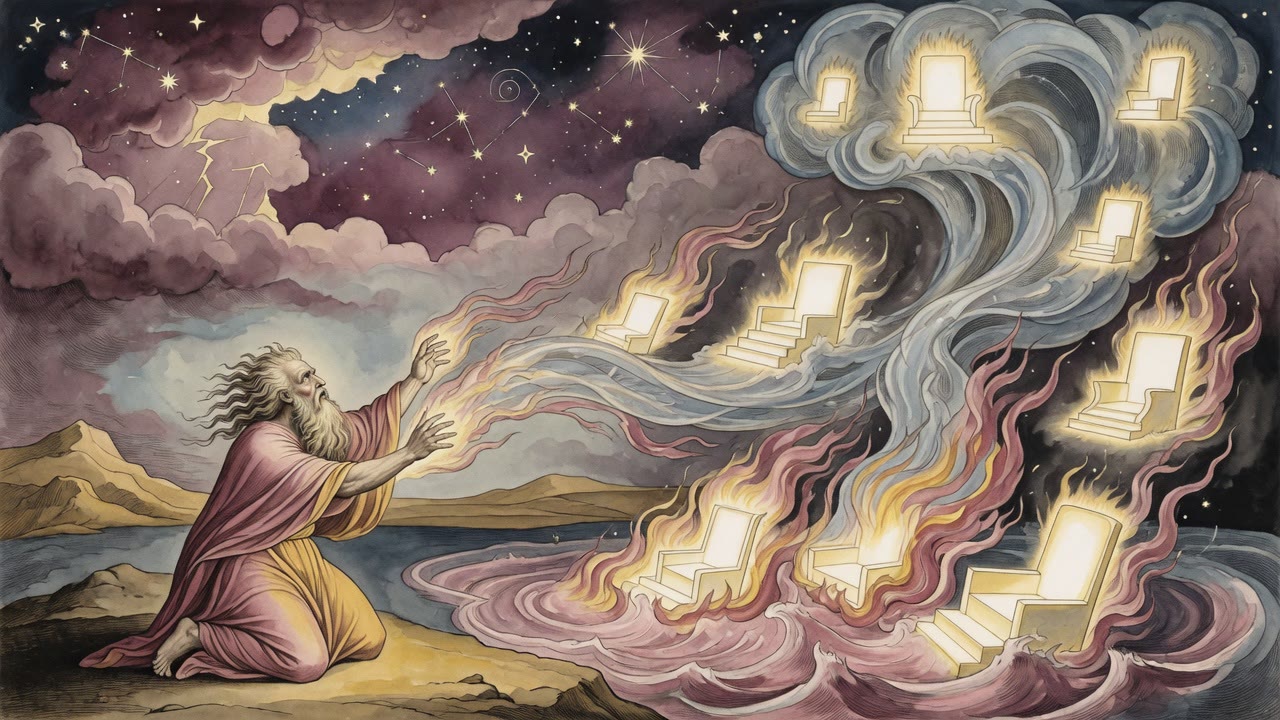
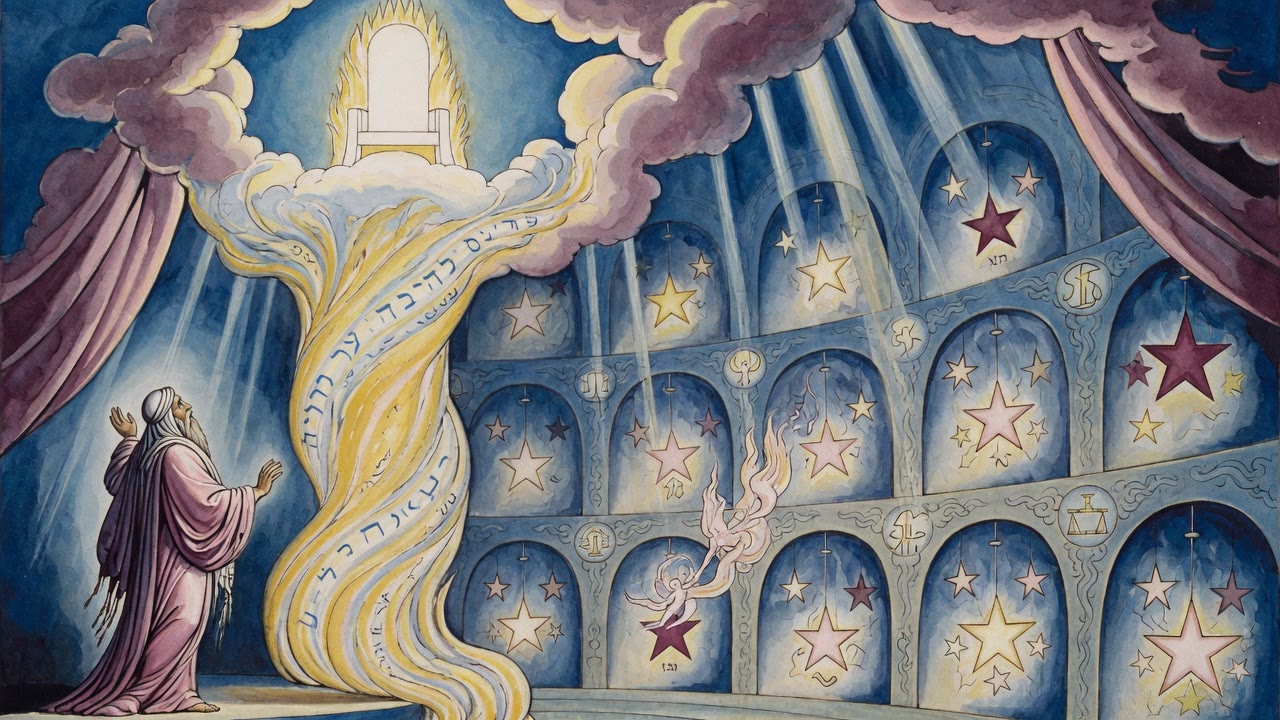
God said one word and the heavens were made, a dwelling readied for the Throne. By the word of the Lord were the heavens made, and that was the whole of it: an utterance, and the upper rooms stood.
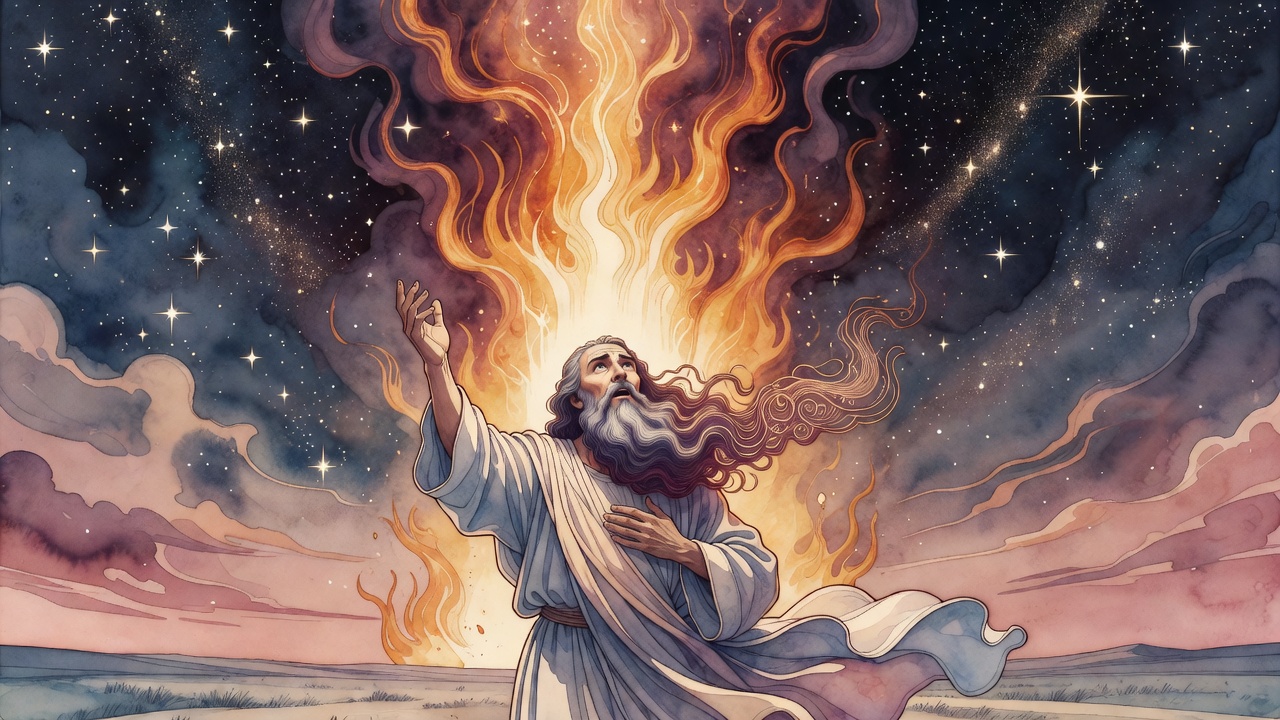
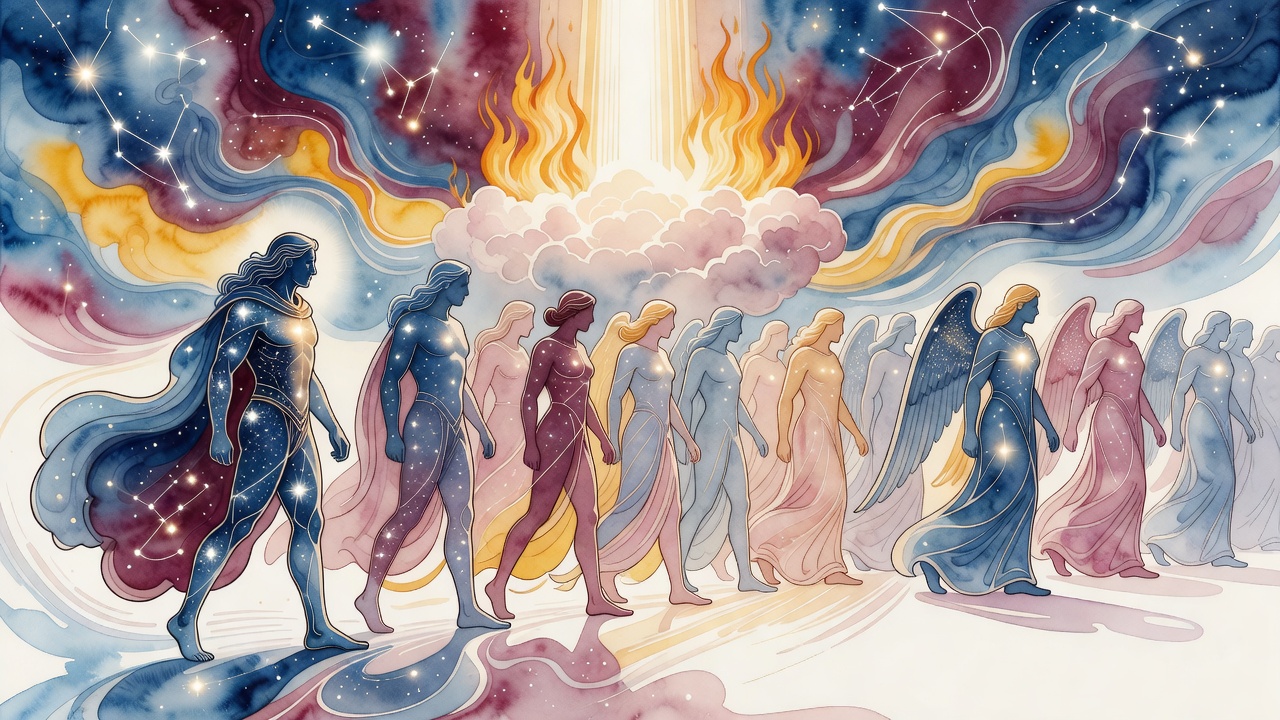
But the host of heaven cost more. For the stars and the whole company of lights one word was not enough, so He labored, and the labor was breath. He blew with His mouth the wind of the breath of life, and all the host of them came to be by the breath of his mouth. One verse, two prices. A word for the hall and breath for every lamp hung in it.
Akiva felt the difference somewhere under his ribs, because the thing on their tablet was one of those lamps. The moon was not a category. It had been breathed out singly, the way a man breathes on a coal he does not want to lose, and now four tired men were trying to say what hour it would be born.
Eliezer tapped the wax twice. "The hour, Elazar."
Delight and Plague Share Their Letters
Elazar would not be turned that fast, since the same mouth that breathed the lights had also set twenty-two letters in a circle like a wall with two hundred and thirty-one gates, every letter paired with every other, the circle turning back and forth. He permuted them and weighed them and transformed them, alef with all of them and all of them with alef, until everything that is formed and everything that is spoken came out of one Name.
Then he gave them the sign that goes with it. There is nothing in good higher than delight, oneg, and nothing in evil lower than plague, nega, and the two words are built out of the same three letters standing in a different order.
That sentence put the room back to work faster than any rebuke would have. If the four of them set the night wrong, the same letters would stand in the wrong order across a whole country. Ishmael said what it would look like on the ground: a town in the Galilee eating its festival meal while a town in Judea was still at ordinary work, one people keeping two calendars, and no way to unmake the error once the messengers had ridden.
Akiva looked at the wax and did not like his own handwriting.
Nothing Wrought in Secret
There were four of them and a shut door. No town would ever watch this work, and no one outside would know whether the number had been reasoned or guessed, so the honesty of it lived entirely inside a room nobody could see into.
Moses had known that problem and had not answered it with prohibitions. He laid the principles down point by point and used examples along with them, showing what an injury sin does and what punishment follows it, and first of all he proved that there is one God whose power fills every place, which means that nothing wrought in secret by men upon the earth escapes His knowledge.
Akiva had spent half the night arguing that the awe belonged in the room. Now he turned the argument over and it came out the other way. If the lights were breathed one at a time, and if nothing done behind a door is unseen, then an hour was not a rounding and a tired man's guess was not a calculation. The awe was not a break from the arithmetic. It was the reason to redo it.
"Read me the column again," he said. "From the top."
The Messenger Rode Before Dawn
They read it from the top, and this time nobody hurried. Akiva scraped a wrong stroke off the wax with his thumbnail and blew the shavings away, a small breath in a room that had spent the night on a larger one, and Ishmael did not let it pass without a look.
The number held. Eliezer sealed the note, the messenger took it with a heel of bread, and hooves went down the stone street toward the valley while it was still dark.
Then somebody finally trimmed the lamp and the light steadied. The wax tablet looked like an ordinary tablet again. Outside in the courtyard the old moon hung thin as a cut nail over the roofs, and Akiva stood under it a while before he went home, looking at the one light they had spent a whole night trying to be accurate about.
← All myths