Parshat Mishpatim6 min read

Onkelos Converted Every Legion Rome Sent to Arrest Him

Rome sent legion after legion to arrest the emperor's convert nephew, and each cohort sat down, listened, and crossed over instead.

Curated by Arthur · Told by Maggid ·
Table of Contents
  1. The Merchant Who Came Back Circumcised
  2. The First Cohort Never Came Back
  3. The Torch That Walks in Front
  4. The King Who Stands Guard Outside
  5. Rome Runs Out of Soldiers

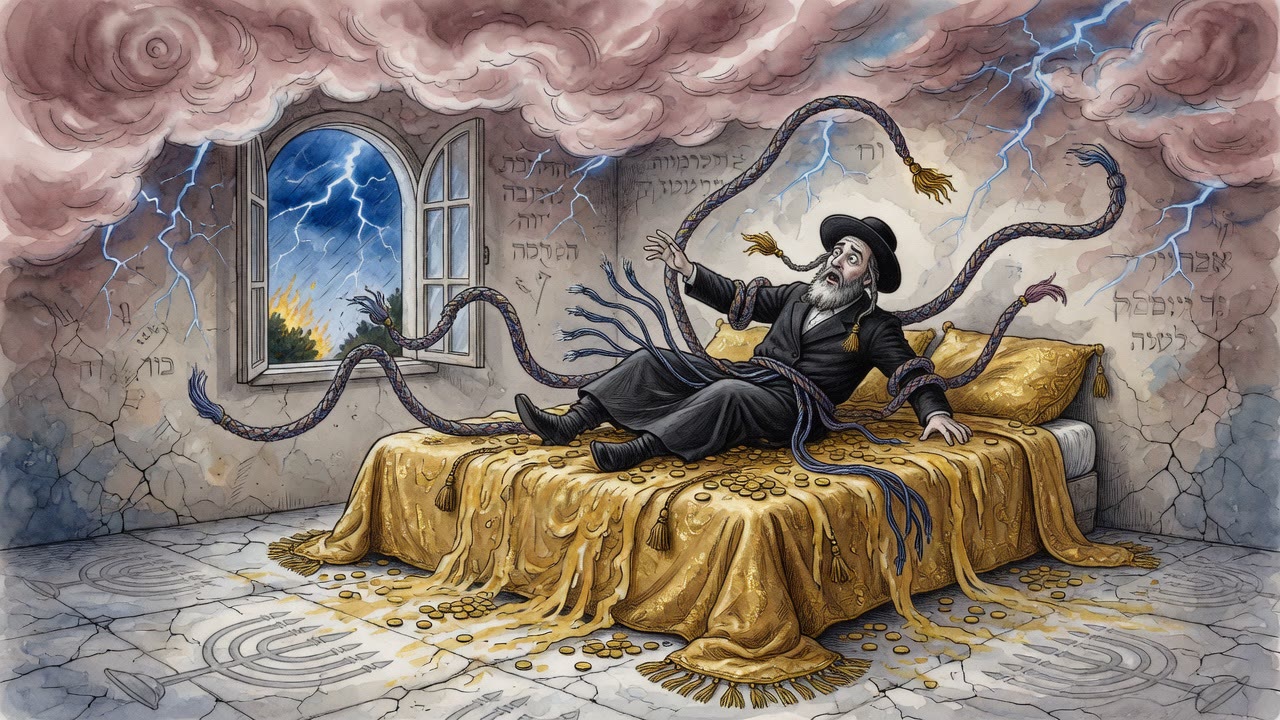
The emperor's own sister's son had traded the eagle of Rome for a fringe and a borrowed Hebrew name, and the imperial court could not let the insult stand. Onkelos bar Kalonikos had been raised inside the palace, close enough to the throne to inherit treasuries. Now he sat in a house in the Land of Israel, teaching letters older than the empire, and word of it traveled back to Rome like a fever. A nephew with eagles on his shoulders was a relative. A nephew in tefillin was a wound that could be seen from the street.

The Merchant Who Came Back Circumcised

It had begun as a clever lie. Onkelos had told his uncle he wished to go abroad and trade. Hadrian, by some tellings the emperor of the day, had offered him the treasury outright, but the young man wanted counsel, not coin. "Any merchandise you see lying low and cast down upon the ground," the emperor told him, "deal in that, for in the end it will rise up and you will profit." Onkelos went out and traveled among all the nations, and he found one people lying lower and more cast down than any other, and he bought into it with his whole life.

When he returned, his face had changed. Rabbi Eliezer and Rabbi Yehoshua had seen it first and said to each other that this Roman had been learning Torah. Hadrian saw it too. "Why is your face changed?" he demanded. "Has your trade collapsed? Has some man wronged you?" Onkelos answered that no man had wronged him. He had studied Torah, and more than that, he had circumcised himself. "Who told you to do this?" Onkelos smiled at the trap closing on his uncle. "You did. You told me to buy what lies cast down, for it will rise. I went among the nations and found none lying lower than Israel, and in the end they will rise, and kings will stand before them."

The emperor struck him across the cheek. A counselor at court fell into a black panic, climbed to the roof, and threw himself off rather than live to see those kings stand. Hadrian could kill an advisor's fear. He could not kill the argument. So he reached for the only instrument an empire trusts when reason fails.

The First Cohort Never Came Back

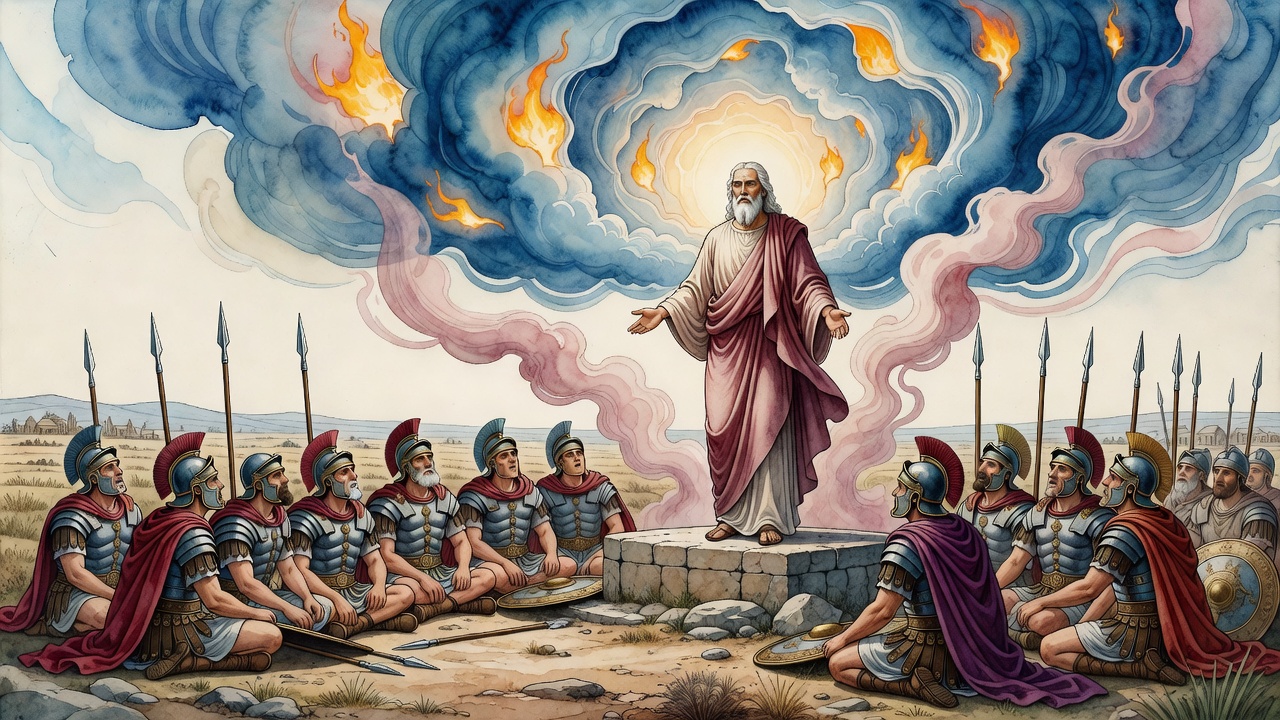
A legion was dispatched to drag Onkelos to Rome in chains. They arrived armed, credentialed, certain. He received them like guests. He did not argue and he did not preach. He sat them down and opened the Scriptures, drawing them along verse by verse the way a man shows a friend a thing too beautiful to keep to himself. The soldiers had come to seize a renegade and march him home for execution. By the time he finished, every one of them had stepped across the line he had crossed first.

No prisoner returned to Rome. Only the silence of a cohort that had vanished into the very thing it was sent to crush.

The Torch That Walks in Front

Hadrian sent a second company, stricter than the first, and this time the order was blunt. Speak nothing to him. Take him and go. The soldiers seized Onkelos and marched him out the door, jaws set, eyes forward.

"Let me tell you one small thing," he said, walking in their grip. "Does a minor official carry the torch in front of a senior officer?" They said no. "Does the senior officer carry it before the governor?" No. "And before the emperor himself, who walks ahead with the flame?" None of them, they admitted. A lesser light never goes before a greater. Onkelos let the answer sit, then turned it over. "Yet of the Holy One it is written that He went before Israel by day in a pillar of cloud, and by night in a pillar of fire, lighting their road. The King of the world carried the torch in front of His servants." The hands on his arms loosened. The second company converted in the road.

The King Who Stands Guard Outside

Now Hadrian sent a third, with the harshest instruction of all. No conversation. No reply. Not a single word, no matter what the man said. They took hold of Onkelos and pulled him toward the threshold.

At the doorpost his hand came up and rested on a small slanted box, and he laughed softly to himself. The soldiers held out against his silence as long as they could, and then one of them broke. "What is that?" Onkelos turned the question back. "You tell me." They could not. So he told them. "In the way of the world, a mortal king sits inside his palace and his servants stand outside in the dark, guarding his sleep. The Holy One does the opposite. His children sit inside their homes, and He stands outside the door and guards them, as it is written, the Lord shall guard your going out and your coming in." His fingers were still on the mezuzah as the third cohort laid down its mission and converted on the spot.

Rome Runs Out of Soldiers

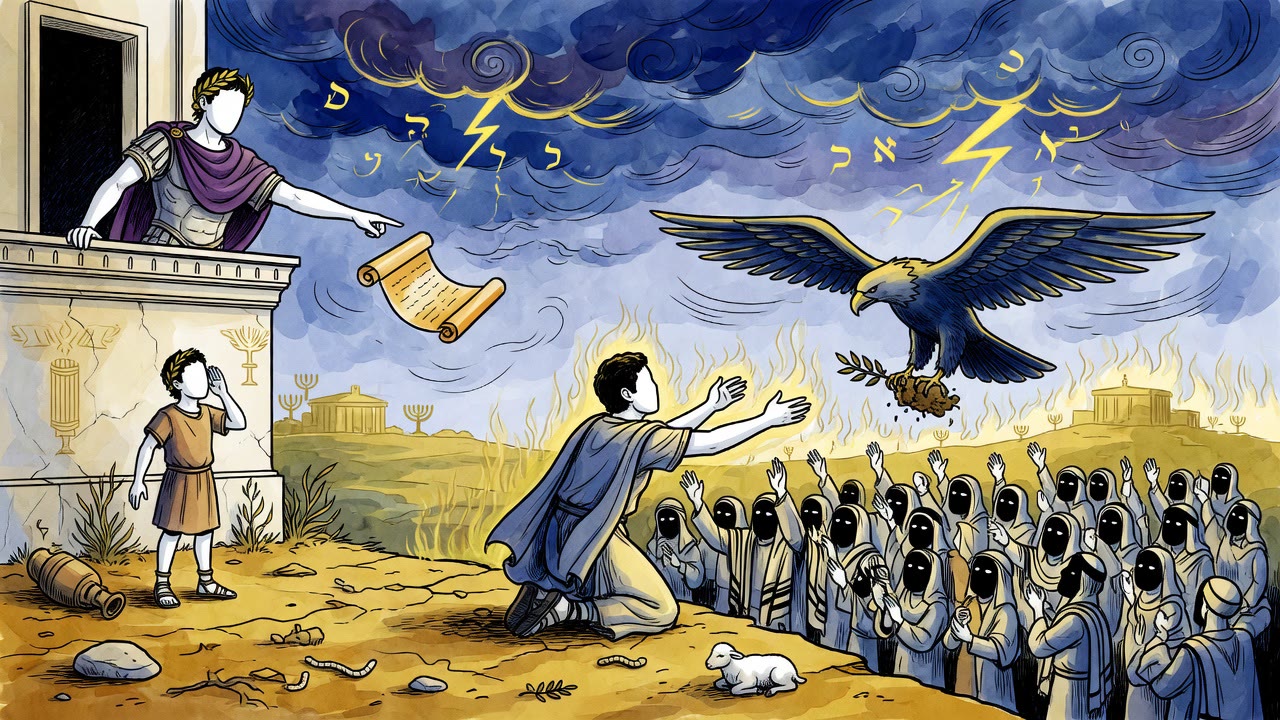
Word came back to the palace the way it always did, by the absence of the men who had been sent. The first legion, gone. The second, gone. The third, swallowed by a doorframe and a single verse. Each squad dispatched to put Onkelos in irons had instead unbuckled its own armor at his table. The emperor commanded armies that had broken nations and burned a Temple. Against one convert at a doorway he could not field a single soldier who would stay a Roman long enough to make the arrest.

So the manhunt simply stopped. There was no one left to send. The nephew who had bought the most despised people on earth went on to render the whole Torah into Aramaic, the translation that every scattered community would read beside the Hebrew for as long as Jews kept reading at all. The empire had wanted him back in chains. It got back nothing, not even its own men.


← All myths
From the tradition

Sources

4 sources

The texts this telling draws on, in full. Open a card to read inline, or expand it for a wider, quieter read.

Gaster, Exempla No. 284; Avodah Zarah 11aThe Exempla of the Rabbis (1924)

Onkelos son of Kalonikos was the nephew of the Roman emperor, by some accounts Hadrian, by others Titus. And one of the great converts to Judaism in the Talmudic age. When Onkelos embraced the Torah, it was a scandal at the highest level of the empire. The emperor could not have a royal nephew trading eagles and togas for tefillin and a Hebrew name.

A legion was dispatched to bring Onkelos back to Rome. They arrived at his house armed, credentialed, and confident.

Onkelos received them politely. He sat down and began to teach Torah, not as an argument, not as a sermon, but as a man who had been given a secret too beautiful to hide. The soldiers listened. They were supposed to arrest a renegade and return him in chains. Instead, by the time the conversation ended, every one of them had converted.

The emperor sent a second legion, stricter than the first. Onkelos spoke with them as he had with the others. The second legion converted. He sent a third, with orders not to speak with the prisoner at all, to simply take him. As the soldiers marched him out, Onkelos touched the mezuzah on his doorframe. They asked him what it was. He told them: the king of a human kingdom sits inside while his guards stand outside, but the King of the world stands outside while His children sit within, protected by His Name (Avodah Zarah 11a; Gaster, Exempla No. 284).

The third legion converted on the spot.

Rome ran out of soldiers willing to come for Onkelos.

The teaching is hopeful and a little funny. When the Torah is shown rather than argued, it disarms its captors. The emperor could muster armies. He could not muster an argument.

Full source
Yalkut Shimoni on Torah 229:1Yalkut Shimoni on Torah

It happened that Rabbi Eliezer, Rabbi Yehoshua, and Rabbi Tzadok were reclining at the wedding feast of the son of Rabban Gamliel, and Rabban Gamliel stood and served drink to them. He gave a cup to Rabbi Eliezer, who did not accept it; he gave one to Rabbi Yehoshua, who accepted it. Rabbi Eliezer said to him: What is this, Yehoshua? We sit while Rabban Gamliel, son of a master, stands and serves drink to us! He said to him: We find one greater than he who stood and served them. Abraham our father was the great man of his generation, and it is written, "and he stood over them" (Genesis 18:8). And lest you say they appeared to him as ministering angels, they appeared to him only as Arabs (wandering nomads), and yet he served them. Shall Rabban Gamliel, son of a master, not stand and serve drink to us?

Rabbi Tzadok said to them: How long will you set aside the honor of the Omnipresent and busy yourselves with the honor of mortals? The Holy One, blessed be He, makes the winds blow and raises the clouds and brings down the rain and makes the ground sprout and sets a table before each and every one, and shall Rabban Gamliel, son of a master, not stand and serve drink to us?

Whence comes this saying that people say, "When I was small I was a man, now that I am old I am a child"? For at first it is written, "and the LORD went before them by day" (Exodus 13:21), and at the end it is written, "Behold, I send an angel before you" (Exodus 23:20).

Rav Yehuda said in the name of Rav: All that Abraham did for the ministering angels himself, the Holy One, blessed be He, did for his children himself, as is written concerning Abraham.

Onkelos bar Kalonikos converted. Caesar sent a troop of Romans after him. He drew them in with Scripture verses and converted them. Caesar again sent a troop of Romans after him. He said to them: Do not say anything to him at all. As they were taking him and going, he said to them: Let me tell you a small matter. Does a lesser official carry the torch before a greater, and the greater before the ruler? They said to him: No. He said to them: And concerning the Holy One, blessed be He, it is written, "and the LORD went before them by day" (Exodus 13:21). They converted. Caesar sent another troop after him. He said to them: Do not converse with him at all. As they seized him and went, he saw a mezuzah and placed his hand upon it and said to them: What is this? They said to him: You tell us. He said to them: The way of the world is that a king sits within and his servants sit outside and guard him, but the Holy One, blessed be He, guards Israel from outside while they sit within, as it is said, "the LORD shall guard your going out and your coming in" (Psalms 121:8). They converted.

Full source
Midrash Tanchuma, Mishpatim 5Midrash Tanchuma

"And these are the judgments" (Exodus 21:1). This is what Scripture says: "He declares his words to Jacob" and so forth; "he has not done so" and so forth (Psalms 147:19-20). Aquilas the convert, the son of the sister of Hadrian, sought to convert, but he was afraid of Hadrian his uncle. He said to him: I wish to engage in trade. He said to him: Perhaps you lack silver and gold; behold, my treasuries are before you. He said to him: I wish to engage in trade, to go abroad to learn the disposition of people, and I wish to take counsel of you how to do so. He said to him: Any merchandise that you see lowly and cast down upon the ground, go deal in it, for in the end it will rise up and you will profit. He came to the Land of Israel and learned Torah.

After a time Rabbi Eliezer and Rabbi Yehoshua found him; they saw that his face had changed. They said to one another: Aquilas is learning Torah. When he came to them, he began to ask them many questions, and they answered him. He went up to Hadrian his uncle, who said to him: And why has your face changed? I suppose that your merchandise has lost value, or perhaps some man has distressed you? He said to him: No. He said to him: You are a relative of mine, and a man distresses you? He said to him: And why has your face changed? He said to him: Because I have learned Torah, and not only that, but I have circumcised myself. He said to him: And who told you to do so? He said to him: I took counsel of you. He said to him: When? He said to him: When I said to you, I wish to engage in trade, and you said to me, Any merchandise that you see lowly and cast down upon the ground, go and deal in it, for in the end it will rise up. I went around among all the nations and I saw no nation lowly and cast down upon the ground like Israel, and in the end it will rise up. For so said Isaiah: "Thus says the LORD, the Redeemer of Israel, his Holy One, to the despised of soul, to the abhorred of the nation, to a servant of rulers: Kings shall see and arise, princes, and they shall bow down, for the sake of the LORD who is faithful, the Holy One of Israel, and he has chosen you" (Isaiah 49:7). His counselor said to him: Are these things you have said going to come to pass, that kings will stand up before them, as it is said, "Kings shall see and arise"? Hadrian struck him on his cheeks and said to him: One places a bandage only over the wound. Now, if they see one cripple, they do not stand up before him, yet you were saying that kings see them and stand up before them.

His counselor said to him: If so, what will you do? Hide him; since he has converted, kill him. He said to him: Aquilas my sister's son, even while he was in his mother's womb, was fit to convert. What did his counselor do? He went up to the roof and fell and died, and the holy spirit cries out, "So may all your enemies perish, O LORD" (Judges 5:31).

Hadrian said to him: Behold, the counselor is dead; will you not tell me on what account you did this thing? He said to him: Because I sought to learn Torah. He said to him: You should have learned Torah and not circumcised yourself. Aquilas said to him: You do not give a soldier his provisions unless he has taken up his weapon. So it is always: if a person is not circumcised, he cannot learn Torah, as it is said, "He declares his words to Jacob" (Psalms 147:19), to the one who is circumcised like Jacob; "he has not done so for any nation" (Psalms 147:20), because they are uncircumcised.

"His statutes," this is Torah. "And his judgments," these are the laws, as it is said, "There he set for him a statute and a judgment" (Exodus 15:25). The Holy One, blessed be He, said to Moses: I have given them the Torah; go and give them the judgments. The Holy One, blessed be He, said to them: If you wish to endure in the world, keep the judgments, for they make the world endure, as it is said, "And these are the judgments which you shall set before them."

The generation of the flood did not perish from the world except because they transgressed against the judgments. Rabbi Elazar ben Pedat said: What is written concerning them? "From morning to evening they are crushed without anyone setting his heart" (Job 4:20). Thus, "And these are the judgments which you shall set." Another interpretation: the generation of the flood, because they did not carry out judgment, it is written concerning them, "My spirit shall not judge in man forever" (Genesis 6:3).

Rabbi Eliezer says: If there is judgment below, there is no judgment above; and if there is no judgment below, there is judgment above. How so? If those below carry out judgment below, judgment is not carried out from above. Therefore the Holy One, blessed be He, said: Keep the judgment, that you do not cause me to carry out judgment from above, as it is said, "And these are the judgments."

The Holy One, blessed be He, said: All that I do, I do with judgment. For if I sought even once to overstep judgment, the world could not endure. Isaiah said: "Fury is not in me; would that I had thorns and briers in the battle, I would march against it, I would set it on fire together" (Isaiah 27:4). One step I would step and overstep judgment; "I would set it on fire together," immediately the world is burned. Why? "Or let him take hold of my stronghold" (Isaiah 27:5). Because my hand is held to my stronghold, my hand is held to judgment, as it is said, "And my hand takes hold of judgment" (Deuteronomy 32:41). "Let him make peace with me" (Isaiah 27:5), between me and judgment, "peace let him make with me" (Isaiah 27:5).

"If I whet the lightning of my sword" (Deuteronomy 32:41). If I alter the judgment, one lightning bolt goes out and destroys the world. And what do I do? "And my hand takes hold of judgment" (Deuteronomy 32:41). The Holy One, blessed be He, said: I am called the Master of Judgment, and I wish to stretch out my hand against Esau and I cannot, until I have paid him the reward of a light commandment that he performed before me in this world.

Rabbi Pinchas the priest bar Hama said in the name of Rabbi Hilkiah in the name of Rabbi Simon: See what is written, "And it shall come to pass on that day, I will seek to destroy" and so forth (Zechariah 12:9). Israel said: Master of the world, who can stay your hand, that you say "I will seek"? He said to them: When I seek merit for them and do not find it, at that hour I will destroy, and so forth.

Rabbi Levi said in the name of Rabbi Shimon ben Lakish: See what is written, "I beheld until thrones were set, and the Ancient of Days sat; his garment was white as snow, and the hair of his head like pure wool" (Daniel 7:9). The Holy One, blessed be He, said: When I clear myself of the nations of the world, of the light commandments they performed before me, at that hour, "until thrones were set." Up to now the vineyard is unripe; once it ripens and the vineyard becomes wine, I tread it and you sing to me, "On that day a vineyard of wine, sing of it" (Isaiah 27:2).

Rabbi Yudan said in the name of Aybo, it is written: "I have trodden the winepress alone, and from the peoples no man was with me" and so forth (Isaiah 63:3). And does the Holy One, blessed be He, need their help? Rather, thus said the Holy One, blessed be He: When I examine their ledgers and no merit is found for them before me, at that hour, "and I trod them in my anger and trampled them in my fury" and so forth (Isaiah 63:3). And at that hour I will redeem you, and you will no longer be enslaved, as it is said, "And I will afflict you no more" (Nahum 1:12).

Full source
Exempla of the Rabbis, No. 284Exempla of the Rabbis (Gaster, 1924)

Onkelos, known in some traditions as Aquila, was a Roman nobleman, a nephew of the Emperor himself, who converted to Judaism. His conversion scandalized the imperial court and became one of the most famous stories of religious transformation in the ancient world.

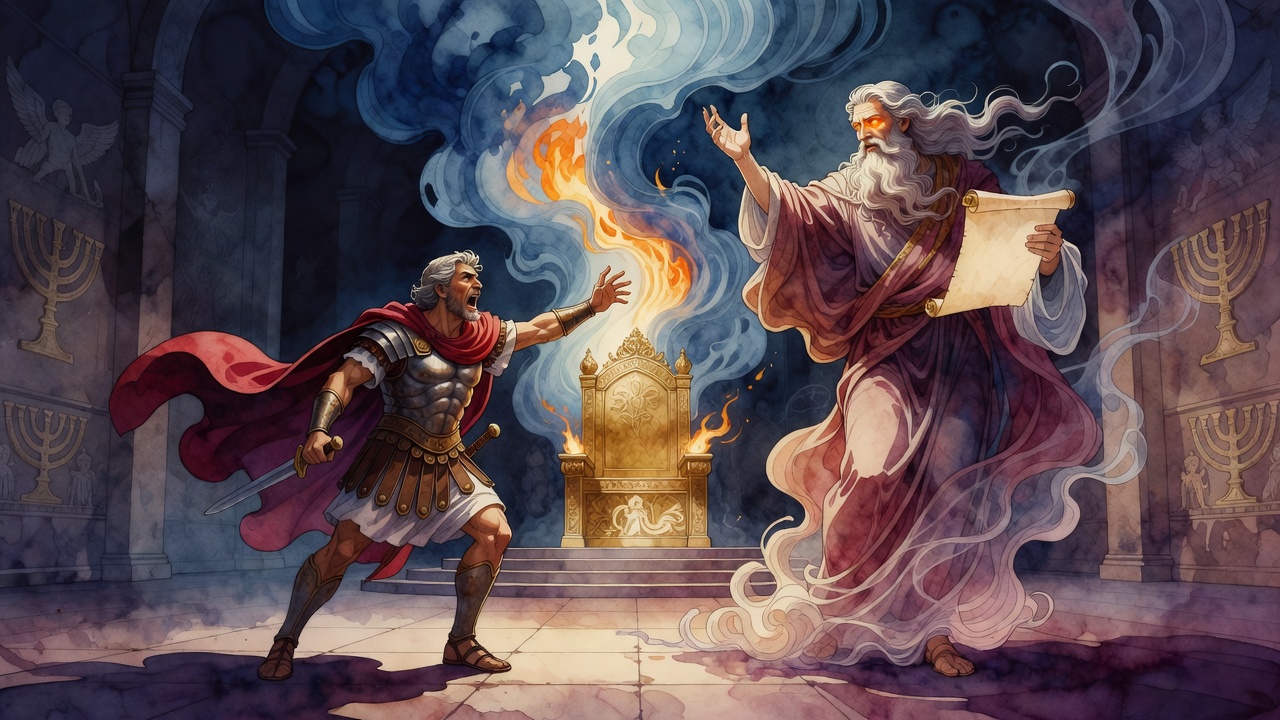
The Talmud (Avodah Zarah 11a, Gittin 56b) records that before converting, Onkelos consulted the spirits of three deceased men to ask their advice about joining the Jewish people. He summoned Titus, the destroyer of the Temple, who told him the Jews were too burdensome. He summoned Balaam, who told him not to seek their welfare. Each spirit, speaking from its experience of opposing Israel, warned him away.

Onkelos was not deterred. He saw in the Jewish people something that their enemies could not see, a relationship with God so deep that even destruction could not sever it. He converted.

The Emperor sent soldiers to arrest him. Onkelos engaged each group in conversation about Torah, and each group was so moved that they converted as well. The Emperor sent a final group with strict orders: "Do not speak to him at all." But as they were dragging him away, Onkelos touched the mezuzah (a parchment scroll affixed to doorposts) on his doorpost and smiled. "What is that?" the soldiers asked, unable to resist. "In the world," Onkelos explained, "a king sits inside his palace while his servants guard him from outside. But God. His servants sit inside their homes, and He guards them from outside." The soldiers converted.

Onkelos went on to produce the authoritative Aramaic translation of the Torah, the Targum Onkelos, which is studied to this day. The Roman nobleman became one of the pillars of Jewish scripture.

Full source