How Four Fringes Struck Nathan Off a Bed of Gold
He paid four hundred coins and crossed the sea for one forbidden night, then his own fringes rose up and slapped him off the bed.
Table of Contents
The bed was ready, the lamp was low, and four white threads hung from the corner of a folded garment, waiting.
 Click for full size
Nathan ben Bar Kaftusa had heard of the woman the way men hear of a wonder they intend to ruin themselves for. She lived across the sea on an island, and her price was four hundred gold coins for a single night. He counted out the sum, sent it ahead, and then crossed the water to claim what the money had bought. He told no one in Tiberias where he was going. A man does not announce that errand.
The Door Shut Behind a Bought Man
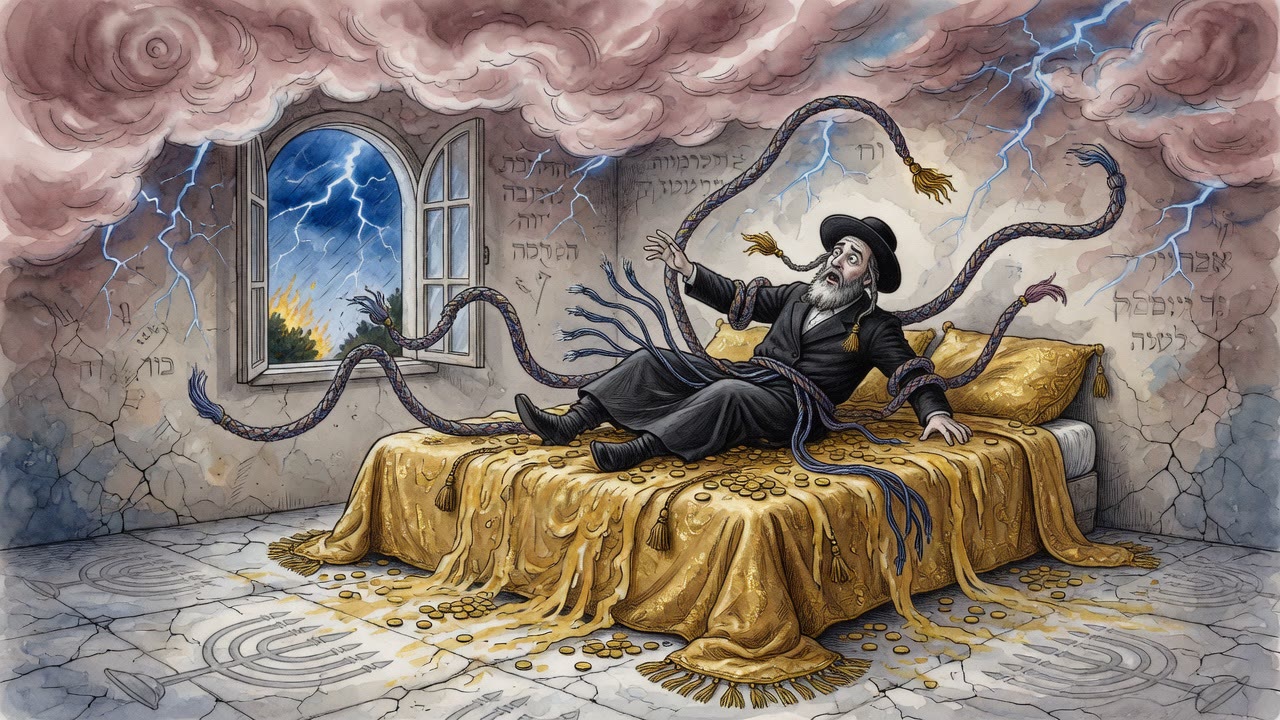
The house was finer than anything in his own town. Servants took his cloak. The courtesan received him without hurry, certain of her work, because no man had ever paid that much and walked away unsatisfied. She arranged seven beds for him, one above the other, six of silver and the topmost of gold, and between each one a ladder of silver leading up to the last. She climbed and sat at the summit, undressed, and waited.
Nathan began to climb behind her. The room was quiet. The door was shut. He sat on the edge of the highest bed and reached to loosen his own garment, the four-cornered cloth every Jewish man wore, and he was already past the moment when a man can still pretend he might turn back.
The Fringes Rose Like Witnesses
Then the threads moved.
The tzitzit, the fringes knotted onto the four corners of his garment, lifted of their own accord and struck him across the face. Four cords, white and small, came up like the flat of a hand and slapped him, once, hard, the way a witness shoves a man back from the edge of a roof. He fell from the bed. He sat on the ground, struck and shaking, and the woman, watching the only man who had ever fled her, climbed down from her gold bed and sat on the ground beside him.
"I will not let you go," she said, "until you tell me what blemish you found in me. By the life of the Roman government, I will not let you go until you tell me."
"I swear to you," Nathan answered, "no woman has ever been as beautiful to me as you. But there is a commandment our God gave us. Tzitzit, fringes, and about them it is written twice, I am the Lord your God. Twice. The same voice that pays a reward is the voice that exacts a punishment. Just now those four threads looked to me like four witnesses, and I saw it. I saw God."
Why the Threads Were Given at All
He could have told her how the fringes came to hang there in the first place, and perhaps he did, sitting on her floor with his heart still pounding.
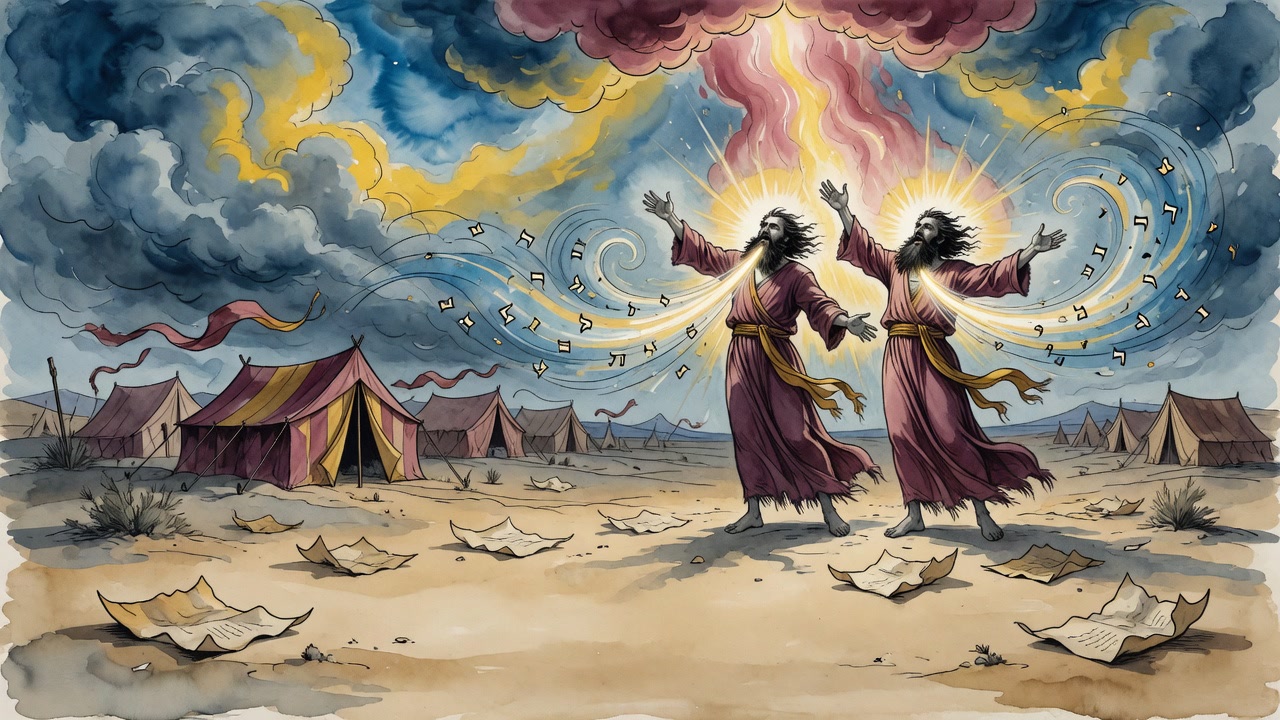
Long before, in the wilderness, a man had broken the Sabbath, and God asked Moses how it had happened. Moses said he did not know. On the weekdays, God explained, that man bound tefillin on his head and arm, and the leather boxes reminded him of his duties all day long. But the Sabbath does not wear tefillin. On that day the man had nothing tied to his body to call his obligations to mind, and so he forgot, and so he fell. "Go," God told Moses, "and find Israel a commandment whose reminder is not folded away on the Sabbath, one that stays with them every day and every holy day alike." Moses chose the fringes. A thing the eye would catch by accident, on a corner, in a doorway, on the edge of a bed, and seeing it a man would remember everything at once.
That was the cord that rose against Nathan. Not a rule he had studied. A reminder God had hung on him precisely for the hour he would try to forget.
The Courtesan Divided Her House
Before he left the island, the woman asked him for his name, his town, and the name of the house of study where he learned. He wrote it all down for her and went home across the sea.
She did not chase him for love of his face. She rose and took everything she owned and split it into three parts. One third she paid to the Roman government in taxes, so that no one could say she fled with stolen standing. One third she gave to the poor of the island. The last third she kept, and the bedding, those seven mattresses of silver and gold, she carried with her, and she crossed the same sea Nathan had crossed.
What She Carried to Tiberias
She came to the study house of Rabbi Chiya and asked him to make her a Jew.
He looked at her a long moment. A beautiful foreign woman arriving at a school full of young men, asking to convert, was a thing he had reason to doubt. "My daughter," he said, "perhaps you have set your eyes on one of my students."
She took out the paper Nathan had written, the one with his name and the name of the house of learning, and she handed it to the rabbi. "Let this be the proof of why I have come," she said. She had come for the God whose fringes struck a man off a bed of gold, not for the man. Chiya read it and accepted her.
The same mattresses she had once spread for sin, she now spread for marriage. The bedding she had laid out for Nathan unlawfully, she was permitted at last to lay out for him lawfully, and she lived the rest of her years inside the covenant she had crossed an entire sea to reach.
← All myths